Feeds:
Posts
Comments

Posts Tagged ‘Shasta daisy’

Shortly after waking up this morning, I walked over to my neighbor Cindy’s garden to see what was in bloom. The last time I checked, about a week ago,  there were lots of flowering day lilies, but I suspected that the recent heat had caused many of them to wilt and die. I am not sure if lilies close up at night, but I did not see any lilies in bloom in the early morning light—I was there about 6:15 today.

However, there were plenty of purple coneflowers and Shasta daisies open and I did my best to capture some their beauty with the short macro lens that I was using. I was delighted to spot a tiny insect creature crawling around on one of the daisies, as you can sort of see in the second photo. The limited light available forced me to open the aperture of the lens and created such a narrow depth of field that I could not get both the insect and the flower in focus.

Most of you know that I enjoy photographing wildlife and nature in more remote locations, but it is reassuring to know that I do not always have to travel far to find subjects—beauty is everywhere.

shasta daisy

Shasta daisy

coneflower

© Michael Q. Powell. All rights reserved.

Read Full Post »

How do you draw attention to the main subject in your photograph? One effective way is to choose a camera setting that will give you a shallow depth of field, so that only the subject is in sharp focus and the rest of the image is blurred. Another way is to ensure that the colors and texture of the background contrast with those of the subject.

I used both of these techniques yesterday morning when I spotted this metallic green sweat bee (g. Agapostemon) on one of the Shasta daisies growing in the garden of my neighbor and photography mentor Cindy Dyer. I love these little bees with their large speckled eyes and shiny green bodies and got as close to this one as I dared with my Canon 60mm macro lens.

I opened the aperture of the lens all the way to f/2.8 to let in lots of light and to achieve the narrowest possible depth of field. That is why the center of the daisy falls so quickly out of focus. As I was composing the shot, the flower reminded me of an egg that had been fried “sunny-side up” and I chose an angle that emphasized that look. (In case you are curious about the other camera settings, the ISO was 800 and the shutter speed was 1/800 sec.)

There is nothing super special about this image, but it is a fun little photo taken close to home that reminds me that beauty is everywhere. A series of creative choices in camera settings and composition by the photographer can often help to draw a viewer’s attention to that beauty. (I encourage you to click on the image to get a better view of the beautiful details of the little green bee.)

green sweat bee

© Michael Q. Powell. All rights reserved.

Read Full Post »

Insect identification is really tough for me. When I saw this insect crawling about on the top of what I believe is a Shasta daisy, I was pretty sure that it was a beetle. Beyond that, I really had no idea what it was. A quick search on the internet made me conclude that it was a kind of scarab beetle.

I posted a photo on the website bugguide.net and asked for help. Responders provided a couple of possibilities and it looks most likely that this is an Oriental Beetle (Exomala orientalis) or (Anomala orientalis). In some ways it’s not that important to identify my subject, but it is something that I strive to do as much as I can and I usually end up learning a lot in the process of figuring out what I have shot.

I took quite a few shots of this beetle and especially like this one, because the beetle raised its head momentarily and I was able to get a look at its cool forked antennae. I also like the way I was able to capture some of the drops of water on the petals of the daisy.

In case any viewer is worried that I have given up on dragonflies, I can reassure you that I still have shots of lots of beautiful dragonflies to be posted and am always seeking more. I just figured that I would mix things up a little and provide a little glimpse at the world through my macro lens.

Oriental Beetle

© Michael Q. Powell. All rights reserved.

Read Full Post »

Do your remember what it was like to be young and in love? You and your beloved couldn’t beat to be separated—you were always together, always close, always touching, like these two Shasta Daisies growing in the garden of my neighbor and fellow photographer Cindy Dyer.

As I was looking for information about the Shasta Daisy, I came across this fascinating information on the history on the flower at lutherburbank.org:

“2001 marked the 100th anniversary of Luther Burbank’s introduction of the Shasta daisy, one of America’s most beloved garden flowers. Burbank spent 17 years developing this quadruple hybrid which he named after Mt. Shasta. Others have continued Burbank’s work and many new varieties of the Shasta daisy have been introduced since Burbank completed his work more than 100 years ago.”

Shasta Daisy

© Michael Q. Powell. All rights reserved.
Read Full Post »

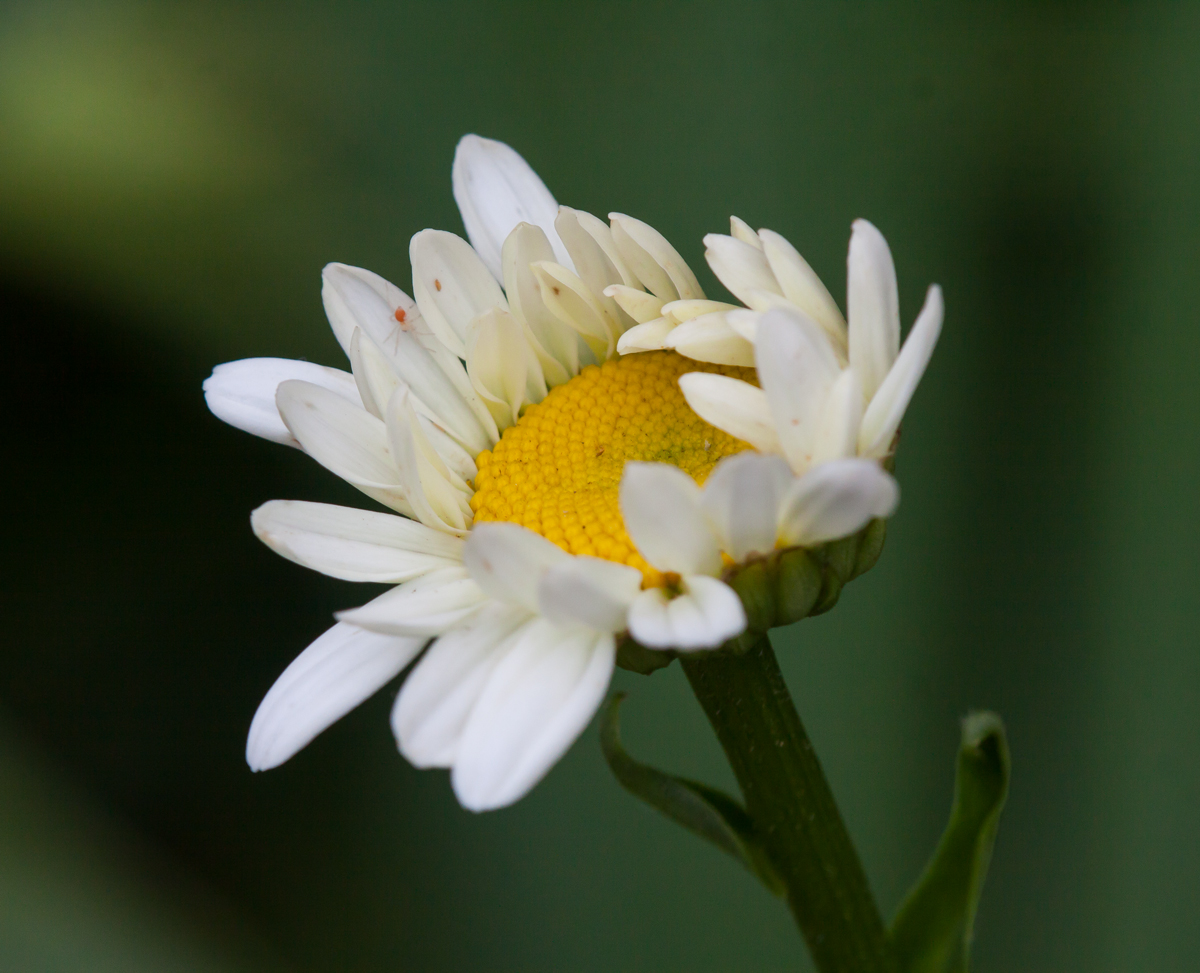
Shy or coy? Whatever the reason, this Shasta daisy seemed reluctant to reveal its whole self to the world and kept a row of petals raised like a fan to add protection and/or mystery.

Sharp-eyed viewers may note that this image has a “bonus bug,” i.e. an insect that you find when processing a photo that you didn’t notice when taking the shot. In this case there looks to be a tiny red insect on one of the white petals to the left of the tallest petal in the uppermost row of petals. (You may need to click on the photo to get a higher-resolution view.)

This is another photo that I took in my neighbor’s garden. Thanks, Cindy.

shy1_june_blog

Michael Q. Powell. All rights reserved.

Read Full Post »