Feeds:
Posts
Comments

Posts Tagged ‘Pandion haliaetus’

When I first spotted two Ospreys (Pandion haliaetus) sitting in a large eagle nest last week at Occoquan Bay National Wildlife Refuge, I assumed that one of them was sitting on eggs. I was therefore a bit surprised when one of the ospreys mounted the other in what I assume was an act of mating. That suggests that there are not yet any eggs in the nest.

After a brief period of activity, the one that is probably the male flew away from the nest and I managed to capture a couple of photos of his departure. Both of the ospreys are in the frame in the second and third photos below and I really like the way that I captured the wing span of the departing osprey and his spread tail feathers. I encourage you to click on these two images to get a closer look at the ospreys, particularly the male.

Osprey

Osprey

Osprey

© Michael Q. Powell. All rights reserved.

Read Full Post »

Earlier this season, it looked like a pair of Bald Eagles had occupied a large nest at Occoquan Bay National Wildlife Refuge. Each time that I visited the refuge, I would check the nesting site to look for indications that an eagle was sitting on eggs. Unfortunately, the nest is so deep and so high up that it is almost impossible to tell if an eagle is inside of the nest.

Last week, I watched a pair of Ospreys (Pandion haliaetus) fly into the nest and seize it and captured this shot of them doing so. Generally ospreys use much smaller, thrown-together nests, but I guess that this pair decided to advantage of what I assume is a currently unoccupied eagle nest.

As I watched the two ospreys approach the nest with dangled legs, I couldn’t help but think of the scenes from the Wizard of Oz movie in which the flying monkeys seized Dorothy. The mind works in strange ways.

osprey

© Michael Q. Powell. All rights reserved.


Read Full Post »

Osprey (Pandion haliaetus) are very opportunistic birds—they will make a nest almost anywhere there is a bit of space. Last week I spotted an osprey perched on the roof of a duck blind in the water and captured this cool little image.

These little shack-like structures on stilts have been built in the waters off of Occoquan Bay National Wildlife Refuge and are used a few weeks a year during duck hunting season. It is a little disconcerting during that time to hear shotguns being fired only a short distance away, but the money collected for hunting licenses is used for waterfowl habitat improvement and restoration in Virginia.

Osprey

© Michael Q. Powell. All rights reserved.

Read Full Post »

Something attracted the attention of this Osprey (Pandion haliaetus) on Tuesday at Occoquan Bay National Wildlife Refuge and it kept looking down at the ground. At first I thought that the osprey had caught a fish that it was trying to protect from competitors, but when I zoomed in, I did not see any fish.

Perhaps the osprey was looking for its mate or was merely curious to observe all the things that were going on. I don’t think that the osprey had spotted me when I took these shots, but that is also a possibility.

Osprey

Osprey

© Michael Q. Powell. All rights reserved.

Read Full Post »

When does spring begin? If you use the meteorological calendar, spring begins on the first of March in the Northern Hemisphere. Most folks here in the United States, though, consider that spring begins with the vernal equinox that falls on 20 March this year.

I look for other signs that mark the beginning of the new season. Yesterday, for example, I saw a few blooming daffodils and crocuses, some of the first spring flowers to appear, and I also spotted some buds starting to open on trees.

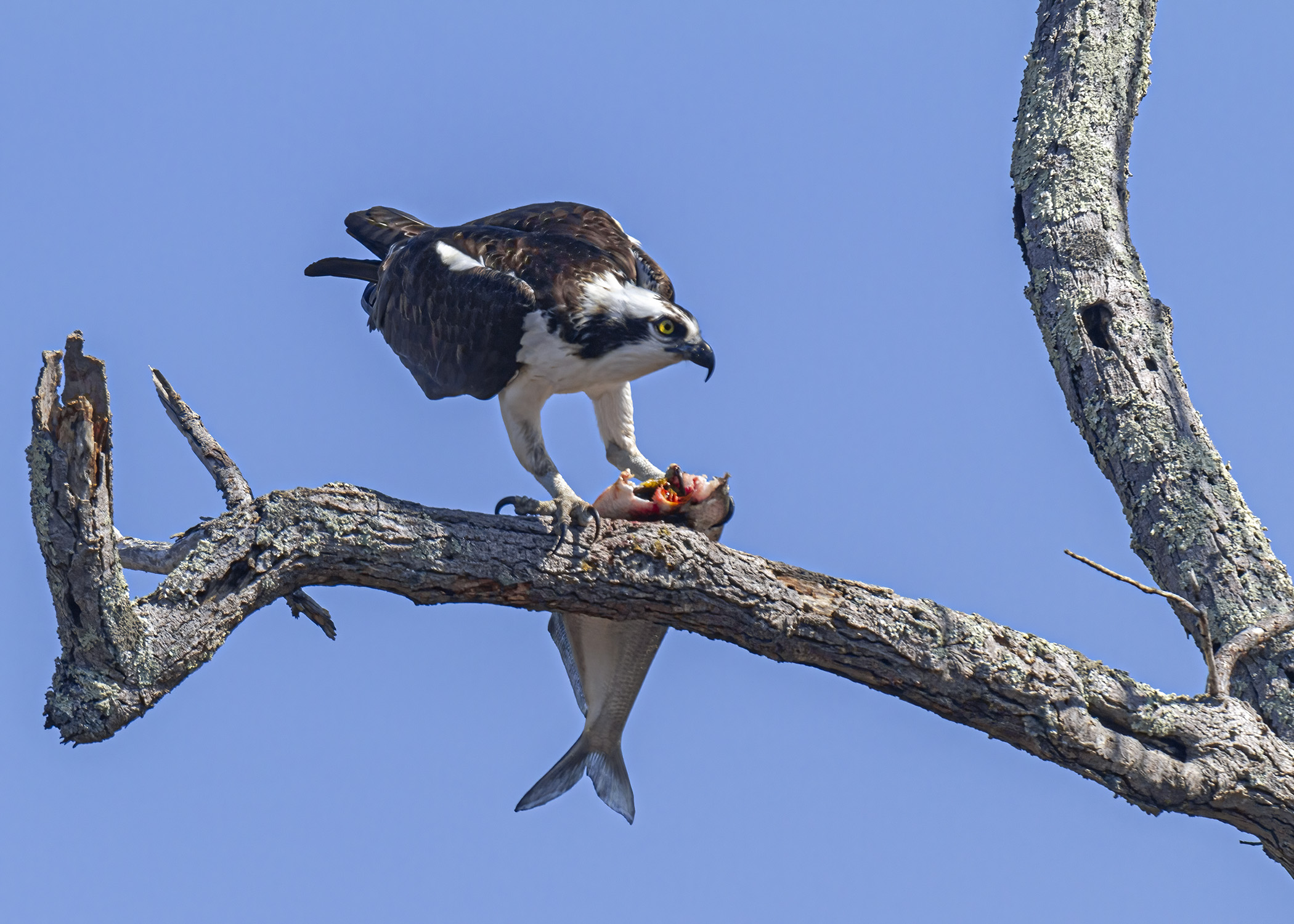
On Tuesday, I spotted my first Ospreys (Pandion haliaetus) of the season at Occoquan Bay National Wildlife Refuge, a sure sign that spring will soon be here.The osprey in the photo was vigorously tearing into the flesh of the fish, stopping periodically to call out to another osprey. I wasn’t sure whether the other unseen osprey was a competitor or a mate, but suspect that it was the latter. A short time later, the osprey flew away to an elevated nesting platform, where I spotted three ospreys that appeared to be sharing the freshly-caught fish, as you can see in the second image below.

Osprey

Osprey


© Michael Q. Powell. All rights reserved.

Read Full Post »

With so many of the trees covered in leaves, it is a bit difficult for me to spot a perched bird. Sometimes, though, I get lucky and a bird will perch in the open on a dead tree and I will be able to get a clean shot of it. Otherwise, they can remain perched, hidden by the shadows of the trees.

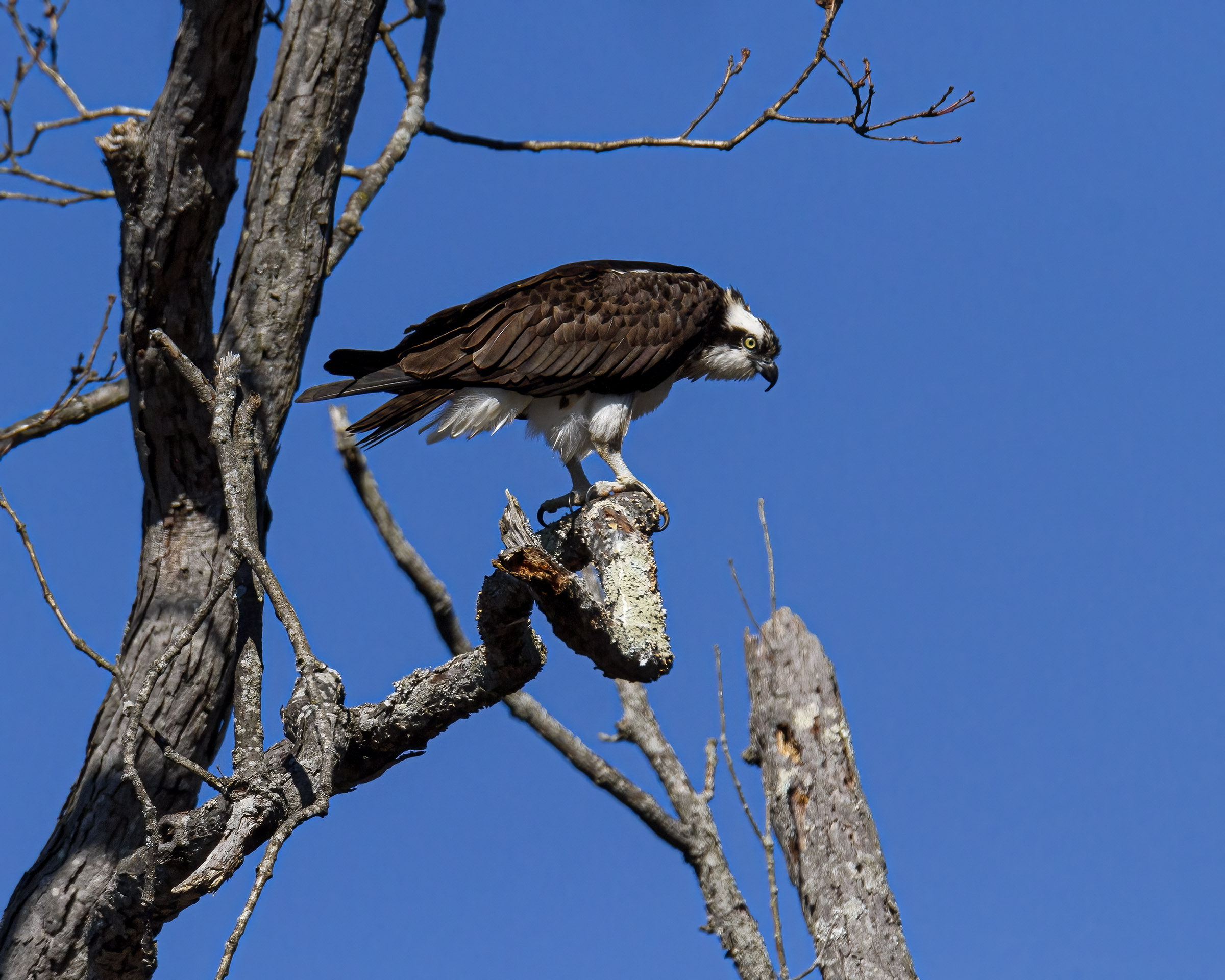
We are in the doldrums of summer right now and many of the birds do not appear to be active during the warm, daylight hours. I was therefore delighted to spot this Osprey (Pandion haliaeteus) as it perched on the dead branches of a tree. This Osprey seemed to be relaxing and did not fly away immediately as I attempted to get a little closer. Occasionally it would turn its head from side to side, but otherwise remained in a relaxed position.

After I had taken a couple of shots, I continued on, leaving the Osprey at peace in the tree.

Osprey

Osprey

© Michael Q. Powell. All rights reserved.

Read Full Post »

There was a lot of activity at one of the Osprey (Pandion haliaetus) nests last Tuesday at Occoquan Bay National Wildlife Refuge. When I first noticed the nest, there were a several Osprey sitting in the nest—initially I thought there were only two in the nest, but when I looked more carefully, I could see that there were at least three osprey there.

As I watched, another osprey flew into the nest as you can see in the first photo below. The nest does not appear to very large, so the the birds had to rearrange themselves a bit to accommodate the new arrival. In the second photo, one of the osprey seemed to be expressing its displeasure with the need to move a bit.

I think this may be a family unit, though I can’t be absolutely sure of that. When I look closely at the eyes of the osprey, some of them appear to be orangish in color, unlike the paler eyes of adults.

I especially love the body language in the second photo. It’s fun to imagine the conversation that is taking place. Perhaps, for example, the osprey with the flapping wings is complaining that the newly arrived osprey did not have a fish in its talons to share with the rest of the family. What do you think?

Osprey

Osprey

© Michael Q. Powell. All rights reserved.

Read Full Post »

Earlier in the season, when the trees were bare, it was very easy to spot Ospreys (Pandion haliaetus) when they returned to our area from their wintering grounds. Now, though, the trees are covered in leaves and Ospreys are increasingly hard to see as they perch among the leaves, especially if they remain silent.

I was delighted to spot this vigilant osprey last week at Occoquan Bay National Wildlife Refuge. He was alert and focused—he seemed to be paying attention to something, though I am not sure of the subject of his surveillance.

The winds were kicking up periodically, causing a cowlick of feathers to stand up in the back of the osprey’s head. When I was a child, I had a similar problem and had to use a bit of Brylcreem to keep the unruly hair in place. (My Mom used to be able to accomplish the same thing with my hair using only a bit of her saliva and her fingers.)

Osprey

© Michael Q. Powell. All rights reserved.

Read Full Post »

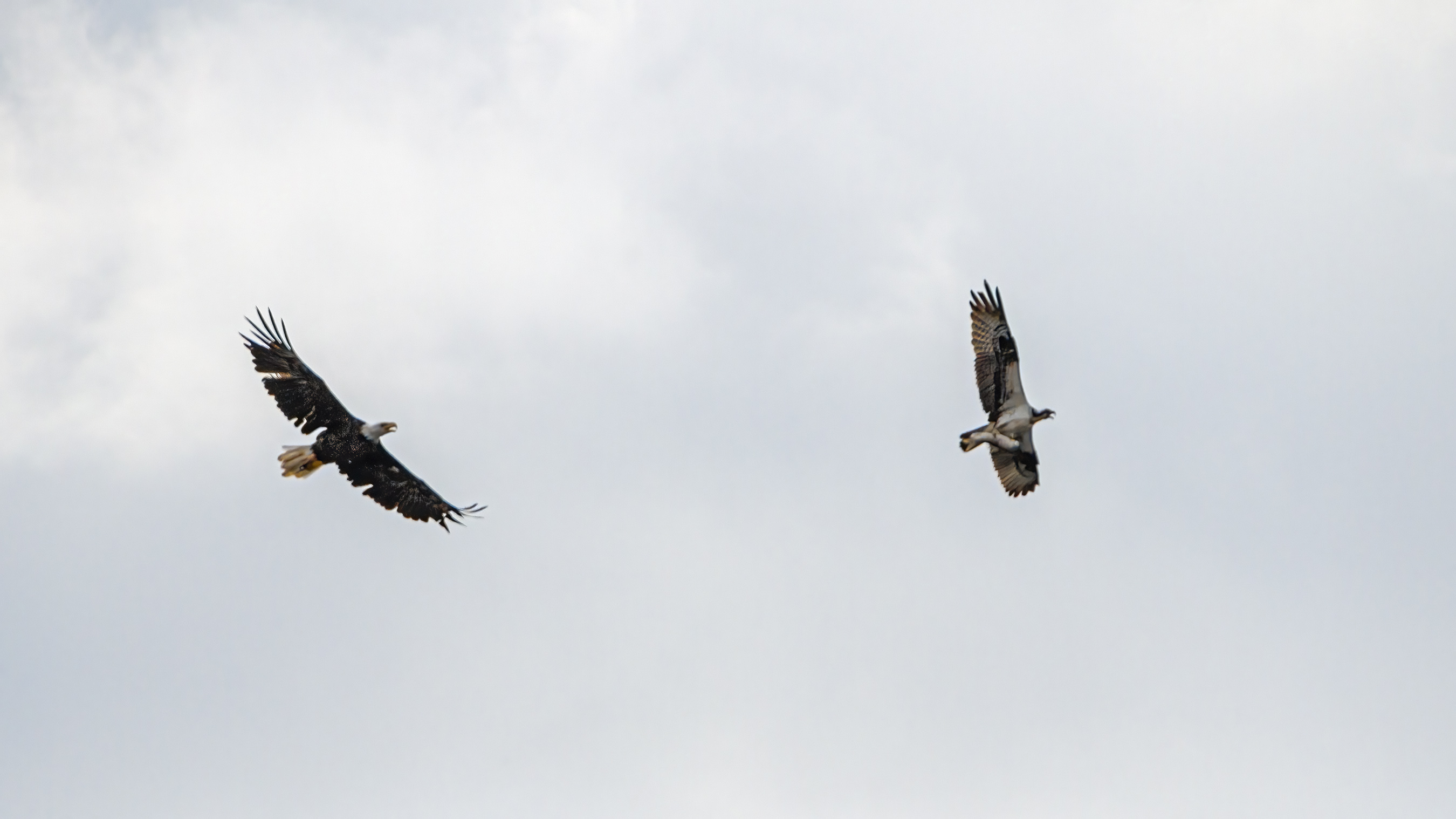
On Wednesday I watched as a Bald Eagle (Haliaeetus leucocephalus) chased an Osprey (Pandion haliaetus) high in the sky above the waters off of Occoquan Bay National Wildlife Refuge in a vain attempt to steal its freshly caught fish. I captured the second shot when the eagle flew past me after giving up on its chase.
It has been several months since I last photographed a Bald Eagle, so I was thrilled to capture these images. As most of you know, I concentrate most of my photographic attention on dragonflies and other insects during the warmer months. However, I am always alert to the possibility of photographing birds when I manage to spot them.
During the winter months I generally use a 150-600mm telephoto zoom lens that gives me a long reach, but in the summer I tend to rely on a 180mm macro lens or the 18-400mm zoom lens that I used for these shots. This lens gives me a good deal of versatility, allowing me to capture my close-in tiny subjects and some longer distance ones like these raptors in flight.
Eagle and Osprey
Bald Eagle
© Michael Q. Powell. All rights reserved.

Read Full Post »

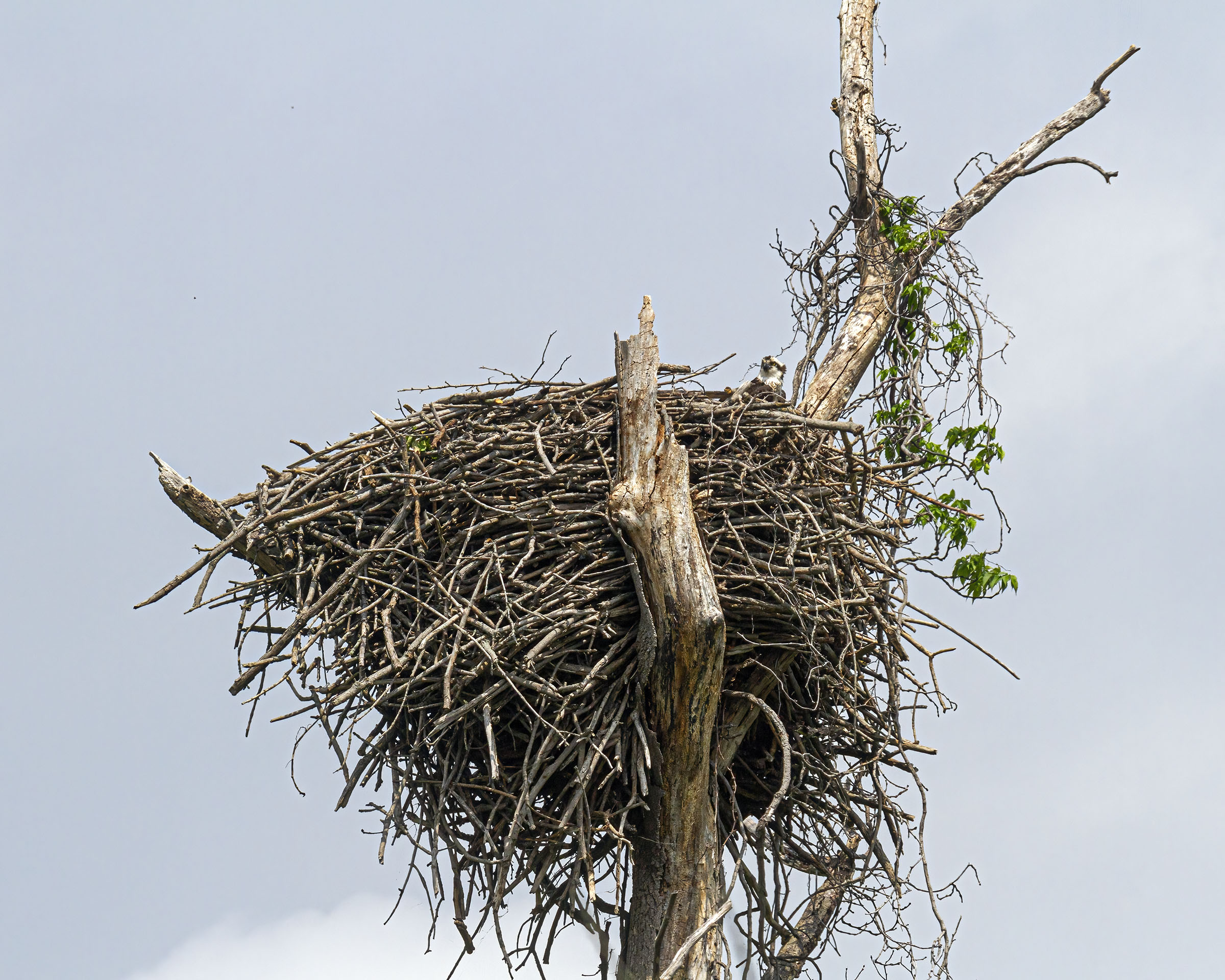
There is one extremely large eagle nest (plus one or two smaller ones) that I monitor each year at Occoquan Bay National Wildlife Refuge. Earlier this year I spotted a lot of eagle activity around that nest and I assumed that the eagles would be nesting in it.

However, recently both members of an eagle couple were spotted on the outside of the nest and ospreys began to display a lot of interest in the nest. I assume that means that the eagles were not successful in incubating eggs, but I do not know for sure what happened.

Last week I photographed an osprey in the nest and captured a few shots of it. The osprey looks absolutely tiny in the nest and the nest is far larger than the typical ones that osprey use.

I will continue to keep an eye on the nest and see if I eventually see some baby ospreys there. The big challenge is that the nest is so large and deep that osprey (or eagles) are not visible when they are sitting on eggs.

osprey


osprey

© Michael Q. Powell. All rights reserved.

Read Full Post »

An Osprey (Pandion haliaetus) raised a wing as it flew by me on Monday at Occoquan Bay National Wildlife Refuge, displaying the fish that it had just caught. There are quite a few osprey at the refuge at this time of the year and it is not uncommon for me to see one clutching an osprey in its talons. However, it is rare that I am able to get a good look at the prey, because it is often hidden by the osprey’s wing movements.

Normally I attempt to capture shots of birds in flight with my longest lens, a Tamron 150-600mm. At this time of the year, though, I am just as likely to want to photograph butterflies and dragonflies as birds, so most of the time I keep my Tamron 18-400mm lens on my camera that lets me focus on a much closer subject. I sacrifice a bit of reach by using this lens, but, as you can see in the image of the osprey captured with this lens, it can produce good results even when fully extended. I encourage you to click on the image to see the feather details of the osprey and the details of the hapless fish too.

osprey

© Michael Q. Powell. All rights reserved.

Read Full Post »

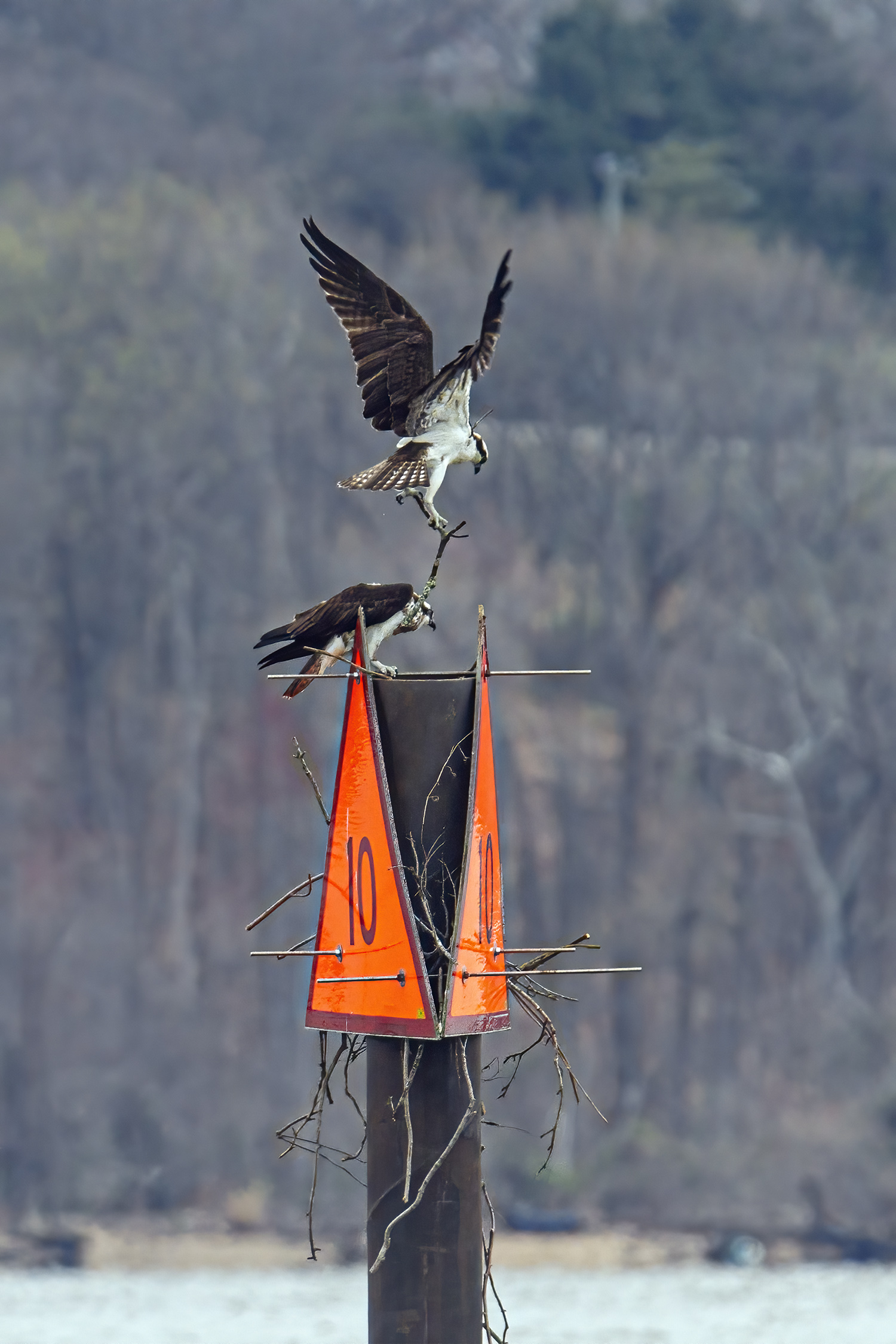
Real estate is at a premium in Northern Virginia, and new houses are jammed into the tiniest of spaces. Unfortunately, this channel marker did not appear to be quite big enough to support the nest of an osprey couple. During a recent visit to Occoquan Bay National Wildlife Refuge I watched the ospreys (Pandion haliaetus) carry a number of sticks to the marker as they unsuccessfully attempted to construct a nest—most of the sticks simply fell off the sides of the marker.

Osprey

Osprey

Osprey

Osprey

© Michael Q. Powell. All rights reserved.

Read Full Post »

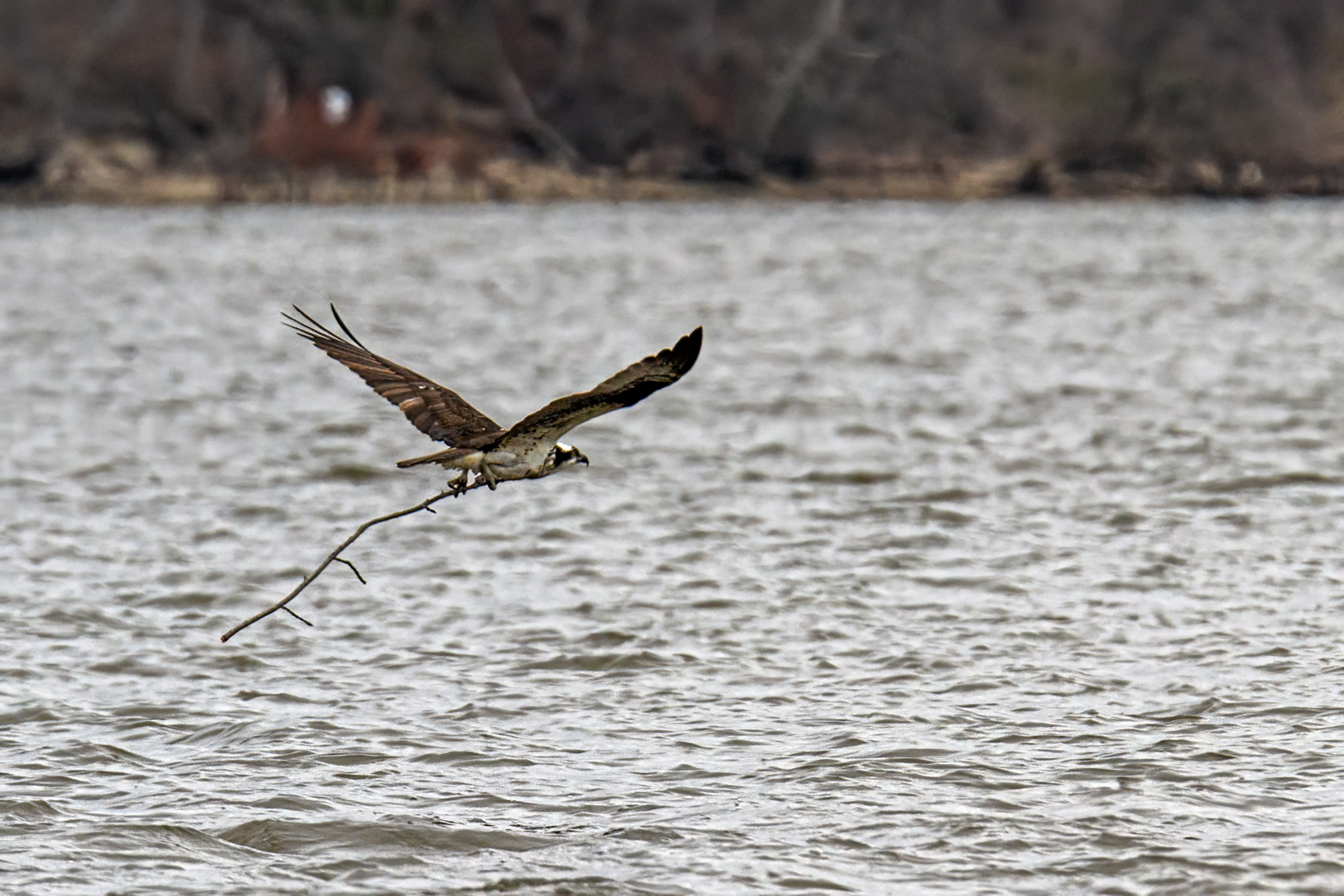
I was delighted on Friday to see that Ospreys (Pandion haliaetus) have returned to Occoquan Bay National Wildlife Refuge. Each autumn we bid farewell to the ospreys, which are also known as fish hawks or sea hawks, and each spring we greet their return.

Unlike eagles, which use large, well-constructed nests year after year, ospreys seem content to throw a bundle of sticks together and call it a nest. Many of these makeshift homes are blown down or fall apart during the winter, so a first priority for the returning ospreys is to construct nests.

During this visit I managed to capture several photos of ospreys overhead in flight with branch in their talons. As both photos show, ospreys often grab branches at one end, rather than in the middle where the weight would be better balanced. I am amazed by the ability of the ospreys to fly so well with those long trailing branches, though I suspect that the branches weigh a whole lot less that the fish that I hope to see them catch later in the season.

Osprey

osprey

© Michael Q. Powell. All rights reserved.


Read Full Post »

Two juvenile Ospreys (Pandion haliaetus) appear to almost grown up, but I believe they are still dependent on their parents to feed them. They made protracted cries of what appeared to be “Feed me” when they spotted an adult osprey flying in the distance last Saturday at Occoquan Bay National Wildlife Refuge.

Sometimes their movements seemed synchronized, as in the first photo, but at other times they expressed themselves in individual ways. In the second photo, you may notice that the two ospreys have speckled feathers and orange eyes, two signs that they are not yet adults, which have dark feathers and yellow eyes.

Osprey

Osprey

© Michael Q. Powell. All rights reserved.

Read Full Post »

For the first time in a month or so, on Wednesday I put my 150-600mm zoom lens on my camera in place of my trusty 180mm macro lens and visited Occoquan Bay National Wildlife Refuge. Rather than focusing on insects, as I have been doing since early spring, I decided to try to get some shots of birds. Several local photographers have recently posted photos of the juvenile bald eagles at the wildlife refuge that are now much larger that when I saw them last and I was hoping that I might have a chance of seeing them myself.

As it turned out, I did not see the juvenile eagles that day, but I did catch a glimpse of at least two Osprey babies (Pandion haliaetus) that were in the nest with one of their parents. I don’t know how old the little ospreys are, but they seemed curious and energetic. One of them stretched out his wings a bit while I was watching, but the babies don’t appear to ready to fly on their own quite yet.

The rather loosely constructed nest has branches sticking out in all directions that often blocked my view of the trio of ospreys and this is one of the few photos that I took in which I had a clear view of all three of their faces. I did not have very much luck getting photos of other birds that day, many of which I could hear but could not see amidst the abundant foliage.

Osprey

© Michael Q. Powell. All rights reserved.


Read Full Post »

There are now plenty of Ospreys (Pandion haliaetus) to see at Occoquan Bay National Wildlife Refuge, though it is still a challenge to get a decent shot of one. I spotted the osprey in the first photo last week and it seemed to be in a pensive mood or perhaps was simply alert to the possibility of an attack from above. One of my Facebook readers suggested that this was an osprey father-to-be who was contemplating the weight of his new responsibilities and the end of his happy-go-lucky bachelor days.

The osprey in the second shot was keeping watch over one of the larger osprey nests at the wildlife refuge. Unlike bald eagles, which put a lot of care and attention into the construction of their nests, ospreys often seem content to throw a few sticks together in a rather haphazard way. As a result, quite a few osprey nests are damaged by winter storms and have to be reconstructed when the ospreys return in the spring.

The osprey in the final shot is working on a different nest. Ospreys lay their eggs later than the eagles, which are already caring for their young eaglets. It is probably about time now for the ospreys to begin sitting on their nests and incubating their own eggs.


Osprey

Osprey

Osprey

© Michael Q. Powell. All rights reserved.

Read Full Post »

Most of the nests of Ospreys(Pandion haliaetus) that I have seen in the past were in trees, but sometimes ospreys build their nests in readily manmade structures. On Tuesday I spotted an osprey couple that appeared to have taken over a nest on a channel marker in the waters off of Occoquan Bay National Wildlife Refuge.

In past years I have seen osprey activity at this same channel marker, but do not know for sure if ospreys were successful in hatching eggs there. The nest takes up only half of the space on the marker and there looks to be enough room to accommodate a second osprey couple. However, I doubt that the current occupants would tolerate the presence of neighbors that close, so it seems unlikely that I will see side-by-side nests in the future.

osprey nest

© Michael Q. Powell. All rights reserved.

Read Full Post »

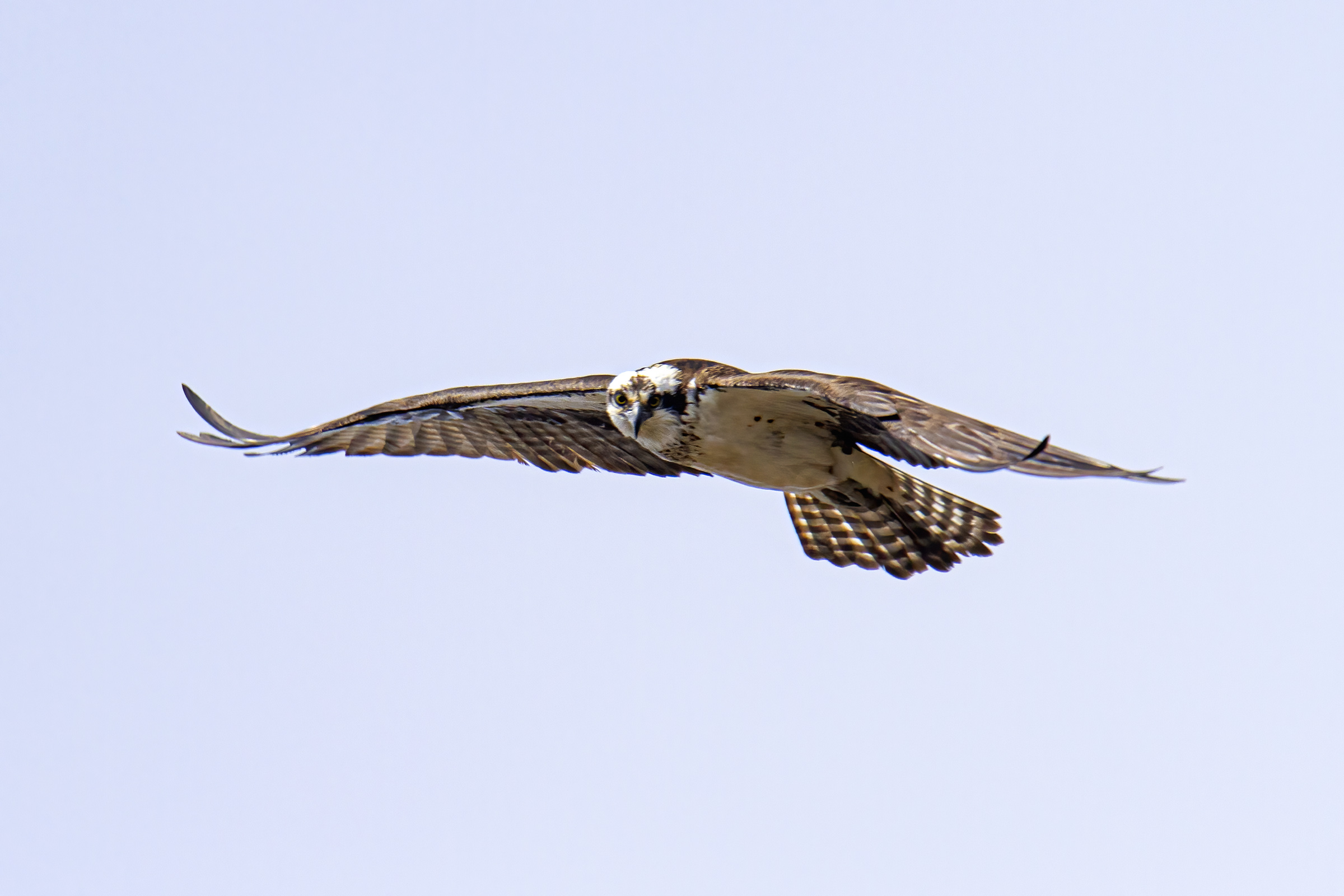
Like many other local photographers, I am thrilled that Ospreys (Pandion haliaetus) have returned to our area—they spend the colder months in warmer locations. On Tuesday, I captured several shots of one of the ospreys as it soared above me at Occoquan Bay National Wildlife Refuge.

Ospreys hover in the air a bit, so it is a bit easier to get shots of them flying than it is with eagles and hawks. However, it is still a challenge to get shots that have good wing and head positions. I was happy that the osprey was flying towards me in both of these images and its eyes are somewhat visible.

More osprey are sure to arrive soon and I am sure that I will get some better (and closer) shots in the upcoming months. I am content with these shots that that document the fact that the ospreys have returned, yet another sign of the arrival of spring.

Osprey

osprey

© Michael Q. Powell. All rights reserved.


Read Full Post »

I am not sure what was going on Tuesday in the waters off of Occoquan Bay National Wildlife Refuge, but two Bald Eagles (Haliaeetus leucocephalus) were perched on a structure and an aggressive Osprey(Pandion haliaetus) kept dive-bombing them repeatedly. The osprey would fly by right above them and each time the eagles would rear up with their talons extended as they screamed at the osprey. I took the shot below from a long way away, but it gives you a sense of the action.

Several of my friends on Facebook suggested that this might have been a territorial dispute. Others posited that the eagles had stolen a fish from the osprey and the osprey was angry about it. Another friend provided a link to a fascinating article at Natural Habitat Adventures entitled “Eagles and Ospreys: When Birds of Prey Clash.” According to the article, eagles will sometimes steal osprey chicks and ospreys may attack eagles while they are eating. It is too early for there to be chicks—ospreys have only recently returned to our area—but it is certainly possible that this was a food fight.

eagles and osprey

© Michael Q. Powell. All rights reserved.

Read Full Post »

I thought that the ospreys (Pandion haliaetus) in our area had already headed south, so I was pleasantly surprised to spot one last Friday at Occoquan Bay National Wildlife Refuge and was thrilled to be able to capture this image as it zoomed by me. During the summer there are multiple pairs of mating ospreys throughout the refuge and the ospreys are vocal and visible, but it had been at least a month since I had last seen an osprey.

Osprey

© Michael Q. Powell. All rights reserved.


Read Full Post »

Some crows were harassing an osprey (Pandion haliaetus) on Tuesday at Occoquan Bay National Wildlife Refuge. The osprey kept looking to the sky and crying out. Was it yelling at the crows or perhaps calling out to its mate?

Eventually one of the crows flew up onto the same branch as the osprey and continued to pester the larger bird. When I captured the final image, the crow looked away with a look of feigned innocence. The osprey, however, was not buying the act and appeared to be looking over its shoulder, keeping an eye on the crow.

Have a wonderful weekend.

Osprey

Osprey

Osprey

© Michael Q. Powell. All rights reserved.

Read Full Post »

Earlier this season I saw a lot of Osprey (Pandion haliaetus) activity at Occoquan Bay National Wildlife Refuge. Many of the Ospreys seemed to be attempting to build nests, but it was never clear to me which ones were viable. These potential nesting sites were scattered around the entire refuge, so I count not simply monitor them as I do with the two eagle nests.

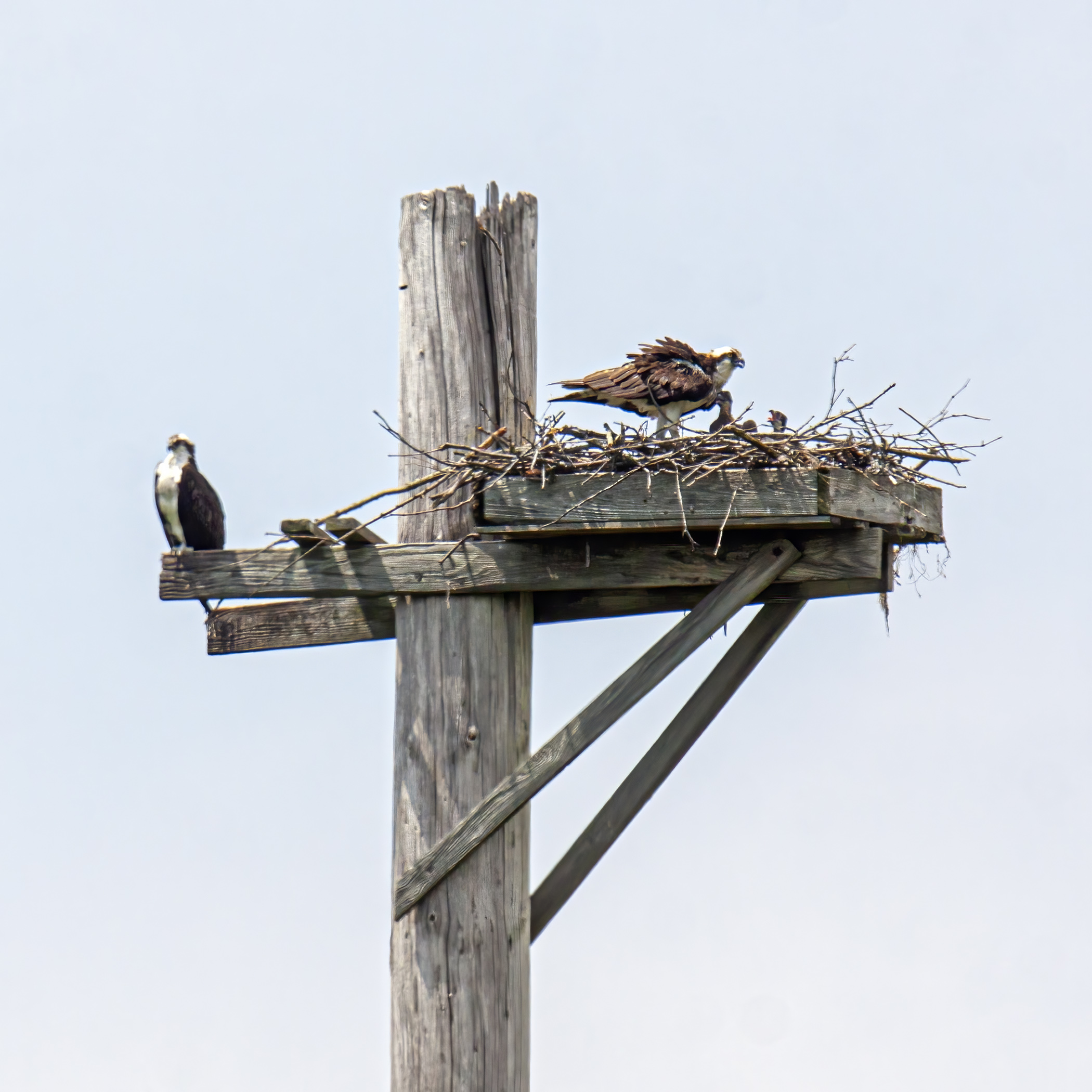
One of these sites is a man-made nesting platform that is located in the middle of a field. It is a simple wooden platform atop a vertical post that looks like a telephone pole. During the off-season, when the ospreys have departed from our area, bald eagles often perch on this platform, but it is not suitable for a bald eagle nest.

Apparently, though, the nesting platform is suitable for ospreys. Last Friday, I noted a lot of activity at the platform and managed to capture this image of an osprey family. I was shooting a telephoto lens, but was a good distance away, so the shot is not quite as sharp and detailed as I would have liked. However, it is easy to pick out both parents and at least two baby ospreys.

That same day, I checked the eagle nest to see if I could see the eaglet that I had previously photographed, but did not see it. Previously it looked like the eaglet was almost ready to fly and it is possible that the eaglet is no longer spending its time in the nest, but I will be sure to check for activity the next time that I visit the refuge—it is one of my regular stops when I make the rounds at the wildlife refuge.

Ospreys

© Michael Q. Powell. All rights reserved.


Read Full Post »
Ospreys (Pandion haliaetus) were really vocal and active last week at Occoquan Bay National Wildlife Refuge.  Most often, though, the ospreys were flying out of range of my lenses, so getting shots of them was a bit of a challenge.

Eventually I manage to get a shot of some  perched ospreys. In the first and third photos, the osprey appeared to have a fish that it kept hidden from me. Perhaps it had had a recent experience with an eagle trying to steal its catch and consequently was hyper-possessive now. I think that attitude also explains why the bird was in a defensive, crouched position and would look around before taking a bite of the unseen fish.

The middle photo shows an osprey on a nest that is being constructed on a channel marker in the waters off of the wildlife refuge. In the past,I have photographed much larger nests on this same buoy—check out my blog posting entitle Defying gravity from last year to see a photo of a previous iteration of a nest at this spot.

In the last few days some local photographers have posted photos of warblers at this wildlife refuge, so I will be looking for small birds as well as the larger, more visible ones like these ospreys. Insect activity is beginning to pick up too, so it looks like April will be a busy time for me and my camera.

osprey

Osprey

osprey

© Michael Q. Powell. All rights reserved.


Read Full Post »
Most of the times when I photograph an Osprey (Pandion haliaetus), the bird appears to be long and lanky. The angle at which I photographed this osprey, however, distorted its proportions, making it seem more short and squat than normal. The spherical head and the osprey’s exaggerated expression of curiosity and surprise help to make this image feel comical and cartoonish—I can’t help but smile every time that I look at the photo.

There are quite a few ospreys now at Occoquan Bay National Wildlife Refuge and quite soon they will be working on their nests. I hope to be able to capture some shots of that activity. Now that we have moved into April, I will start to switch some of my focus to searching for dragonflies. With a bit of luck, I will see my first dragonflies of the year with a week or two.

Osprey

© Michael Q. Powell. All rights reserved.

Read Full Post »
Some of the Ospreys (Pandion haliaetus) that I spotted last week at Occoquan Bay National Wildlife Refuge seemed to be making early claims on the existing nests from last year, while others were simply perched on trees throughout the refuge. Mostly they kept their distance, though, so I had to be content with relatively distant shots of these recently returned raptors.

osprey

Osprey

© Michael Q. Powell. All rights reserved.

Read Full Post »

Quite a few ospreys (Pandion haliaetus) have returned to Occoquan Bay National Wildlife Refuge and I spent a lot of time last Thursday trying to photograph them. Most of my efforts were focused on trying to capture images of them in flight.

Ospreys will fly in circles over the water and occasionally will hover and glide a little as they search for prey, which makes it somewhat easier to focus on them than on many other birds. However, it’s still a pretty formidable challenge to get shots in which the eyes are visible and in focus and in which the wing positions are good.

For the first image, I did not react quickly enough to zoom out when the osprey flew overhead, so I clipped its wings in the photo. I think that it is nonetheless a cool shot that provides a good look at the feather details of the osprey and at its eye and beak.

In the second shot, I captured the osprey at a moment when it had its wings fully extended. I like the way that the osprey’s yellow eye really stands out in the image.

I am sure that I will get lots of chances to photograph ospreys in the upcoming months, but it is always exciting me to them again for the first time each year—another sign that the seasons are changing.

osprey

osprey

© Michael Q. Powell. All rights reserved.

Read Full Post »

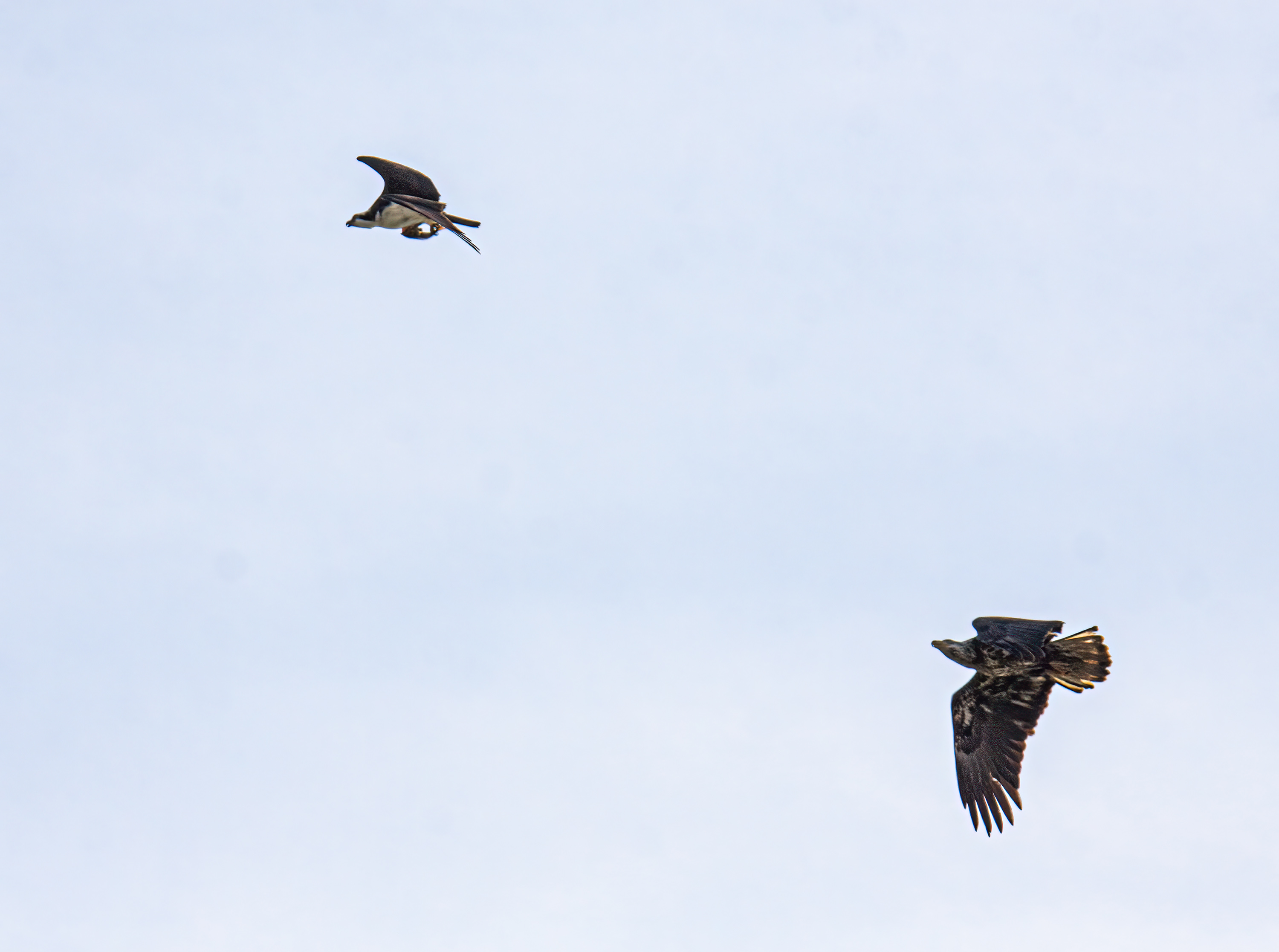
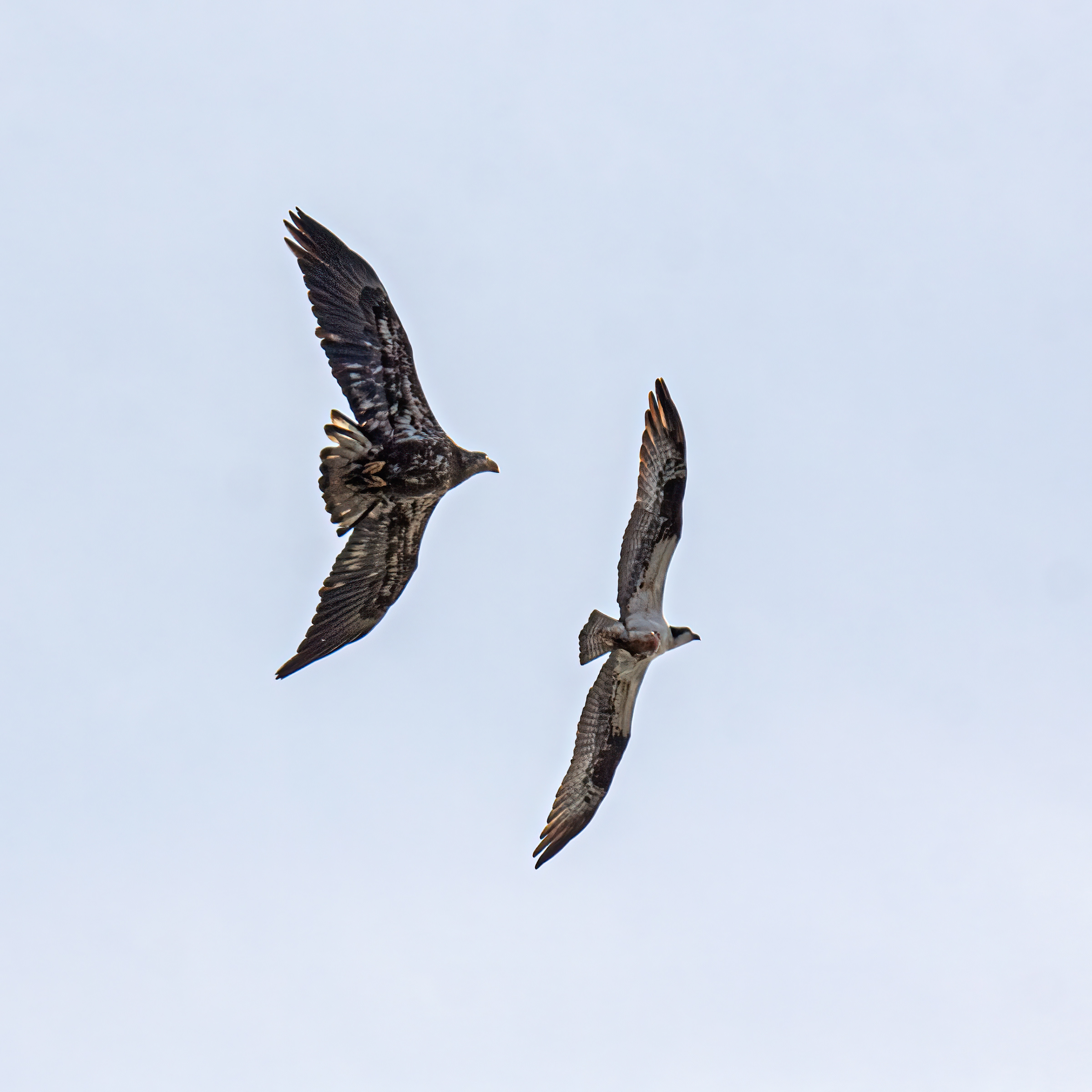
A juvenile Bald Eagle (Haliaeetus leucocephalus) tried to steal a fish from an Osprey (Pandion haliaetus) on Thursday at Occoquan Bay National Wildlife Refuge and chased it across the sky. It was quite an aerial dogfight. In the end, I think that the osprey dropped the fish and both birds ended up “empty-handed.”

Ospreys migrate away from my area for the winter and I was delighted to see that they had returned. I spotted at least a half-dozen or more ospreys and they were both active and vocal. Ospreys have high-pitched, distinctive voices that the Cornell Lab of Ornithology described in these words, ” Their calls can be given as a slow succession of chirps during flight or as an alarm call—or strung together into a series that rises in intensity and then falls away, similar to the sound of a whistling kettle taken rapidly off a stove.” Here is a link to a Cornell Lab webpage where you can listen to recordings of various osprey calls.

These three photos give you a general sense of the chase. In the first shot, you can definitely see the “prize,” the fish that the osprey had caught. In the second shot, the eagle has closed the distance separating it from the osprey. In the third shot, the osprey is doing its best to maneuver away from the eagle, but the eagle was able to match the osprey turn by turn. All of this took place over the water and eventually the two birds flew out of range.

eagle osprey chase

eagle osprey chase

eagle osprey chase

© Michael Q. Powell. All rights reserved.

Read Full Post »

When I saw an osprey couple trying to build a nest earlier this spring on a channel marker in the waters off of Occoquan Bay National Wildlife Refuge, the building site seemed way too small. Amazingly the ospreys (Pandion haliaetus) found a way to add an overhanging extension that seems to defy gravity. The couple seemed comfortable in the nest, which appear to be capable of easily holding their weight.

A neighboring osprey couple had the opposite problem—they had too much space. The ospreys used only half of the space for their nest and could easily have shared the other half with another couple, but I think that ospreys like to keep their neighbors at arm’s length, or maybe it would be better to say “at wing’s length.”

osprey nest

osprey nest

© Michael Q. Powell. All rights reserved.


Read Full Post »

Some of the newly-returned Ospreys (Pandion haliaetus) at Occoquan Bay National Wildlife Refuge were busy on Friday building or renovating their nests. In past years I have seen ospreys make nests in a wide range of locations, both natural as well as man-made. This osprey was ferrying out sticks to a nest on a distant channel marker in the bay, where its mate waited patiently for each new delivery.

Osprey

Osprey

© Michael Q. Powell. All rights reserved.

Read Full Post »

Some birds return silently in the spring and you have to search hard to find them. Ospreys (Pandion haliaetus), on the other hand, make their presence known as they soar overhead, often calling out in their loud, high-pitched voices that the Cornell Lab of Ornithology compared to “the sound of a whistling kettle taken rapidly off a stove.”

I spotted only a few ospreys yesterday at Occoquan Bay National Wildlife Refuge, some of which I managed to photograph, but know from experience that they are only the advance guard of a larger group of osprey that will arrive soon and begin to build or repair their nests. As you may notice in the second photo, trees in our area are being to produce buds and it won’t be long before leaves begin to complicate my efforts to spot birds.

Osprey

osprey

© Michael Q. Powell. All rights reserved.

Read Full Post »
This is the time of the year when warblers are moving through the area in which I live and bird photographers have been congregating at Occoquan Bay National Wildlife Refuge, a local hotspot for warblers and other birds that, unlike many other parks, has been open during this shutdown. Not wanting to risk contact with so many people, I have been avoiding this refuge for the most part, even though it is my favorite place to take photos.

Last week, though, I made a trip to the wildlife refuge on a weekday morning when the weather was less than optimal. As I had hoped, the weather kept most of the other photographers away and I was able to visit some of my favorite spots. I checked out several osprey nests, hoping to see some baby ospreys. The ospreys were no longer sitting on any of the nests, but I could not tell if there were baby ospreys in them or not.

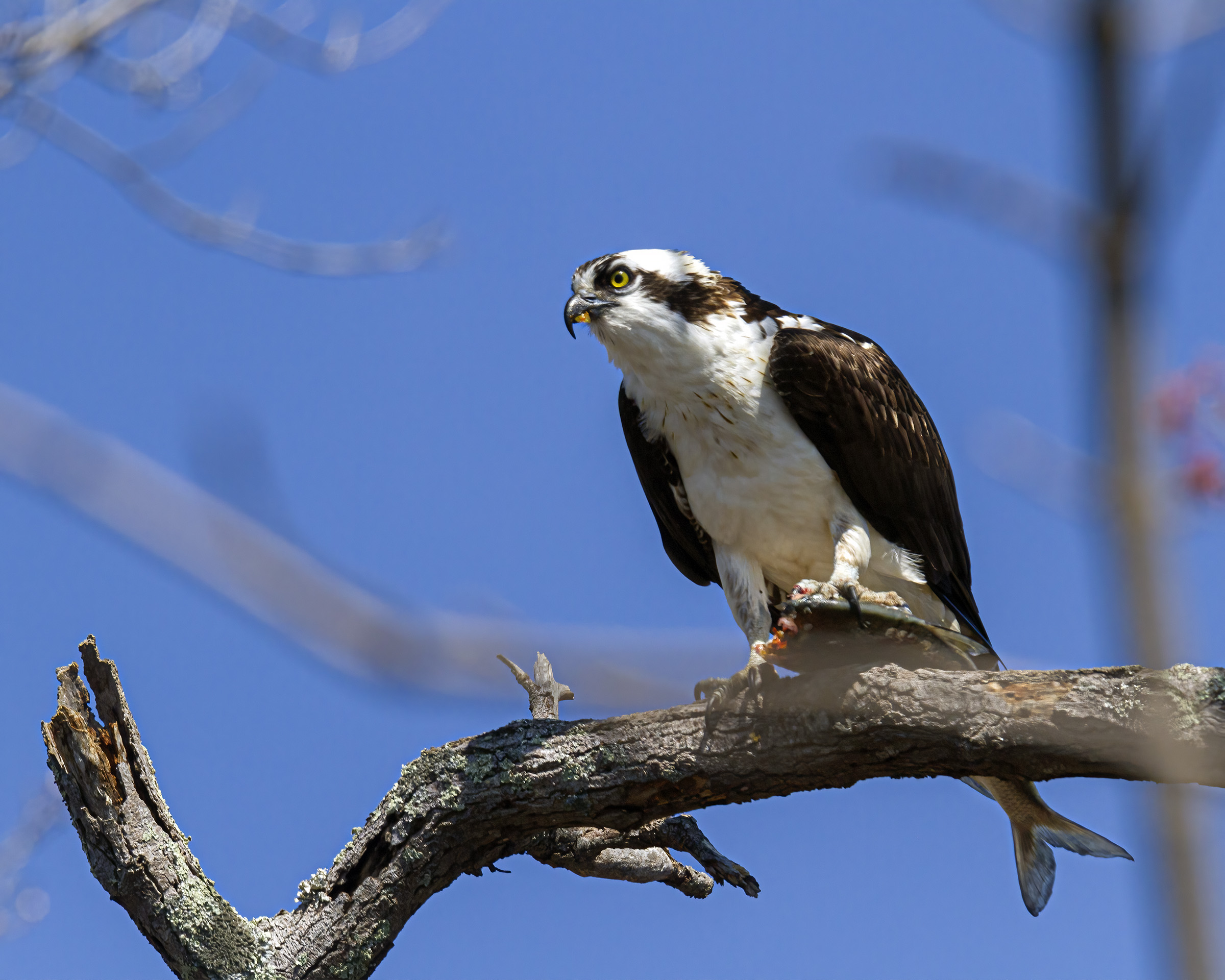
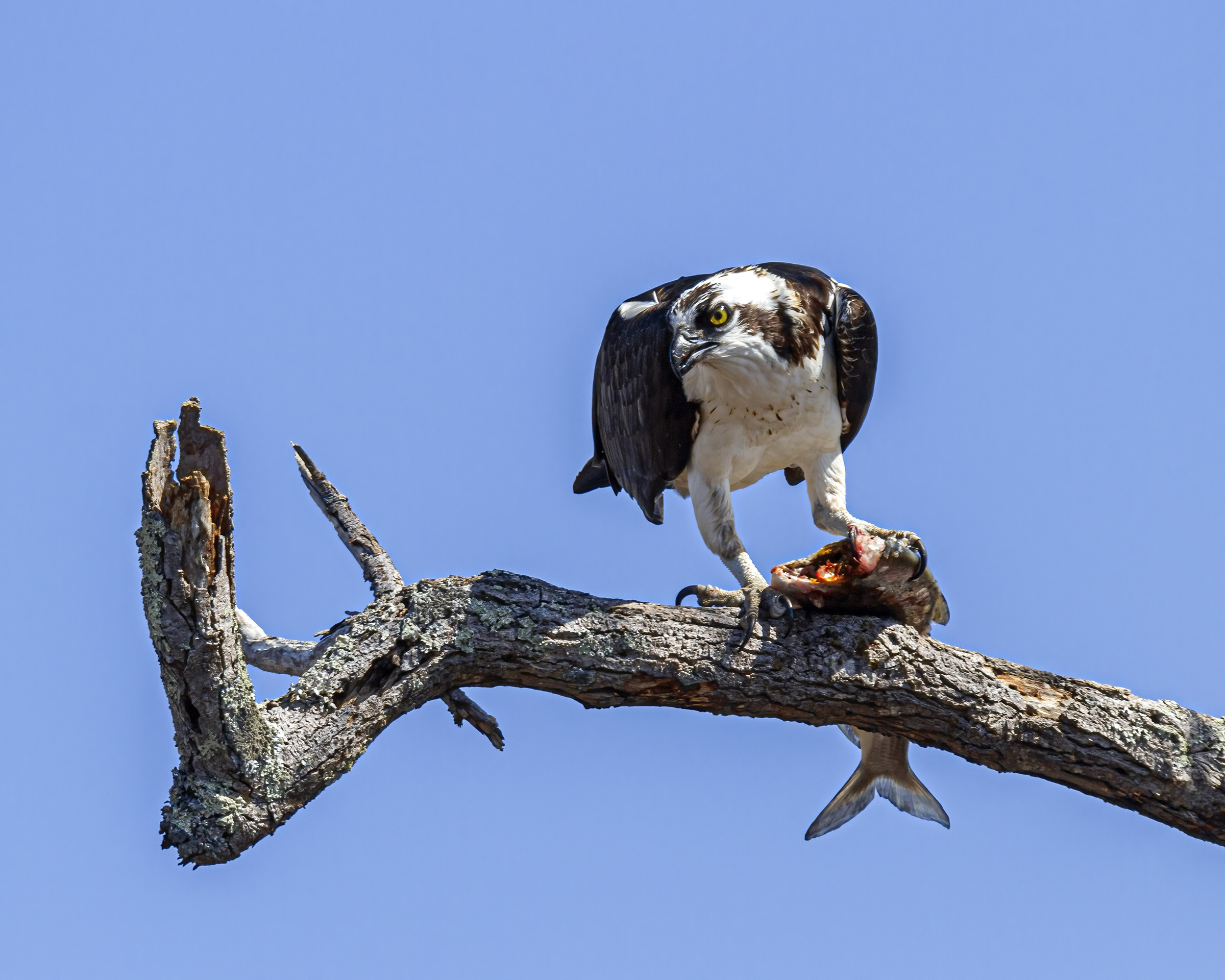
Peering through the branches near one nest, I spotted this perched Osprey (Pandion haliaetus) with a fish in its talons. The osprey was at the stage of consumption when quite often it will take the remaining portion to its mate. I never did see its mate, but was happy to capture this shot before the osprey flew away.

Osprey

© Michael Q. Powell. All rights reserved.


Read Full Post »

Older Posts »