Feeds:
Posts
Comments

Posts Tagged ‘North Dakota’

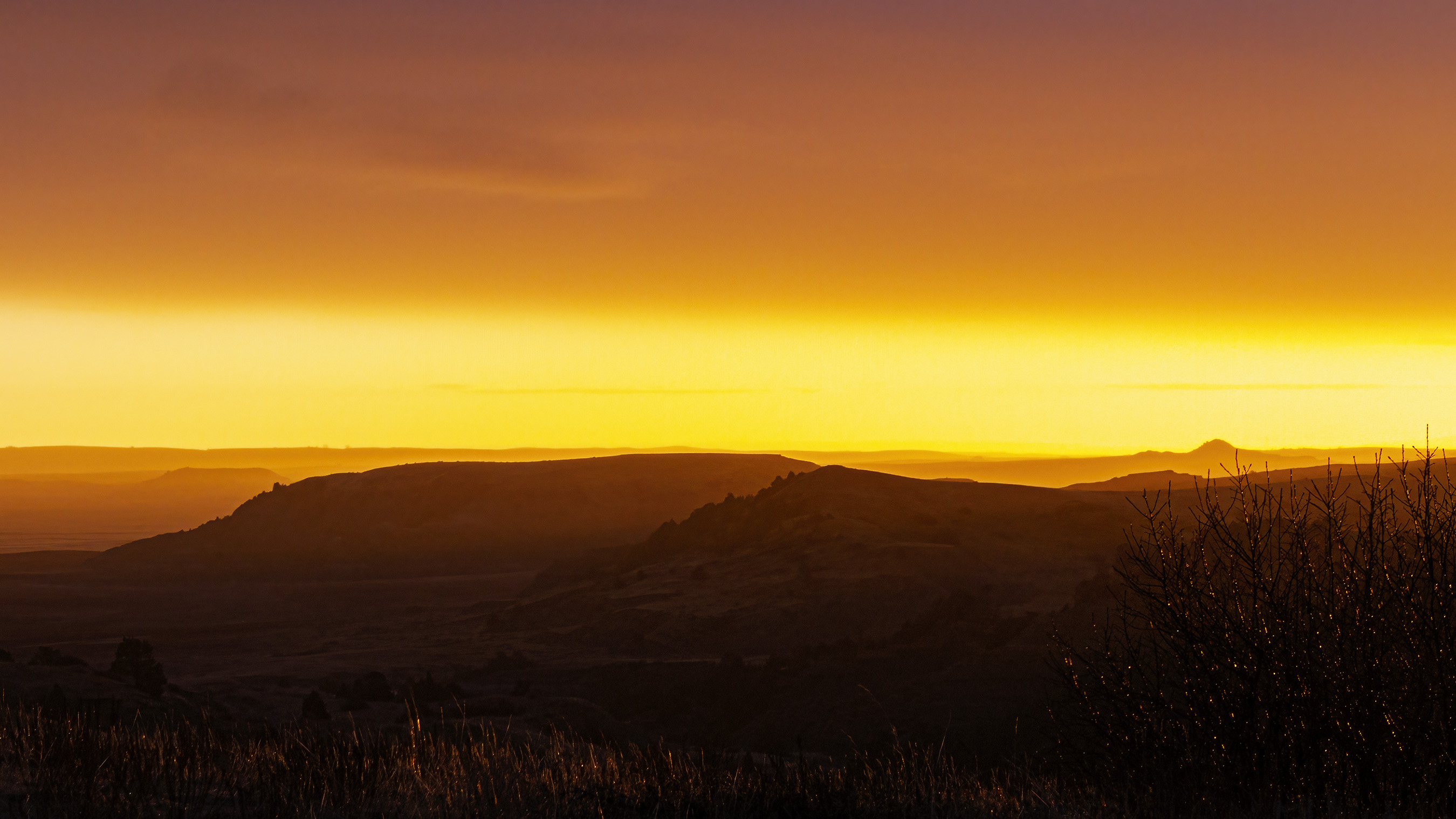
I am finally more or less caught up with my photos from my road trip to Seattle and back. Here are a couple of my favorite shots of the trip, when I captured the sunrise on 5 November at Theodore Roosevelt National Park in Medora, North Dakota. It was dark and cold when I crawled out of my sleeping bag that morning, but I really wanted to try to see the sunrise.

The sun rises and sets each day, but each one is unique, affected by a whole host of uncontrollable factors, including meteorological conditions and the landscape. Sometimes the sun arrives slowly and subtly and sometimes it explodes into view. Professional landscape photographers scout locations in advance and figure out the optimal locations to catch the sunrise. I simply got into my car and began to drive slowly on the road through the park.

As I was driving I came upon this view as I rounded a corner just as the sun was rising over the horizon. Results are unpredictable when you point your camera directly at the sun, but somehow I managed to get it almost right in the first shot below—well at least I got a cool image that I like. When I moved the camera to the side a little so the sun was no longer in the frame, I was able to capture the final photo. I really like the sort of layering in the background, as the sun painted the various land features.

I am not sure if I will do a posting tomorrow, when those of us in the United States will be celebrating Thanksgiving. In case there is posting tomorrow, let me thank all of you now who pause for a moment to look at my photos or read my rambling prose. Thanks for all of your support and encouragement over the years.

sunrise

sunrise

© Michael Q. Powell. All rights reserved.

Read Full Post »

After a frigid night camping at Theodore Roosevelt National Park in North Dakota, I awoke early Tuesday morning to catch the sunrise. It was not super spectacular, but I was able to capture some of the color as the sun rose over the mountains.

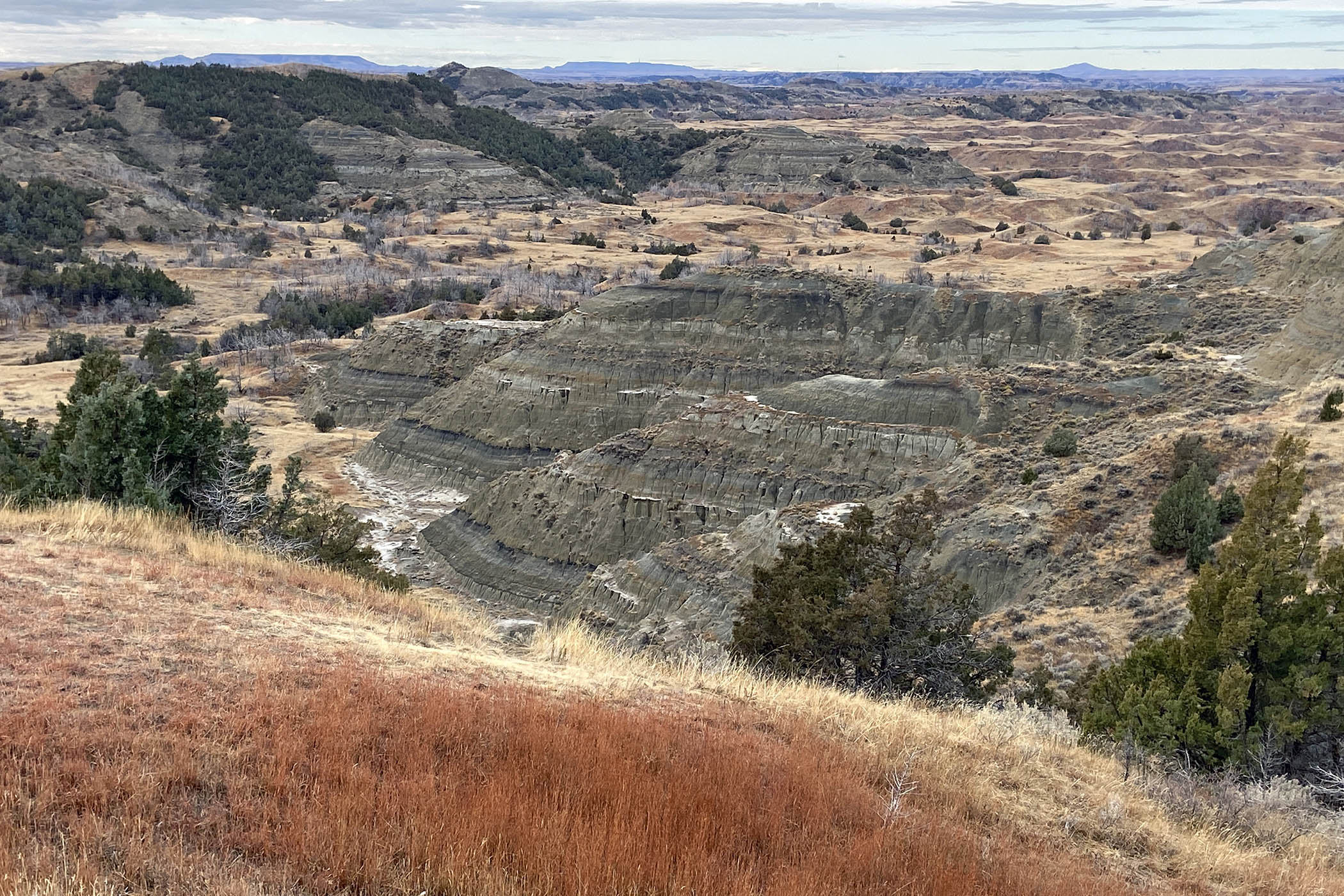
When the sun was a little higher in the sky, I was able to get a better view of the spectacular landscape with incredible rock formations, as you can see in the final photo. I encourage you to click on that photo to get an enlarged view of the details of the landscape. In this part of the country, these terrain features are referred to as “buttes,” though it is not always clear exactly what make a “butte” a “butte,” rather than a “hill” or “mountain.” No matter what you call them, these terrain features are breath-taking.

sunrise in North Dakota

sunrise in North Dakota

buttes in North Dakota

© Michael Q. Powell. All rights reserved.

Read Full Post »

I was thrilled to spot this very pretty filly in the midst of a band of wild horses at Theodore Roosevelt National Park in North Dakota on 10 August 2022. If you look closely, you’ll see that she has incredible blue eyes.

I think that this baby horse may be named Dreamer, born on 2 June, judging from the photos of the 2022 foals at the park on the North Dakota Badlands Horse website. The North Dakota Badlands Registry, according to its website, is a non-profit organization that “was established to register, promote, appreciate and preserve the wild horses of Theodore Roosevelt National Park, North Dakota that are unique to the area.”

Several times during my visits to the national park, I encountered members of this organization while I was observing the , who shared with me a lot of information about the wild horses. One of the really cool things that the group does is keep track of the composition of the different bands of horses within the park—it is estimated that there are about 183 wild horses scattered throughout the national park.

It definitely was a challenge getting a clear shot of the baby horse’s face—most often her head was down or she was hidden behind her mother. However, I waited patiently and eventually was able to capture these shots of the sweet little horse.

wild horse filly

wild horse filly

© Michael Q. Powell. All rights reserved.


Read Full Post »

Theodore Roosevelt National Park in North Dakota is one of the few national parks where visitors can observe free-roaming horses. According to the National Park Service, “their presence represents Theodore Roosevelt’s experiences here during the open-range ranching era. Ranchers turned horses out on the open range to live and breed. When needed, they would round up horses and their offspring for use as ranch horses. For generations, ranchers used land that would later become the park for open-range grazing.”

Once the park was fenced in, one of the issues was what to do with the horses. Initially the authorities tried to capture and remove all of the horses, but some small bands of horses eluded capture and continued to live free-range in the park. “In 1970, a change of park policy recognized the horse as part of the historical setting. New policies were written and enacted to manage the horses as a historic demonstration herd.”

I had multiple sightings of wild horses during my visit to the national park. Most of the time it was only one or two horses, but on my final day I ran into a larger group. As I was observing them, another visitor told me that this was Xander’s band, named for the lead stallion.

The other visitor turned out to be a member of a group that tracks the bands of wild horses in the park. She patiently explained to me that the horses travel in groups of 5 to 15 horses, known as bands, with a well-established social hierarchy. The bands are pretty stable—young colts and fillies are kicked out of their groups at the age of 2-3 and form new bands. Some of the individual horses that I observed, she said, were likely to be bachelors.

The first photo shows the band all grouped up together in a shadow of a rock formation where I first saw them. They were packed together so tightly that it was hard to get an accurate head count. I believe that the gray horse in the front is Xander, the leader. Eventually the individuals of the group spread out a bit (it looks like there are ten members in the band) and began to graze, as you can see in the second and third photos.

The National Park Service tries to manage the number of wild horses in this park tor prevent overpopulation. “Historically, the park conducted roundups every three to four years using helicopters to herd horses to a handling facility and then sold them at public auction. More recently, the park has tried new methods for herd management including contraceptives, low-stress capture techniques, genetics research, and partnerships with nonprofit horse advocacy groups. Horses are currently captured using tranquilizer darts and sold in online auctions.”

Xander's band

Xander's band

Xander's band

© Michael Q. Powell. All rights reserved.


Read Full Post »

As many of you know, I have spent the last week driving across the United States to spend some time with family outside of Seattle, Washington. I departed from Virginia at midday last Monday and by the time that I finally arrived on Saturday afternoon, I had traveled a distance of 3085 miles (4964 km).

I spent a lot of time driving, but made an extended stop at Theodore Roosevelt National Park in western North Dakota, where I camped out for two nights. During my visit, I had multiple encounters with American Bison (Bison bison), including one memorable moment when my car was almost surrounded as a small herd of bison moved past me on the road.

It was a bit strange for me to take wildlife photos from inside my car, but that definitely was the safest thing to do with these bison. Some of the bulls looked to be as large as my KIA Soul. I noted that there were a good number of calves too, and definitely did not want to mess with a potentially mad mamma bison if I got between her and her baby.

I am still sorting through my images, but I thought I would lead with these little portraits that show some of the personality of the individual bison.

In addition to the bison at the national park, I was able to photograph wild horses, prairie dogs, birds, and even a few dragonflies. You should see some of them in the near future.

American Bison

American Bison

American Bison

© Michael Q. Powell. All rights reserved.

Read Full Post »