Feeds:
Posts
Comments

Posts Tagged ‘Nannopterum auritum’

The feathers of Double-crested Cormorants (Nannopterum auritum) are not completely waterproof, so periodically they have to dry out their wings. I often see cormorants completely out of the water, perched on rocks or logs with extended wings. This cormorant last week at Occoquan Bay National Wildlife Refuge apparently decided, however, that a perch was not necessary—it simply spread its wings in the air and held them in that position.

A bit earlier I captured the second image below. Usually I see cormorants in the deep waters of the bay, but this cormorant was in a small pond at the wildlife refuge. The pond is mostly surrounded by trees that are now in bloom and I was happy to capture some of the colors of the trees in their reflections on the surface of the water.

Double-crested Cormorant

Double-crested Cormorant

© Michael Q. Powell. All rights reserved.

Read Full Post »

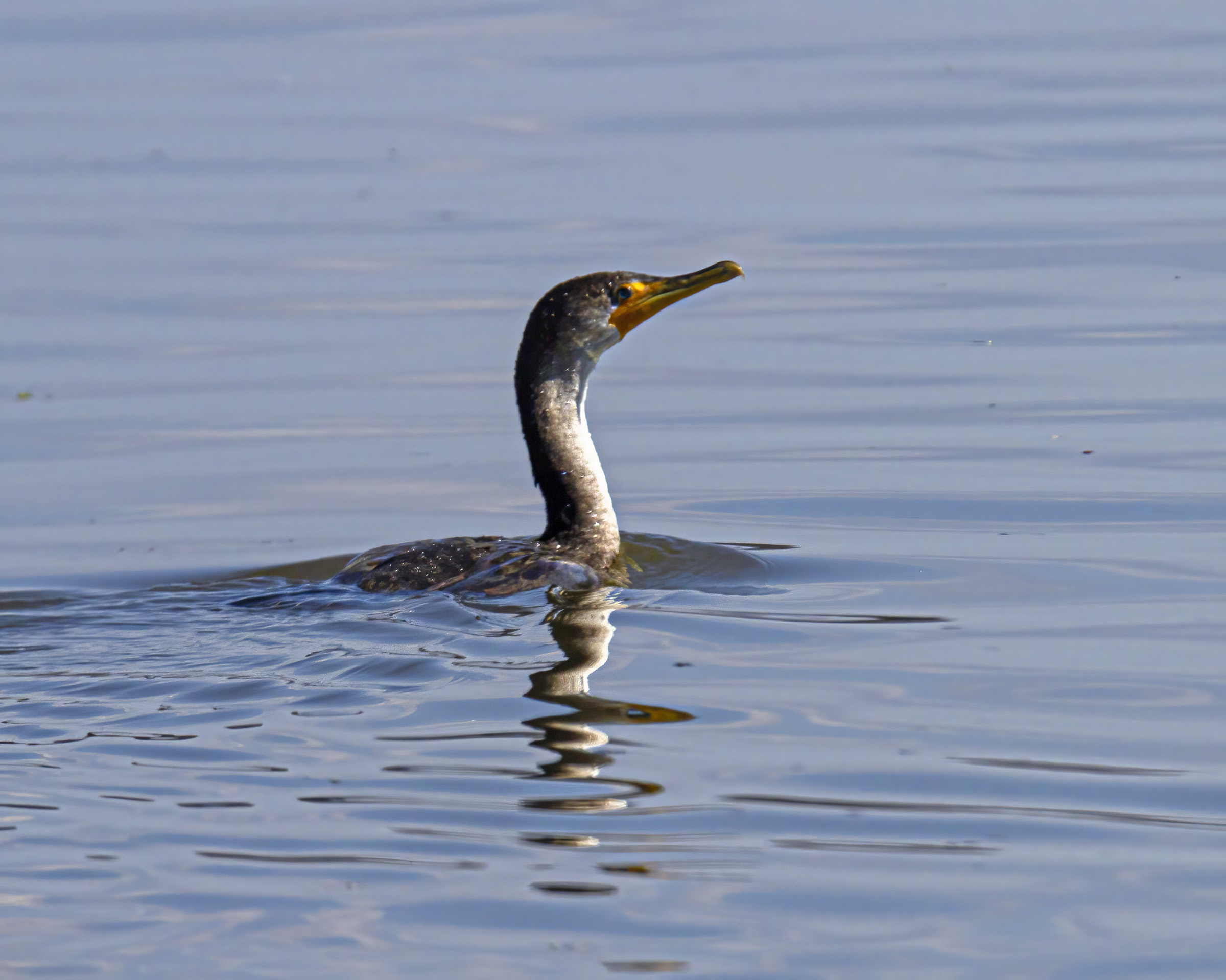
Most of my recent photos of Double-crested Cormorants (Nannopterum auritum) has show the birds taking off. Indeed, cormorants tend to be quite skittish and react quickly when they detect my presence. Last Wednesday, I spotted a cormorant in the waters off of Occoquan Bay National Wildlife Refuge that was so focused on repeatedly diving under that the did not notice me.

I was really happy with the photo that I captured of the cormorant, especially the way that it shows the bird’s beautiful rippled reflection. You may note that the cormorant is really low in the water, with most of its body submerged. As I noted in a recent post, cormorants’ feathers are not completely waterproof and can become waterlogged. For that reason, cormorants need to periodically come out of the water and stretch out their wings to dry them.

Double-crested Cormorant

© Michael Q. Powell. All rights reserved.

Read Full Post »

This past Monday I spotted some Double-crested Cormorants (Nannopterum auritum) in the waters off of Occoquan Bay National Wildlife Refuge and once again they took off immediately, even though I was quite a distance away from them. Fortunately I anticipated that this would happen and was able to react quickly enough to capture the action. The second photo below shows the way that cormorants bounce across the water, leaving a trail of small splashes, to gain the speed needed to lift off from the water.

The first photo, my favorite of the two, depicts the cormorant on its last bounce, making final preparations for takeoff with its feet just barely in the water. I really like the position of the extended wings in this image and if you zoom in and look at the face, you will get a look at the brilliant turquoise eyes of the cormorant.

Double-crested Cormorant

Double-crested Cormorant

© Michael Q. Powell. All rights reserved.


Read Full Post »

Last Friday I spotted a Double-crested Cormorant (Nannopterum auritum) in the waters off of Occoquan Bay National Wildlife Refuge. As I was bringing my camera up to my eye, the cormorant suddenly took off and I captured a couple of shots of the action. I was shooting almost directly into the light, so the bird is almost a silhouette, but I was happy to capture some of the action. As you may be able to see, the cormorant initially runs across the surface of the water to generate some momentum before it takes to the air.

When I went searching for the Latin name, I was a little surprised to see that it had changed. The Double-crested Cormorant used to be considered part of the genus Phalacrocorax, but, according to Wikipedia, a 2014 study supported reclassifying it and several other American cormorant species into the genus Nannopterum. The International Ornithologists’ Union reportedly adopted this change in 2021.

Double-crested Cormorant

Double-crested Cormorant

© Michael Q. Powell. All rights reserved.

Read Full Post »

Although it may look like this Double-crested Cormorant (Nannopterum auritum) was trying to recreate the “I’m Flying” scene from the movie Titanic (with Jack and Rose on the bow of the ship), it was simply trying to dry its feathers. It baffles my mind a bit to think that a bird that spends most of its time in the water has feathers that are not waterproof. According to the Cornell Lab of Ornithology, “They have less preen oil than other birds, so their feathers can get soaked rather than shedding water like a duck’s. Though this seems like a problem for a bird that spends its life in water, wet feathers probably make it easier for cormorants to hunt underwater with agility and speed.”

The little grouping of cormorants that I spotted last Thursday at Occoquan Bay National Wildlife Refuge looks like a family to me, with two parents and a juvenile, judging from their poses. In case you are curious, the little duck in the left-hand corner is probably a scaup.

As most of you know, I like to include the Latin name for my subjects whenever possible. Some of my readers live in other countries and may encounter the same or similar birds and insects, but know them by their names in their own languages. Strange as it sounds, Latin becomes our common language. According to Wikipedia, the Double-crested Cormorant has a relatively new Latin name. “It was formerly classified in the genus Phalacrocorax, but a 2014 study supported reclassifying it and several American cormorant species into the genus Nannopterum. The International Ornithology Committee followed this classification in 2021.”

Double-crested Cormorant

© Michael Q. Powell. All rights reserved.


Read Full Post »