Feeds:
Posts
Comments

Posts Tagged ‘mating ebony jewelwings’

Dragonflies and damselflies have rather limited lifespans after they emerge from the water and are transformed from aquatic nymphs into aerial acrobats. One of their biological imperatives is to perpetuate their species, so it is not unusual to see mating activity during this time of the year that is primetime for dragonflies and damselflies.

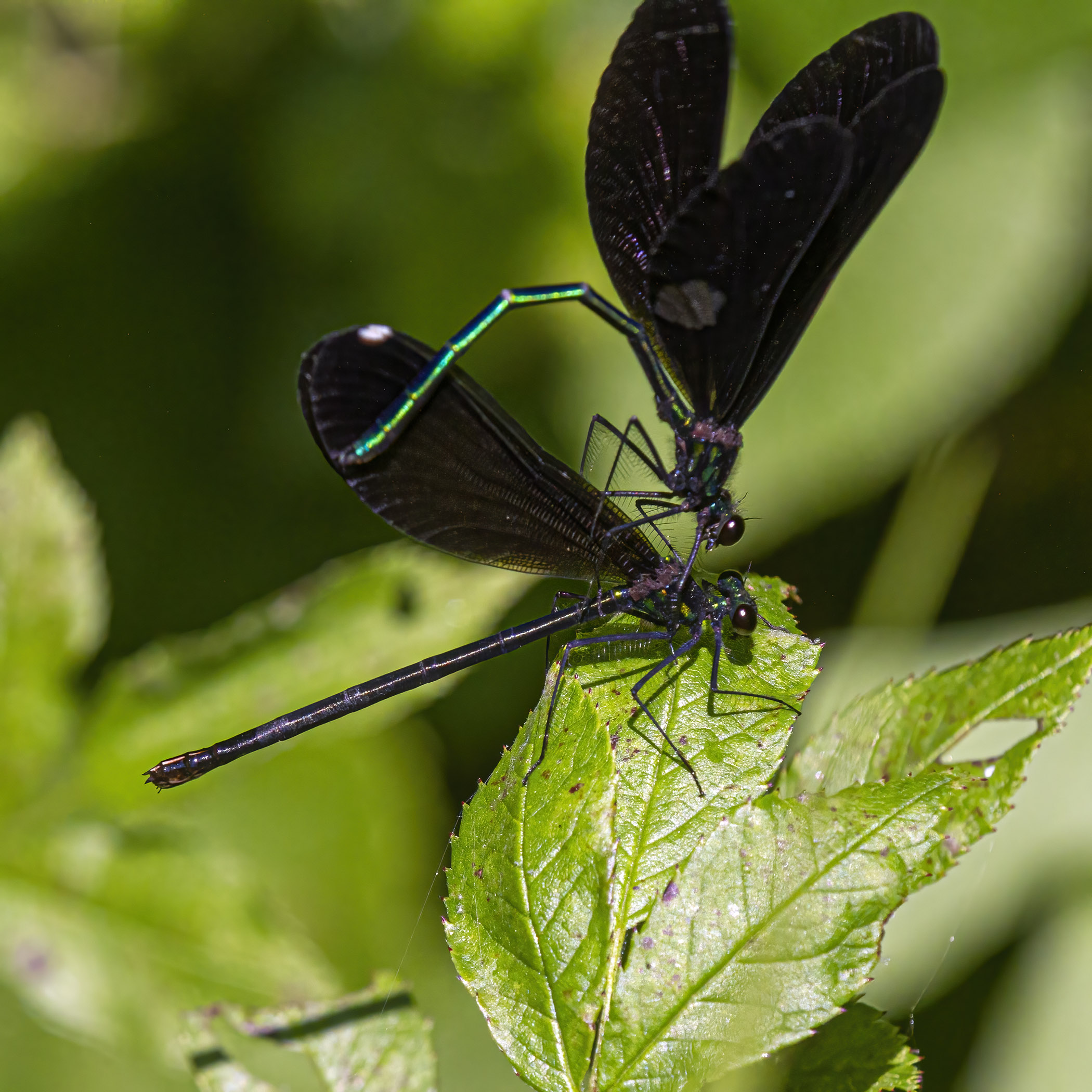
On a trip earlier this month to Occoquan Regional Park, I spotted this pair of Ebony Jewelwing damselflies (Calopteryx maculata) in their distinctive sidewards-heart mating position. I am really happy with this image because I was able to use my shooting angle and camera settings to keep the bodies of both damselflies in focus and achieve a blurry background that allows a viewer to focus on the damselflies without any visual distractions.

In case you are curious, the damselfly to the left is the female and the one with the shiny green body is the male. You can tell the genders from the mating position and from the little white patch on the wings that is present on female Ebony Jewelwings and not on the completely dark wings of the males


Ebony Jewelwing

© Michael Q. Powell. All rights reserved.

Read Full Post »

Last week I managed to capture a series of images of a hook-up between two Ebony Jewelwing damselflies (Calopteryx maculata). Initially I was focused on a female that was perched on a leaf, but then noticed a male who was circling around her. According to Wikipedia, “Calopteryx males will hover in front of a female with alternating fast and slow wingbeats; if she is receptive she will remain perched, otherwise she will fly off.” This female remained in place, so the male moved in, as you can see in the first three photos.

During mating, the male uses claspers at the tip of his abdomen to grasp the female behind her head tightly enough to resist the attempts by other males to dislodge him, a position sometimes called “tandem.” The male then flexes his abdomen to encourage the female to loop her abdomen round to interlock with him, forming the “wheel’ position,” the sidewards-heart position shown in the final photo.

I suppose that I could leave the description here, but the process that was taking place was so weird and fascinating that I thought I should explain what is going on. In order to keep from getting too graphic, I will borrow some language from Wikipedia.

“Mating in damselflies, as in dragonflies, is a complex, precisely choreographed process involving both indirect insemination and delayed fertilization….When he (the male) is ready to mate, he transfers a packet of sperm from his primary genital opening on segment 9, near the end of his abdomen, to his secondary genitalia on segments 2–3, near the base of his abdomen. The male then grasps the female by the head with the claspers at the end of his abdomen; the structure of the claspers varies between species, and may help to prevent interspecific mating… The female then curls her abdomen downwards and forwards under her body to pick up the sperm from the male’s secondary genitalia, while the male uses his “tail” claspers to grip the female behind the head: this distinctive posture is called the “heart” or “wheel.”

Wow! I think I will leave it at that. Suffice it to say that the process is complicated and the participants have to be incredibly flexible.

Ebony Jewelwing

Ebony Jewelwing

Ebony Jewelwing

Ebony Jewelwing

Ebony Jewelwing

Ebony Jewelwing

© Michael Q. Powell. All rights reserved.
Read Full Post »

When damselflies mate, it is often a very conspicuous event, easily recognized by the heart-shaped “wheel” formation of the mating couple. The male clasps the female by the back of her head and she curls her abdomen to pick up sperm from secondary genitalia at the base of the male’s abdomen. That’s about as graphic as I dare go in describing the process.

Yesterday I spotted a pair of mating Ebony Jewelwing damselflies (Calopteryx maculata) as I was exploring a stream in Fairfax County, Virginia, the county in which I live. Ebony Jewelwings are immediately identifiable, because they are the only damselflies in our area with dark wings. They can be found at a wide variety of running waters, especially at shaded forest streams, like the one where I found this couple.

Male Ebony Jewelwings have wings that are all black, while females have dark brown wings with conspicuous white pseudostigmas—the male is on the right in this photos. The body of the males is a metallic green with copper highlights—in certain lights, their bodies may look distinctly blue. Females seem to have a bit more color variation, though it is hard to tell their true color because of the reflected light from their shiny bodies.

Ebony Jewelwing

© Michael Q. Powell. All rights reserved.

Read Full Post »

When it comes to damselflies, I love the sidewards heart that their bodies create when they are in this mating position. I have been told that the process is somewhat brutal, but I like to think of it as romantic, two hearts joined as one.

I spotted these Ebony Jewelwing damselflies (Calopteryx maculata) last Sunday in Fairfax County. At this time of the year Ebony Jewelwings are quite common, especially in the shaded forest streams that I like to explore.

In addition to the sidewards heart, I really like the interplay of the light and the shadows in the background that adds a lot of visual interest without detracting from the primary subjects. You can get a really feel for the dappled sunlight that kept the scene from being in complete shade.

Ebony Jewelwing

© Michael Q. Powell. All rights reserved.

Read Full Post »

Ebony Jewelwings (Calopteryx maculata) are everywhere in some of the forest streams I like to explore at this time of the year. Still, I love when I can get a good angle on these beautiful damselflies when they are in wheel position and forming a sidewards heart, as was the case with this pair that I spotted last Thursday in Fairfax County.

Yes, as some of you already know, the damselflies are in the process of mating, with the male on the right and the female on the left.


Ebony Jewelwing

© Michael Q. Powell. All rights reserved.


Read Full Post »

This past Saturday I was thrilled to spot this mating pair of Ebony Jewelwing damselflies (Calopteryx maculata). No, I am not a peeping Tom, but I do enjoy being able to see the male and female of a species together, so that I can compare their coloration and markings.

When it comes to damselflies, I just love the sidewards heart that their bodies create when they are in this mating position. I have been told that the process is somewhat brutal, but I like to think of it as romantic, two hearts joined as one.

Ebony Jewelwing

© Michael Q. Powell. All rights reserved.

Read Full Post »