Feeds:
Posts
Comments

Posts Tagged ‘male ring-necked duck’

During the winter I often see rafts of ducks in the waters off of Occoquan Bay National Wildlife Refuge. Usually they are gathered in the deep water, far from the shore and out of camera range for close-up shots, but I can usually identify them with my long telephoto lens.

On Wednesday during a visit to Occoquan Bay National Wildlife Refuge, I spotted a large group of mostly American Coots and Ruddy Ducks. When I examined the group really carefully, however, I noticed a pair of Ring-necked ducks (Aythya collaris) that were resting on a semi-submerged log. I have seen this species of diving ducks at other locations, primarily in ponds, but don’t recall seeing them in the open water like this.

I’m pretty sure that the duck in the first photo is a male Ring-necked Duck, thanks to his striped bill and distinctive yellow eye. I am a little less certain about the duck in the second photo, but I think it is probably a female Ring-necked duck because of the white eye ring. I am a little rusty with my bird identifications after a summer spent chasing mostly insects and mammals, but suspect that I will better as we move into winter.

Male Ring-necked Duck

Female Ring-necked Duck

© Michael Q. Powell. All rights reserved.
 

Read Full Post »

Yesterday I made a quick trip to a local suburban water retention pond, where several migratory bird species overwinter with us. I was shocked to see that no Canada Geese were there, but did spot two Double-Crested Cormorants, a few Ruddy Ducks, and several pairs of Ring-necked ducks (Aythya collaris). All of these are diving birds, so they mostly hung out near in the deeper waters at the center of the pond.

I spent a good amount of time watching one Ring-necked Duck repeatedly dive into the water and would try to guess when and where he would resurface. Male Ring-necked Ducks have a distinctive appearance, with yellow eyes, a striped bill, and a strangely pointed head.

Clouds would drift across the sun from time, causing patterns on the surface of the water to shift and change. I really got caught up in these reflections and these three photos give you a sense of the swirl of colors and patterns that provided an amazing backdrop for these cool-little ducks.

Ring-necked Duck

Ring-necked Duck

Ring-necked Duck

© Michael Q. Powell. All rights reserved.

Read Full Post »

As I was exploring a small pond last week at Occoquan Bay National Wildlife Refuge, I spotted a male Ring-necked Duck (Aythya collaris). Other than a few mallards at the other end of the pond, the Ring-necked Duck was all alone at the pond. I captured this image as the Ring-necked Duck swam up to a weathered mallard decoy and appeared to be trying to interact with it.

After a few moments without response from the mallard, the Ring-necked Duck slowly swam away, looking elsewhere for companionship. Perhaps he will have more luck with the turtles that were sunning themselves on the shore of the pond.

Ring-necked Duck

© Michael Q. Powell. All rights reserved.


Read Full Post »

Male Ring-necked Ducks (Aythya collaris) are rather odd ducks. They have an unusual pointed head and striking yellow eyes. However, they have a striped pattern on their bills that make them pretty easy to identify. Although they paddle about a lot like dabbling ducks, they will periodically dive to the bottom to eat submerged plants and aquatic invertebrates.

Despite their name, it is unusual to be able to see the chestnut collar on a Ring-necked Duck’s black neck. According to the Cornell Lab of Ornithology, the ring is “not a good field mark to use for identifying the bird, but it jumped out to the nineteenth century biologists that described the species using dead specimens.”

Like several other species that I have featured recently, this Ring-necked Duck was part of a small flock that I spotted swimming about in a small suburban pond not far from where I live. Sometimes in the winter I will make a quick visit to this pond when I to experience nature, but don’t have the time to devote to a trip to the larger wildlife refuges in my area.

Ring-necked Duck

Ring-necked Duck

© Michael Q. Powell. All rights reserved.

Read Full Post »

At this time of the year several species of ducks migrate into my area and take up residence for the winter. One of the most distinctive species is the Ring-necked Duck (Aythya collaris), especially the male. Even from a distance you can notice the oddly peaked head and when you move in closer you can see the multi-colored bill and the bright yellow eyes if it is a male. As is most often the case with birds, the females are less colorful in appearance, though, as you can see from the final photo, they are quite beautiful.

I spotted a small flock of these ducks yesterday in a nearby suburban manmade pond where I have seen then annually for at least the last five years. Although Ring-necked Ducks are diving ducks, they don’t seem to require really deep water.

So where is the ring around the neck? According to the Cornell Lab of Ornithology, “This bird’s common name (and its scientific name “collaris,” too) refer to the Ring-necked Duck’s hard-to-see chestnut collar on its black neck. It’s not a good field mark to use for identifying the bird, but it jumped out to the nineteenth century biologists that described the species using dead specimens.”


Ring-necked duck

Ring-necked duck

Ring-necked duck

© Michael Q. Powell. All rights reserved.


Read Full Post »

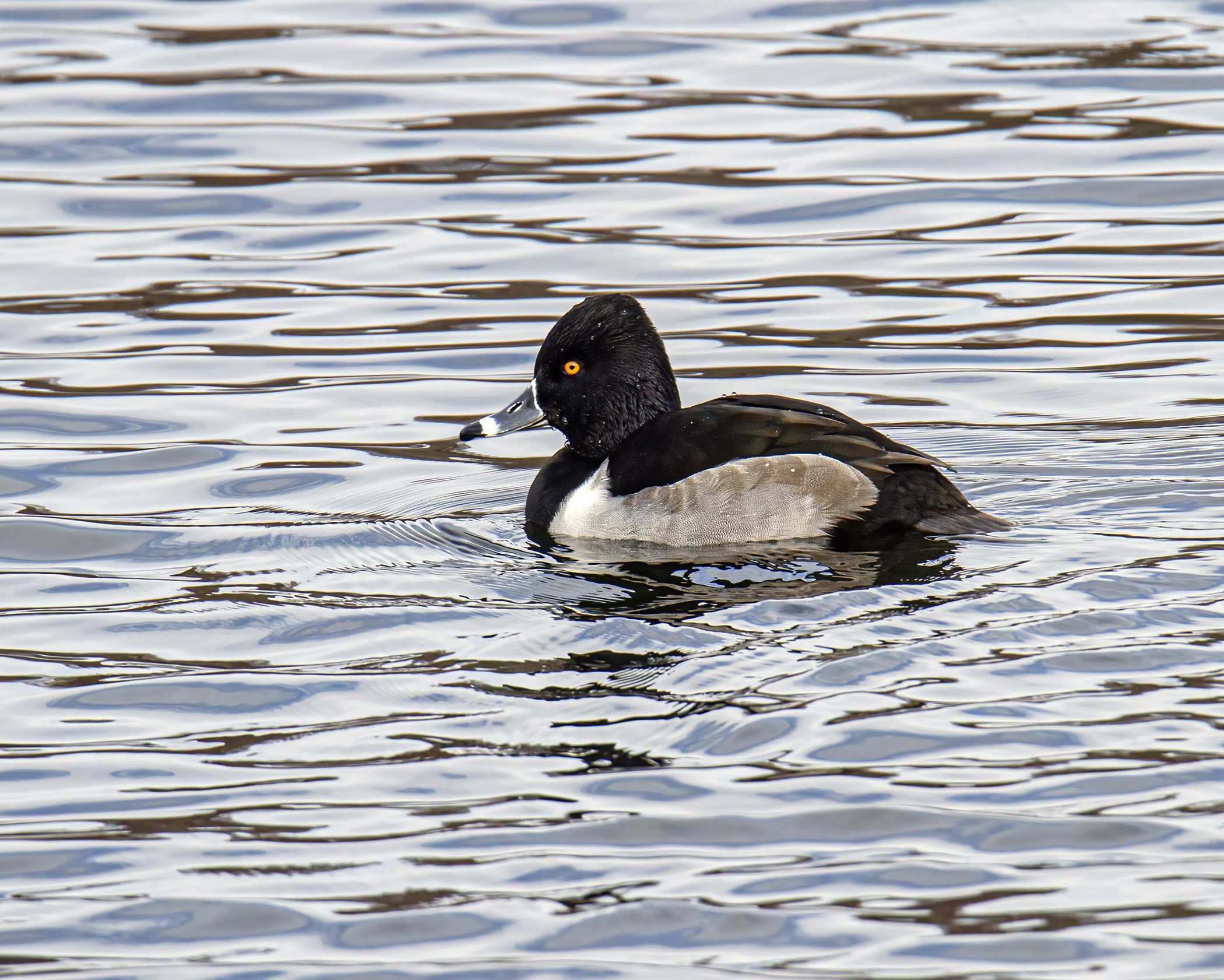
The blue and gray colors of this male Ring-necked duck (Aythya collaris) seemed to be a perfect match for the cool tones of the icy waters of the suburban pond where I spotted him earlier this week. All of those cool colors also really make the warm yellow of his eyes stand out.

Ring-necked duck

© Michael Q. Powell. All rights reserved.

Read Full Post »