Feeds:
Posts
Comments

Posts Tagged ‘female big bluet’

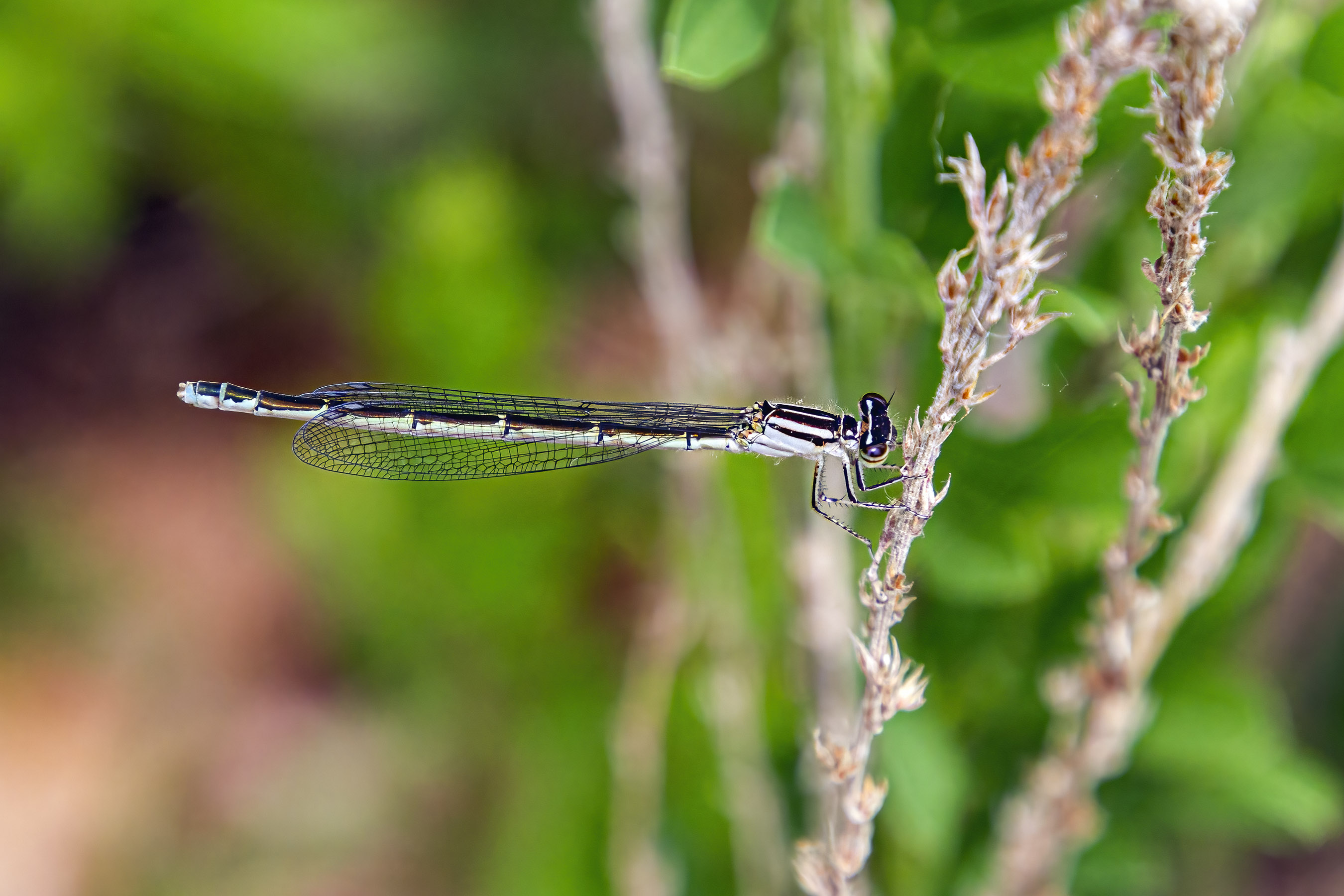
During a visit on Monday to Occoquan Bay National Wildlife Refuge, I noted that many of the summer dragonfly and damselflies are starting to appear. I was particularly delighted to spot several Big Bluet damselflies (Enallagma durum). As their name suggests, Big Bluets are relatively large damselflies, with an overall length of about 1.7 inches (43 mm).

Big Bluets tend to active and a bit skittish, so it’s a bit tough to get a decent shot of one, especially when I am shooting with a zoom lens. The auto-focus of my Tamron 18-400mm zoom often has trouble focusing on a damselfly, because their bodies are so thin and they clasp their wings together over their bodies. Consequently, I frequently end up focusing manually and it is an advantage with this lens that the minimum focusing distance is 17.7 inches (45 cm), so I can get pretty close to my subject.

I was delighted to be able to capture this beautiful image of a female Big Bluet. My focusing was spot on and the background blurred out nicely. If you look closely, you may notice that the depth of field, i.e. what was in focus, was so shallow that much of the stalk of vegetation on which the damselfly was perched was out of focus. In case you are curious, I tried to position myself so that I was on a parallel plane with the damselfly’s body to get as much of it in sharp focus as possible.

One interesting factual tidbits about Female Big Bluets is that, like several other damselfly species, they come in two different color variants. This one is the blue form and there is also an olive form. What that means is that I cannot rely exclusively on the color of the damselfly to determine its species and must also look at other features like the shapes of the eyespots and markings on the terminal appendages.
Big Bluet

© Michael Q. Powell. All rights reserved.

Read Full Post »

Last week I spotted this female Big Bluet damselfly (Enallagma durum) at Occoquan Bay National Wildlife Refuge, one of the few damselflies still around this late in the season. Big Bluets are primarily a coastal species in our area, which helped me to narrow down the possibilities when trying to identify the damselfly species. Generally female damselflies are tougher to identify than males, but I pretty confident that this one is a Big Bluet.

UPDATE: A sharp-eyed viewer pointed out to me that this is probably an immature male Big Bluet, not a female, based on a number of specific physical features. I think he’s right! It is not the first time that I have misidentified a damselfly and it almost certainly will not be the last time.

I love the way that the light green in the background matches the color of the damselfly’s body and makes for a really pleasing image.

Big Bluet

© Michael Q. Powell. All rights reserved.


Read Full Post »

I will often shoot the same subjects over and over again. Each photo opportunity offers the possibility of a difference setting, a different pose, and different lighting conditions. I guess that is why I like the excitement and unpredictability of nature photography versus the more controlled environment of studio photography.

Last week I captured this image of a female Big Bluet damselfly (Enallagma durum) at Occoquan Bay National Wildlife Refuge. The single leaf on which the damselfly is perched makes for a simple composition that helps the subject to stand out, which is really important when the subject is so small. The sunlight helped to create a cool elongated shadow on the leaf that add additional visual interest to the shot. The minimal color palette works well too, I think.

Sometimes it is nice to have a little extra drama in our lives, even if it is only a dramatic damselfly.


Big Bluet

© Michael Q. Powell. All rights reserved.

Read Full Post »

With a name that includes the word “bluet,” you might expect that this female Big Bluet damselfly (Enallagma durum) would be blue, but obviously that is not the case here. There is a blue female variant in this species, but this one appears to be the olive variant.  Damselfly identification is difficult under the best of circumstances, because so many of them share the same colors—only the patterns help you distinguish among them. In this case, size helps a bit too, because Big Bluets are in fact larger than many other damselflies.

As I was exploring Occoquan Bay National Wildlife Refuge a few days, I was fortunate that this damselfly chose to perch at almost eye level on a stalk of Eastern Gamagrass, which let me get a clear shot with the sky in the background.  Most of the time damselflies like this perch lower to the ground in areas with denser vegetation.

Big Bluet

© Michael Q. Powell. All rights reserved.


Read Full Post »