Feeds:
Posts
Comments

Posts Tagged ‘eagle takeoff’

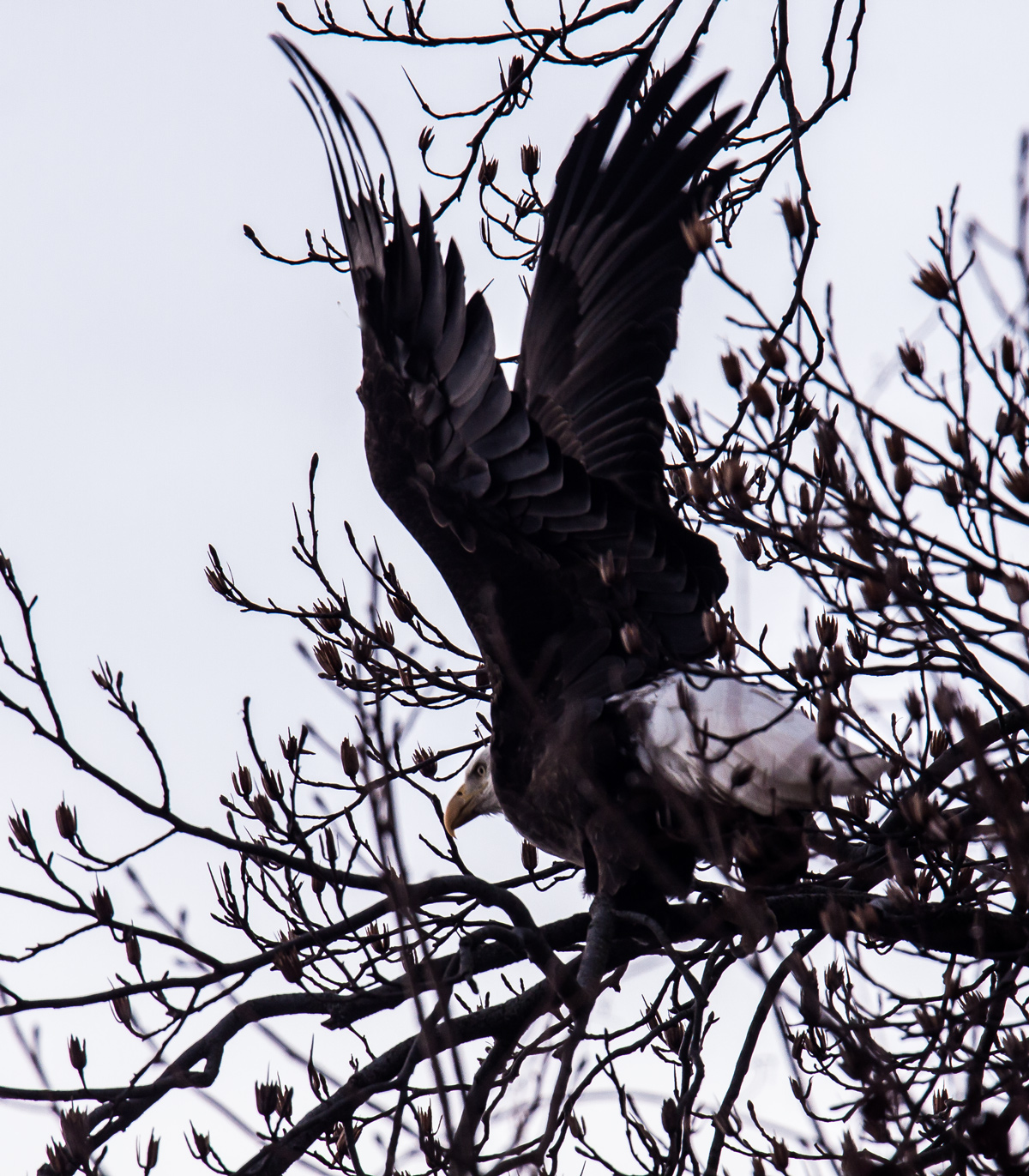
It is almost nesting time for the Bald Eagles (Haliaeetus leucocephalus) at Occoquan Bay National Wildlife Refuge. Last Friday I spotted two eagles perched in the trees adjacent to the very large nest that has hosted numerous eagle couples over the years.

Later that same day I passed by the nest again and an eagle was sitting in the nest. I captured the second image when the eagle unexpectedly took off from the nest. I like the way that I captured the action,although I would have preferred not to have clipped the eagle’s wing as it extended it upwards to generate lift for its takeoff.

Bald Eagle

bald eagle

© Michael Q. Powell. All rights reserved.

Read Full Post »

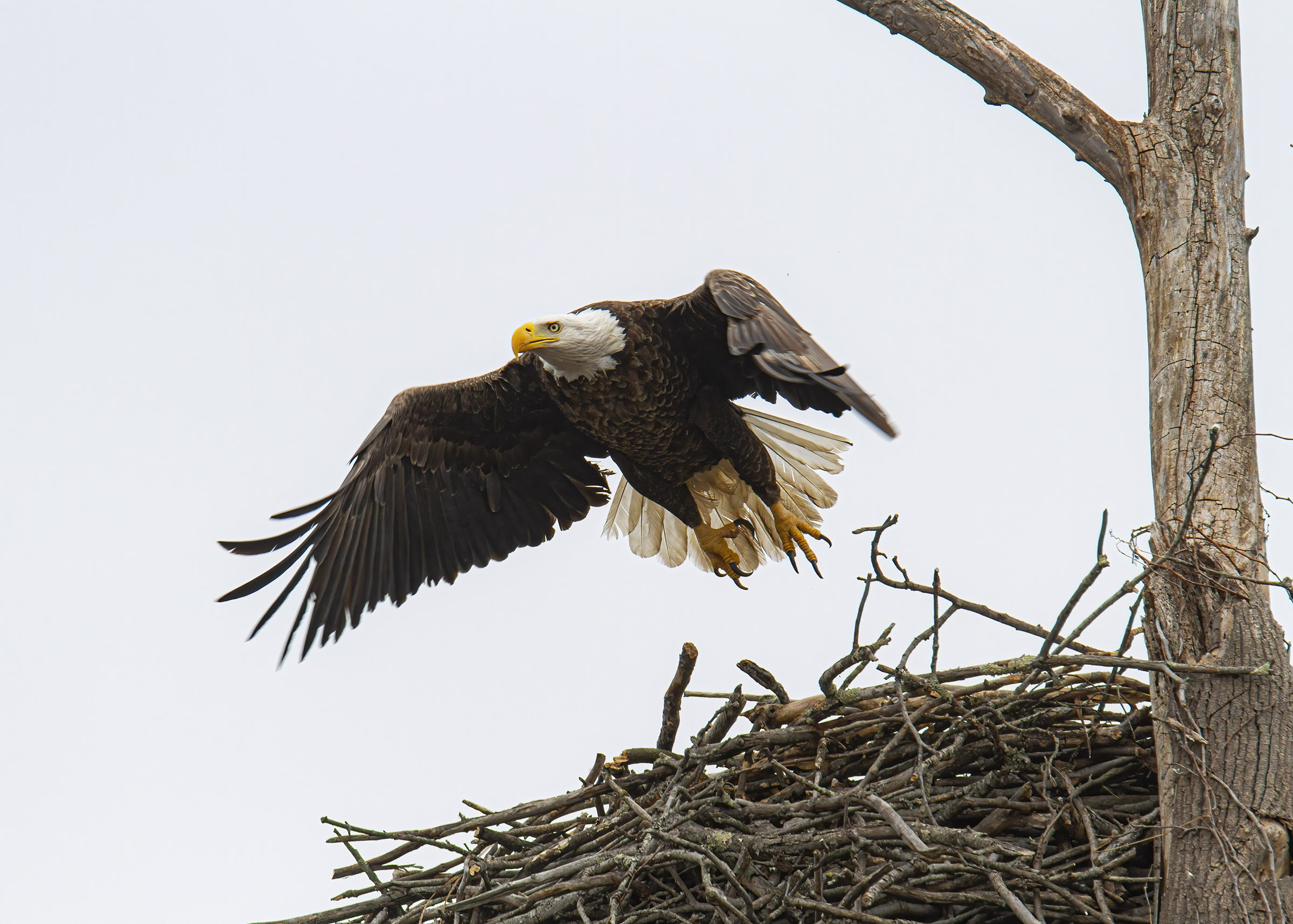
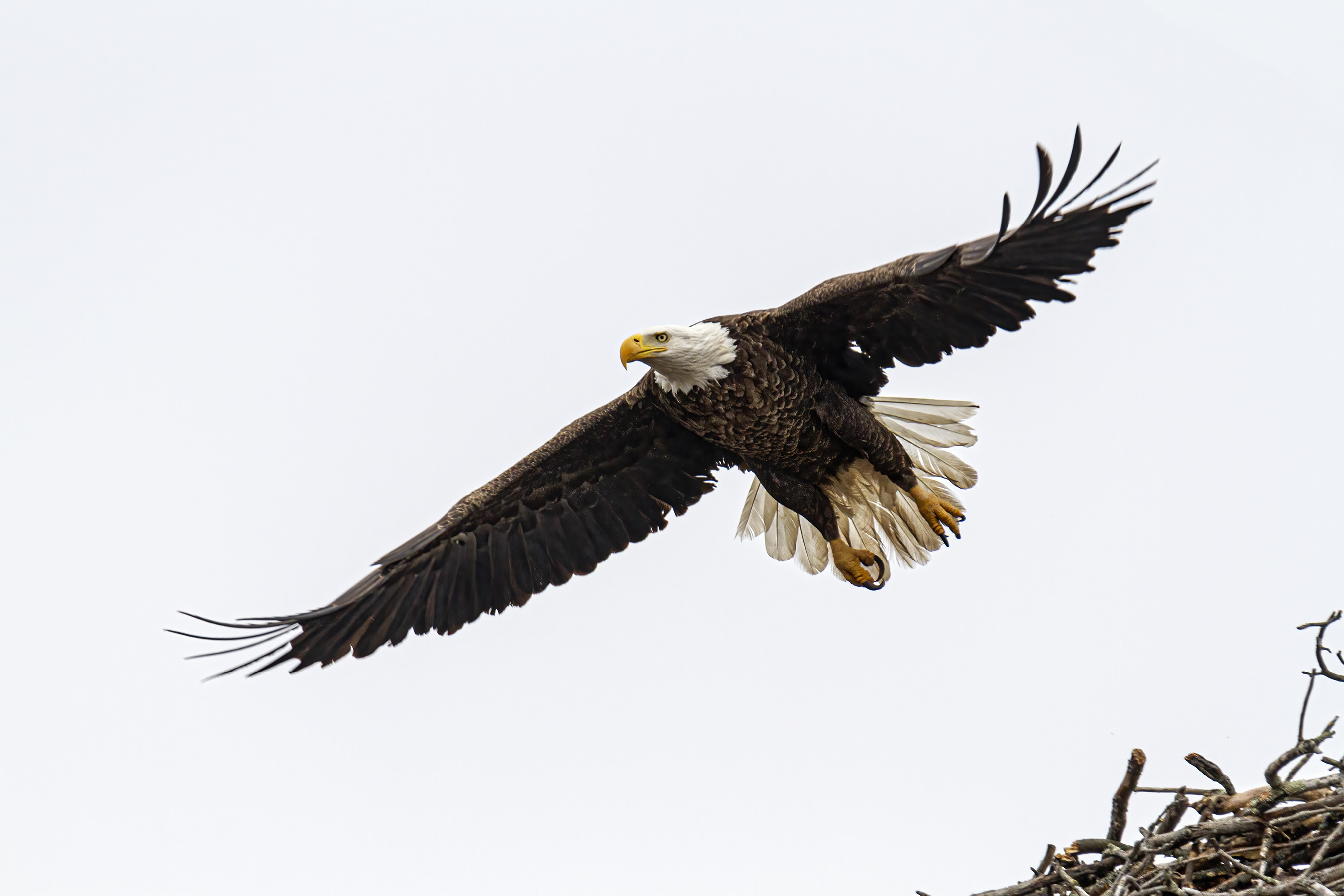
The sky was almost completely overcast last Thursday morning at Occoquan Bay National Wildlife Refuge and looked almost white in my photos, making some of my shots look like they were taken in a studio. Still, the uncluttered backdrop helps to draw the viewers attention to these cool images of a Bald Eagle (Haliaeetus leucocephalus) as it took off from the very large eagle nest at the refuge. The final photo, taken with my iPhone a few days earlier, gives you an idea of the setting in which the nest is located—the photos make it look like I was a lot closer to the nest than I actually was.

I spotted eagles perched on or in three separate nests that day, a clear sign that nesting season is almost here. The fact that the eagles did not remain continuously in the nest suggests to me that they are not yet sitting on eggs. I will continue to monitor the nests and with a little luck I may be able to see some eaglets in the upcoming months.

Bald Eagle

Bald Eagle

eagle nest

© Michael Q. Powell. All rights reserved.

Read Full Post »

Whenever I am walking on the trails at Occoquan Bay National Wildlife Refuge, I am always on the lookout for Bald Eagles (Haliaeetus leucocephalus). At this time of the year especially I keep my eyes for signs of new eagle nests. At the moment, I am aware of three nesting sites on the refuge, although I am not sure if all three are being used this year.

On Monday I spotted the bright white head of a mature Bald Eagle in a distant tree. As I trained my long telephoto lens on the eagle, I noticed that it was perched just above what looked to be a nest. I moved a bit further down the trail to get a somewhat less obstructed view of the nest and looked carefully to see if I could spot an eagle sitting in the nest.

Although I was standing quite still and was partially hidden from view by heavy vegetation, the eagle seemed to sense my presence and took off. I was happy to be able to capture a couple of shots of the eagle as it was flying away.

This may be another new nesting site or it may be a view of one of the newest nest from a different angle than I usually see it. Several roads at the refuge are not closed to protect the nesting eagles, so there is really only one nest that I can monitor closely—the very large nest that I have repeatedly featured in blog postings.

Bald Eagle

Bald Eagle

Bald Eagle

© Michael Q. Powell. All rights reserved.

Read Full Post »

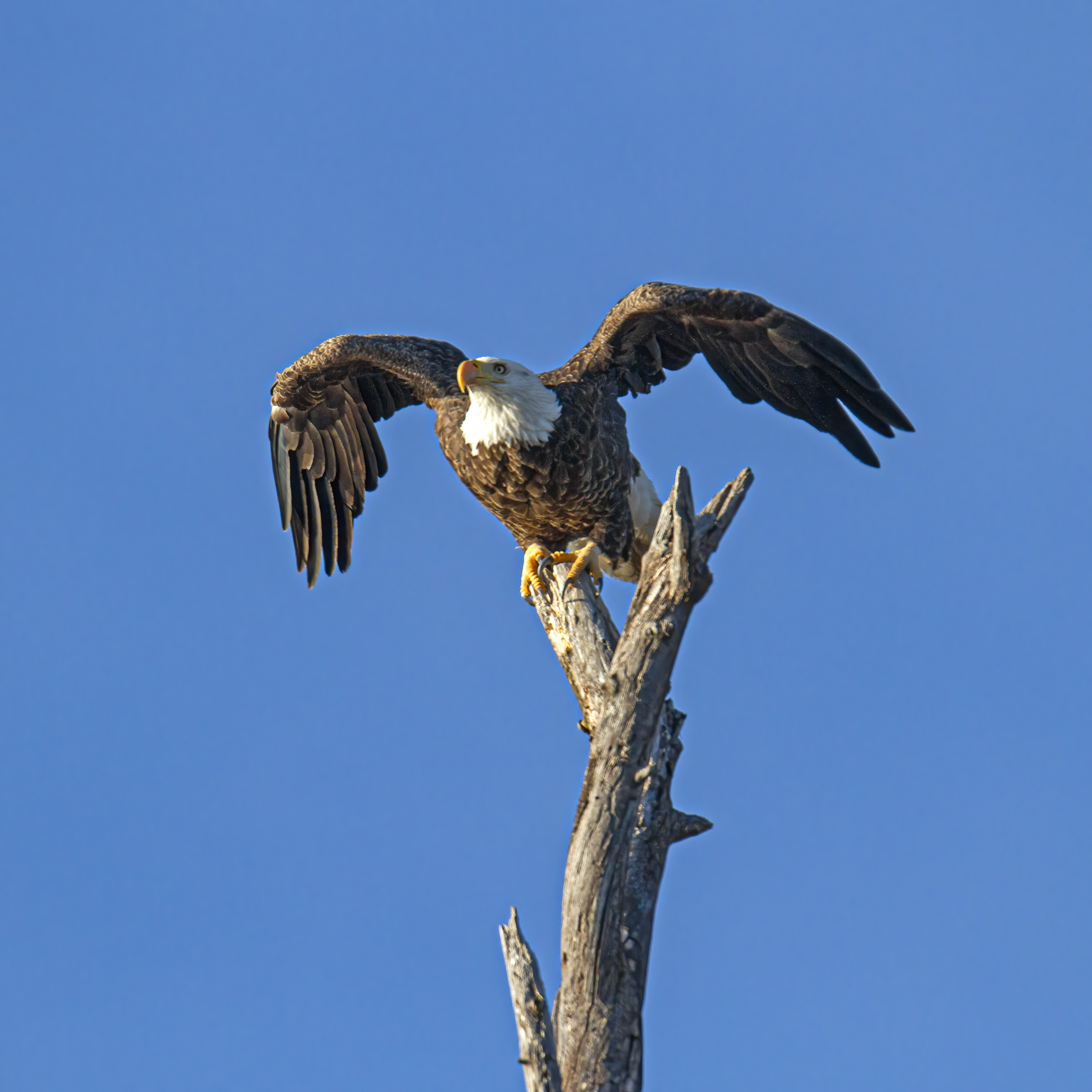
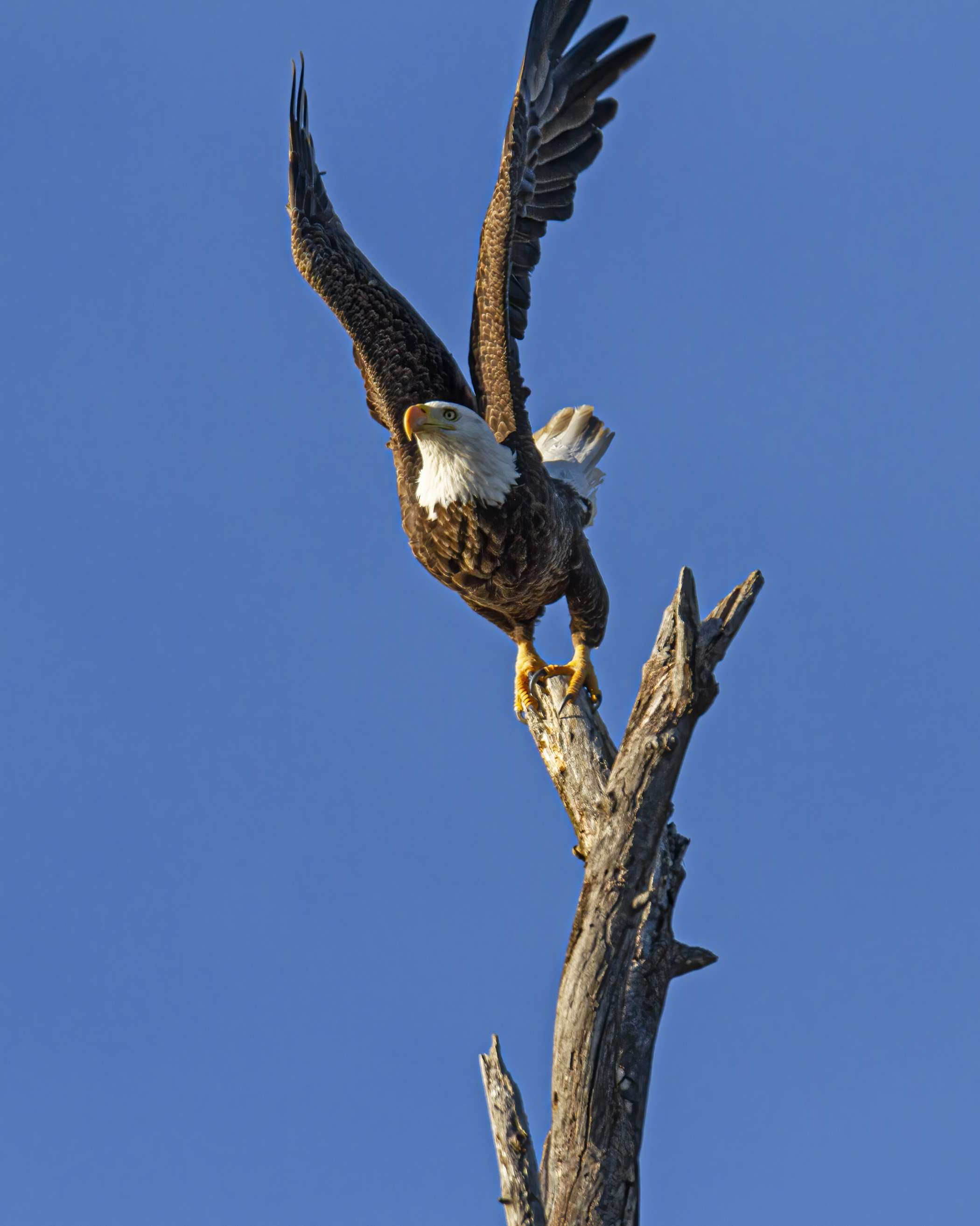
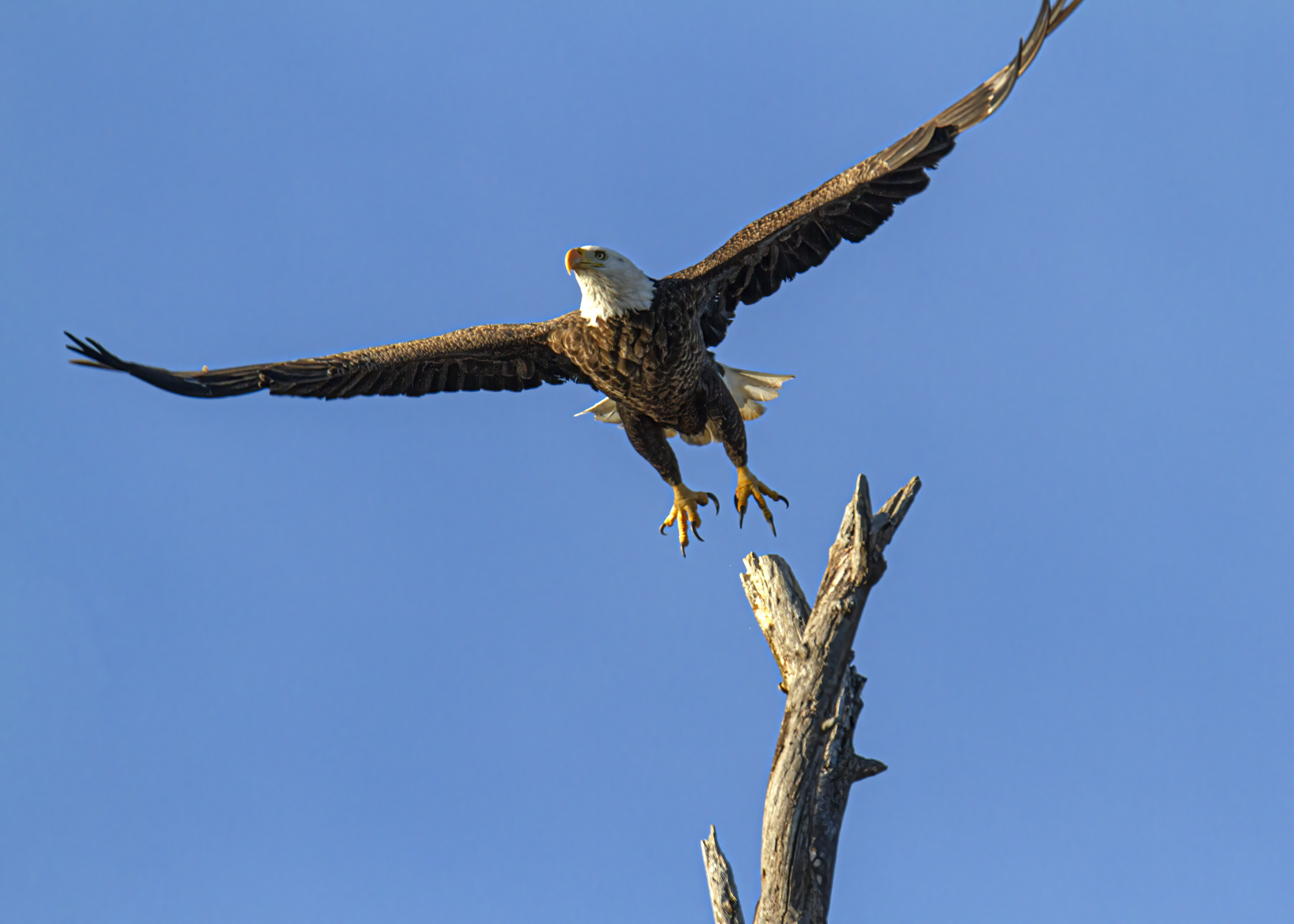
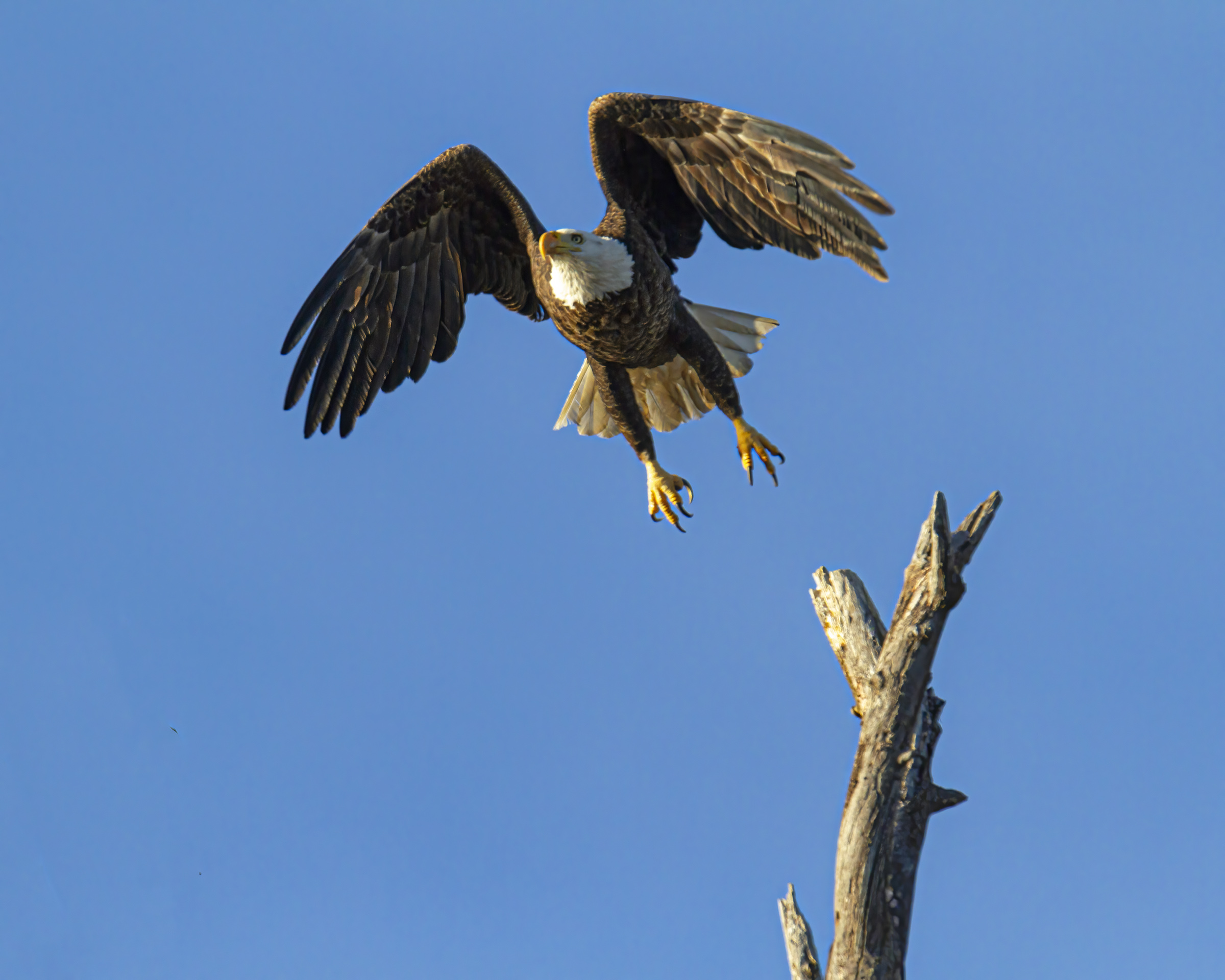
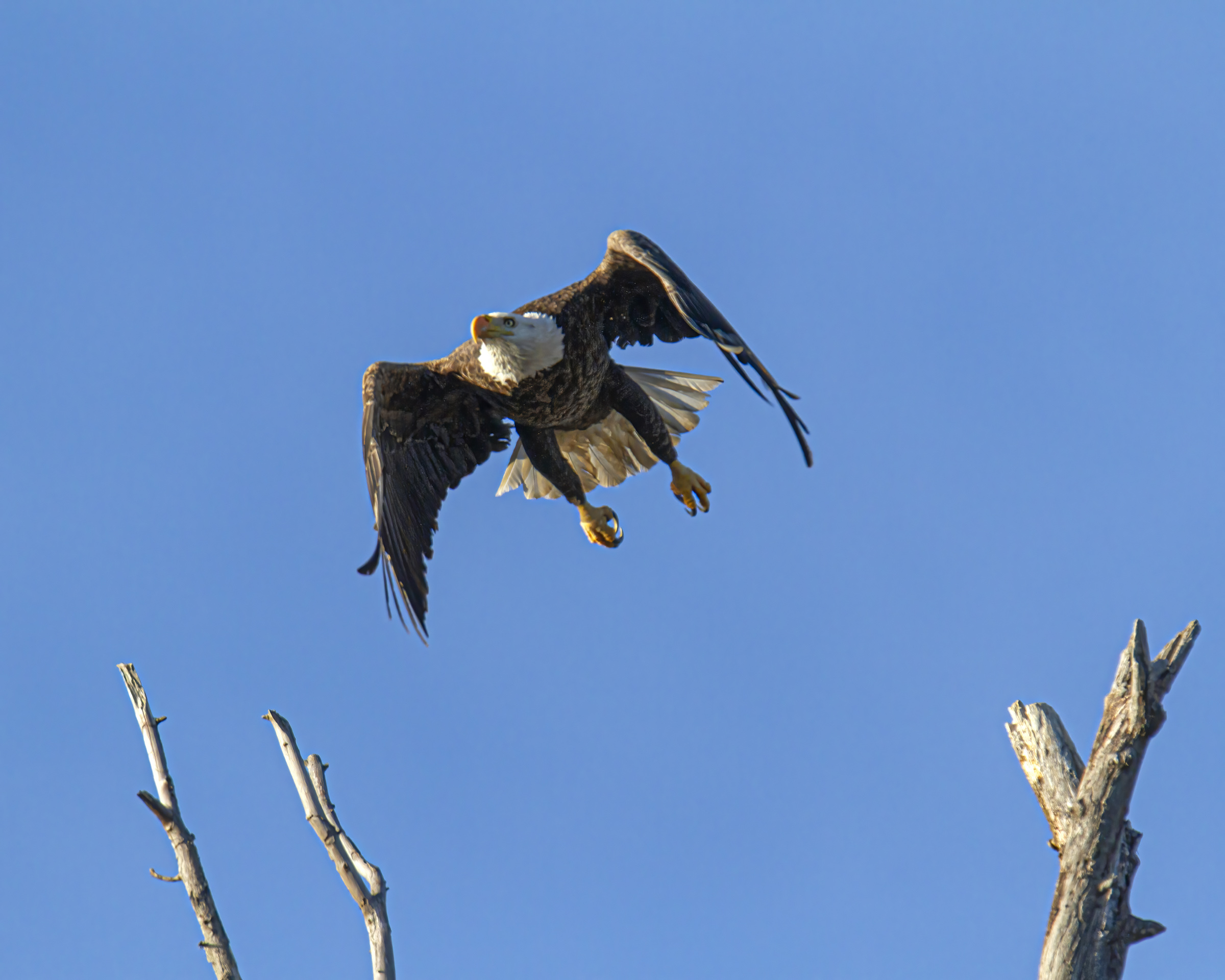
This Bald Eagle (Haliaeetus leucocephalus) was perched just above the large nest last Tuesday at Occoquan Bay National Wildlife Refuge. I was ready when the eagle started to extend its wings, as you can see in the first photo, and managed to capture a series of shots during its takeoff. The images show a variety of the wing positions used by the eagle to lift off and fly forward.

The wings of the eagle were so long that when it extended them upwards, the tips were out of the frame—note that the eagle’s feet were still on the perch in the second photo. When the eagle extended its wings fully to the side and moved upwards into the air, I once again was not quick enough to zoom out and clipped the tips of one wing in the third shot. The final two photos show some additional positions of the wings as the eagle continued to move away from its perch.

The day when I captured these images was an unusually fruitful one for me. I had multiple encounters with eagles and came away with some pretty good shots. As most wildlife photographers are well aware, those kind of day are quite rare, so I was happy to take advantage of my good fortune when the opportunities arose.


Bald Eagle

Bald Eagle

Bald Eagle

Bald Eagle

Bald Eagle

© Michael Q. Powell. All rights reserved.

Read Full Post »

I initially hesitated to post another sequence of shots of a Bald Eagle (Haliaeetus leucocephalus) takeoff, given that I posted a similar set of photos in yesterday’s blog posting. However, I never tire of seeing eagles and I hope that you agree with me. Unlike yesterday’s eagle that flew downward and away from me, the eagle in these shots had a more level flight path and I was able to capture a couple of images as it zoomed past me.

Eagles are a tough subject to photograph because of the extreme contrast between the white feathers on their heads and the dark feathers on their bodies. If the exposure is too far off from what it should be, it is easy to blow out the highlights on the head or to have super deep shadows on the body, both of which lead to a loss of details. When I took these shots, the light was pretty bright, creating shadows that further complicated my efforts.

None of these images is quite as sharp as I would like them to have been, but I am pretty happy with the overall results. Eagles are special and I consider any day when I spot one to be a good day. Capturing shots of one is a bonus.

Bald Eagle

Bald Eagle

Bald Eagle

© Michael Q. Powell. All rights reserved.

Read Full Post »

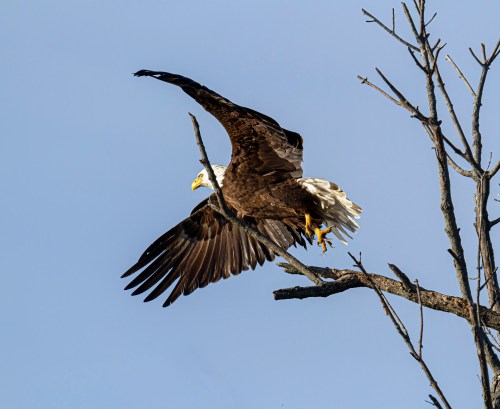
Whenever I am observing a perched Bald Eagle (Haliaeetus leucocephalus), I look for signs that it is preparing to take off. Sometimes there are little clues, like a flex of the wings or a slight movement of the feet, but quite often there is no warning. Usually I have my camera on a monopod, so my arms do not get fatigued as I try to stay ready and focused.

When the eagle actually takes to the air I have to track the movement and anticipate the direction in which the eagle will fly so that I can keep my subject within the frame. In the second image, for example, the eagle could have flown up into the air, but instead, as you can see in the third image, the eagle flew downwards. I was a little slow in following the bird and in the next frame, which I did not post, only half of the eagle was visible.

During a typical visit to the wildlife refuge, I am fortunate if I have one or two encounters of this sort, so I feel a little pressure to take advantage of each opportunity. There are so many variables over which I have no control that success is far from being guaranteed. No matter how good my shots may be, I am always convinced that I can get better ones, which helps to motivate me to go out again and again with my camera.

Technology is always advancing and some of the newer cameras have amazing capabilities to track moving subjects and stay focused on their eyes. Recently I watched a video on YouTube entitled “What is the SKILL and TALENT of a Wildlife Photographer” in which Scott Keys, a wildlife photographer, discussed the relative importance of personality traits, skill, talent, and gear in getting good photos. I highly recommend that you watch this video if you have ever thought about this issue.

Scott and I both agree that the most important of these four is the personality—you need to be patient and persistent, observant and aware in order to maximize the number of opportunities to get “the shot.” Knowledge and practice, which is how I would define skill, would be next in priority order for me. Gear would be in third or even fourth place and talent, i.e. God-given ability, occupying the remaining slot.

 

Bald Eagle

Bald Eagle

Bald Eagle

© Michael Q. Powell. All rights reserved.

Read Full Post »

Quite often I will spot a perched Bald Eagle (Haliaeetus leucocephalus) perched in the distance when I am on certain trails at Occoquan Bay National Wildlife Refuge. The trail runs parallel to the waters of the bay and eagles like to perch in the high trees overlooking the water. My challenge is to get close enough to the eagle to get a decent shot without spooking the eagle.

Normally I will creep forward slowly, stopping periodically to get a shot. As I am moving forward, I am very conscious of the fact that the eagle may take off at any moment, but it is not easy to predict the direction of the takeoff. Sometimes eagles will fly upwards when they take off and other times they will drop from the branches like a rock. I feel a bit like a goalie in soccer match when an opposing player is taking a penalty shot as I look for clues that will allow me to predict the eagle’s timing and direction of its takeoff.

Last Thursday, I spotted an eagle perched at the top of a tree. As I approached the eagle, it grew larger in my camera’s viewfinder, though it still filled only a relatively small part of it. Suddenly the eagle took off. As it flapped its mighty wings, the eagle increased in size and rose into the air. As you can see, I clipped one of its wings when I captured the first image below. I had only a split second to react and I did ok, but there was definitely room for improvement.

Later in the day, I spotted another bald eagle high in a tree overhanging the trail. I had quite a bit of trouble getting a shot of it, because the sun was directly in my eyes. I tried to walk underneath the eagle to get the sun to my back, but the eagle spotted me and I snapped off the second shot below as it was taking off. Technically speaking it is not a very good shot, but I really like the way that I captured the underside of the eagle that was almost directly overhead and the light shining through the tail feathers is pretty cool.

When it comes to reaction time and eyesight, a bald eagle clearly has me beat, but that does not discourage me. Some of the time, the eagles are distracted or inattentive and I manage to capture action shots of them. I am blessed to live in an area with a good number of eagles and I never tire of photographing them.  Hopefully you enjoy seeing photos like these ones, especially if you don’t see eagles very often.

Bald Eagle

Bald Eagle

© Michael Q. Powell. All rights reserved.

Read Full Post »

It looks like Bald Eagles (Haliaeetus leucocephalus) follow a pre-flight checklist before takeoff. They stretch their wings, crouch down and lean forward, and then they fully extend their wings and push off with their legs.

I spotted this eagle on Monday at Occoquan Bay National Wildlife Refuge. I had been observing it for quite a while when suddenly it looked like it was going to take off. I am not sure exactly what the signs were, but I correctly anticipated its actions and was able to capture this sequence of shots.

Most of the time birds take off so quickly that we don’t know exactly how they did it—one second they are in a tree and the next second they are in the air. It was nice to be able to get a sense of the process that a bird goes through as it takes off. As I have seen with ducks, however, the process varies by species and is probably affected by factors such as the weight of the bird and the length of their wings.

Bald Eagle

Bald Eagle

Bald Eagle

© Michael Q. Powell. All rights reserved.

Read Full Post »