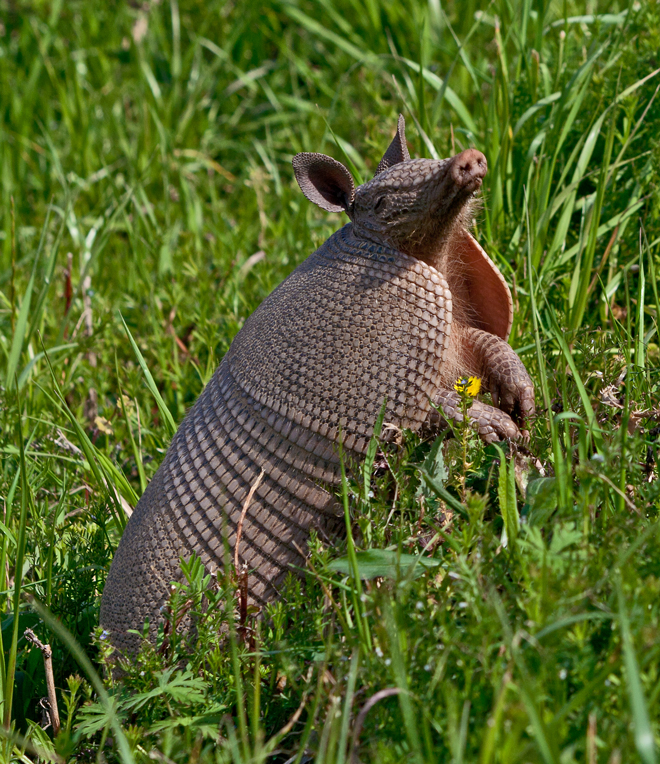
I am finally posting some more photos of the Nine-banded Armadillo (Dasypus novemcinctus) that I spotted a couple of weeks ago when visiting the Phinizy Swamp Nature Park in Augusta, GA.
Previously, I posted a photo of the armadillo standing on his hind legs, but I thought it would be interesting to post some additional shots of the armadillo in action.
I grew up in New England, so the armadillo qualifies as an exotic animal for me, although there are probably folks in Texas and elsewhere that view armadillos as pests. I am completely fascinated by the texture of his shell, particularly the tail, and tried to highlight it in the photos.
The armadillo spent most of its time rooting about in the grass and most often his head was not visible, which was a challenge for photos. Even when I moved relatively close, the armadillo seemed so focused on what he was doing (or so near-sighted), that he paid no attention to me.
I actually had two mini-encounters with him. The first time, he scurried pretty back to the swampy field from which he had emerged when he sensed my presence. I retreated from the immediate area and returned to find him in the same location. This time, after getting his fill of insects (or whatever else he was eating), he lumbered back to the swampy field.
So far, there are no armadillos in my neighborhood in Northern Virginia, but Wikipedia notes the armadillo’s rapid expansion northward, primarily because of the lack of natural predators within the United States, little desire on the part of Americans to hunt or eat the armadillo, and the animals’ high reproductive rate. Eventually, armadillos are predicted to reach as far north as Ohio, Pennsylvania, and New Jersey.
As I studied up a bit on armadillos, I learned that armadillos can contract (and pass on) leprosy (yikes!), so you won’t see me handling any armadillos. Additionally, Nine-banded Armadillos have an unusual reproductive system, in which four genetically identical offspring are born, the only mammals in which polyembryony is reliably manifested, according to Wikipedia. This trait makes them particularly suited for certain types of scientific and medical tests that need consistent biological and genetic makeup in the test subjects.


Michael Q. Powell. All rights reserved
 Mike Powell