Feeds:
Posts
Comments

Posts Tagged ‘Cygnus columbianus’

As I was observing two Tundra Swans (Cygnus columbianus) last Tuesday at Occoquan Bay National Wildlife Refuge, a loud boat passed by and scared the two swans. I managed to capture some action shots of one of the swans as it was taking off.

Some waterbirds can lift off directly from the water, while others need to run across the surface of the water to generate some momentum before they can take off. The tundra swan seems to be in the latter group. As you can see from the splashes in the water in some of the photos, the swan was bouncing along as it flapped its impressively large wings. In the final photo, the swan was in the air and was able to retract its feet into a more aerodynamic position.

Tundra Swan

Tundra Swan

Tundra Swan

Tundra Swan

© Michael Q. Powell. All rights reserved.

Read Full Post »

I usually try to zoom in on my subjects as much as I can, but it is also great to show their environment (sometimes by choice and sometimes out of necessity). I captured these long distance in-flight shots of a Tundra Swan (Cygnus columbianus) and a Bald Eagle (Haliaeetus leucocephalus) during recent visits to Occoquan Bay National Wildlife Refuge. The eagle was a bit closer to me than the swan, which is why the background was so much more blurry in the second shot than in the first one.

Tundra Swan

Bald Eagle

© Michael Q. Powell. All rights reserved.

Read Full Post »

I was thrilled yesterday to spot two Tundra Swans (Cygnus columbianus) a-swimming in the waters off of Occoquan Bay National Wildlife Refuge. The light brown coloration and the pink that is still visible on their bills suggest to me that these are juveniles—adult Tundra Swans have white feathers and black bills.

I have seen Tundra Swans only a few times in the past. I think that we are relatively close to the southern boundary of the area in which Tundra Swans overwinter. According to the Cornell Lab of Ornithology, “Tundra Swans breed on lakes, ponds and pools situated along river deltas in Alaska and Canada…wintering flocks gather on estuaries, lakes, bays, ponds and rivers, often situated close to agricultural fields where the birds feed.”

I do not know if there was a flock of swans nearby, but these two were the only ones that I saw. I was hoping to get better photos of the swans, but unfortunately they were scared away by a loud motor boat that ventured too close. It was a real challenge to get a shot of the two swans together as they swam in and out of the patches of bright sunlight at varying distances from each other. The second and third shots that show the two individuals were a bit easier to capture.

Tundra Swans

Tundra Swan

Tundra Swan

© Michael Q. Powell. All rights reserved.


Read Full Post »

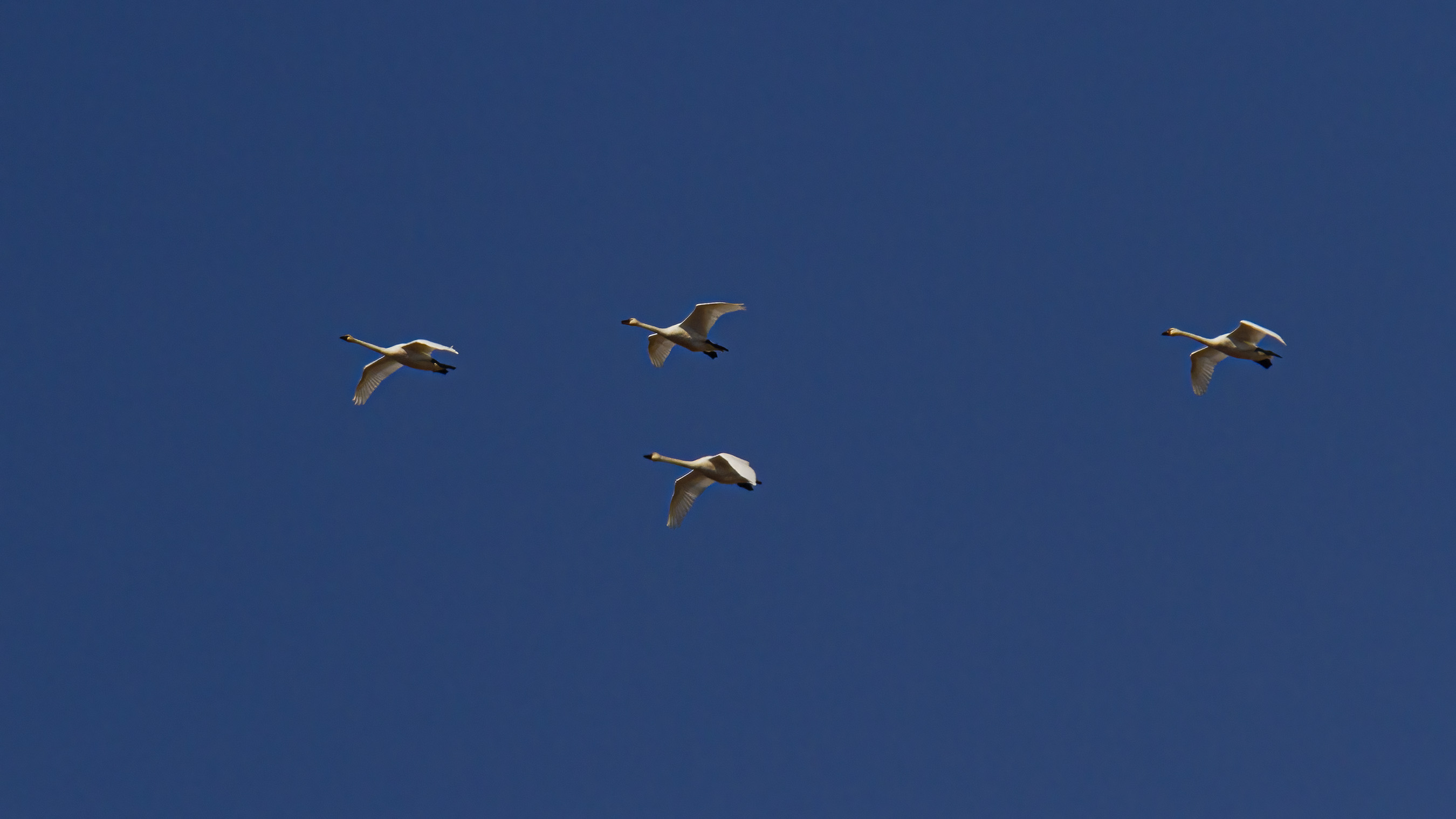
I was thrilled on Thursday when a small flock of Tundra Swans (Cygnus columbianus) flew overhead while I was at Occoquan Bay National Wildlife Refuge. It is rare for me to see swans of any kind in this area. When I spotted the formation approaching, I initially thought they were Canada Geese, but as they got closer I could tell that they looked different and sounded different.

Tundra Swan

© Michael Q. Powell. All rights reserved.

Read Full Post »

When I photographed a family of Tundra Swans (Cygnus columbianus) early in January at Occoquan Bay National Wildlife Refuge, I initially put off doing a post on them, thinking I would be likely to see more of them later and hopefully at a closer range. As time passed and I took more photos, I sort of forgot about the swans, even though it was my first time seeing this species.

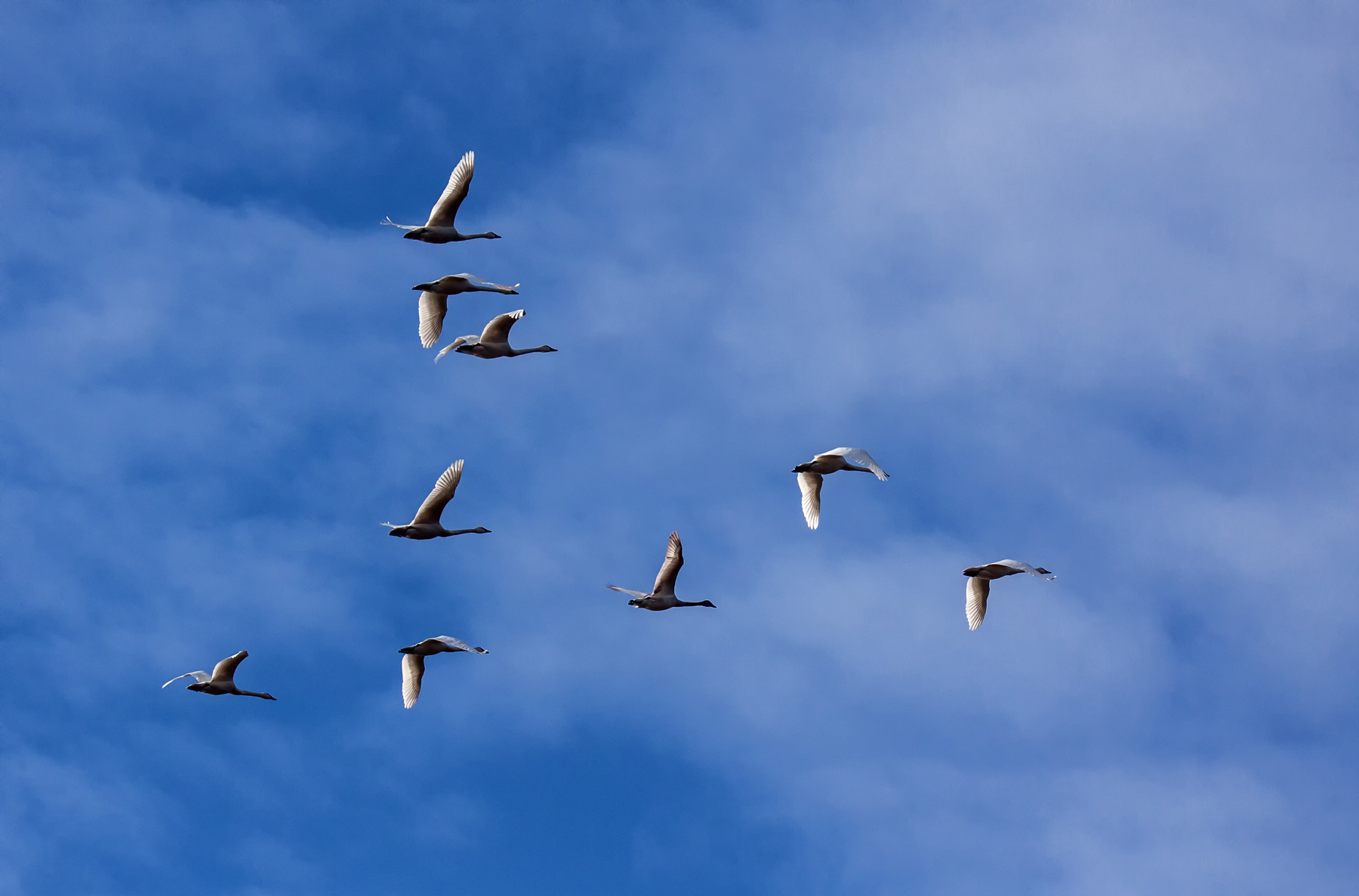
As it turns out, I did not see any other Tundra Swans in January, so I thought I would feature them today. I initially spotted the swans across a wide expanse of ice near a small island. From the differences in coloration, I judged that there were two adults and three juveniles. I was a long way away and don’t think that I spooked them, but suddenly they took to the air. I especially like my in-flight shots, with the cool-looking clouds, but I am also including a shot of the swans in the process of taking off.

I took a whole series of shots and as I reviewed them, I realized how tough it is to capture an image in which all of the birds are facing the right way and have their wings in a good position. Actually, that’s a problem with any group photo, so I can’t blame the birds too much.

Tundra Swans

Tundra Swans

Tundra Swans

© Michael Q. Powell. All rights reserved.

Read Full Post »