Feeds:
Posts
Comments

Posts Tagged ‘cuckoo bee’

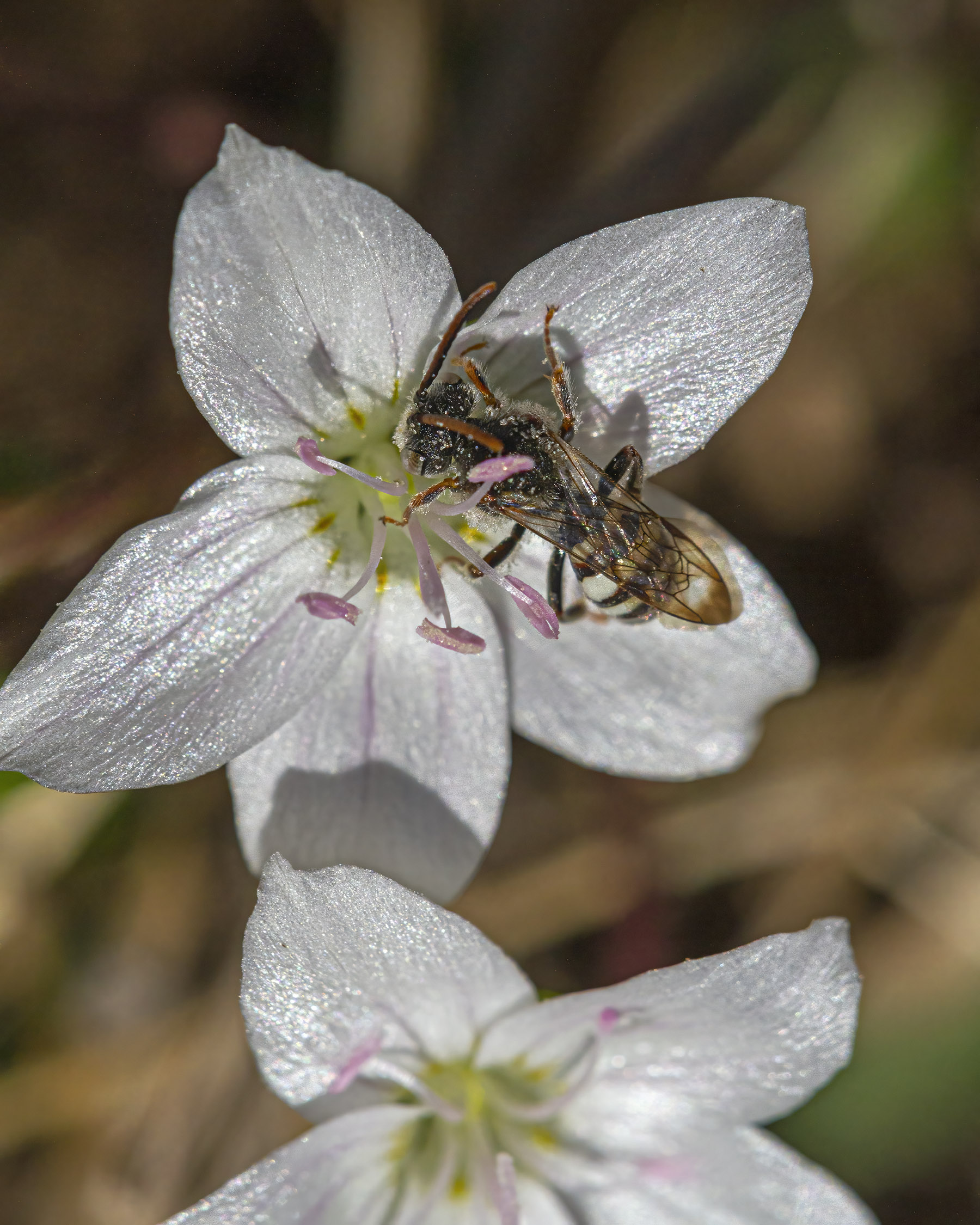
Early spring wildflowers, like the Virginia Spring Beauty (Claytonia virginica), are an important source of food for a host of small bees and other insects. Many insects gather pollen from these flowers and in doing so help to pollinate the plants.

Some species of bees, though, lack  scopa (the pollen-collecting hairs) and do not collect pollen to feed their offspring. The genus Nomada, according to Wikipedia, is the largest genus of kleptoparasitic bees sometimes referred to as “cuckoo bees.” Kleptoparasitic bees are so named because they enter the nests of a host and lay eggs there, stealing resources that the host has already collected.

It is a little hard to see the body of the bee in the photo below, but if you look closely you can see its striped abdomen, which is wasp-like in appearance. I was not sure of the type of bee, so I posted it to BugGuide, a useful resource for insect identification, and one of the experts there identified the bee as belonging to the genus Nomada.
cuckoo

© Michael Q. Powell. All rights reserved.

Read Full Post »

When I saw this insect sipping nectar from a Spring Beauty wildflower on Tuesday, I was sure that it was some kind of wasp or hornet. Bees, I thought, do not have such narrow waists. I was wrong. Some of the experts at bugguide.net identified my insect as a male Nomad Bee (genus Nomada).

Nomad Bees are the largest genus of kleptoparasitic “cuckoo bees,” according to Wikipedia. “Kleptoparasitic bees are so named because they enter the nests of a host and lay eggs there, stealing resources that the host has already collected.” Nomad bees do sip nectar like other bees, as you can see in my photos, but do not collect pollen to feed their offspring.

I remember being shocked the first time that I read about cuckoos and cowbirds deliberating laying their eggs in the nests of other birds to avoid having to build their own nests and raise their own babies. I guess I can add nomad bees to the list of deliberately delinquent parents.


nomad bee

nomad bee

© Michael Q. Powell. All rights reserved.

Read Full Post »