Feeds:
Posts
Comments

Posts Tagged ‘cricket frog’

Last Wednesday I went on a hike in Prince William Forest Park, a National Park Service site in nearby Triangle, Virginia. Unlike the coastal plains and marshes where I spent a lot of my time in nature, Prince William Forest Park, as its name suggests, is a forested area that is full of hills and valleys with numerous creeks.

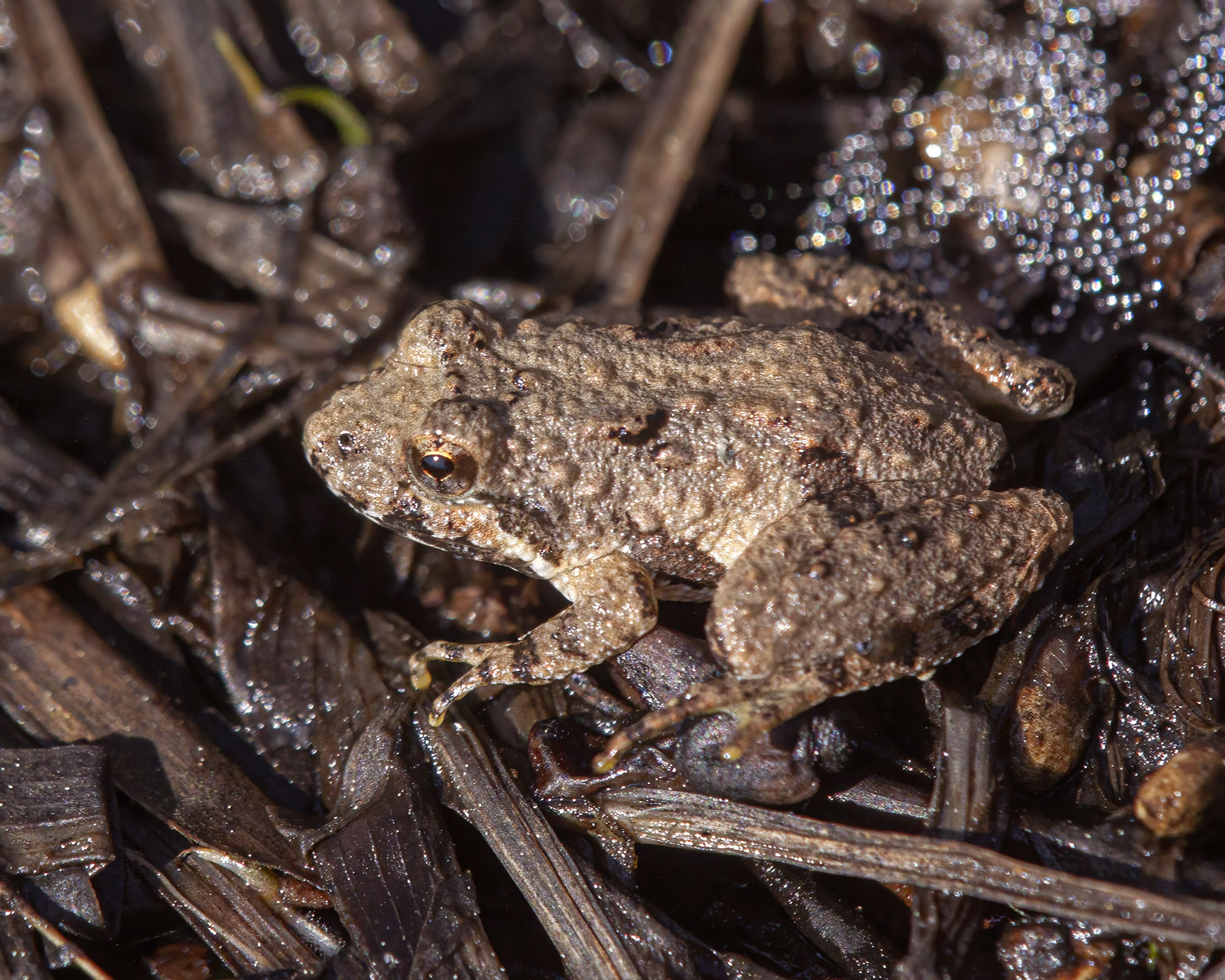
One of the highlights of my hike was seeing my first Eastern Cricket Frogs (Acris crepitans crepitans) of the season. Cricket frogs of the genus Acris are quite small (about one inch (25 mm) in length) and I often spot them at the edge of the creeks in the park. On this occasion I spotted the frog when it hopped right in front of me, though most often I hear the frogs before I see them. Cricket frogs have a distinctive call that sounds like two pebbles being clicked against each other—some scientist thought it sounded like a cricket, which accounts for the common name for the species .

Eastern Cricket Frog

© Michael Q. Powell. All rights reserved.

Read Full Post »

When it comes to camouflage, size does not always matter. Last Wednesday as I was exploring in Prince William County here in Virginia, both a large toad and a small frog were so well hidden that I did not see either of them until I almost literally stepped on them, which prompted them to move and reveal their presence.

I was really startled on Wednesday when a large toad suddenly leaped upwards right in front of me, exploding out of a covering of fallen leaves. I think that this is an Eastern American Toad (Anaxyrus americanus americanus), judging by its large size, but there is a chance that it is a Fowler’s Toad.

The tiny Eastern Cricket Frog (Acris crepitans) in the second photo blended in so well with the sandy edge of a stream that I initially did not see him until he moved a bit. The texture and color of his skin made him so hard to spot that when I focused on his eye in my camera’s viewfinder, I could not see the contours of the frog’s body.

toad

Cricket frog

© Michael Q. Powell. All rights reserved.

Read Full Post »

As I was walking along a creek on Monday at Prince William Forest Park, several tiny frogs unexpectedly jumped out of my way. I was able to visually track one of those frogs and saw where it landed. After a single leap, the frog froze in place and I was able to slowly maneuver myself into position to capture this image.

I am pretty sure that this is a Northern Cricket Frog (Acris crepitans). A bit later in the season, I will be able to hear the cricket frog’s distinctive call, which sounds to me like two marbles being clicked together, but the frogs that I encountered that day were silent.

According to the Virginia Department of Wildlife Resources, the Northern Cricket Frog is one of the smallest frogs in Virginia, ranging from .87 inches to 1.14 inches (22-29 mm) in length. Their typical life span is four to twelve months, though sometimes they can live as long as three years. Cricket frogs hatch from their eggs in 29-90 days between July and August and metamorphosize into adults in late summer. In early autumn, the frogs burrow into the soil to hibernate until spring comes.

I was quite pleased with the amount of detail that I was able to capture in this image, from the bumpy warts of the frog’s back to the stripes on its tiny toes. My Tamron 18-400mm lens is quite versatile and is capable of providing macro-like capability in certain circumstances. I encourage you to click on this image to get a better look at the tiny cricket frog.

Northern Cricket Frog

© Michael Q. Powell. All rights reserved.

Read Full Post »

Following the lead of fellow photographer Steve Gingold, I decided that today is a Frog Friday. I spotted these Eastern Cricket Frog (Acris crepitans), one of the smallest frogs in Virginia, on Monday as I was exploring in Prince William County. I really like frogs and was happy to capture some of the cool details of these frogs in these shots, like their tiny toes.

Be sure to check out Steve’s blog posting for today entitled Frog Friday—before and after. While you are there, I encourage you to poke about on his site—Steve has an amazing array of nature photos that he has taken, primarily in the western part of Massachusetts.

Cricket Frog

Cricket Frog

Cricket Frog

© Michael Q. Powell. All rights reserved.

Read Full Post »

It was sunny and warm on Monday, so I went off in search of dragonflies. There has already been at least one sighting of a dragonfly this month in Virginia, but it realistically is still a bit early for any to appear in the northern part of the state where I live. I searched diligently at a pond and at several small streams in Prince William County, but did not find any dragonflies or damselflies.

I was happy, however, to spot several Eastern Cricket Frogs (Acris crepitans crepitans). These frogs are tiny, with a length of about 5/8 to 1-3/8 inches (16-35 mm). One of the most distinctive things about this species is the male mating call that resembles the sound of two stones being hit together or perhaps is similar to the sound of a cricket.

According to the Virginia Herpetological Society, “This species prefers grassy margins of ponds, ditches and wetlands. Permanent bodies of water with emergent or shoreline vegetation and exposure to the sun are preferred habitat,” a perfect description of the locations where I spotted these frogs.

Each year I am confused when researching this species, because I see references to Eastern Cricket Frogs and Northern Cricket Frogs used almost interchangeably. If I understand it correctly Northern Cricket Frog (Acris crepitans) is the species name and Eastern Cricket Frog (Acris crepitans crepitans) is one of the subspecies.

As you can see from these images, cricket frogs blend in really well with their surroundings. If I had not seen these frogs jump to their new locations, I am pretty sure that I would not have seen them. I walked around all day with my 180mm macro lens attached to my camera and it served me well to capture some of the details on the bodies of the little frogs. I attempted to get as low as I could and to shoot from the side in order to get as much of the frog in focus as I could, so muddy knees were inevitably one of the “benefits” of getting these shots.

cricket frog

cricket frog

© Michael Q. Powell. All rights reserved.


Read Full Post »