Feeds:
Posts
Comments

Posts Tagged ‘cornell lab of ornithology’

This morning I went shooting at Cameron Run, a tributary stream of the Potomac River in Alexandria, VA. I frequently commute along a road that parallels this stream and have often seen large white wading birds as I drove by. Today I decided to investigate and see if I could get some photos and determine if they were herons or egrets or some other kind of bird.

I did manage to get some shots of the birds in the water and even in the trees, but learned how difficult it is to get a proper exposure with a pure white bird. I’m pretty confident that the birds are Great Egrets (Ardea alba), which are also known as Great White Egrets. A passerby with binoculars (who seemed to know what he was talking about) told me that the orange beak is one of the characteristics that distinguishes the egret from the heron. If you want to know more, there is lots of interesting information about the Great Egret in an article on the website of the Cornell Lab of Ornithology.

The Great Egret is a really impressive looking bird, so much so that it is the symbol of the National Audubon Society, according to Wikipedia.  The Cornell Lab article points out that Great Egrets were hunted nearly to extinction for their plumes in the late nineteenth century, sparking conservation movements and some of the first laws to protect birds.

I was struck by the fact that the Great Egret roosts in the trees and seems to enjoy doing so with other egrets. In one cluster of trees I saw three egrets that appeared to be grooming themselves—they definitely did not seem territorial. I was impressed too by the wingspan that I got to see when I startled one of them and he flew up to a nearby tree.

Now that I know what kind of birds these are and where they hang out, I’m sure I’ll be back to watch them and, hopefully, to photograph them.

Great Egret in a tree
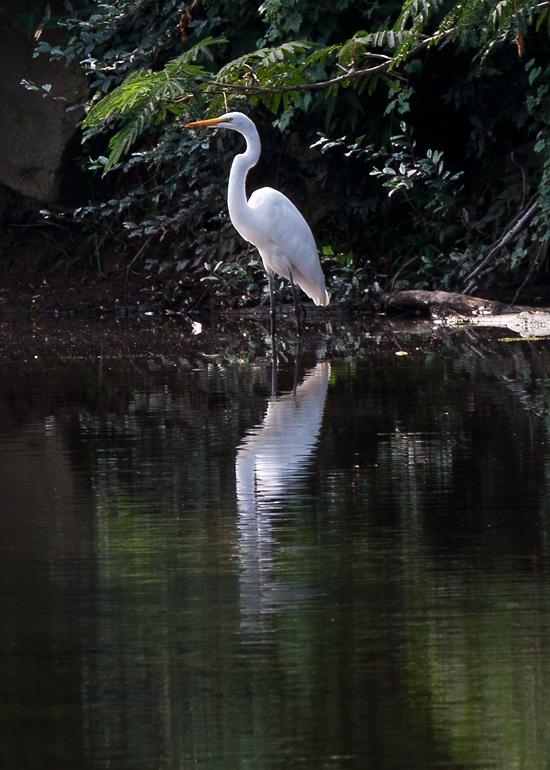
Great Egret in the shade

Great Egret fishing in the stream

Reflections of a Great Egret

© Michael Q. Powell. All rights reserved.

Read Full Post »

Stereotypes of a heron’s  appearance

This past weekend I visited a pond at a local garden and encountered this interesting bird. He looked a little like a heron but had a totally different body type—he was shorter and squatter than the herons I was used to seeing. I have photographed blue herons and white herons and have a mental picture of what a heron looks like. They are tall and slender and posses a fashion model’s elegance. Could this really be a heron?

Surveying the situation

Playing and posing like a child

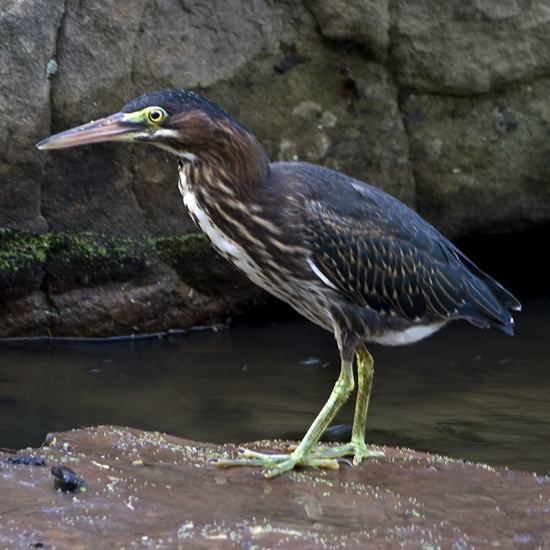
I was alone with the bird for quite some time for the gardens were deserted after a thunderstorm. The beautiful bird, later identified as a juvenile green heron, seemed to be unusually willing to remain as I attempted to photograph him. At times he even seemed to be posing for me. Like a child he was enjoying himself, running around and playing in the water. He definitely was not intent on adult-type tasks such as catching food.

Full body shot. Don’t I have great legs?

Is this enough of a smile for you?

It’s a green heron

I am pretty confident that this bird is a green heron (Butorides virescens). Wikipedia helped me determine that he is a juvenile because of the brown-and-white streaked feathers on his breast and the greenish-yellow webbed feet. (The adult green heron has a darker bill and a more pronounced  chestnut-colored neck and breast.) NatureWorks has some summary information if you want to quickly learn about green herons.

This grass feels really good on my bare feet.

A tool-using bird

My favorite website for information on the green heron, however, belongs to the Cornell Lab of Ornithology, which includes range maps and audio files. It also noted the following truly amazing fact about green herons, “The Green Heron is one of the few tool-using birds. It commonly drops bait onto the surface of the water and grabs the small fish that are attracted. It uses a variety of baits and lures, including crusts of bread, insects, earthworms, twigs, or feathers.”

Ready for my close-up

Maybe the green heron should have its own reality television show, “Fishing With a Green Heron-Choosing the Right Bait. You Don’t Even Need a Hook”

© Michael Q. Powell. All rights reserved.
Read Full Post »