I am finally nearing the end of my photos from my brief stay in Theodore Roosevelt National Park in North Dakota at the beginning of November. I captured quite a few images of wild horses, bison, and prairie dogs at the national park and it has been a real joy reviewing the photos on my computer and relive the memories after my return home. Normally I try to post images on my blog that are a week old or less, but I figure that you will forgive me for posting images that are three weeks old.
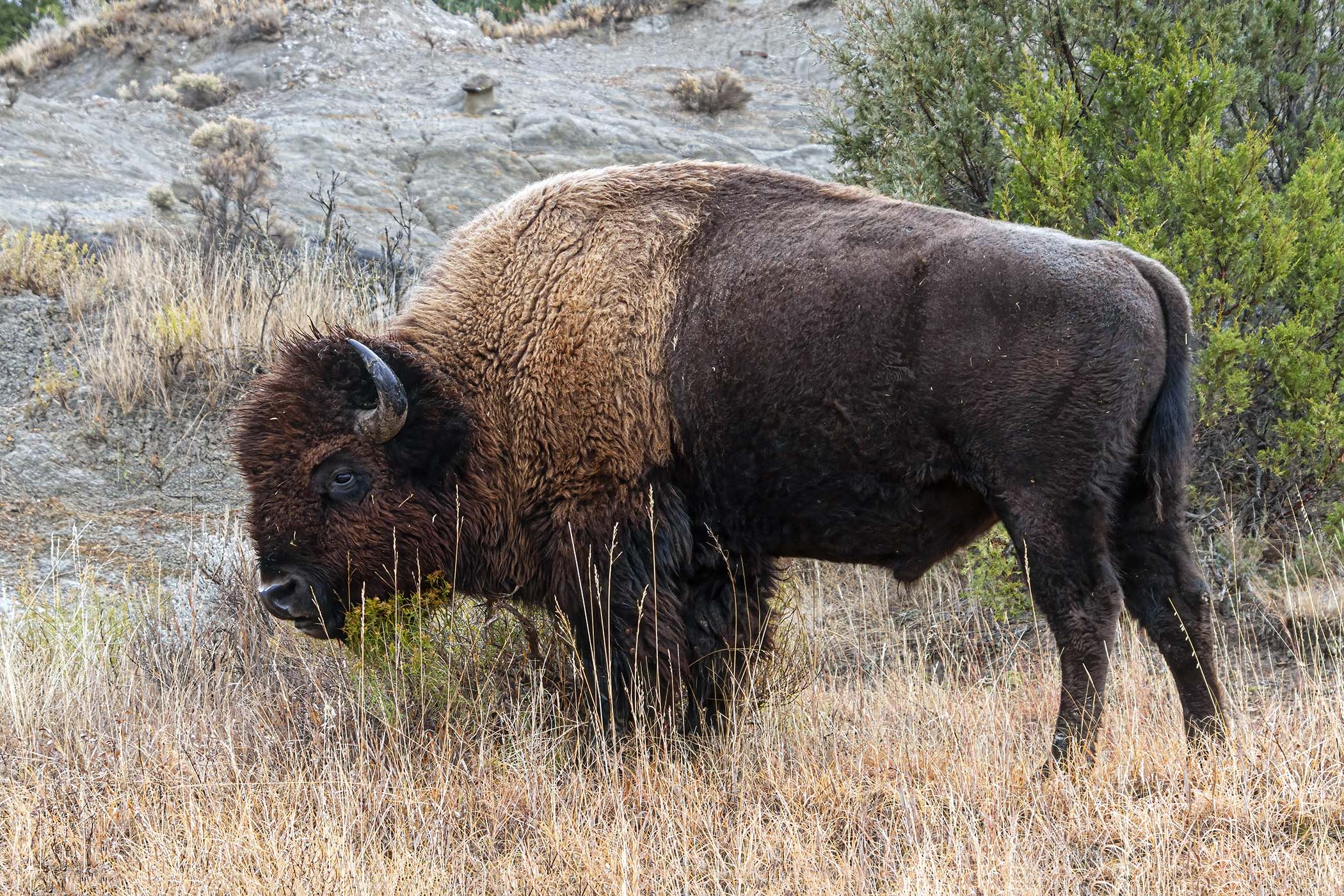
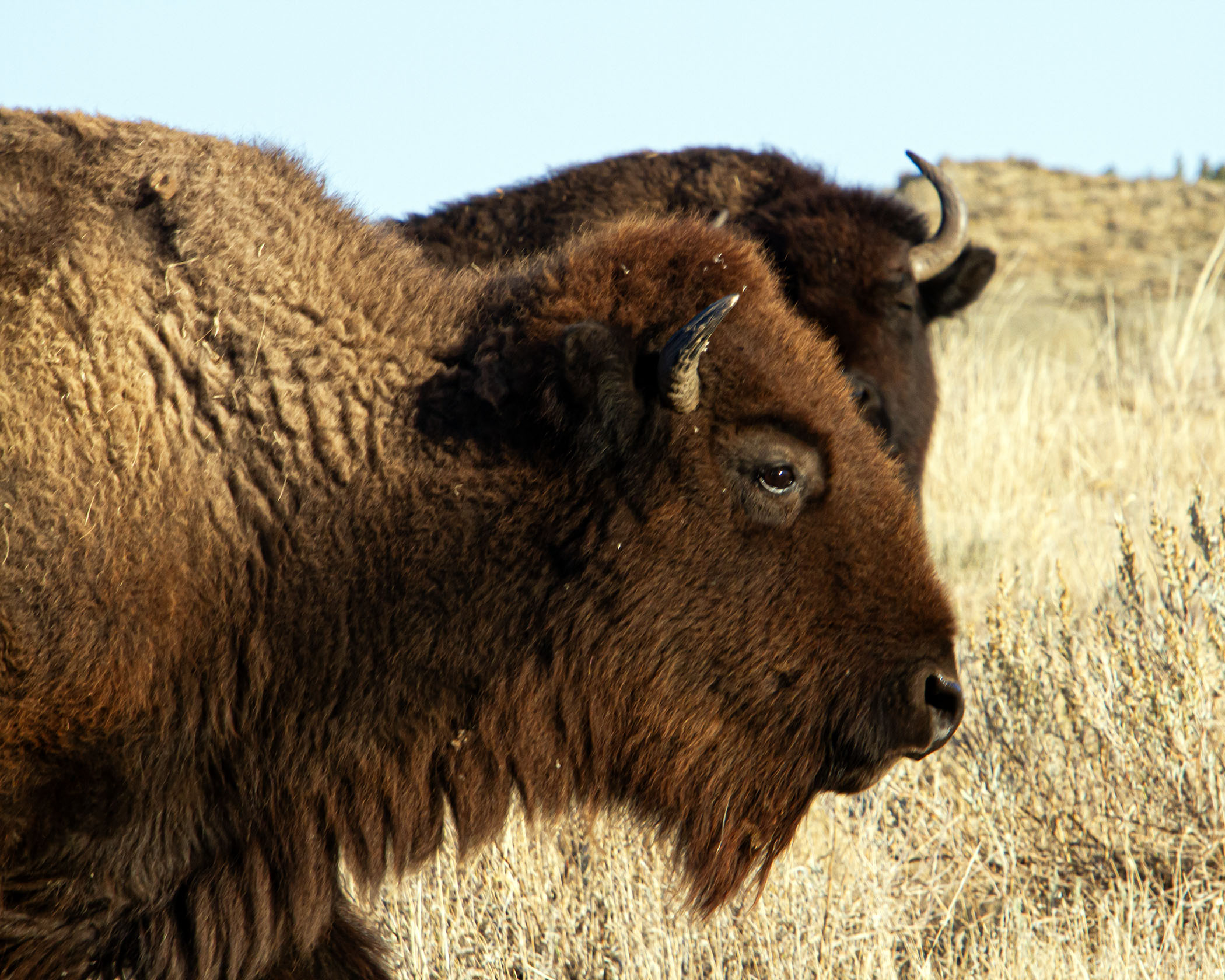
Here are a few selected images of American Bison (Bison bison) that I spotted at the park in early November. Most often the were simply grazing, so frequently I would try to capture some interesting background, as in the first photo below. I was quite excited to spot the young bison in the second photo. It was quite a bit smaller than the adults, but already seemed to be growing horns.
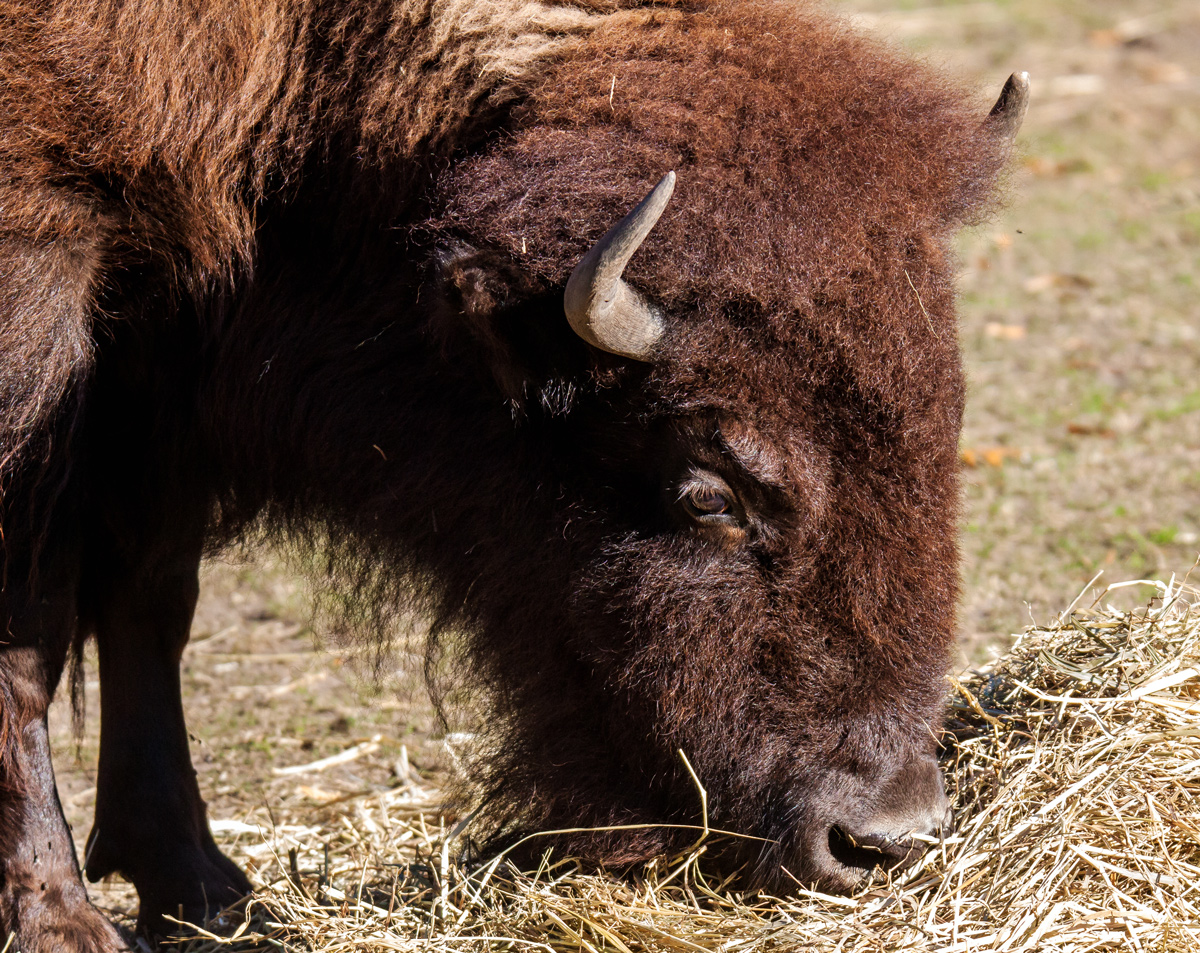
The bison in the final photo lifted its head momentarily, allowing me to capture this informal portrait. It may look like I was really close to the bison, but I was using a telephoto zoom lens on my camera and I am pretty sure that I took the shot from inside my car. However, the bison was close enough that I had to zoom out a little to 322mm (on an 18-400mm lens) to fit the bison’s enormous head in the frame.
It is always a challenge to shoot directly into the sun. You never quite know what kind of sun flares will make their way into you photo or how much your subject will become a silhouette. Still I can’t help but attempt to capture a photo whenever the opportunity presents itself.
My gamble paid off last week when I captured this cool image of an American Bison (Bison bison) last week at Theodore Roosevelt National Park in Medora, North Dakota. It was just after sunrise and the sun was still quite low on the horizon, creating a distorted, elongated shadow of the bison. You can see only a few details of this magnificent animal, but the shape of the profile of the bison makes it easy to identify the primary subject.
Luck plays often plays a significant role when it comes to wildlife photography, but I can’t help but think of the old adage, usually attributed to Wayne Gretzky, “You miss 100 % of the shots that you don’t take.” While I am not a fan of the “spray and pray” approach to photography, I do think it is worthwhile to take a shot whenever something catches your eye—sometimes you will be pleasantly surprised by the results.
One of the highlights of my recent visit to Theodore Roosevelt National Park in Medora, North Dakota was having the chance to see quite a few American Bison (Bison bison). Unlike during a previous visit there two years ago, the bison were not blocking the road, but some of them were alongside the edges of the road.
These mammoth creatures seemed to be almost as large as my KIA Soul, so I often stayed inside my car when taking photographs of them. I ventured outside of the relatively friendly confines of my little car only when the bison were a good distance away from me.
Until quite recently, I had never tried to create videos with my iPhone and still have not tried to do so with my DSLR camera. I guess that I am a little old-fashioned and think of a phone as primarily a device for making phone calls and a camera as a device for taking still photos. I am gradually changing to using my phone for texting and during my recently completed road trip, I played around with taking short videos with my iPhone. Maybe it is possible to teach an old dog new tricks.
The change was prompted in part by the fact that I had to radically change my shooting habits when visiting Theodore Roosevelt National Park in North Dakota. I camped out at the park for two nights when I was headed westward towards Seattle and another two nights on my return trip eastward to Virginia. At that park, I got used to seeing large creatures like American Bison (Bison bison) at close-range and photographing them from inside my car. Suddenly it dawned on me that videos would be an effective way of capturing some of that action. In addition to bison, I also had several encounters with wild horses that I was able to document in videos.
As you probably noticed, the first image is not a video—I inserted it so that an image would show up as a thumbnail in the “Reader” feed for those who view my postings in that way. The still photo shows a large bull moving down the recently repaved roads of the park. At that time they had not yet painted lines on the road, so I had to pay a lot of attention while driving, given that many of the roads were full of curves and and in some cases there were steep drop-offs. I do not think that the bison cared about the lack of lines—as far as I was concerned, they owned the roads and always had right-of-way.
The first video shows one of the huge male bisons that I encountered on the roads at the national park. I was safely inside of my car when I took this video, though I must confess that this bull bison looked to be almost as big as my KIA Soul and may have outweighed it.
The second and third videos show bands of wild horses that I encountered at separate locations in the park. I was particularly impressed by the beauty of these horses and it was cool to capture them in action.
I was not sure how to present videos here in WordPress, but I think it works to post them to YouTube first and then to embed a link to that posting here. In this way, the videos do not count against my data allowance on my WordPress plan.
I definitely need to improve on my skills as a videographer, but I am happy with these initial results. The sound quality is still a problem, because it was often windy and the video also includes some extraneous conversation. I may have to learn to do voiceovers for the videos or to add some music to them.
So what do you think? These little clips are definitely a change from my normal content, but I thought it would be a fun way to share some of my experiences more directly with all of you. As you probably noticed, the first image is not a video—I inserted it so that an image would show up as a thumbnail in the “Reader” feed for those who view my postings in that way.
As many of you know, I have spent the last week driving across the United States to spend some time with family outside of Seattle, Washington. I departed from Virginia at midday last Monday and by the time that I finally arrived on Saturday afternoon, I had traveled a distance of 3085 miles (4964 km).
I spent a lot of time driving, but made an extended stop at Theodore Roosevelt National Park in western North Dakota, where I camped out for two nights. During my visit, I had multiple encounters with American Bison (Bison bison), including one memorable moment when my car was almost surrounded as a small herd of bison moved past me on the road.
It was a bit strange for me to take wildlife photos from inside my car, but that definitely was the safest thing to do with these bison. Some of the bulls looked to be as large as my KIA Soul. I noted that there were a good number of calves too, and definitely did not want to mess with a potentially mad mamma bison if I got between her and her baby.
I am still sorting through my images, but I thought I would lead with these little portraits that show some of the personality of the individual bison.
In addition to the bison at the national park, I was able to photograph wild horses, prairie dogs, birds, and even a few dragonflies. You should see some of them in the near future.
“Don’t mess with me while I am eating.” That seemed to be the message that an American Bison (Bison bison) was sending to me during a recent trip I made to the National Zoo. The bison had lifted its enormous head, twisted it violently in my direction, and looked right at me. It then returned to calmly munching on some hay.




 Mike Powell