Feeds:
Posts
Comments

Posts Tagged ‘Bald Eagle’

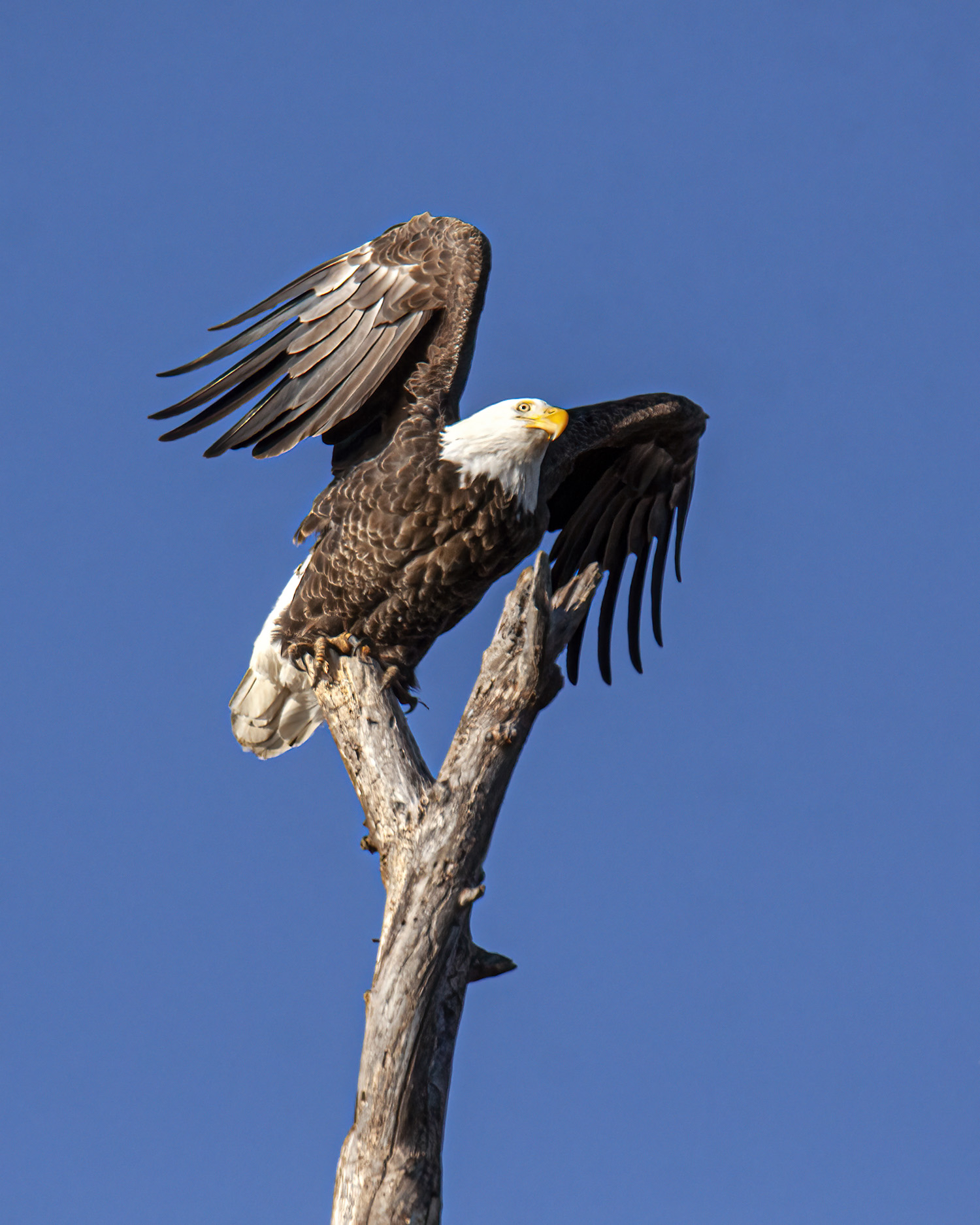
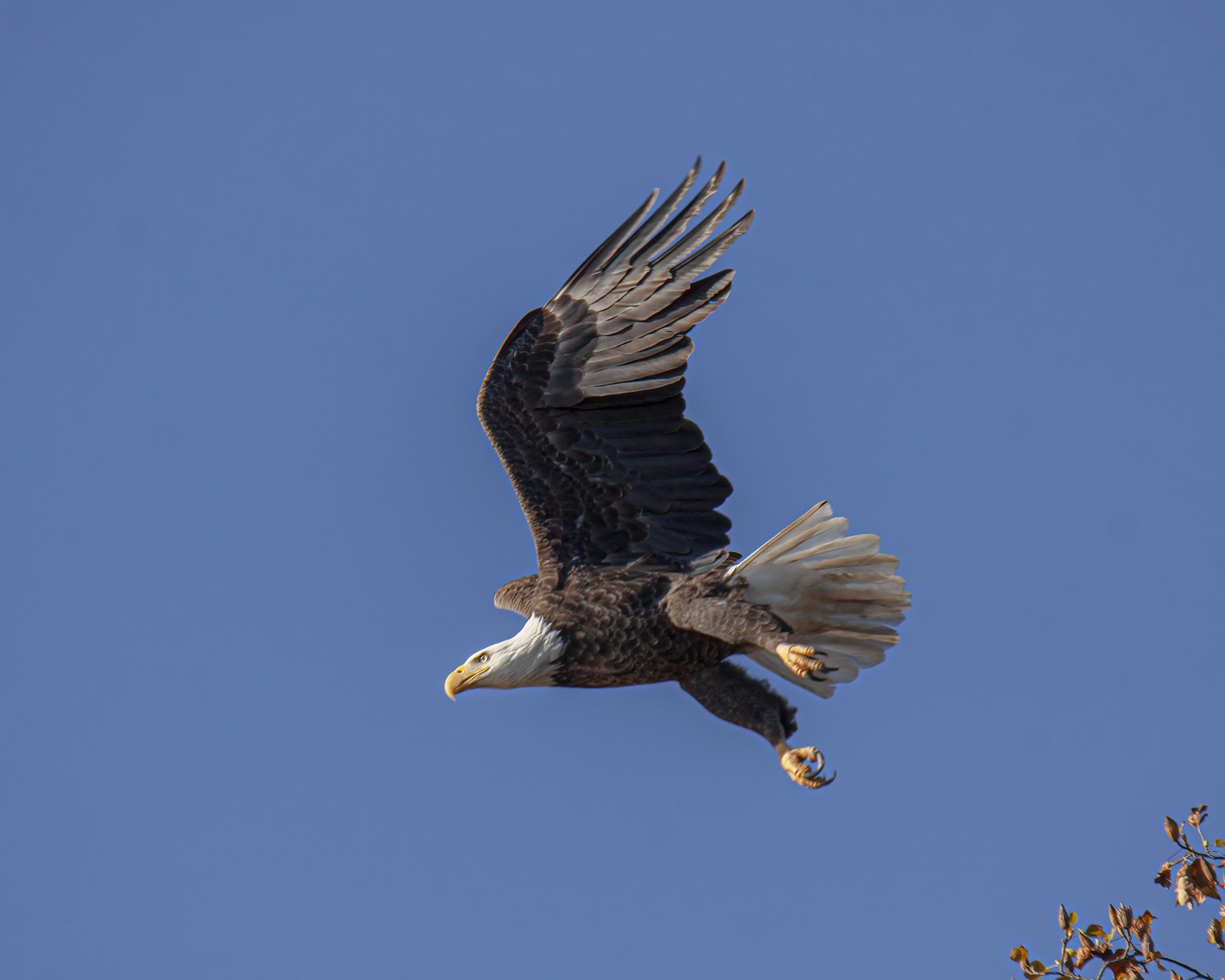
There was a lot of activity on Tuesday at the large Bald Eagle (Haliaeetus leucocephalus) nest at Occoquan Bay National Wildlife Refuge. I still cannot determine if any eaglets have hatched, but several times I observed an eagle fly into the nest or fly out of it. The nest is so deep that an eagle is often hidden from view when sitting on an egg—the only way to know for sure that an eagle is present is when one of them arrives or departs.

The eagle in the first photo was arriving and had spread its wings to slow down its speed and forward momentum. In the second photo, an eagle that was in nest had popped its head up and was looking towards a nearby tree where its mate was perched. After the eagle had reassured itself that everything was ready, the two eagles executed a changing of the guard ceremony—the eagle in the nest flew away and the perched eagle took its place. I captured the third image just as the eagle was taking off from its perch to take its turn watching over the nest.

Bald Eagle

Bald Eagle

bald eagle


© Michael Q. Powell. All rights reserved.

Read Full Post »

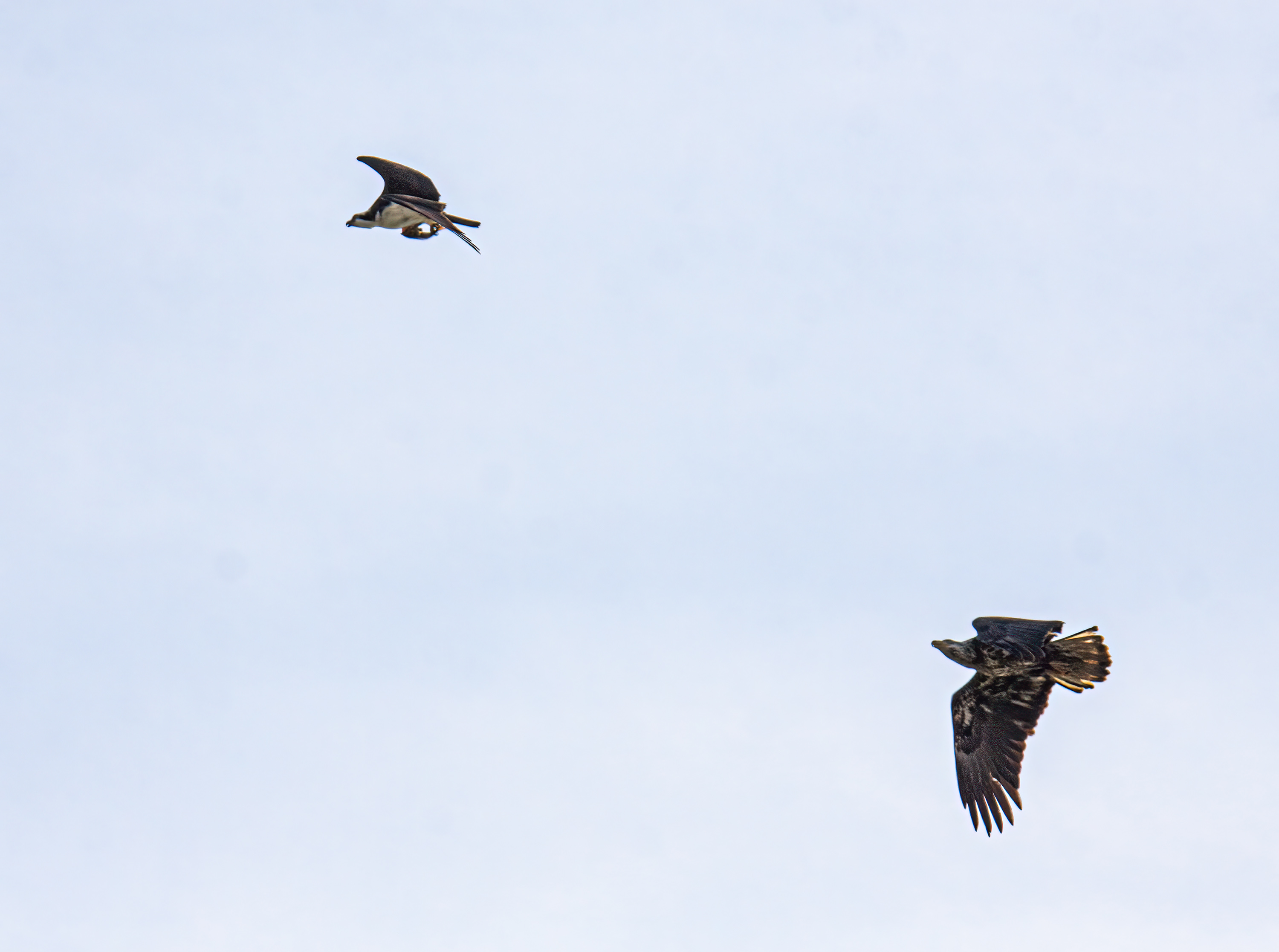
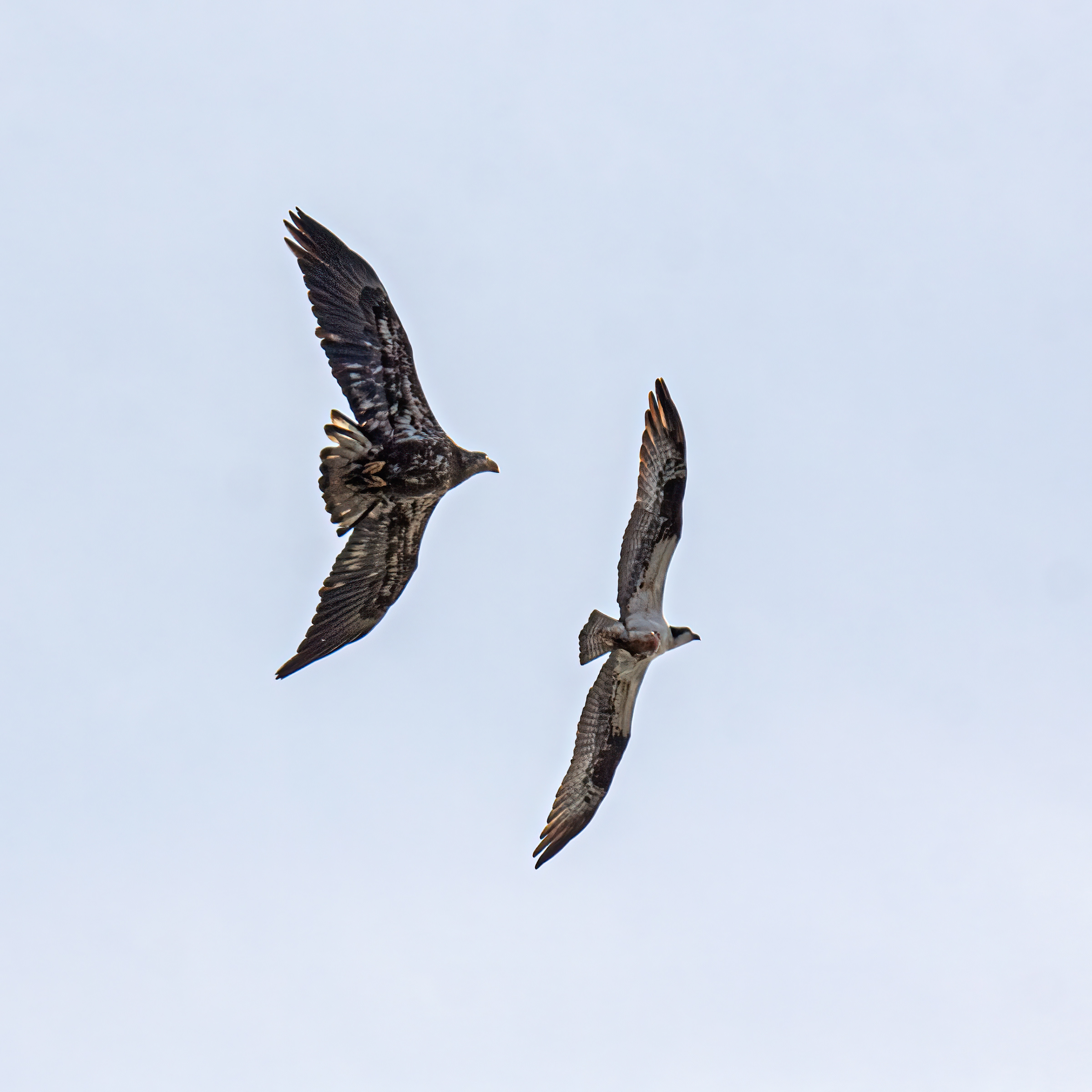
A juvenile Bald Eagle (Haliaeetus leucocephalus) tried to steal a fish from an Osprey (Pandion haliaetus) on Thursday at Occoquan Bay National Wildlife Refuge and chased it across the sky. It was quite an aerial dogfight. In the end, I think that the osprey dropped the fish and both birds ended up “empty-handed.”

Ospreys migrate away from my area for the winter and I was delighted to see that they had returned. I spotted at least a half-dozen or more ospreys and they were both active and vocal. Ospreys have high-pitched, distinctive voices that the Cornell Lab of Ornithology described in these words, ” Their calls can be given as a slow succession of chirps during flight or as an alarm call—or strung together into a series that rises in intensity and then falls away, similar to the sound of a whistling kettle taken rapidly off a stove.” Here is a link to a Cornell Lab webpage where you can listen to recordings of various osprey calls.

These three photos give you a general sense of the chase. In the first shot, you can definitely see the “prize,” the fish that the osprey had caught. In the second shot, the eagle has closed the distance separating it from the osprey. In the third shot, the osprey is doing its best to maneuver away from the eagle, but the eagle was able to match the osprey turn by turn. All of this took place over the water and eventually the two birds flew out of range.

eagle osprey chase

eagle osprey chase

eagle osprey chase

© Michael Q. Powell. All rights reserved.

Read Full Post »

This Bald Eagle (Haliaeetus leucocephalus) definitely had something to say when I spotted it last week at Occoquan Bay National Wildlife Refuge. I think I may have been guilty of eavesdropping, though, because the eagle appeared to be calling out to its mate.

One of the things that I really like about this image is the way that I was able to capture a sense of the rough texture of both the bark on the tree and the feathers on the eagle’s body.

Bald Eagle

© Michael Q. Powell. All rights reserved.


Read Full Post »

I was blessed to see multiple Bald Eagles (Haliaeetus leucocephalus) last Friday during a visit to Occoquan Bay National Wildlife Refuge. I am used to seeing two eagle couples that occupy the nests plus a few other from time to time. On this day, though, there seemed to be a whole lot more eagles than normal.

Seeing eagles is great, of course, but getting photos of them is not always easy. In the first photo, the eagle was flying almost directly over me and it is challenging to hold a long telephoto lens upright and track a moving subject. I am pretty happy with the way that this one turned out. If you click on the photo you can see the wonderful details of the eagle more closely, including what looks to a band on at least one leg and possibly on both of them—to me it looks like the eagle is flying with leg shackles.

In the second image, I captured an eagle as it was preparing to land on its nest. There was a lot of activity at that nest on that day, with both eagles flying in and out of that nest. It seems a bit early, but I wonder if there is a change that the eaglets have already hatched. The only way that I will know for sure that there are eaglets is if they pop their heads up. However, the nest is so deep that it will probably be a while before the eaglets are big and strong enough to be seen.

Bald Eagle

Bald Eagle

© Michael Q. Powell. All rights reserved.
Read Full Post »

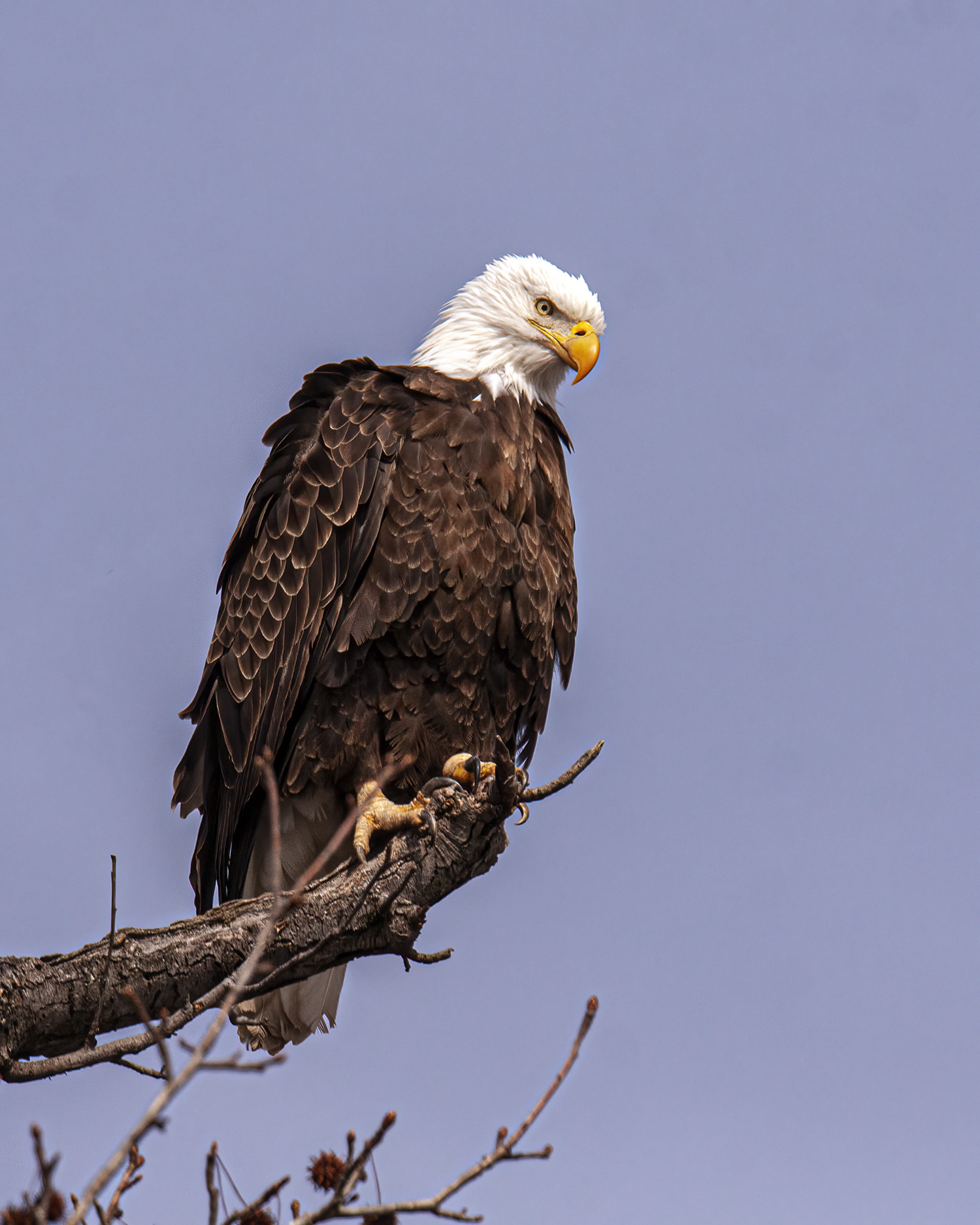
I never fail to be impressed by the beauty and majesty of Bald Eagles (Haliaeetus leucocephalus), like this one that I spotted a week ago at Occoquan Bay National Wildlife Refuge. This eagle had chosen a high branch as its perch and appeared to be surveying the situation from on high.

As I noted yesterday, I continue to be deeply disturbed and shaken by Russia’s ongoing invasion of Ukraine. I’ll pose to you the same question that I posted last night on Facebook and make the same request—that we pray for the Ukrainian people, who are suffering in so many different way, and that we pray for peace to prevail.

“Would you selflessly be willing to take up arms to defend your country, your freedom, and your way of life against an aggressor that invades your territory and seeks to destroy your nation? I feel nothing but admiration and respect for the brave Ukrainians who continue to fight with courage and determination against overwhelming odds. Please join me in praying for all Ukrainians as their country continues to be attacked by Putin’s forces.”

Bald Eagle

Bald Eagle

© Michael Q. Powell. All rights reserved.
 

Read Full Post »

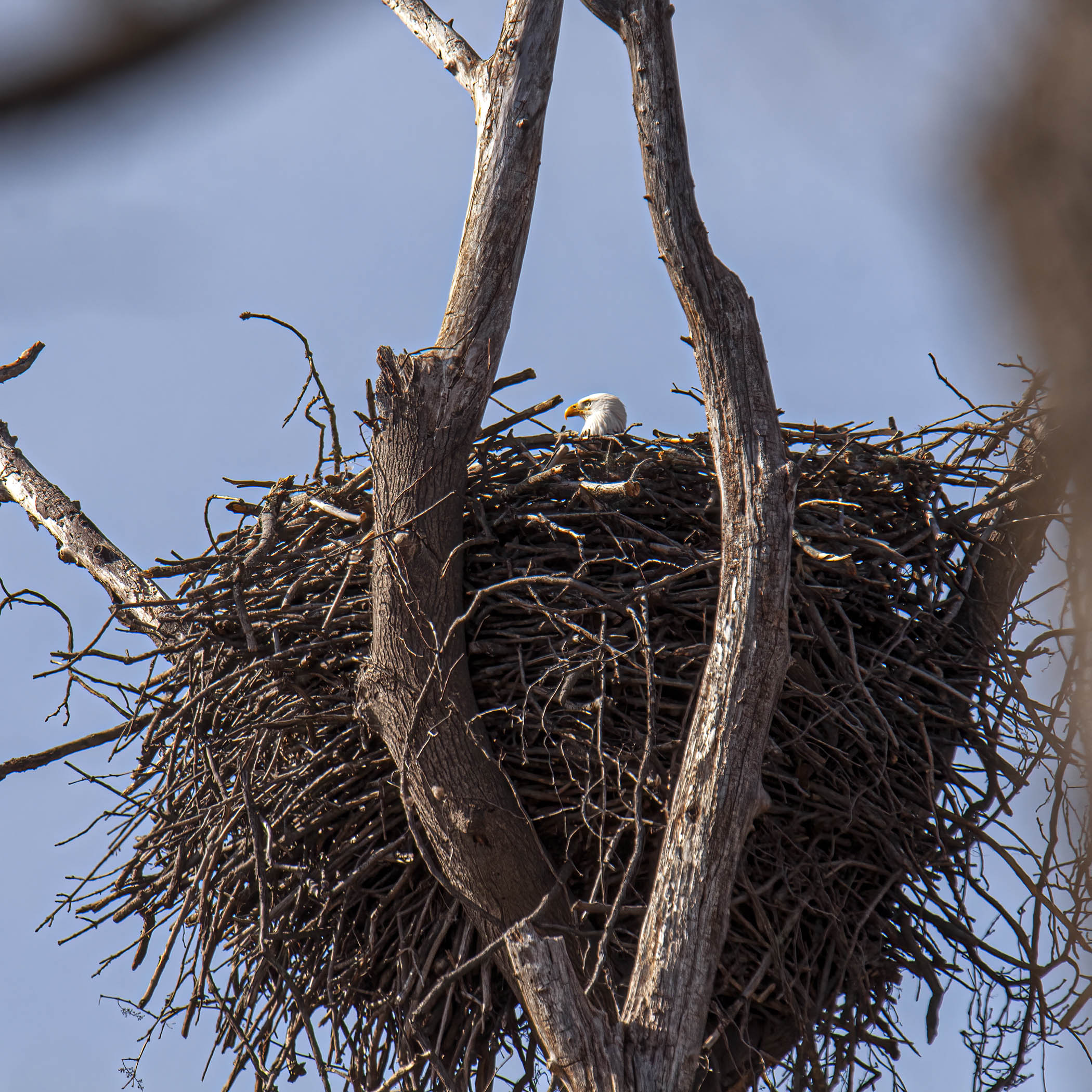
I had already spotted a Bald Eagle (Haliaeetus leucocephalus) sitting on a small nest at Occoquan Bay National Wildlife Refuge (see the final photo in my recent posting Out on a limb). However, until Wednesday  I had been unable to determine if the eagles had started to sit on eggs in the much larger and prominent nesting sight. That nest is so large and deep that a nesting eagle is hidden from view most of the time.

We had unusually warm weather on Wednesday, so I felt compelled to leave my house with my camera and towards my favorite site for wildlife photography. As I walked past my normal viewing site for the nest, I wasn’t surprised that I could not see an eagle in it.  As I continued to walk down the trail, however, I continued to keep my eye on the nest as I continued to walk down the trail. My view was partially blocked by trees, but looking through the trees, I suddenly spotted a small white head sticking out of the nest.

I don’t know if the warmer weather prompted the eagle to sit up higher in the nest than during cold weather, when the eagle would tend to hunker down to keep the eggs warm. Whatever the case, I welcomed this confirmation that the eagles were in the nest. The first image shows that the eagle was quite alert and keeping and eye on things. The second image helps to give you all a sense of the massive size of this nest.

As I write this posting, my heart is breaking as I continue to watch horrific events unfolding in Ukraine. I would simply ask that you pray for the brave Ukrainian people who are fighting and, in many cases, dying to defend themselves and their country.

Bald Eagle

Bald Eagle

© Michael Q. Powell. All rights reserved.

Read Full Post »

As we near the end of the month of February, we are moving into nesting season for the Bald Eagles (Haliaeetus leucocephalus) that I regularly observe at Occoquan Bay National Wildlife Refuge. Some other wildlife photographers have photographed one of the eagle pairs mating, but when I visited the refuge last Wednesday, there was no such activity. The best images that I was able to capture were of a solitary bald eagle perched on the outermost tip of a branch overlooking the trail on which I was walking—as the first photo shows, the eagle was quite aware of my presence.

Later that same day, I spotted a bald eagle that appears to be sitting on one of the two nests that monitor. One of the nests is so large and high up in the trees that it is almost impossible to tell when an eagle is sitting on the nest. The other nest, which is the one shown in the final photo, is much smaller and a sitting eagle is quite visible. There are barriers blocking the road to keep eagles from being disturbed, because a trail runs right under the nesting tree, so I am able to capture images only from a distance.

I will be checking in on the nests as time passes and with a little luck will be able to share some images of any eaglets that I manage to spot.

Bald Eagle

Bald Eagle

Bald Eagle

© Michael Q. Powell. All rights reserved.


Read Full Post »

Through the distant trees, I spotted a shadowy shape in the early morning hours last week at Occoquan Bay National Wildlife Refuge. Was it a large bird or simply a malformed tree? It is a little embarrassing to admit it, but I often find myself taking photos of odd-shaped branches or leaf formations, thinking they might be birds.

In this case, though, it turned out to be a bird. When I zoomed in to get a closer look, I initially thought it might be a hawk, but the more I stared at the hazy form, the more I realized that it was almost certainly an immature Bald Eagle (Haliaeetus leucocephalus).

It takes almost five years for an adult Bald Eagle to develop its signature look, with its yellow beak, light-colored eyes, and white head and tail. In the interim the eagle’s plumage is flecked with white, rather than being a solid dark color, and the beak and eyes are darker than they will eventually become. Experts can tell the age of an immature eagle on the basis of its plumage pattern—I am definitely not an expert and would guess from what I have read on-line that this eagle is probably about a year old or so.

Although I was a long way away from the eagle, it seemed to sense by presence and took off shortly after I spotted it. As the eagle flew away, I was able to capture an image with a view of the mottled pattern of the feathers on the underside of its wings and its dark tail feathers

Bald Eagle

Bald Eagle

© Michael Q. Powell. All rights reserved.

Read Full Post »

I was looking into the sun when I spotted this Bald Eagle (Haliaeetus leucocephalus) in a tree during a recent visit to Occoquan Bay National Wildlife Refuge. The eagle took off before I could get into a better shooting position, but I was able to capture some of the sunlight shining through its tail feathers.

I wish I had been able to frame the photo a bit better, but it is always tricky when focusing on a perched eagle to figure out how much to zoom out in order to capture its entire wingspan. In this case, I was worried more about adjusting for the backlight, so that I would not have a silhouetted shot, and was not worrying about framing the photo.

It is amazing to realize how many different considerations were coursing through my brain as I tried to analyze the situation, predict the possibilities, and react to changes. I remember how overwhelmed and paralyzed I felt in this kind of a situation when I was just starting to get serious about my photography some ten years ago. Now I am much  more comfortable with my gear and have a certain amount of muscle memory, so I am able to react more calmly and instinctively, without having to think consciously about all of the variables.

Every situation is different, though, and no matter how much I practice, there is still a spurt of adrenaline when a moment like this arrives and I realize I have to react instantaneously to take advantage of the situation. Things rarely works perfectly, but I am more than happy when they work as well as they did when I captured this image of the eagle’s takeoff.

bald eagle

© Michael Q. Powell. All rights reserved.

Read Full Post »

As many of you know, I have been keeping an eye on a pair of Bald Eagle (Haliaeetus leucocephalus) nests at Occoquan Bay National Wildlife Refuge, waiting for the eagles to begin sitting on the nests. I featured one of the nests, an enormous one high in a tree, several times during January, but have not yet posted any shots of the smaller nest this year until now.

The most direct roads leading to this smaller nest are blocked off at this time of the year, because the nesting tree is located near the intersection of several major trails, including one on which cars are normally permitted to drive. However, I am able to take a circuitous route to reach one of the barriers that provides a distant view of the nest from which I can take some photos.

Several weeks ago I was delighted to photograph both members of an eagle couple perched together on a limb of the tree with the small nest that has been used in each of the past three years (and maybe even longer than that). As you can see in the first photo, one of the eagles is quite a bit larger than the other—generally the female is the larger one.

When I first started watching the nest that day, only the smaller eagle to the left was perched on the limb. As I pulled back on my zoom lens to be able to show the nest in the lower righthand corner of the photo, the second eagle flew in to perch next to her mate, and I captured that moment in the second photo.

The two eagles stayed together for a short while side-by-side, when suddenly the larger eagle took off. The final shot shows the eagle extending her wings and taking off from the perch, leaving the smaller eagle to keep watch over the nesting site.

I have been back several times to the site since this encounter, but have not seen the eagles there again. I am optimistic that they will soon be sitting on some eggs. In this smaller nest, the eagle is partially visible when she is sitting on eggs, whereas the other nest is so big and deep that a nesting eagle is hidden from view.

Bald Eagle

Bald Eagle

Bald Eagle

© Michael Q. Powell. All rights reserved.

Read Full Post »

Sometimes Bald Eagles (Haliaeetus leucocephalus) will perch out in the open on branches or in prominent trees where they are relatively easy to spot. At other times, though, they perch in the crooks of the trees, almost hidden from view. I encountered these two semi-hidden eagles last Tuesday as I was wandering the trails at Occoquan Bay National Wildlife Refuge.

I really like the contrast between the two expressions and poses of the two eagles. The eagle in the first image seems stern and serious—I don’t think that I would want to mess with him. The eagle in the second image seems almost a little goofy with a whimsical smile and windswept hair—for some reason he reminds me of Big Bird from Sesame Street.

Bald Eagle

Bald Eagle

© Michael Q. Powell. All rights reserved.


Read Full Post »

This Bald Eagle (Haliaeetus leucocephalus) definitely did not seem to be thrilled with my presence last week at Occoquan Bay National Wildlife Refuge. Despite its looks of disapproval, though, it remained in place for our little portrait session and was still perched when I continued down the trail.

You never know how wildlife will react when they detect your presence. Most often they will crawl, swim, or fly away immediately, because they perceive you as a predator. Occasionally, particularly when they are young, they will look back at you with a mixture of wonder and may even come a little closer. On rare occasions, you seem to come to a silent agreement with your subject to peacefully coexist.

Generally I photograph wildlife subjects from a good distance away (with the notable exception of insects that I like to photograph at close range) and try not to spook them. Sometimes, though, you just can’t help it. This eagle was perched on some branches overhanging the trail that I had to use to get back to where my car was parked—I had to pass right under the perched eagle.

I tried to move slowly and stealthily, but I knew from past experience that an eagle’s eyesight is much keener than mine and its reaction time much quicker—there was no way I was going to pass by unnoticed. As you can undoubtedly tell, I took these shots shooting upwards from almost directly below the eagle. I made small adjustments to my position as I tried to frame the eagle through the branches, but I did not want to scare away the eagle.

As I departed, I was really happy with the encounter and the fact that the eagle was able to retain its chosen spot. The eagle, for its part, was probably equally happy to return to basking in the warmth of the winter sun after being momentarily disturbed by a pesky photographer.


Bald Eagle

Bald Eagle

Bald Eagle

© Michael Q. Powell. All rights reserved.

Read Full Post »

Last Wednesday was a wonderful day for photographing Bald Eagles (Haliaeetus leucocephalus) at Occoquan Bay National Wildlife Refuge. I spotted them at several locations on the refuge and even managed to get a few portrait-style shots in which the eagles look particularly regal and majestic.

Earlier in the day the sun was shining brightly and I had the brilliant blue sky as a backdrop, as you see in the second photo below. However, that eagle was buried a bit in the vegetation and the background is a little more cluttered than I would have preferred. Still, I like the expression on the eagle’s face, the kind of semi-smile that some people make when you ask them to pose.

Later in the day the skies clouded over and the color of the background was much more subdued. Somehow, that seems to fit well with the serious expression on the face of the eagle in the first image. I like too that he was perched on a “snag,” a dead or dying tree that is still standing, so there were no distracting small tree branches.

I am always happy when I manage to see a Bald Eagle, one of the symbols of the United States, and even more thrilled when I can capture images like this one.

bald eagle

Bald Eagle

© Michael Q. Powell. All rights reserved.
Read Full Post »

The Bald Eagles (Haliaeetus leucocephalus) left their big nest at Occoquan Bay National Wildlife Refuge unattended last Wednesday and several Turkey Vultures (Cathartes aura) decided to check it out. I don’t know if the eagles were eating fish in the nest in the past or if the vultures were merely curious.

Later in the day I passed the same nest and both of the eagles were perched near the nest, including the one shown in the second image below. That shot gives you a good sense of how big that nest really is. The eagles have been using it for many years and each year they seem to add on to it. It is so deep now, that it is almost impossible to tell if an eagle is sitting on eggs, but I will be checking periodically for other signs.

Turkey Vultures

eeeagle nest

© Michael Q. Powell. All rights reserved.
Read Full Post »

I spotted Bald Eagle couples (Haliaeetus leucocephalus) near each of the two bald eagle nests at Occoquan Bay National Wildlife Refuge this past week, but I have not yet seen them in the nest itself quite yet. I believe that it is now mating season and it probably will not be long before the eagles start nesting.

This past Wednesday I spotted one of the eagle couples perched on an osprey nesting platform that is not far from one of the eagle nests. This seems to be one of the favorite spots for the eagles to hang out together and I have seen them at this spot multiple times in the past. I was a good distance away from the eagles, but was monitoring them through my telephoto zoom lens.

I sensed that they were getting prepared to take off, so I got ready prepared in case they happened to fly in my direction. I was delighted when they zoomed past me and was even more thrilled when I managed to capture this image with both of the eagles in flight.

It is pretty hard to photograph a bird in flight under the best of circumstance and really difficult when there is more than one bird. I would consider this one to be a successful shot.

Have a wonderful weekend.

Bald Eagles

© Michael Q. Powell. All rights reserved.

Read Full Post »

Last week I managed to maneuver myself so that I had a clean line of sight to one of the Bald Eagles (Haliaeetus leucocephalus) at Occoquan Bay National Wildlife Refuge. Most of the time my view is at least partially blocked by vegetation or the eagle flies away before I can get myself into position.

This eagle was perched on a broken off tree, not far from a nesting site. I extended my 150-600mm telephoto lens to its maximum length and watched and waited. Fortunately I was using a monopod to steady my camera and lens, so I was able to keep my camera and raised for an extended period of time and the eagle adjusted its feathers and monitored the area from its high perch.

After a while, I noticed that eagle was getting a little fidgety and I correctly anticipated that the eagle was preparing to take off and managed to capture a couple of images as it was doing so. It may sound like a pretty straightforward process, but in fact the eagle has lots of options when it takes to the air—it can fly off in any direction and at any height.

When I am in this kind of situation, I feel a bit like the goalkeeper for a penalty kick in a soccer (football) match. I know that there will be a moment of decisive action and that I will have to react quickly. I will watch my “opponent” for telltales signs of his intentions, but ultimately I will have to commit to one direction as I “guess” when and how it will act. Sometimes the goalkeeper makes the save and sometimes he is outsmarted by the offensive player—that, in essence, is the story of the life of a wildlife photographer.Bald Eagle

Bald Eagle

Bald Eagle

© Michael Q. Powell. All rights reserved.

Read Full Post »

It is almost nesting season for Bald Eagles (Haliaeetus leucocephalus). Recently when I have seen eagles, they have mostly been in pairs. When I spotted the Bald Eagle in the first photo last Monday, it was calling out loudly to its mate, I believe, as it perched atop a raised platform at Occoquan Bay National Wildlife Refuge on which ospreys sometimes build a nest. An actual nesting site that has been used in recent years is located in a nearby sycamore tree.

A much larger nest is located in another part of the refuge, as shown in the second photo. Two eagles—presumably a mating pair—were hanging around close to that nest, though I have not yet seen them occupy it. The final photo is a close-up shot of the eagle that was perched right above the nest.

I will be checking the nesting sites periodically for signs of further activity. The large nest is set back from the trail a good ways, so you cannot approach it and the trail remains open. The smaller nest in the sycamore tree is adjacent to a trail that is now closed to keep the eagles from being disturbed. I am able to observe that nest from the barrier that blocks the trail and, if I am lucky, I will be able to monitor the nest and capture a few distant shots as I have done in the past.

Bald Eagle

Bald Eagles

Bald Eagle

© Michael Q. Powell. All rights reserved.


Read Full Post »

A Bald Eagle (Haliaeetus leucocephalus) was wedged in so tightly between the branches that it almost looked like it was hugging the tree last Thursday at Occoquan Bay National Wildlife Refuge. The eagle was perched in a tree just off of the trail that I was following. The sun was shining brightly, but it was not generating much heat and a breeze was kicking up periodically, ruffling the eagle’s feathers.

I realized that I had a problem when I first focused on the eagle—I was looking right into the sun and the eagle was nothing but a silhouette. On one side of me was thick vegetation and the water of the bay was on the other side, so my options for framing a shot were limited. I realized that the only way that I could get a decent shot of the eagle was to walk past it and then turn to face it with the sun to my back.

Sound crazy, right? I moved as slowly and cautiously as I could and amazingly my plan worked. As the first photo suggests, the eagle was aware of my presence, but did not immediately take off. I observed it silently for a few minutes as it adjusted its position and preened a bit.

I was preparing to move on when suddenly the eagle took off. My camera was zoomed in all of the way, so I was not able to capture the eagle’s full wingspan when it flew almost directly over me as it cleared the sweet gum tree in which it was perched. I managed, however, to get a pretty good shot at the eagle’s body and especially its talons from this unusual shooting angle.

It is almost time for the eagles at the refuge to begin their nesting and authorities have already blocked the roads in some areas of the refuge. With a little luck, though, I will be able to get some shots in the upcoming of the eagle couples as they renovate the nests, albeit from a far greater distance than when I captured the images in this posting.

Bald Eagle

Bald Eagle

Bald Eagle

© Michael Q. Powell. All rights reserved.

Read Full Post »

It was cold, cloudy, and windy last week when I visited Occoquan Bay National Wildlife Refuge—it definitely is beginning to feel like winter. I had bundled up, wearing a hooded jacket and gloves in an effort to stay warm.

On days like this, I often marvel at the ability of wild creatures to survive in harsh weather conditions. I was a little surprised when I spotted a Bald Eagle (Haliaeetus leucocephalus) nestled into the inner branches of a tree. Quite often when I see eagles, they are perched at the top of trees, majestically surveying their kingdom from on high.

This eagle, however, seemed to be hunched over a bit with its feathers puffed up, perched lower in the tree. The eagle’s feet with their massive talons were tucked in under the feathers, presumably to help them stay warm.

Vegetation kept me from getting very close to the eagle and I really did not want to disturb the eagle from its comfortable perch. So I framed my shots from a somewhat awkward angle, content that I had even spotted this handsome bird.

As I was preparing to move on, I noticed the eagle beginning to shift around a little. I correctly guessed that the eagle was preparing to take off, but did not react quickly enough to capture the action. I was still focused on the branch and when the eagle spread its wings and took to the air, I clipped its wings, not realizing in that split second that I had zoomed in too closely.

Still, I am pretty happy with the second shot below and the way that it caught the eagle in mid-air. There is a dynamic feel in this kind of action shot that is impossible to capture when a bird remains perched. The degree of difficulty though is significantly magnified when motion is involved, so I tend to judge myself a little less critically when photographing moving subjects, like this puffy bald eagle, vice static subjects.

Bald Eagle


Bald Eagle

© Michael Q. Powell. All rights reserved.

Read Full Post »

It was cool and breezy last Saturday at Occoquan Bay National Wildlife Refuge and most birds seemed to be out of sight, seeking shelter to stay warm. I was thrilled therefore when I managed to spot this pair of Bald Eagles (Haliaeetus leucocephalus) perched together on a distant tree.

I suspect that this is an eagle couple and the two eagles appeared to be carrying on a spirited discussion. Although it is hard to be certain of their genders, female eagles tend to be larger than their male counterparts, so I suspect that the eagle on the right is the female one.

Bald Eagles

© Michael Q. Powell. All rights reserved.

Read Full Post »

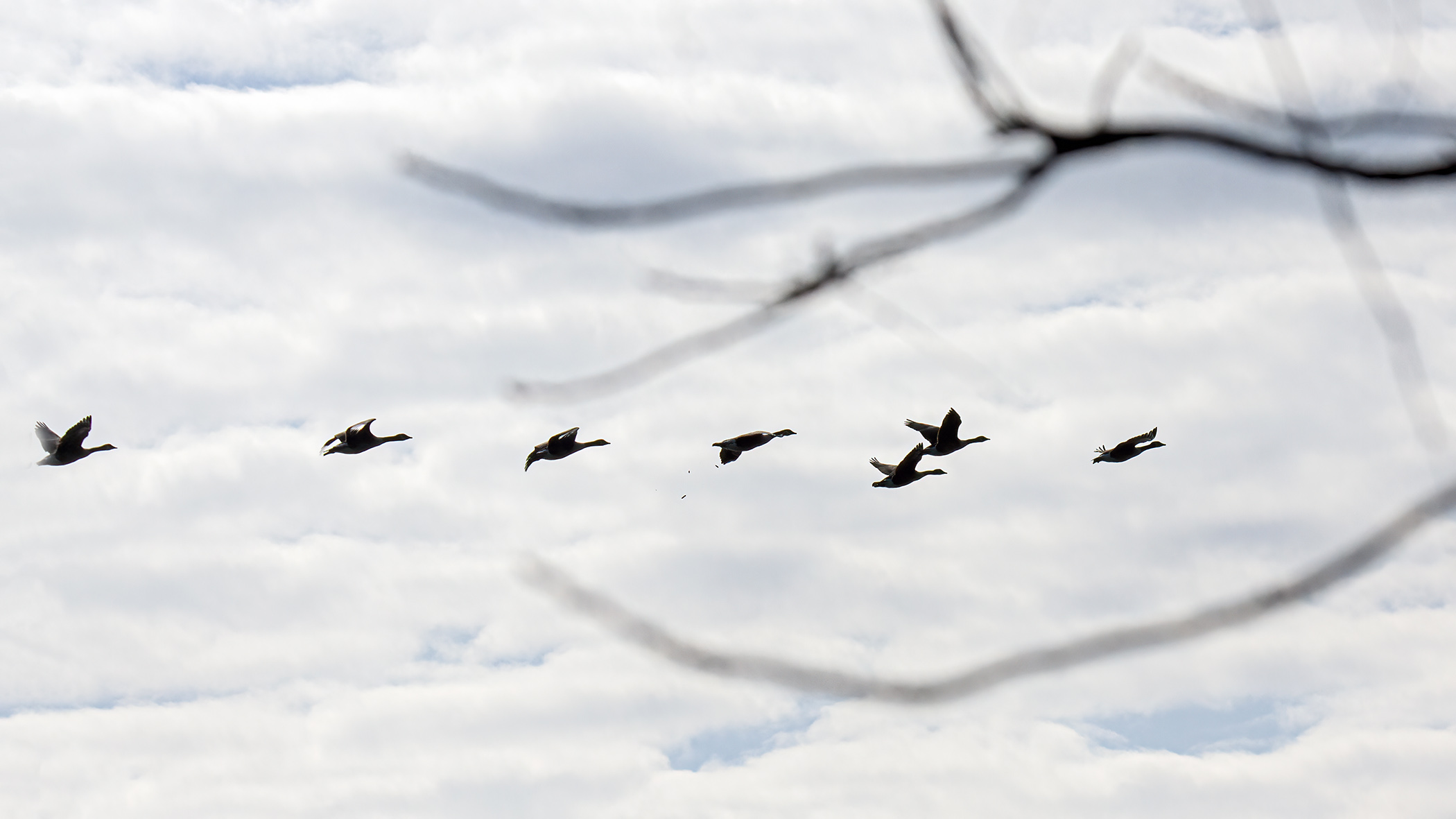
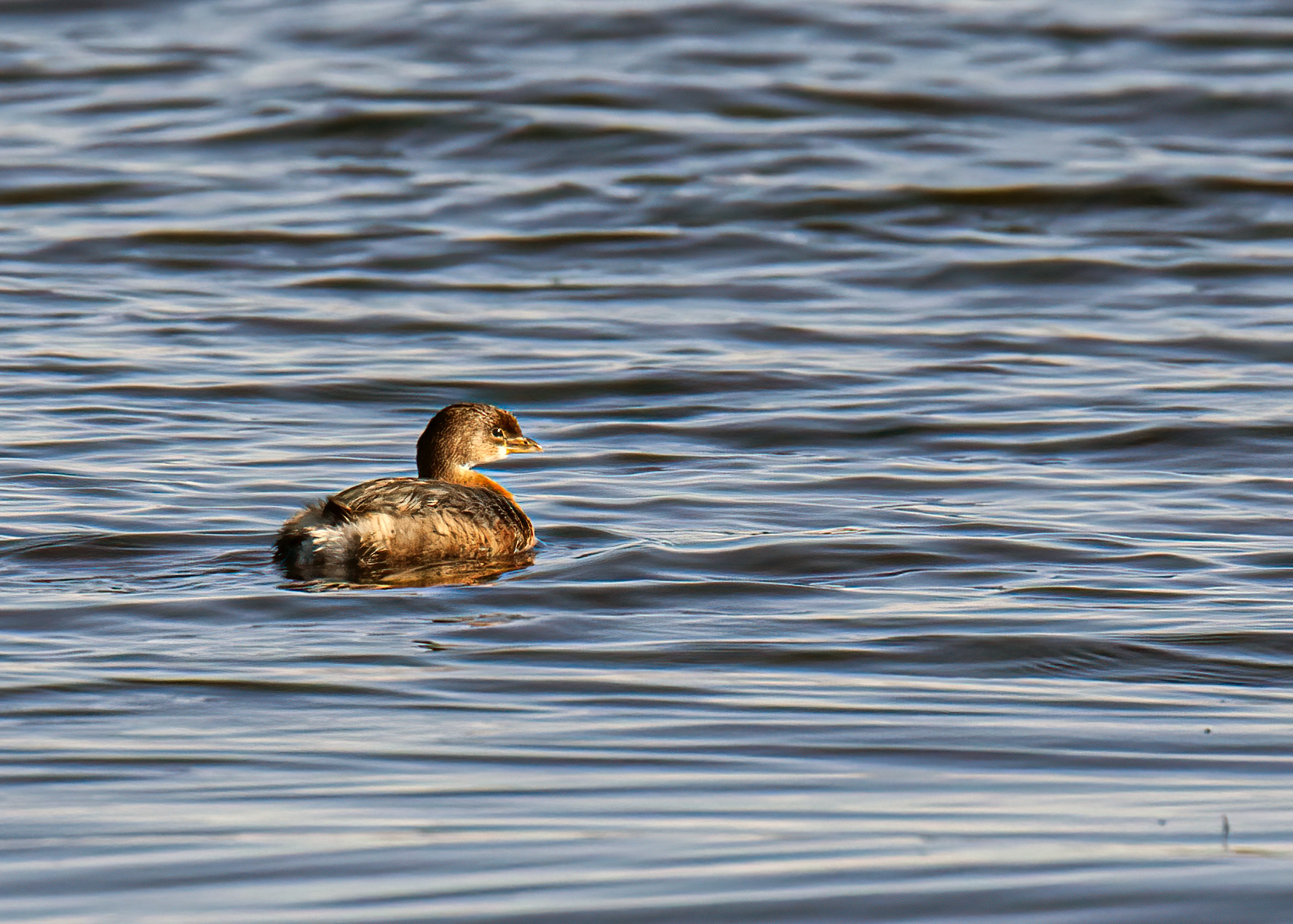
There was a lot of bird activity on Tuesday at Occoquan Bay National Wildlife Refuge both in the air and on the water. Unfortunately most of the action took place well out of the optimal range of my camera, so I had to be content with capturing long distance photos.

Flocks of Canada Geese (Branta canadensis) periodically announced their presence as they passed by. A large flock of crows was equally vocal as it harassed a pair of Bald Eagles (Haliaeetus leucocephalus) perched peacefully in a distant tree. Only the shy little Pied-billed Grebes (Podilymbus podiceps) were silent as they paddled about, periodically diving in search of food.

I spent several hours walking about, listening and observing, enjoying the fresh air and the beauty of natural surroundings, unconcerned that I was not able to capture amazing photos during this outing. That is the uncertain fate of a nature photographer. To borrow a line from Paul in his letter to the Philippians, I have learned to be content whatever the circumstances.

I returned home from this walk in the wild feeling renewed and refreshed—that was my biggest reward.

Canada Geese

Bald Eagle

Pied-billed Grebe

© Michael Q. Powell. All rights reserved.

Read Full Post »

I was thrilled to spot this Bald Eagle (Haliaeetus leucocephalus) at Occoquan Bay National Wildlife Refuge. The eagle was perched high in a tree, as shown in the final photo and kept looking from side to side, as though it was looking for its mate. I am not sure if the eagle was aware of my presence, but all of the sudden it took off and flew away—I should know by now never to underestimate the acuity of an eagle’s vision.

I managed to capture the first shot below as the eagle was really stretching itself out just prior to takeoff. It is an unusual pose that I really like. A split second later I captured the shot of the eagle in flight. There were several other shots in between the first and second images, but I did not track the eagle accurately enough and the eagle’s wings were cut off in those shots.

It has been a while since I last got good shots of a Bald Eagle, so I was particularly happy when this photo opportunity arose.

Here in the US, today is Veterans Day, a day when we honor all those who have served in our armed forces. Elsewhere in the world, today is commemorated in many different ways, including as Armistice Day, the day when World War I ended. Wherever you happen to live, I hope that you never forget the the brave men and women who have served and are serving on your behalf, safeguarding your freedom—we owe them all a debt of gratitude.


Bald Eagle

Bald Eagle

Bald Eagle

© Michael Q. Powell. All rights reserved.

Read Full Post »

As I was wandering the trails early last week at Occoquan Bay National Wildlife Refuge, I was fortunate to spot this Bald Eagle (Haliaeetus leucocephalus) perched in a tree, almost hidden amongst the leaves. I would like to think that my stealthiness permitted me to get close to the eagle, but suspect instead that the eagle was comfortable in its perch and simply did not view me as a threat.

The eagle moved its head from side to side a bit and glanced down at me occasionally, but stayed in place as I took some shots. The trail took me past the tree in which the eagle was perched and after I had passed underneath the eagle, I glanced over my shoulder and was pleasantly surprised to see the eagle was still there. I love it when I am able to capture my images without disturbing my wildlife subjects, though most of the time they are so skittish that they move away as soon as they detect my presence.

Bald Eagle

Bald Eagle

© Michael Q. Powell. All rights reserved.

Read Full Post »

This majestic Bald Eagle (Haliaeetus leucocephalus) was almost hidden in the foliage when I spotted it on Wednesday at Occoquan Bay National Wildlife Refuge. If the eagle’s head had not been so bright white in color, I might not have noticed it at all. At this time of the year, when I often can hear the birds, but cannot see them, it is always a challenge for me to photograph birds.

To mark the change of the seasons, I have switched over to walking around with my Tamron 150-600mm telephoto zoom lens affixed to my camera, a recognition that I am as likely to encounter birds as insects. I am still, however, carrying my 180mm macro lens in my backpack, in case I run into the right kind of shooting situation with an insects or other small creatures.

Initially the eagle had its head almost completely buried in the leaves, as you can see in the first photo. I gradually noticed, though, that the eagle was moving its head around a bit and I was able to capture some images that show a bit more of the eagle’s face. I changed my body position slightly as I watched and waited, but tried to minimize my movements for fear of spooking the eagle.

It has been quite a while since I last featured Bald Eagles in a posting, and I am excited at the prospect of seeing them more regularly. If so, you are sure to see the results here, because, as I have said on multiple occasions, any day in which I see a Bald Eagle is a good day and getting good shots is real bonus.

Bald Eagle

Bald Eagle

Bald Eagle

© Michael Q. Powell. All rights reserved.

Read Full Post »

It has been several months since I last checked on the Bald Eagle (Haliaeetus leucocephalus) nest at Occoquan Bay National Wildlife Refuge, so I made a visit there on Monday to check on the eaglets. The young eagles that I found still hanging around the nest are definitely no longer babies, though most people would not yet recognize them as Bald Eagles—it takes almost five years for them to acquire their distinctive white heads and tails.

I am pretty sure that these two eaglets are now capable of flight, though they remained in place on the branches overlooking the nest the entire time that I observed them. For the first time in quite some time I had my 150-600mm lens on my camera that allowed me to zoom in on each of the eaglets and then zoom back for the final shot to give you an idea of how close they were to the nest.

The bedraggled plumage makes it look like it was really windy, but in fact there was no wind when I captured the images. The eaglets clearly have a lot of work to do on their grooming before they are ready to take their place as one of our national symbols.

I did not see any adult Bald Eagles until much later in the day when I spotted one in another part of the wildlife refuge. Although the eaglets appear to be more or less full grown in terms of size, I question the degree to which they are self-sufficient and suspect that they are still dependent on their parents to provide them with food. As their flying skills improve, the eagles will almost certainly venture out farther and farther and it will become correspondingly more difficult for me to spot them.

Bald Eagle

Bald Eagle

Bald Eagle

© Michael Q. Powell. All rights reserved.

Read Full Post »

As some of you know, I have been monitoring two Bald Eagle (Haliaeetus leucocephalus) nests this spring at Occoquan Bay National Wildlife Refuge. This past month I have devoted most of my photography time to dragonflies, so yesterday I grabbed my long lens and headed off to the refuge, hoping to see some baby eagles. One of the nests is huge and has high walls, so it is hard to know what, if anything, is going on inside it.

I waited and waited and finally the head of an eaglet popped up over the edge of the nest. As I reviewed the first photo, I noticed that there is another eaglet on the other side of the tree trunk, just a little lower. (You may need to click on the image to spot the second eaglet.) Both of the baby birds were facing the tree trunk and I soon learned why.

It turns out that one of there was an adult eagle behind the tree trunk. In the second image, it looks like the adult eagle, whose only visible part was its beak, was giving a bite of food to one eaglet while its sibling looked out from the other side of the tree trunk and did not seem very happy about the situation.

In the final shot, you get a better look at the adult eagle and a partial view of one of the eaglets. I now know for sure that there are at least two eaglets in that nest—some years there have been three eaglets. As the eaglets get older, I hope they will be more active and curious and that will allow me to get some better shots of them.

eaglet

eaglet

bald eagle

© Michael Q. Powell. All rights reserved.


Read Full Post »

Perhaps these Bald Eagles (Haliaeetus leucocephalus) were singing or maybe they were trying to scare off incoming osprey, but most importantly they were doing it together as a couple on a shared perch when I spotted them on Monday at Occoquan Bay National Wildlife Refuge at a moment when the skies were completely overcast.

Bald Eagles


© Michael Q. Powell. All rights reserved.


Read Full Post »

Both members of a Bald Eagle (Haliaeetus leucocephalus) couple were active on Monday in and around the big nest at Occoquan Bay National Wildlife Refuge—neither of them appeared to be sitting continuously in the nest.  Perhaps there are eaglets already, though the nest is so deep I could not see any little heads.

I captured this image as one of the eagles was making its final approach to land on the nest. I really like the position of the wings that help the eagle slow its forward progress and the way that the light coming from the side was illuminating the tail feathers.

I will be continuing to monitor this nest and the other one at the wildlife refuge for signs of baby eagles and hopefully will have the chance to capture some shots of them soon.

bald eagle

© Michael Q. Powell. All rights reserved.

Read Full Post »

It was early in the morning when I spotted this Bald Eagle (Haliaeetus leucocephalus) on Tuesday at Occoquan Bay National Wildlife Refuge. Utterly fascinated, I watched the eagle methodically preening, moving from one area of its body to another, adjusting the feathers and removing some small wispy ones. When you are a national symbol, I guess you have to try to look majestic at all times.

This particular eagle was pretty relaxed and I managed to walk almost underneath the overhanging branch without disturbing it. If you look carefully at the final photo, you can tell that I was shooting almost straight up in order to get the shot. Remarkably the eagle remained in place when I continued on my way down the trail. I would like to be able to claim that I was really stealthy in my movements, but I think it was more likely that the eagle was simply willing to tolerate my presence, of which he was undoubtedly aware.

Bald Eagle


Bald Eagle

Bald Eagle

© Michael Q. Powell. All rights reserved.


Read Full Post »

For the last six weeks or so, I have been monitoring two Bald Eagle couples (Haliaeetus leucocephalus) at Occoquan Bay National Wildlife Refuge as they have repaired and renovated two different nests. On Saturday morning I made my way to one of them and was delighted to see an eagle sitting low in the nest. I cannot be completely certain, but I think that the eagle is sitting on one or more eggs. If true, the eaglets should hatch in about 35 days or so.

This relatively small nest was damaged last summer when it looks like one of the supporting branches broke off and half of the nest fell to the ground. I observed some of the reconstructions efforts and documented it in an early February posting called Rebuilding the nest. It looks to me like the nest has grown considerably in size since that time.

This nest is located in a sycamore tree just off one of the major trails at the wildlife refuge. Each year the authorities block off all of the nearby roads to allow the eagles to nest in peace. The final photo shows the tree in which the nest is located and the current barrier across the trail from which I took the first photo. A telephoto lens tends to compress distances, so it is hard to judge exactly how far away the tree is from the barrier—I estimate that it is about a hundred yards (91 meters).

I will continue to keep an eye on this nest and hopefully will manage to get a glimpse of some eaglets in the upcoming months. Last year I believe that there was only a single eaglet (check out my May 2020 posting entitled One little eaglet), although in past years there were often two eaglets (check out this April 2018 posting called Baby bald eagles for a look at two adorable little eaglets).

Bald Eagle nest

Bald Eagle nest

© Michael Q. Powell. All rights reserved.

Read Full Post »

I really enjoy posting photos here on my blog because I have the freedom to post multiple images and spend as much time and text as I want talking about them—most other forms of social media have implicit or explicit limits on the content. I post a subset of my blog content on my personal Facebook page and in several Facebook groups.

Many of these Facebook groups are very specialized and are full of experts. I actually prefer to post to groups that are aimed more towards generalists who have a broad interest in nature and wildlife. One of my favorites is called “Nature Lovers of Virginia” and I was thrilled when one of my recent photos of a Bald Eagle (Haliaeetus leucocephalus) at Occoquan Bay National Wildlife Refuge was selected as the banner photo for the group for the month of March. The enclosed photo shows the banner photo as it looks in Facebook.

I take photos mostly for my own enjoyment, but do love to share them with others. It is a nice plus to get a little recognition from time to time.

banner image

© Michael Q. Powell. All rights reserved.

Read Full Post »

« Newer Posts - Older Posts »