Feeds:
Posts
Comments

Posts Tagged ‘bald eagle takeoff’

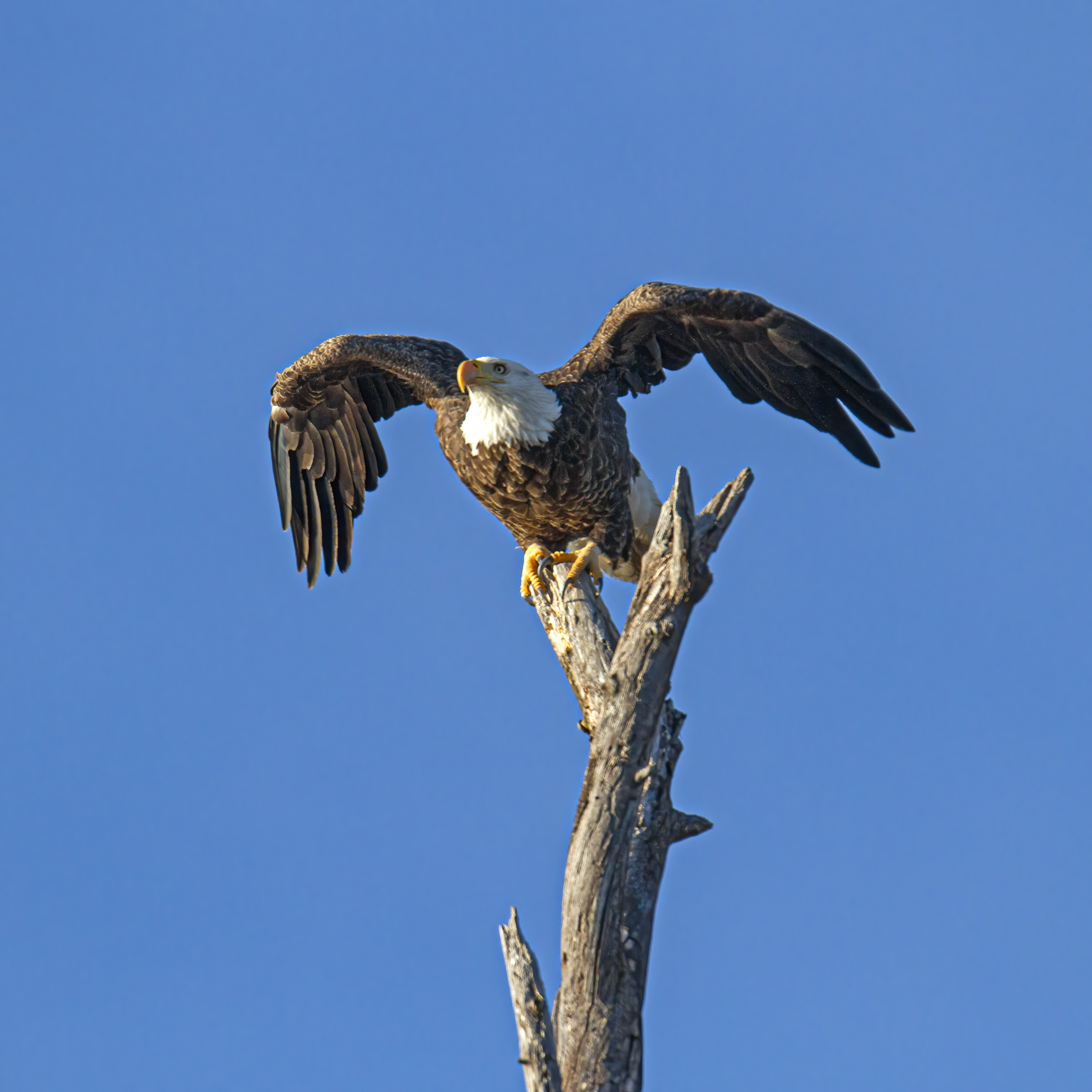
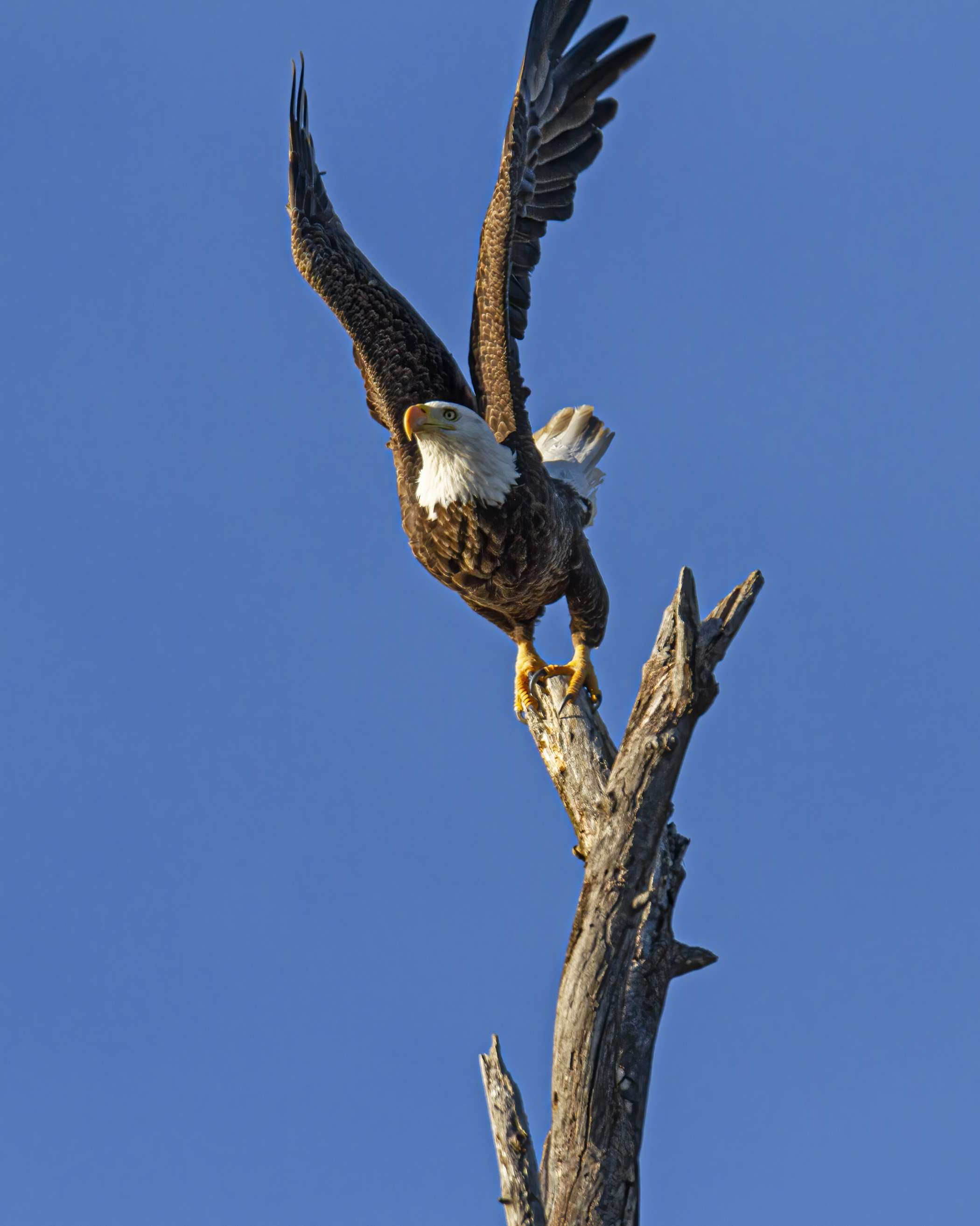
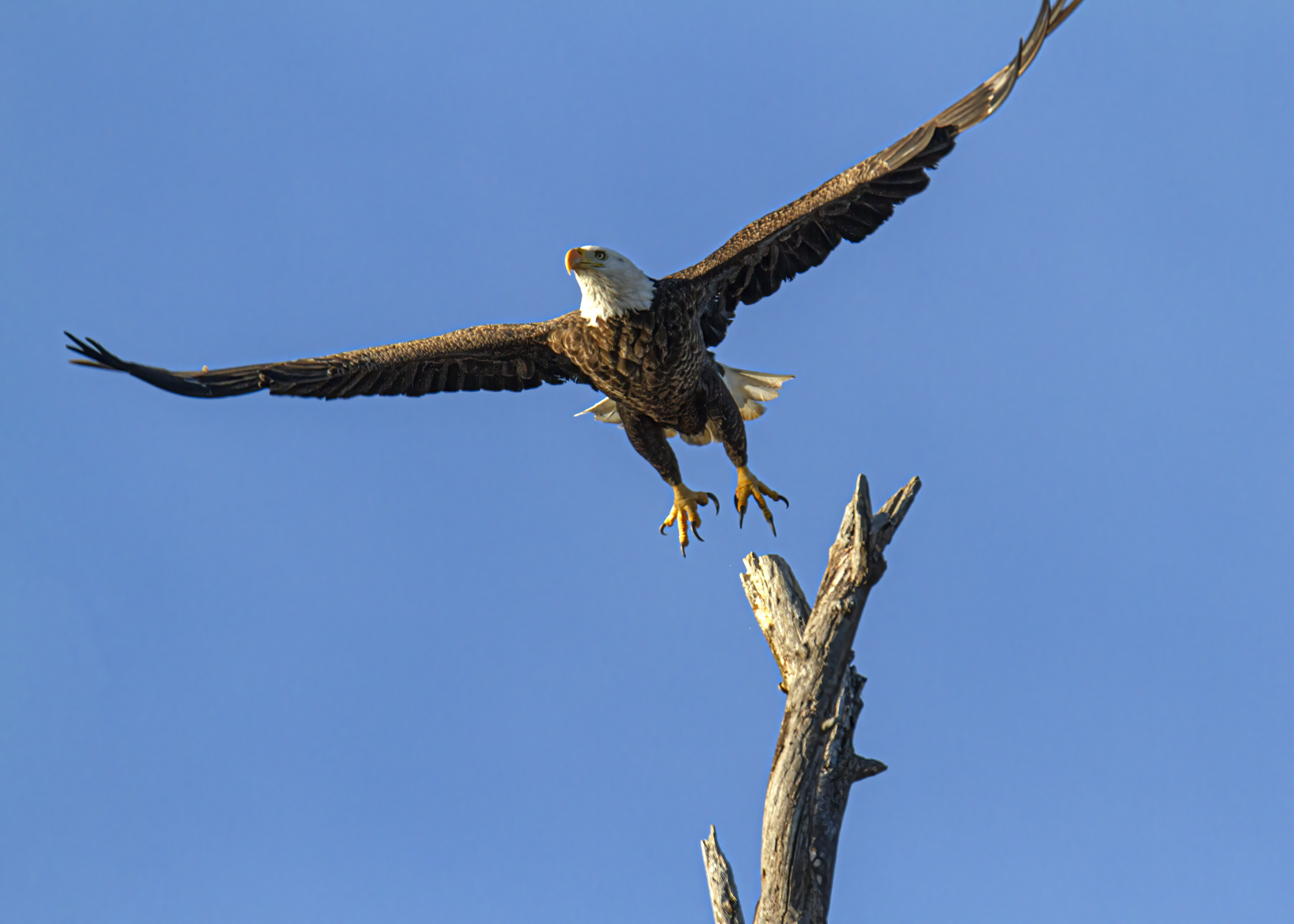
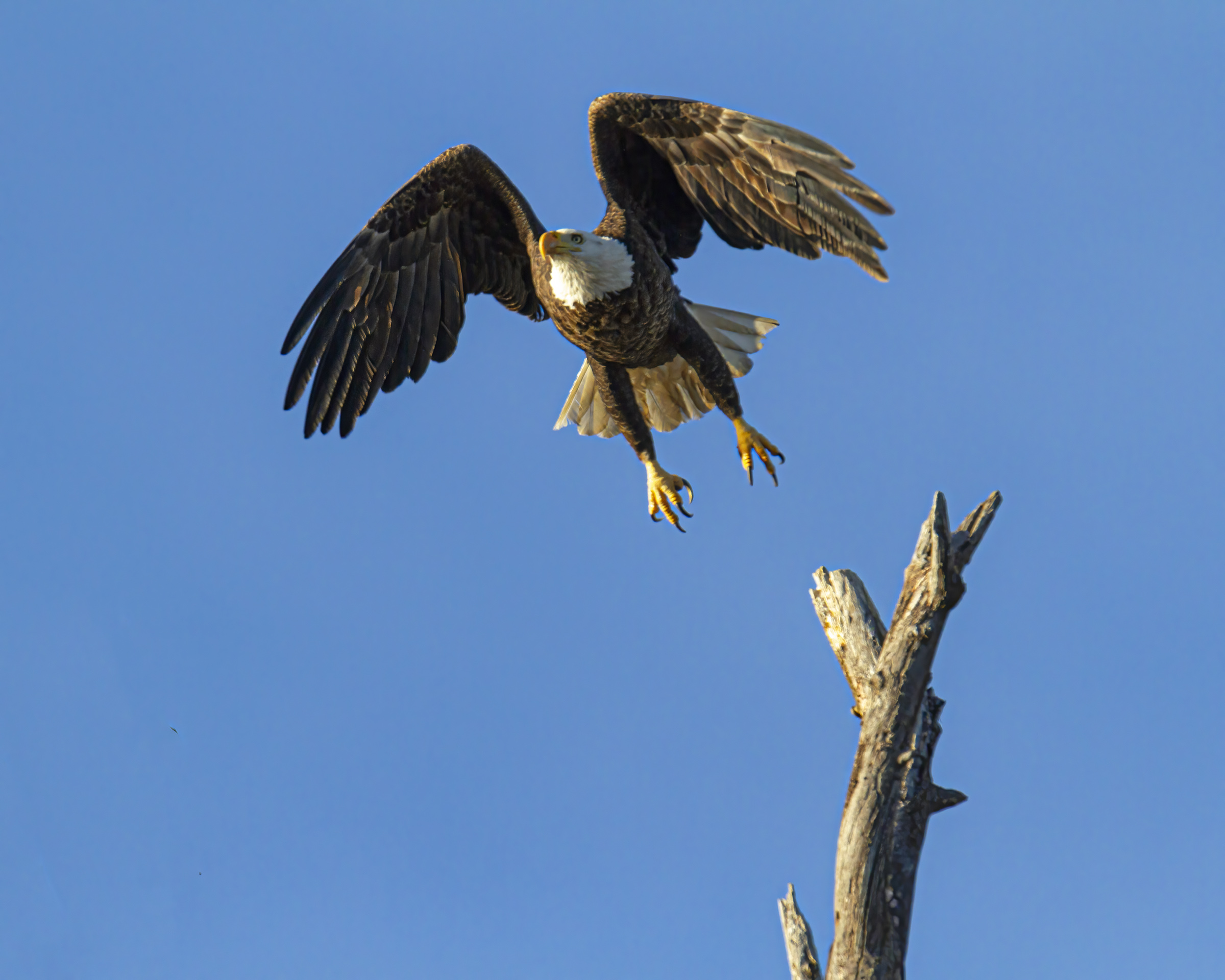
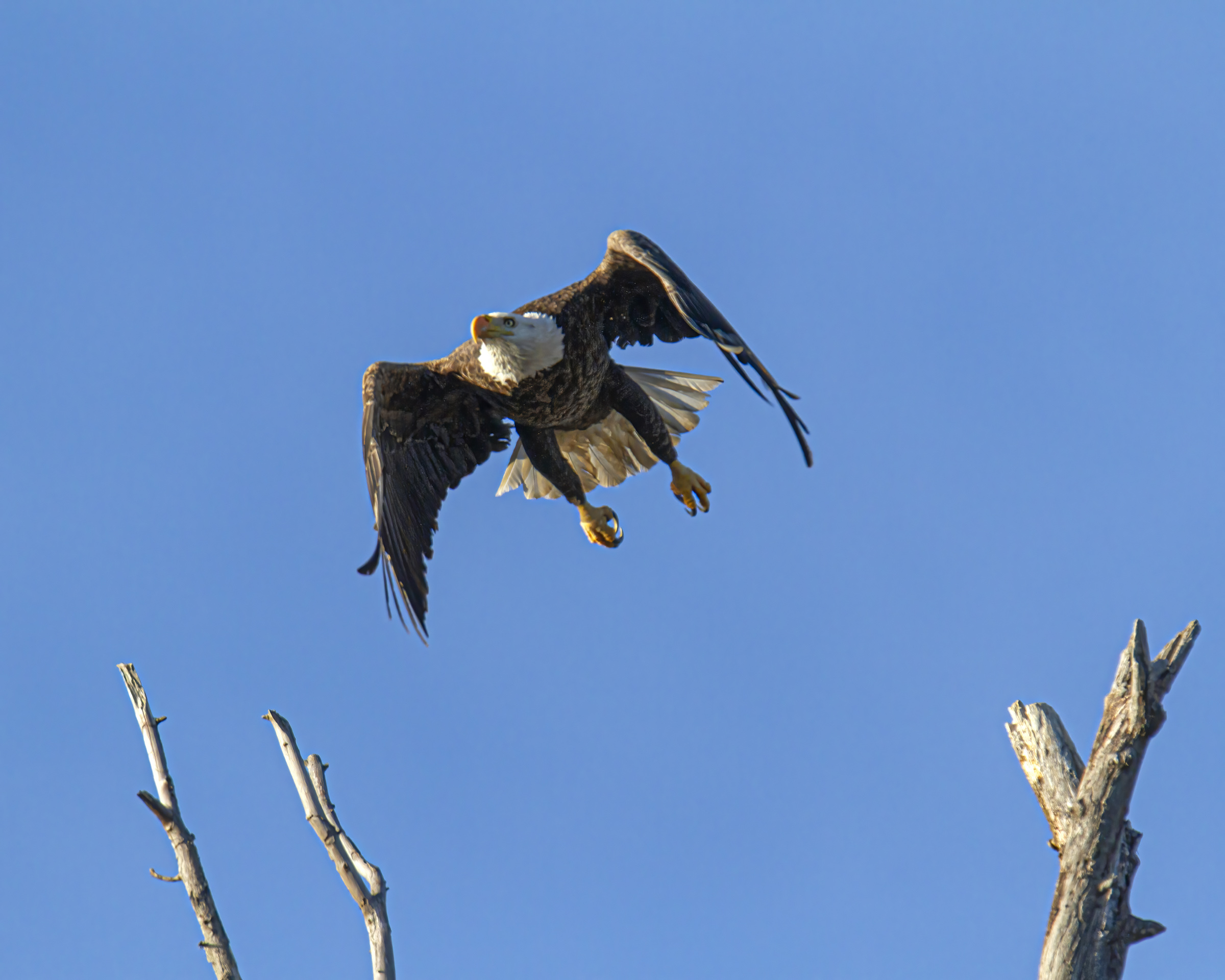
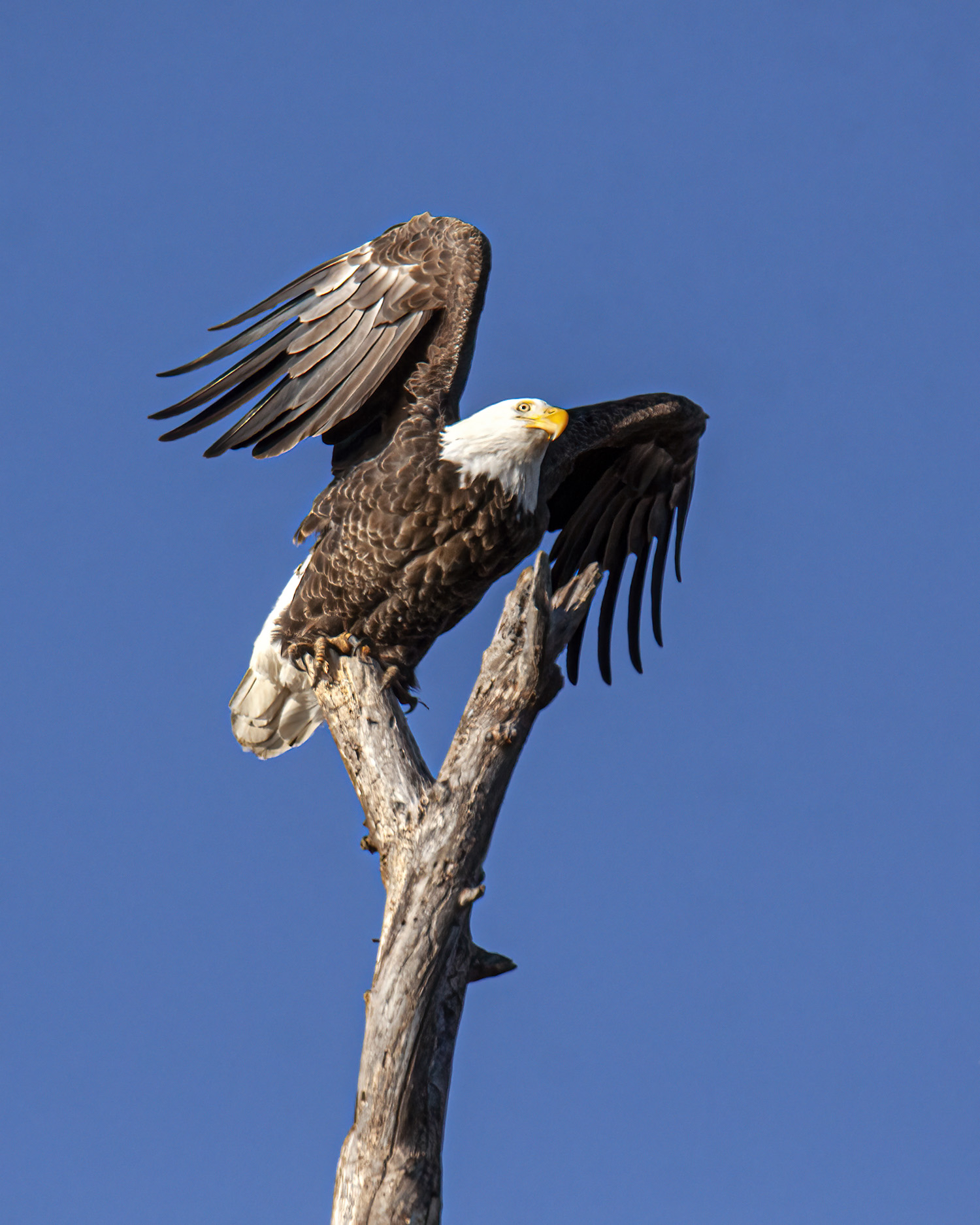
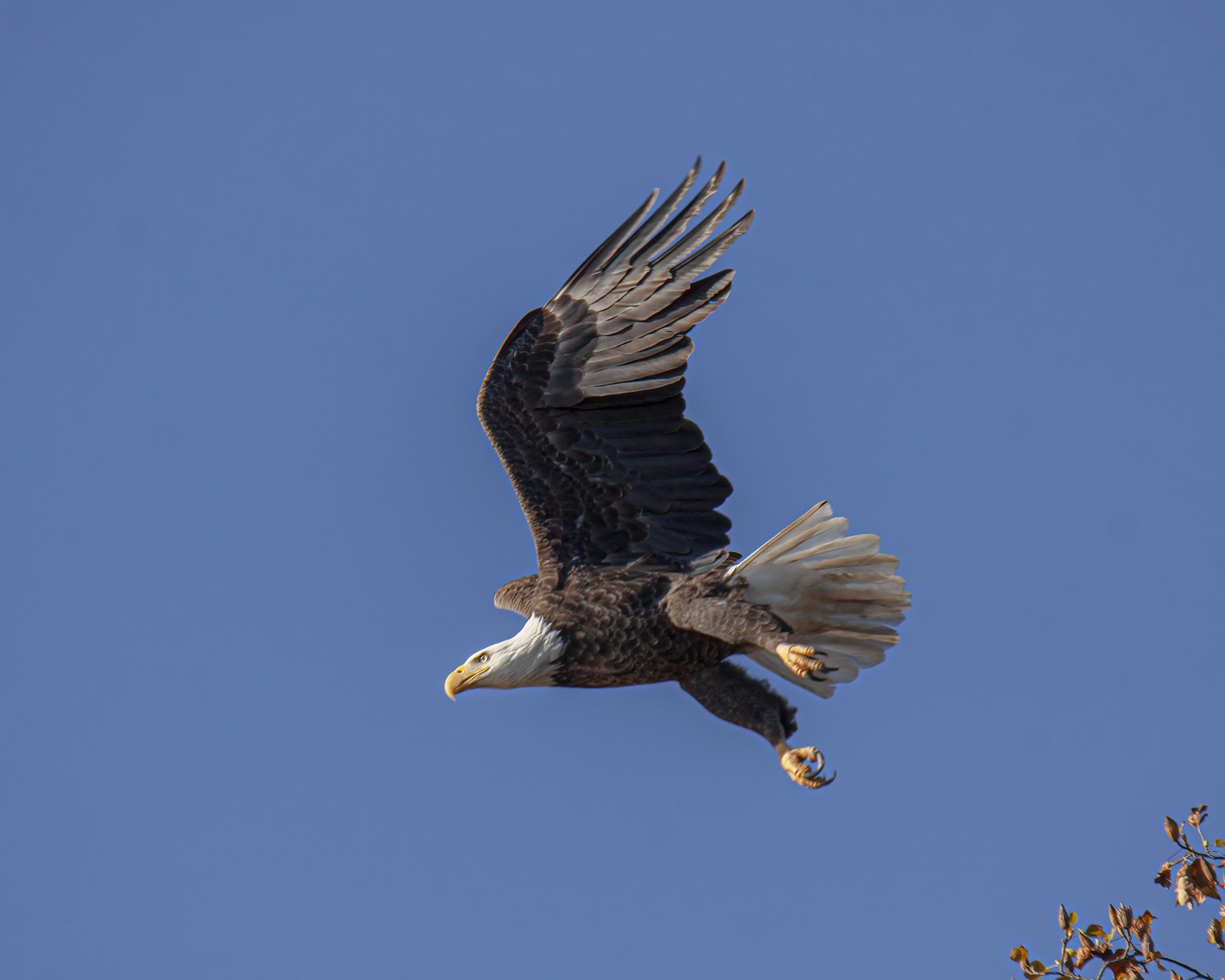
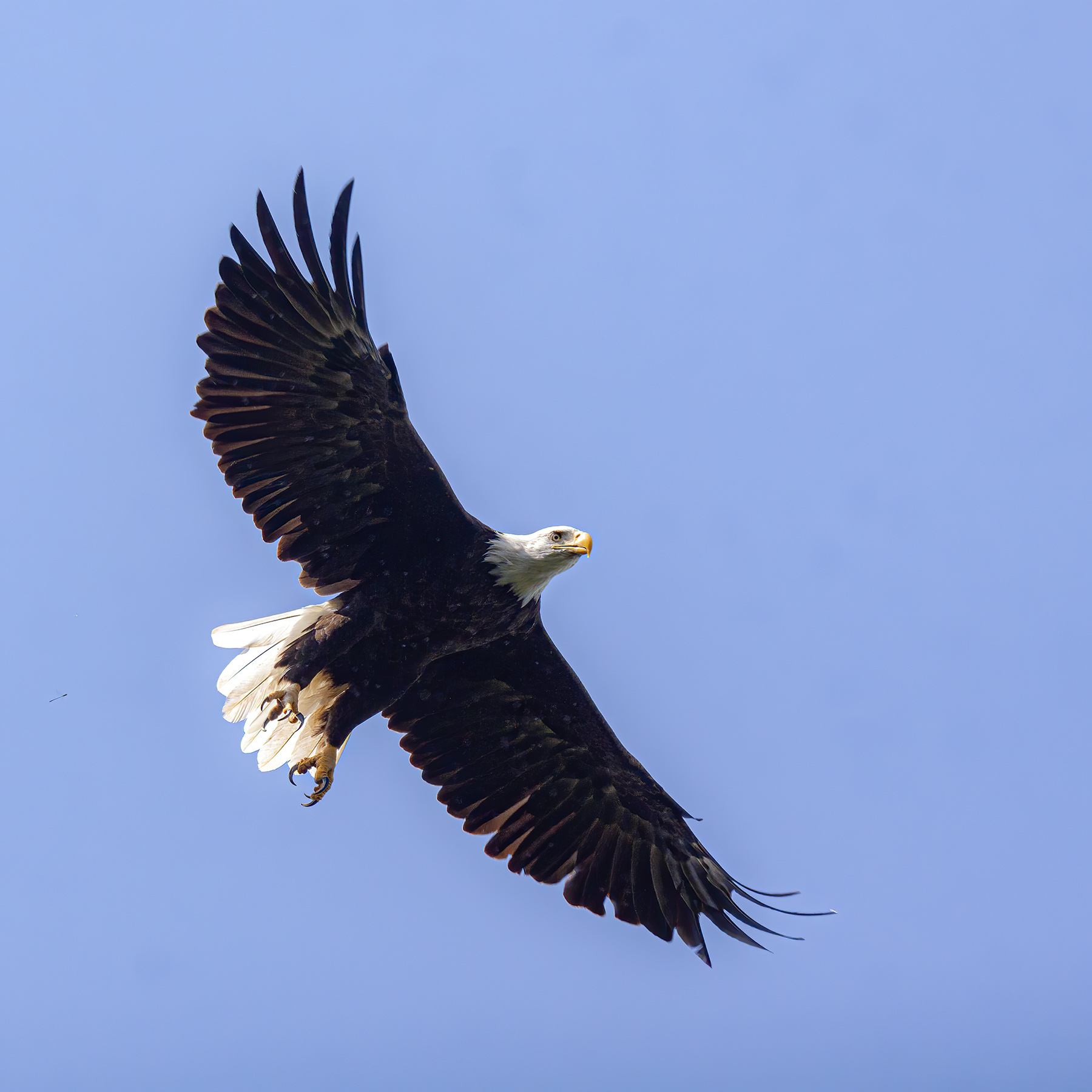
When the leaves are gone from the trees, it’s a little easier to spot perched Bald Eagles (Haliaeetus leucocephalus), like this one that I photographed last week at Occoquan Bay National Wildlife Refuge. I am blessed to live in an area where there are enough bald eagles that it is not uncommon for me to spot one. However, the eagles have much more developed senses that I do, so often my first indication of their presence is when they are flying away from me, as you can see in the first photo below.

In the case of the second photo, there was a good deal of vegetation between me and the eagle that partially hid my presence. I was able to manually focus my lens on the perched eagle through the vegetation and get a relatively clear shot of the eagle, which took off almost immediately after I had snapped a couple of photos.

I am not certain if I will be able to get out with my camera during the few remaining days of 2025, so these photos may well be my last shots of the year of these majestic birds.

Bald Eagle

Bald Eagle

© Michael Q. Powell. All rights reserved.


Read Full Post »

As I rounded a bend in a trail last Monday at Occoquan Bay National Wildlife Refuge, I spotted a Bald Eagle (Haliaeetus leucocephalus) in the foliage of a tree right in front of me. The eagle and I both reacted instantly, but its reflexes were faster than mine and the eagle took the air. I managed to capture a few shots of the departing eagle, a testament to both my luck and a quick reaction in bringing my camera up to my eye.

Bald Eagle

Bald Eagle

Bald Eagle

© Michael Q. Powell. All rights reserved.


Read Full Post »

This Bald Eagle (Haliaeetus leucocephalus) was partially hidden by tree branches when I first spotted during a recent visit to Occoquan Bay National Wildlife Refuge. I tried to move as stealthily as I could to try to get a clearer view of the eagle, but the eagle detected my presence. I captured this image as the eagle was preparing to take off. The eagle flew downwards from its perch and my view was completely obstructed, so I was not able to capture any in-flight shots of the eagle.

As you can see, many of the trees in my area have buds now. I think this tree might be a Sweet Gum tree, because I can see some of its distinctive spiky seed balls still hanging from the tree.

Bald Eagle

© Michael Q. Powell. All rights reserved.

Read Full Post »

Quite often when I review my photos a second time I find photos that I missed during my initial look, like this photo of a Bald Eagle (Haliaeetus leucocephalus) that was just starting its liftoff from a tree last Saturday morning at Occoquan Bay National Wildlife Refuge.

When I spotted this pair of eagles in a distant tree, I watched and waited, hoping that they both would turn in my direction. However, the eagle in the back kept looking in the opposite direction and branches were also blocking my view. Suddenly the eagle in the front raised its wings to take off and I was able to react quickly enough to capture the moment when it was just starting to push off from the branch.

As you can probably tell from the lighting in the photo, this was another early morning encounter with bald eagles. I was very fortunately to have multiple encounters that morning. It will soon be nesting season for the eagles and I hope to able to capture some images as the eagles work on preparing the nests for another season—there are three nesting locations at the wildlife refuge, although one of the nests looks like it may have disappeared, possibly because one of the main supporting branches collapsed.

Bald Eagle

© Michael Q. Powell. All rights reserved.

Read Full Post »

Last Saturday morning I spotted a Bald Eagle (Haliaeetus leucocephalus) perched in the middle of a tangle of small trees at Occoquan Bay National Wildlife Refuge. My view was partially obscured by a large number of branches, but I still managed to focus on the eagle.

I captured this sequence of shots when the eagle unexpectedly took off. The eagle had to maneuver its wings carefully until it was away from the branches and in the final photo the eagle was finally able to display its impressive wingspan.

Bald Eagle

Bald Eagle

Bald Eagle

© Michael Q. Powell. All rights reserved.

Read Full Post »

Two Bald Eagles (Haliaeetus leucocephalus) were perched together in a distant tree early in the morning last Saturday at Occoquan Bay National Wildlife Refuge. One of them suddenly decided to take off and I captured this fun shot. I encourage you to click on the image to get a closer views of the details, including the expression on the eagle that was in mid-air.

Somehow the eagle’s pose reminded me of the winged monkeys in the Wizard of Oz. I guess it has something to do with the dangling legs that look like they could easily snatch up Toto.

The early morning light gave this image a glow that I really like. Photographers sometimes refer to this time of the day as the “golden hour,” though it often lasts for a much shorter period of time.

Bald Eagle

© Michael Q. Powell. All rights reserved.

Read Full Post »

I spotted this Bald Eagle (Haliaeetus leucocephalus) in a distant tree on Tuesday at Occoquan Bay National Wildlife Refuge at about the same time that it spotted me. I reacted quickly and managed to capture this first image as it prepared to take off. As you can see, there is already a bit of color in our autumn foliage, but the colors are relatively muted here in Northern Virginia, compared to what I would see when I was growing up in New England.

The second photo shows the eagle a few seconds after its takeoff as it rose above the trees. At that moment its feet were still dangling, but it raised its “landing gear” shortly after I captured the image.

It has been a while since I last posted eagle photos and it was wonderful to have a couple of sightings of these majestic birds on a beautiful fall day.

Bald Eagle

Bald Eagle

© Michael Q. Powell. All rights reserved.

Read Full Post »

This Bald Eagle (Haliaeetus leucocephalus) was perched just above the large nest last Tuesday at Occoquan Bay National Wildlife Refuge. I was ready when the eagle started to extend its wings, as you can see in the first photo, and managed to capture a series of shots during its takeoff. The images show a variety of the wing positions used by the eagle to lift off and fly forward.

The wings of the eagle were so long that when it extended them upwards, the tips were out of the frame—note that the eagle’s feet were still on the perch in the second photo. When the eagle extended its wings fully to the side and moved upwards into the air, I once again was not quick enough to zoom out and clipped the tips of one wing in the third shot. The final two photos show some additional positions of the wings as the eagle continued to move away from its perch.

The day when I captured these images was an unusually fruitful one for me. I had multiple encounters with eagles and came away with some pretty good shots. As most wildlife photographers are well aware, those kind of day are quite rare, so I was happy to take advantage of my good fortune when the opportunities arose.


Bald Eagle

Bald Eagle

Bald Eagle

Bald Eagle

Bald Eagle

© Michael Q. Powell. All rights reserved.

Read Full Post »

I initially hesitated to post another sequence of shots of a Bald Eagle (Haliaeetus leucocephalus) takeoff, given that I posted a similar set of photos in yesterday’s blog posting. However, I never tire of seeing eagles and I hope that you agree with me. Unlike yesterday’s eagle that flew downward and away from me, the eagle in these shots had a more level flight path and I was able to capture a couple of images as it zoomed past me.

Eagles are a tough subject to photograph because of the extreme contrast between the white feathers on their heads and the dark feathers on their bodies. If the exposure is too far off from what it should be, it is easy to blow out the highlights on the head or to have super deep shadows on the body, both of which lead to a loss of details. When I took these shots, the light was pretty bright, creating shadows that further complicated my efforts.

None of these images is quite as sharp as I would like them to have been, but I am pretty happy with the overall results. Eagles are special and I consider any day when I spot one to be a good day. Capturing shots of one is a bonus.

Bald Eagle

Bald Eagle

Bald Eagle

© Michael Q. Powell. All rights reserved.

Read Full Post »

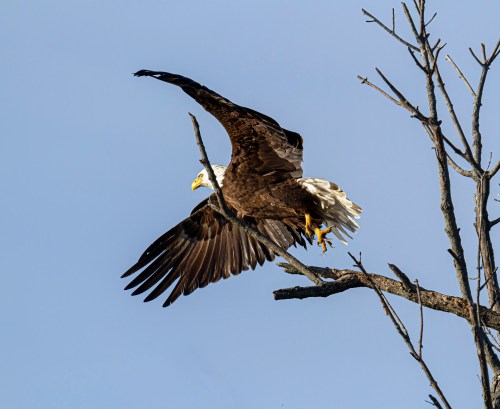
Whenever I am observing a perched Bald Eagle (Haliaeetus leucocephalus), I look for signs that it is preparing to take off. Sometimes there are little clues, like a flex of the wings or a slight movement of the feet, but quite often there is no warning. Usually I have my camera on a monopod, so my arms do not get fatigued as I try to stay ready and focused.

When the eagle actually takes to the air I have to track the movement and anticipate the direction in which the eagle will fly so that I can keep my subject within the frame. In the second image, for example, the eagle could have flown up into the air, but instead, as you can see in the third image, the eagle flew downwards. I was a little slow in following the bird and in the next frame, which I did not post, only half of the eagle was visible.

During a typical visit to the wildlife refuge, I am fortunate if I have one or two encounters of this sort, so I feel a little pressure to take advantage of each opportunity. There are so many variables over which I have no control that success is far from being guaranteed. No matter how good my shots may be, I am always convinced that I can get better ones, which helps to motivate me to go out again and again with my camera.

Technology is always advancing and some of the newer cameras have amazing capabilities to track moving subjects and stay focused on their eyes. Recently I watched a video on YouTube entitled “What is the SKILL and TALENT of a Wildlife Photographer” in which Scott Keys, a wildlife photographer, discussed the relative importance of personality traits, skill, talent, and gear in getting good photos. I highly recommend that you watch this video if you have ever thought about this issue.

Scott and I both agree that the most important of these four is the personality—you need to be patient and persistent, observant and aware in order to maximize the number of opportunities to get “the shot.” Knowledge and practice, which is how I would define skill, would be next in priority order for me. Gear would be in third or even fourth place and talent, i.e. God-given ability, occupying the remaining slot.

 

Bald Eagle

Bald Eagle

Bald Eagle

© Michael Q. Powell. All rights reserved.

Read Full Post »
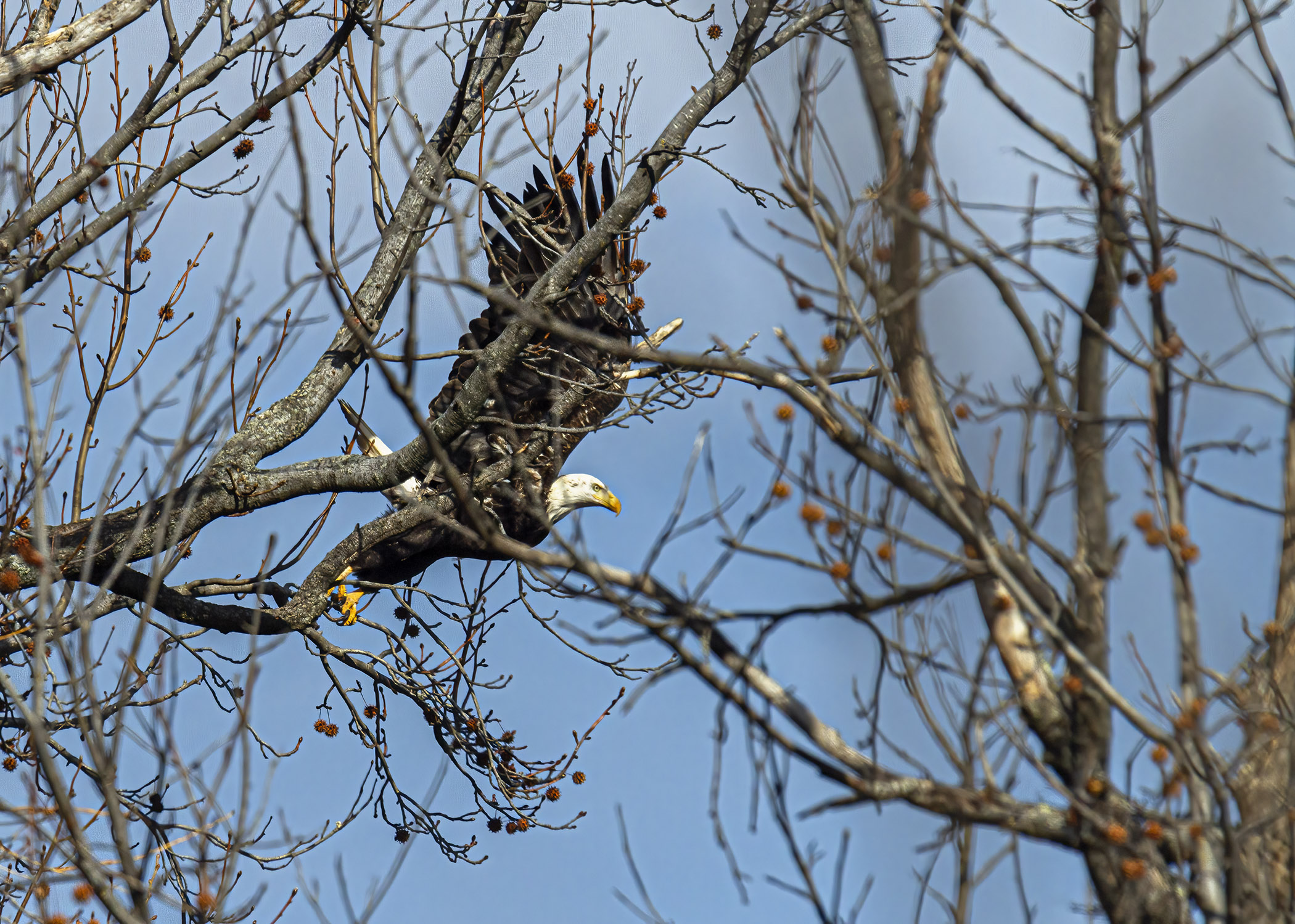
When I spotted the Bald Eagle couple (Haliaeetus leucocephalus) on Tuesday at Occoquan Bay National Wildlife Refuge, they were perched closely together on a branch of a distant tree. My view of them was partially obscured by branches of vegetation, so I had to maneuver around to get a mostly clear shot of them.

I thought that the vegetation would mask my movement and the eagles would not detect my presence. I was wrong. As I was observing them through my long telephoto lens, one of the eagles, the larger of the two, took to the air without warning and I was fortunate to capture its departure from the branch. If you look closely at the perched eagle in the second image, it appears to be giving me a stern look of disapproval. A short time later, the second eagle also flew away.

Bald Eagles

Bald Eagles

© Michael Q. Powell. All rights reserved.

Read Full Post »

Last week I managed to maneuver myself so that I had a clean line of sight to one of the Bald Eagles (Haliaeetus leucocephalus) at Occoquan Bay National Wildlife Refuge. Most of the time my view is at least partially blocked by vegetation or the eagle flies away before I can get myself into position.

This eagle was perched on a broken off tree, not far from a nesting site. I extended my 150-600mm telephoto lens to its maximum length and watched and waited. Fortunately I was using a monopod to steady my camera and lens, so I was able to keep my camera and raised for an extended period of time and the eagle adjusted its feathers and monitored the area from its high perch.

After a while, I noticed that eagle was getting a little fidgety and I correctly anticipated that the eagle was preparing to take off and managed to capture a couple of images as it was doing so. It may sound like a pretty straightforward process, but in fact the eagle has lots of options when it takes to the air—it can fly off in any direction and at any height.

When I am in this kind of situation, I feel a bit like the goalkeeper for a penalty kick in a soccer (football) match. I know that there will be a moment of decisive action and that I will have to react quickly. I will watch my “opponent” for telltales signs of his intentions, but ultimately I will have to commit to one direction as I “guess” when and how it will act. Sometimes the goalkeeper makes the save and sometimes he is outsmarted by the offensive player—that, in essence, is the story of the life of a wildlife photographer.Bald Eagle

Bald Eagle

Bald Eagle

© Michael Q. Powell. All rights reserved.

Read Full Post »

A Bald Eagle (Haliaeetus leucocephalus) was wedged in so tightly between the branches that it almost looked like it was hugging the tree last Thursday at Occoquan Bay National Wildlife Refuge. The eagle was perched in a tree just off of the trail that I was following. The sun was shining brightly, but it was not generating much heat and a breeze was kicking up periodically, ruffling the eagle’s feathers.

I realized that I had a problem when I first focused on the eagle—I was looking right into the sun and the eagle was nothing but a silhouette. On one side of me was thick vegetation and the water of the bay was on the other side, so my options for framing a shot were limited. I realized that the only way that I could get a decent shot of the eagle was to walk past it and then turn to face it with the sun to my back.

Sound crazy, right? I moved as slowly and cautiously as I could and amazingly my plan worked. As the first photo suggests, the eagle was aware of my presence, but did not immediately take off. I observed it silently for a few minutes as it adjusted its position and preened a bit.

I was preparing to move on when suddenly the eagle took off. My camera was zoomed in all of the way, so I was not able to capture the eagle’s full wingspan when it flew almost directly over me as it cleared the sweet gum tree in which it was perched. I managed, however, to get a pretty good shot at the eagle’s body and especially its talons from this unusual shooting angle.

It is almost time for the eagles at the refuge to begin their nesting and authorities have already blocked the roads in some areas of the refuge. With a little luck, though, I will be able to get some shots in the upcoming of the eagle couples as they renovate the nests, albeit from a far greater distance than when I captured the images in this posting.

Bald Eagle

Bald Eagle

Bald Eagle

© Michael Q. Powell. All rights reserved.

Read Full Post »
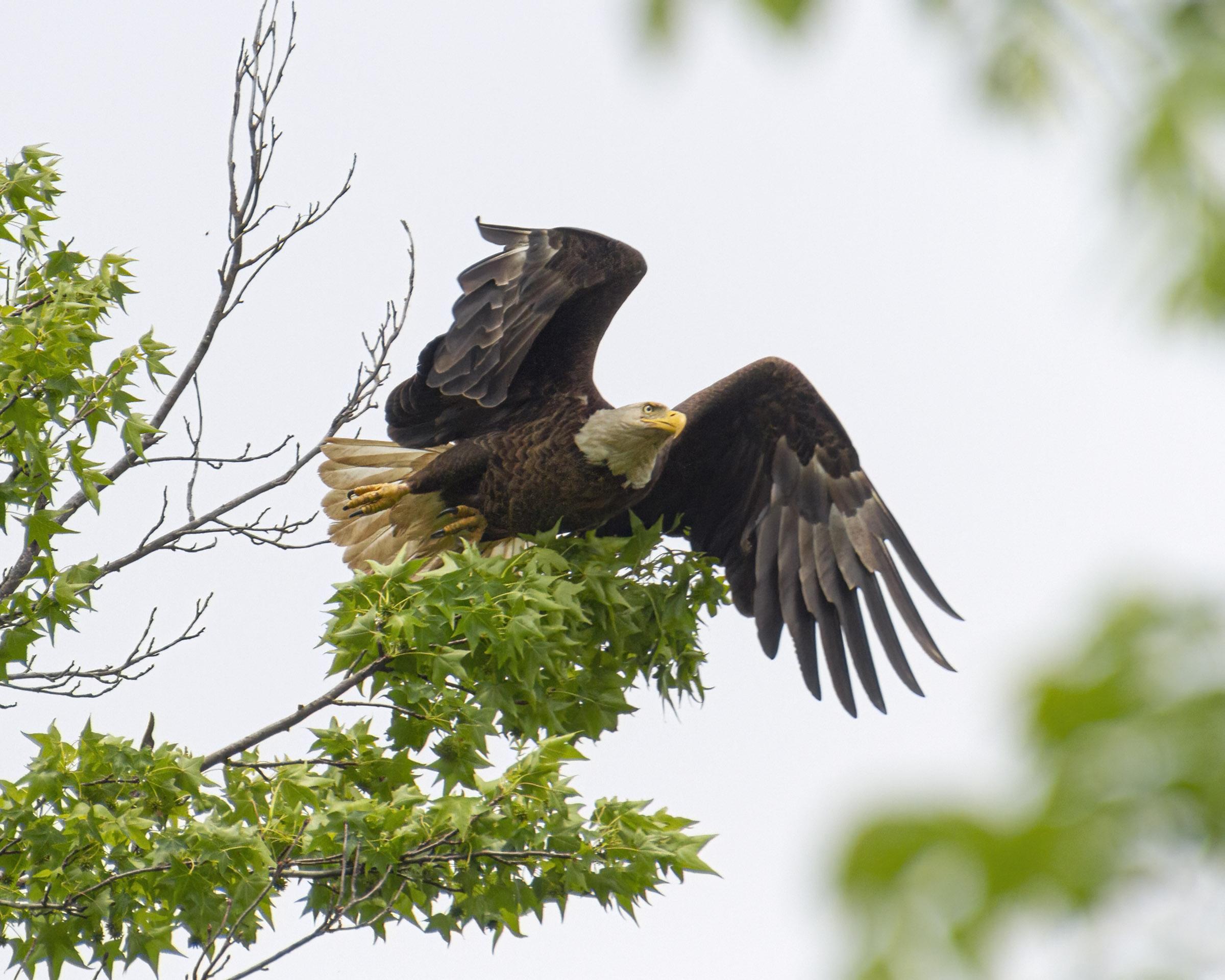
I was thrilled to spot this Bald Eagle (Haliaeetus leucocephalus) at Occoquan Bay National Wildlife Refuge. The eagle was perched high in a tree, as shown in the final photo and kept looking from side to side, as though it was looking for its mate. I am not sure if the eagle was aware of my presence, but all of the sudden it took off and flew away—I should know by now never to underestimate the acuity of an eagle’s vision.

I managed to capture the first shot below as the eagle was really stretching itself out just prior to takeoff. It is an unusual pose that I really like. A split second later I captured the shot of the eagle in flight. There were several other shots in between the first and second images, but I did not track the eagle accurately enough and the eagle’s wings were cut off in those shots.

It has been a while since I last got good shots of a Bald Eagle, so I was particularly happy when this photo opportunity arose.

Here in the US, today is Veterans Day, a day when we honor all those who have served in our armed forces. Elsewhere in the world, today is commemorated in many different ways, including as Armistice Day, the day when World War I ended. Wherever you happen to live, I hope that you never forget the the brave men and women who have served and are serving on your behalf, safeguarding your freedom—we owe them all a debt of gratitude.


Bald Eagle

Bald Eagle

Bald Eagle

© Michael Q. Powell. All rights reserved.

Read Full Post »

It is hard to predict how a Bald Eagle (Haliaeetus leucocephalus) will take off. Will it fly up or down of maybe sidewards? Will it push off its perch or flap its mighty wings and ascend upwards? Will it wait until I am ready or wait and wait until I am not?

This past Thursday I was fortunate to capture an image of this bald eagle as it was leaving its perch at Occoquan Bay National Wildlife Refuge. The eagle was high in a tree and quite a distance away, but I was able to steady my camera on my monopod and capture a decisive moment. Be sure to check out all of the cool details on the eagle’s body, like the rows of chest feathers and the very sharp-looking talons.


Bald Eagle

© Michael Q. Powell. All rights reserved.

Read Full Post »

I was thrilled yesterday at Occoquan Bay National Wildlife Refuge to spot this beautiful Bald Eagle (Haliaeetus leucocephalus). Unfortunately it also spotted me. I captured these images as the eagle began to take off and then as it was flying away.

I was looking for an uncommon dragonfly that had been seen recently at this refuge, so I had my macro lens on my camera and was mostly looking down. As I was passing through a section of the trail that had a lot of tree cover, though, I heard what I thought was the call of an eagle. I slowed down and started scanning the trees. I spotted eagle out on a limb when I stepped partially out of the tree cover. I knew that I was exposed and would be seen, so I positioned myself and prepared for what I anticipated would happen.

I am surprised that I was able to capture such detailed images considering that I was shooting with such a short lens—my 180mm macro lens has an equivalent field of view of a 288mm lens because my camera has an APS-C crop sensor. Be sure to double click on the images if you want to see the details of this majestic bird, including its beak and its talons.

In a way, however, it was an advantage that I was not shooting with my zoom lens, because I could focus all of my efforts on tracking the eagle and did not have to worry about zooming in and out. For example, if I had zoomed in on the eagle for the second shot when its body was compact, I would probably have clipped its wings when it spread them wide open in the third shot.

I did not find the dragonfly that I was looking for, but, as I have said repeatedly in this blog, any day that I see a bald eagle is a good day, especially when I manage to photograph it.

Bald Eagle

Bald Eagle

Bald Eagle

© Michael Q. Powell. All rights reserved.


Read Full Post »

I spotted this Bald Eagle last week at Occoquan Bay National Wildlife Refuge. The eagle was initially mostly hidden by branches, but I managed to get a clear shot of its head when it leaned forward and started to take off.

This month I have been particularly fortunate in finding eagles and in getting some pretty good shots of them. It is almost time for them to be nesting and before long portions of the refuge will be closed to keep the eagles from being disturbed. In the mean time I continue to walk the trails, trying to stay alert as I scan the trees and the skies for the possible presence of one of these majestic birds.

bald eagle

© Michael Q. Powell. All rights reserved.

Read Full Post »

I never get tired of photographing Bald Eagles (Haliaeetus leucocephalus). Here is a shot of one taking off from a tree last week at Occoquan Bay National Wildlife Refuge. My view was partially obscured by branches, but I somehow managed to keep the eagle’s eye in focus.

I never got a fully clear shot of the eagle when it was perched, so it was a happy surprise that I was able to capture this image when it started to take off. I think the eagle’s pose here is more dynamic than any shot I could have taken when it was in a static position, so it is not a huge loss that I have no perched pose.

bald eagle takeoff

© Michael Q. Powell. All rights reserved.

Read Full Post »

Although I am normally a little unhappy when I cut off the tip of a bird’s wings when taking its photo, the intensity of this Bald Eagle(Haliaeetus leucocephalus) more than made up for any sense of disappointment and I am actually thrilled with these shots. I was standing close only a short distance from the eagle last Thursday at Occoquan Bay National Wildlife Refuge and was concentrating on photographing it while it was perched. When the eagle suddenly extended its wings and took off without warning, my immediate reaction was to concentrate on tracking it rather than worry about pulling back on the zoom and in all three of these photos I clipped the wings.

I decided to present the photos in reverse chronological order, because the first image is my favorite. If you look closely you will note that the eagle snagged a few spiky balls from the sweet gum tree in which it was perched, sending them flying and leaving one stuck in its tucked-in talons. You can also see how the eagle generated its initial lift with a flap of its impressive wings in the final photo and then pushed off with its talons to clear the branches in the penultimate image.

Bald Eagle

Bald Eagle

Bald Eagle

© Michael Q. Powell. All rights reserved.

Read Full Post »

This is definitely not Paris. Yesterday, less than 24 hours after my return from my stay in Paris, I was back on the trails at Occoquan Bay National Wildlife Refuge, one of my favorite places to photograph wildlife.

It was a cloudy, blustery day and there was not a lot of wildlife active, but I did manage to capture this shot of a Bald Eagle (Haliaeetus leucocephalus). From a distance, I spotted the top of the eagle’s head as it hunkered down in a nest, presumably seeking shelter from the wind. Although I was a pretty far away, it spotted me and quickly took to the air. My vision is really good after my cataract removal surgery a couple of years ago, but when it comes to being “eagle-eyed,” I am no match for the real thing.

Bald Eagle

© Michael Q. Powell. All rights reserved.

Read Full Post »

Any day that I spot a Bald Eagle (Haliaeetus leucocephalus) is a good day. Yesterday qualified as a great day when I was able to capture an image of a Bald Eagle taking off from the slender branches of a tree at Occoquan Bay National Wildlife Refuge.

I was a bit shocked when I initially spotted the eagle perched in a cluster of leaves overhanging one of the trails at the wildlife refuge—presumably there was a branch in there somewhere, but it did not seem substantial enough to hold the weight of an eagle.

I zoomed in all the way with my 150-600mm lens and was able to get a pretty detailed shot of the eagle, as you can see in the final shot. The eagle turned its head in various directions and I knew that I did not have much time before it decided to take off. When the eagle turned its body toward the water and began to crouch, I tried to ready myself and anticipate the direction of its initial movement. In most of the shots in the burst that I took, the eagle’s wings blocked its face or extended well beyond the edges of the frame, but I was pretty happy with the one that I posted as the initial photo in this posting.

Why did the eagle choose such a precarious perch? I have no idea why, but I am happy that it gave me the chance to get these shots.

Bald Eagle

Bald Eagle

Bald Eagle

© Michael Q. Powell. All rights reserved.

Read Full Post »