Feeds:
Posts
Comments

Posts Tagged ‘bald eagle nest’

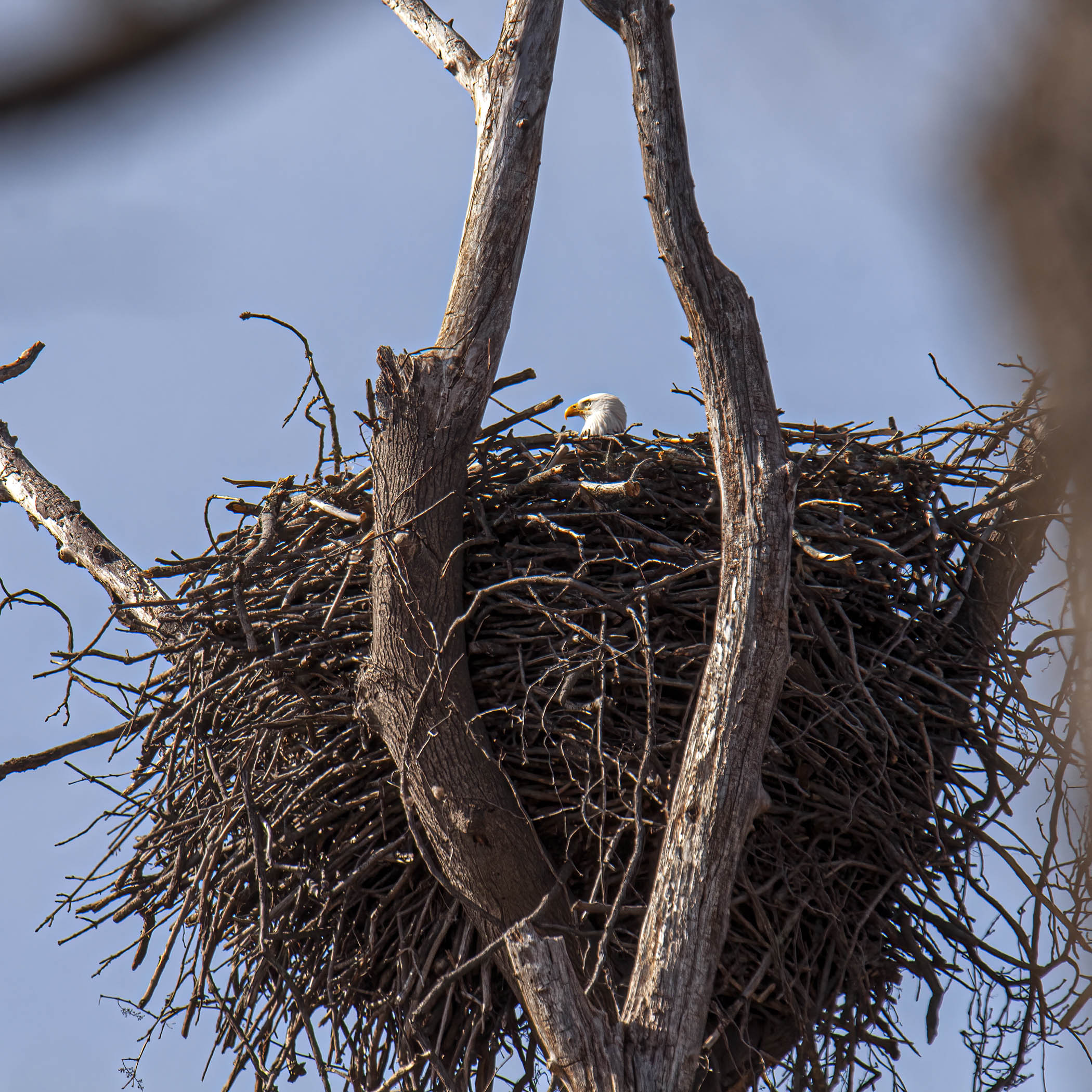
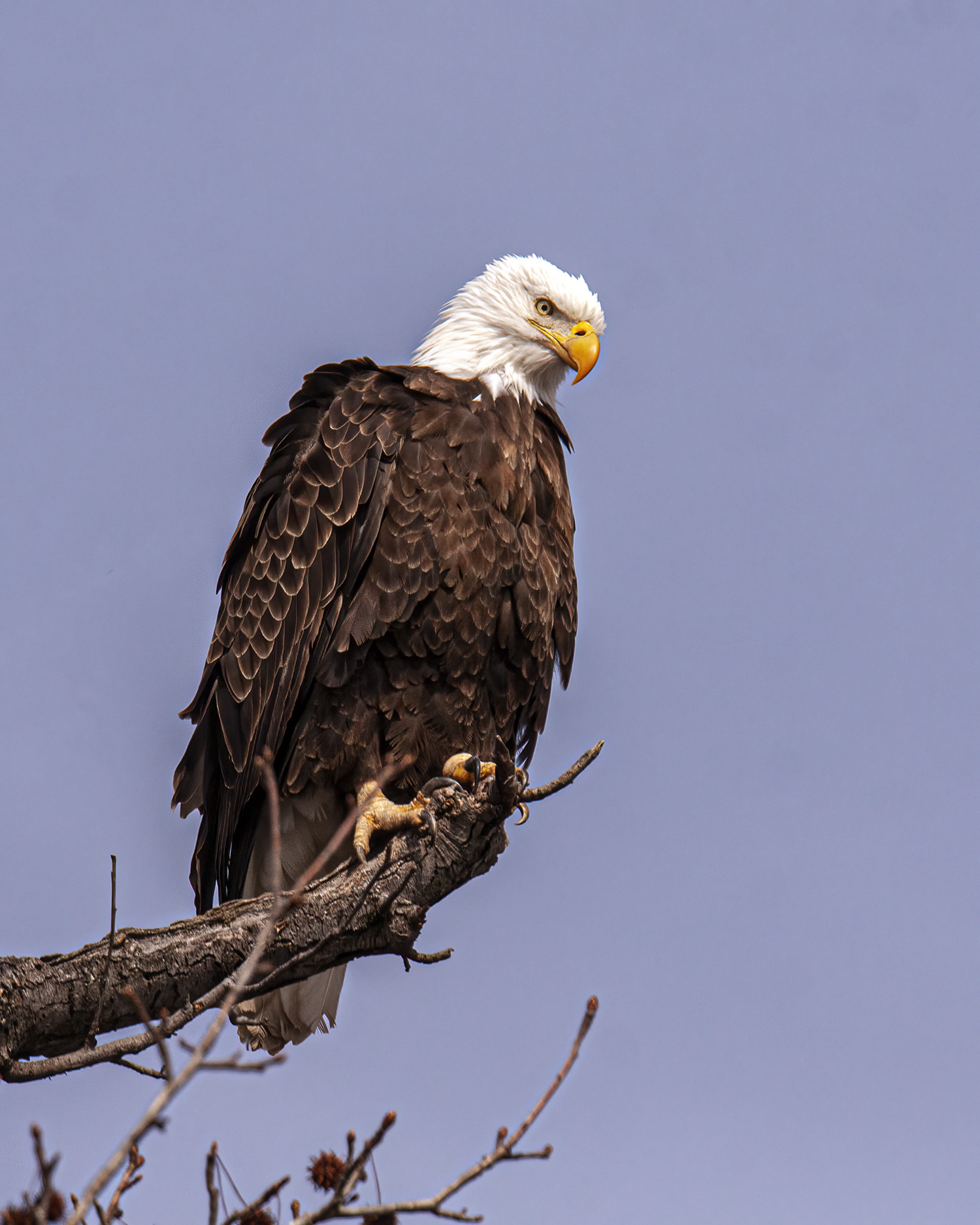
Earlier this season, it looked like a pair of Bald Eagles had occupied a large nest at Occoquan Bay National Wildlife Refuge. Each time that I visited the refuge, I would check the nesting site to look for indications that an eagle was sitting on eggs. Unfortunately, the nest is so deep and so high up that it is almost impossible to tell if an eagle is inside of the nest.

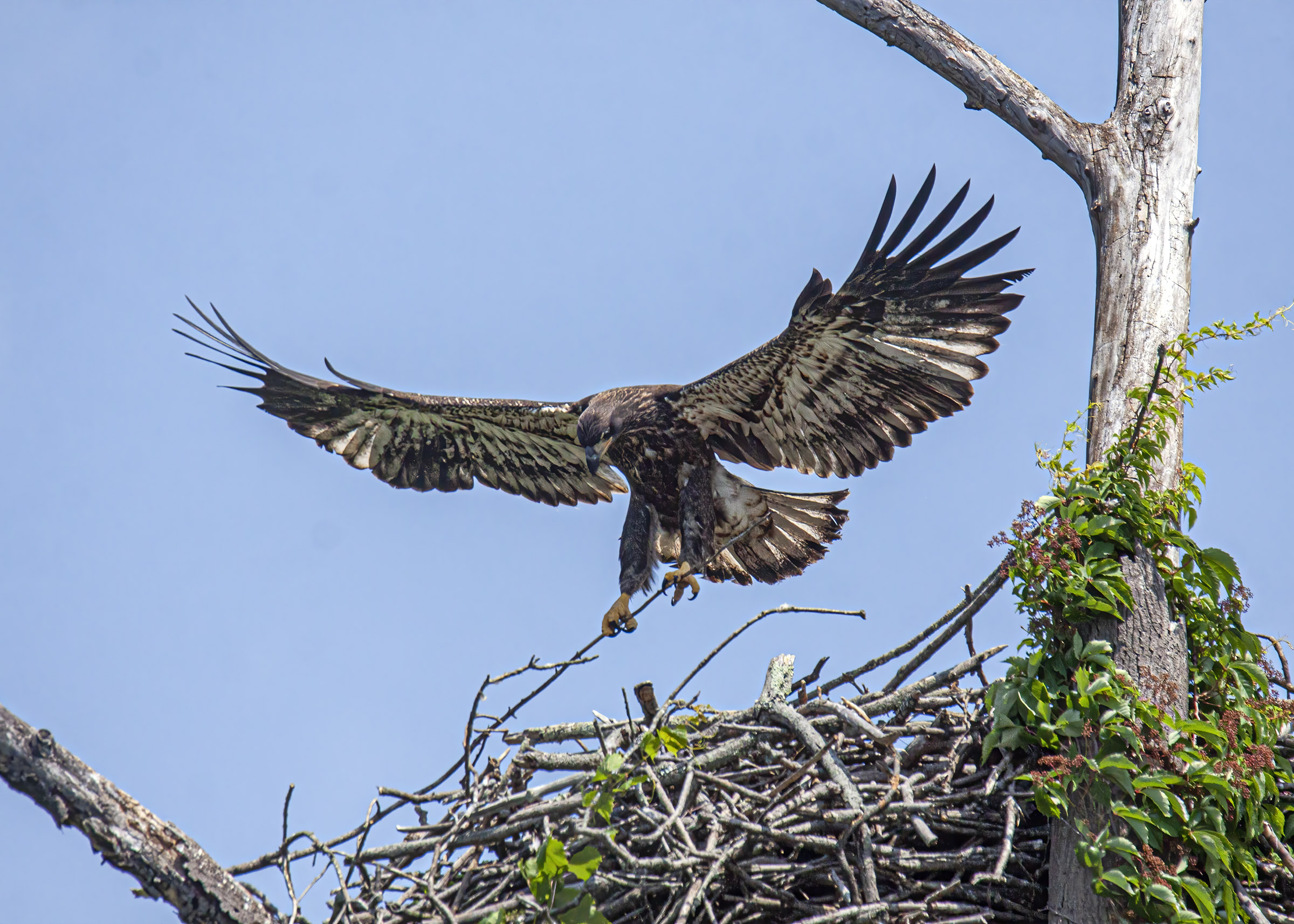
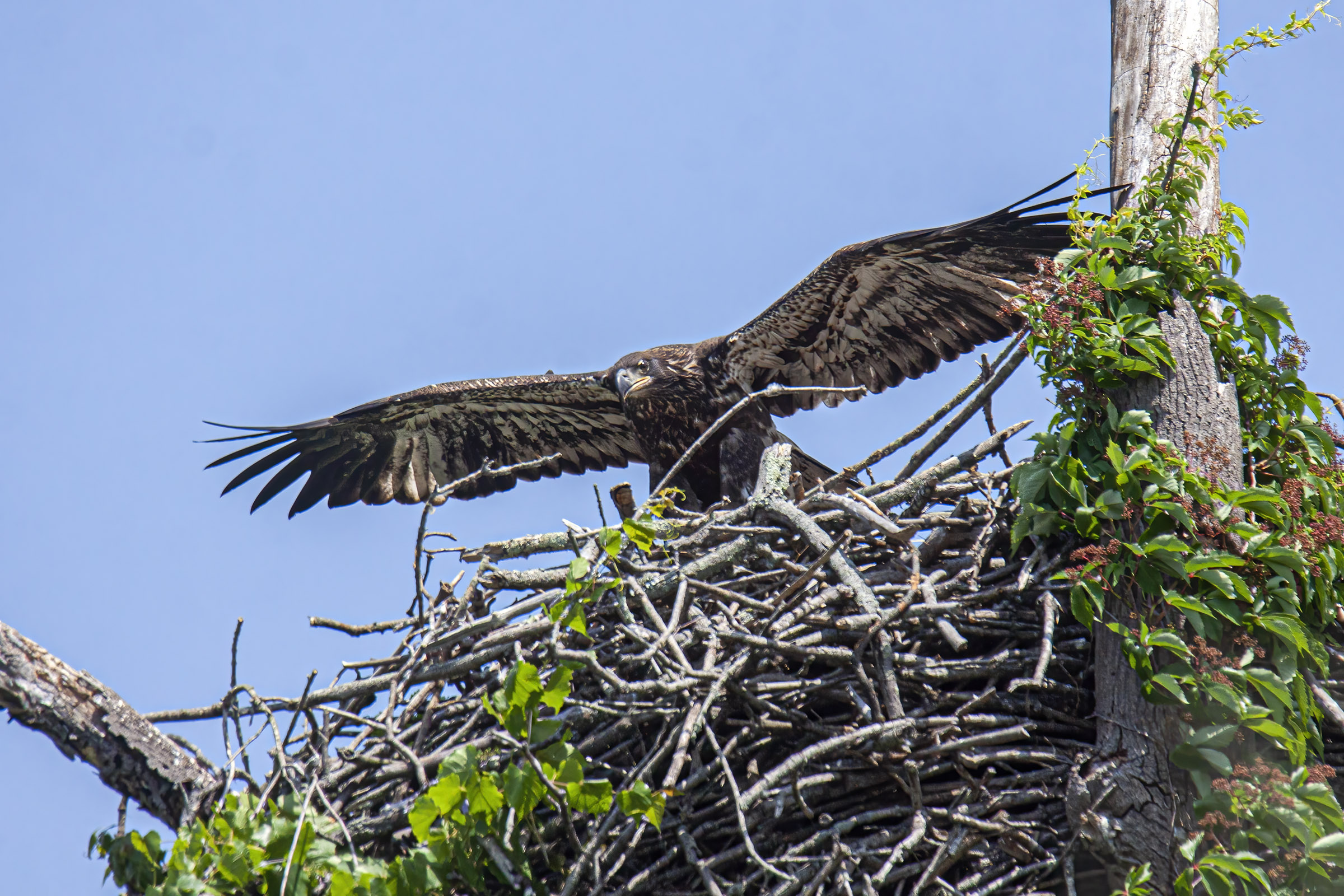
Last week, I watched a pair of Ospreys (Pandion haliaetus) fly into the nest and seize it and captured this shot of them doing so. Generally ospreys use much smaller, thrown-together nests, but I guess that this pair decided to advantage of what I assume is a currently unoccupied eagle nest.

As I watched the two ospreys approach the nest with dangled legs, I couldn’t help but think of the scenes from the Wizard of Oz movie in which the flying monkeys seized Dorothy. The mind works in strange ways.

osprey

© Michael Q. Powell. All rights reserved.


Read Full Post »

As many of you know, I keep an eye on several eagle nests at Occoquan Bay National Wildlife Refuge at this time of the year, waiting with hopeful expectation for the birth of new eaglets. In one nest that is relatively small, the adult Bald Eagle (Haliaeetus leucocephalus) is now sitting upright, rather than hunkering down over the eggs to keep them warm. I suspect that there is at least one eagle baby, but I have not yet seen any tiny eagle heads pop up over the edge of the nest.

I am not sure what’s happening with the much larger eagle nest. I had assumed that the eagles were sitting on eggs. However, on Tuesday I watched as an osprey perched on one of the trees supporting the nest and buzzed a nearby perched eagle. Several other photographers have reported seeing osprey actually sitting in the eagle nest.

As I observed the nesting area on Tuesday afternoon, two eagles in a tree overlooking the nest briefly engaged in what looked like mating behavior. Was an earlier nesting attempt unsuccessful? Are the eagles going to make another attempt to have babies this season?

It is a bit late in the year for the eagles to begin nesting, but I think there is still time for them to do so. Normally this process begins earlier in the year before the ospreys have returned, so there is no competition for the nest. Although there appears to be competition now, I would put my money on the eagles, which I believe are larger and stronger than the osprey.

I will continue to monitor the nesting situation. There may be more drama there this spring than in previous years.

Bald Eagle

© Michael Q. Powell. All rights reserved.


Read Full Post »

When I watched a Bald Eagle (Haliaeetus leucocephalus) fly into a nest on Monday at Occoquan Bay National Wildlife Refuge, I was not sure if it was occupied. We have reached the time of the year when the eagles at this refuge begin to sit on their eggs, but I did not know if the process had begun at this small nest that was used for the first time last year. As you can see in the first photo, the nest is only about as wide as the eagle’s outstretched wings.

After the eagle had landed and settled down, the body of a second eagle appeared from within the nest. I never did get a good look at the second eagle, because it kept its head down as it made some adjustments in the nest while the newly arrived eagle waited patiently to take over nest responsibilities.

One eagle flew away and the remaining one sank lower from view as it spread its body to cover the eggs. The nest is quite shallow, though, so I could still see the top of the eagle’s head most of the time. Occasionally the eagle would raise its head a little and I was able to capture a few shots like the final one here in which the eagle was looking up into the sky, wondering perhaps when its mate would return to the nest.

Bald Eagle

Bald Eagle

Bald Eagle

© Michael Q. Powell. All rights reserved.

Read Full Post »

Have you ever tried to sneak up on a Bald Eagle (Haliaeetus leucocephalus)? Given the eagles’ superior eyesight and quicker reactions, they almost always detects me before I can get within camera range and often my first indication of an eagle’s presence is when I see it flying away from me.

As many of you know, there are several eagle nests at Occoquan Bay National Wildlife Refuge and this is the time of the year when eagles begin nesting in them. The roads are blocked in the area surrounding one of the nests, so it is hard to get a good look at it. The largest nest, though, is set way back in the trees, but is visible from one of the main trails, which remains open.

During a visit to the refuge on Wednesday (Valentine’s Day), I noticed through the trees that both members of an eagle couple were perched atop the nest. Male eagles are often smaller than the females, so I think that the eagle to the left in the first photo is a male. I was still a long way from the nest when I captured that first photo, but experience has taught me that it is best to capture a “record” shot, before trying to get closer for a better one.

I continued down the trail in the direction of the eagle nest doing my best to walk near the high vegetation at the edge of the trail that blocked the eagle from seeing me and, alas, prevented me from seeing the eagle.

I know where the spots are where there is an open view of the nest and I prepared myself as I approached the best one. As I stepped partially into the open and raised my camera, one of the eagles took off and I captured the second shot below. As I was trying to track that eagle in the air, the second one took off too and I watched as they both flew away over the waters of the bay.

Before long, the eagles should be sitting on one or more eggs in the nest. The nest is quite deep and high up that it is almost impossible to tell if there is an eagle in the nest when they are incubating the eggs. The members of the couple rotate the responsibility for sitting on the eggs and I have been lucky on a couple of occasions to see the “changing of the guards.” Perhaps I will have that same good fortune this year.

Bald Eagle

Bald Eagle

© Michael Q. Powell. All rights reserved.

Read Full Post »

Bald Eagles (Haliaeetus leucocephalus) at Occoquan Bay National Wildlife Refuge are increasingly spending time in and around existing eagle nests. It probably won’t be long before eggs are laid and the eagles begin to sit on the eggs.

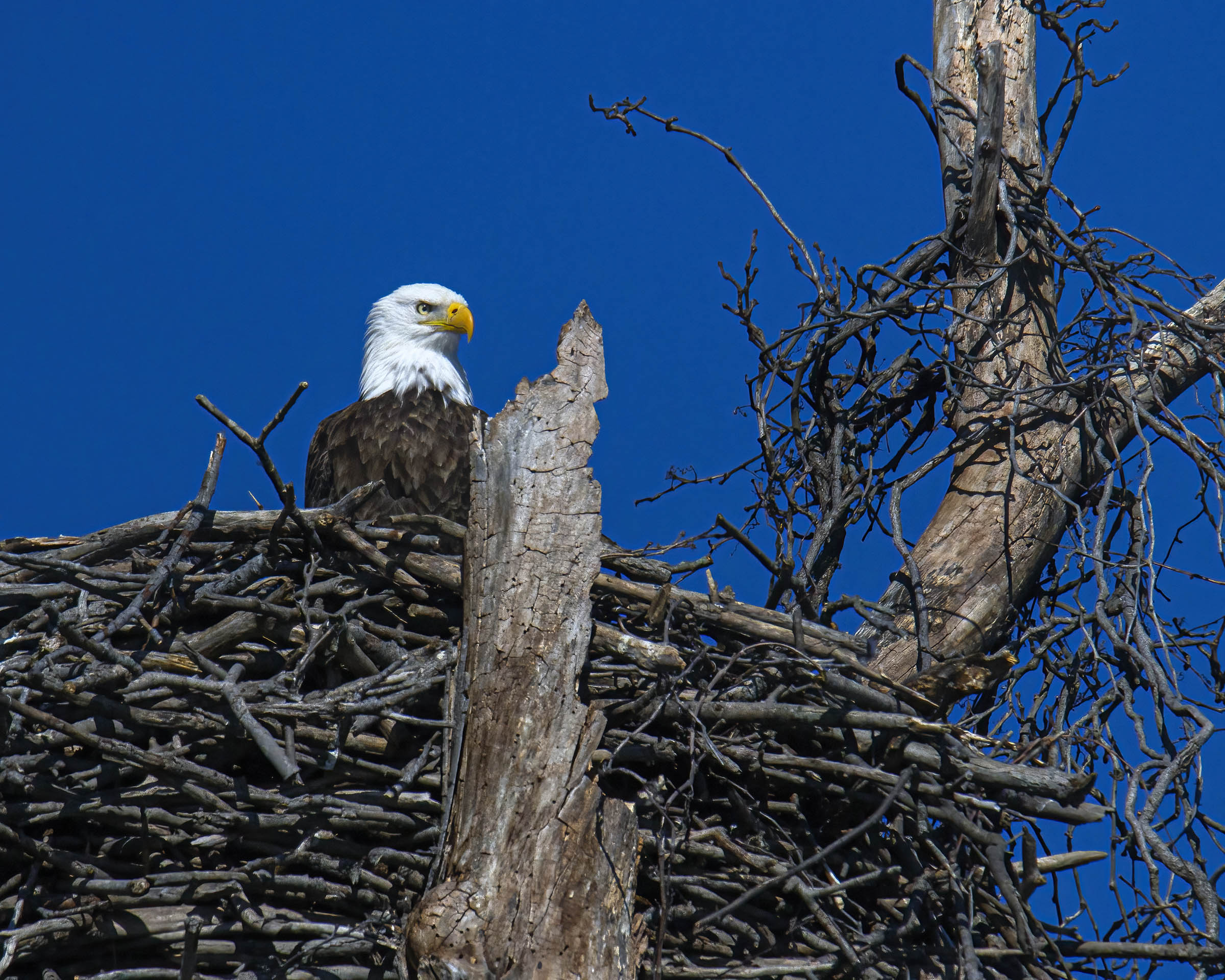
On Thursday I spotted an eagle perched high in a nest while its mate kept watch from a nearby tree, as you can see in the final photo. This eagle nest is huge and is by far the largest one at the wildlife refuge. The nest has been used for many years and each year the eagles seem to add another layer to it. It was very easy to spot this eagle, because its bright white head was sticking prominently out of the nest.

When the eagles begin incubating the eggs, however, they hunker down in the deep nest and it is usually impossible to know for certain when they are present. During that period of time I will sometimes watch and wait, hoping to be there for the “changing of the guard,” when one member of the couple takes over duties from the other, but I have been lucky enough to be there only a few times when that happened. Otherwise I have to wait for the eaglets to get big enough to poke their little heads out of the top edge of the nest.

On another part of the refuge, barriers have now gone up to protect the nesting eagles at that location. That nest is adjacent to one of the trails, whereas the large nest pictured here is far enough away from the trail that the authorities do not seem to think that the eagles require additional protection.

Bald Eagle

Bald Eagle

Bald Eagle

Bald Eagle

© Michael Q. Powell. All rights reserved.


Read Full Post »

It won’t be long before the Bald Eagles (Haliaeetus leucocephalus) begin to incubate their eggs at one of several nests of which I am aware at Occoquan Bay National Wildlife Refuge. The smallest nest was used for the first time last year and I was curious to see if the eagles would return to it. I was therefore quite happy to spot an eagle on Tuesday perched in that nest in what looks to be a sycamore tree. Usually eagles sit much lower in the nest when there are eggs present, so I suspect that this eagle was checking out the nest, possible as a prelude to renovating or enlarging it.

I was a pretty good distance away from the eagle and was partially hidden by vegetation and trying to be stealthy, but the eagle detected my presence. I captured the second image right after the eagle flew out of the nest. I managed to get only a single decent shot, because the eagle descended and was immediately hidden by the abundant branches—if the eagle had flown upwards I might have had a better chance of getting several clear shots.

Last year the authorities at the refuge eventually blocked the trail on which I was traveling to keep the eagles from being disturbed during the nesting season. I would not surprised to find the trail blocked the next time I visit the refuge. During the period of time before the trees begin to leaf out, I may still be able to keep track of the nest, albeit from a slightly greater distance from it.

Bald Eagle

Bald Eagle

© Michael Q. Powell. All rights reserved.

Read Full Post »

It is almost nesting time for the Bald Eagles (Haliaeetus leucocephalus) at Occoquan Bay National Wildlife Refuge. Last Friday I spotted two eagles perched in the trees adjacent to the very large nest that has hosted numerous eagle couples over the years.

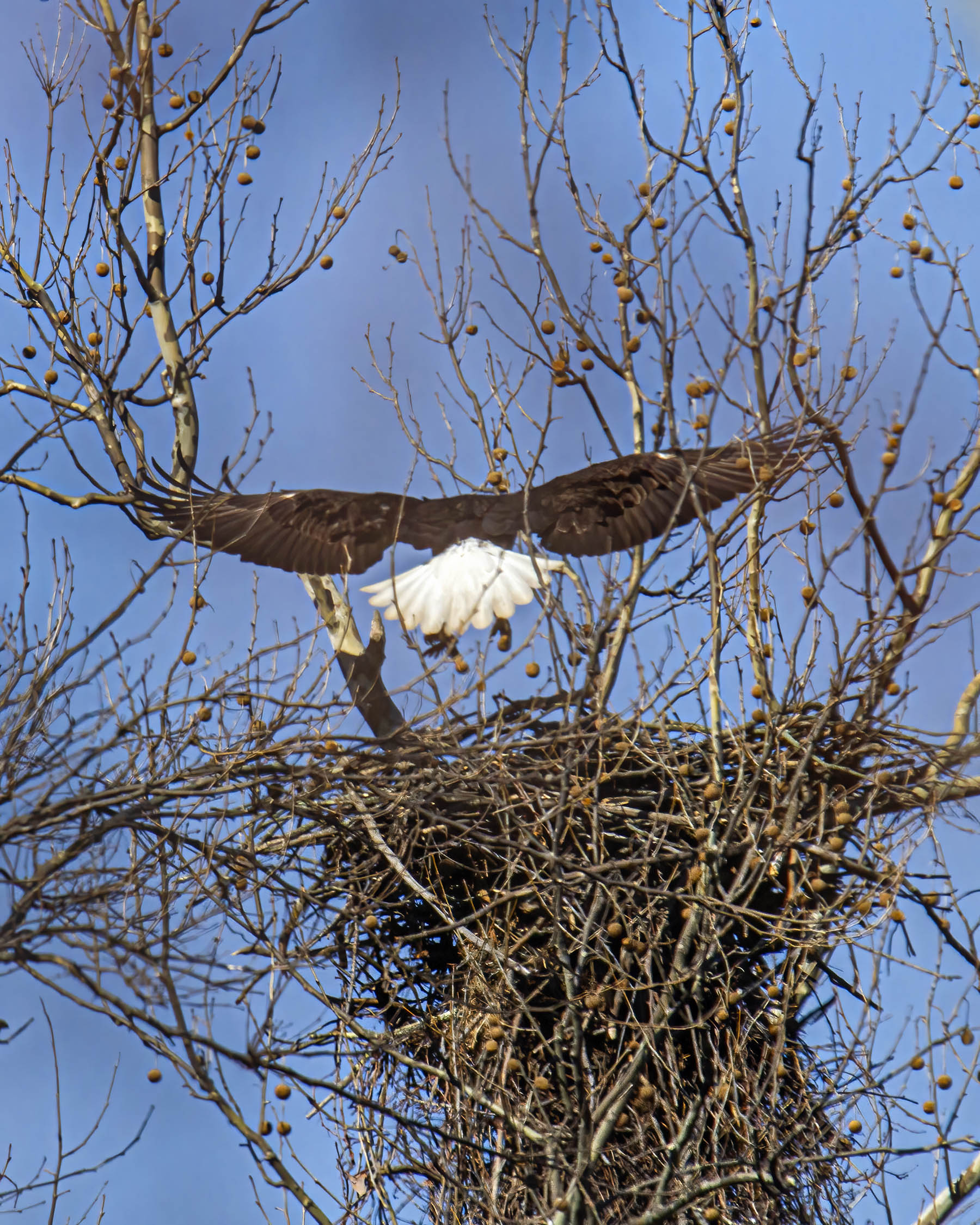
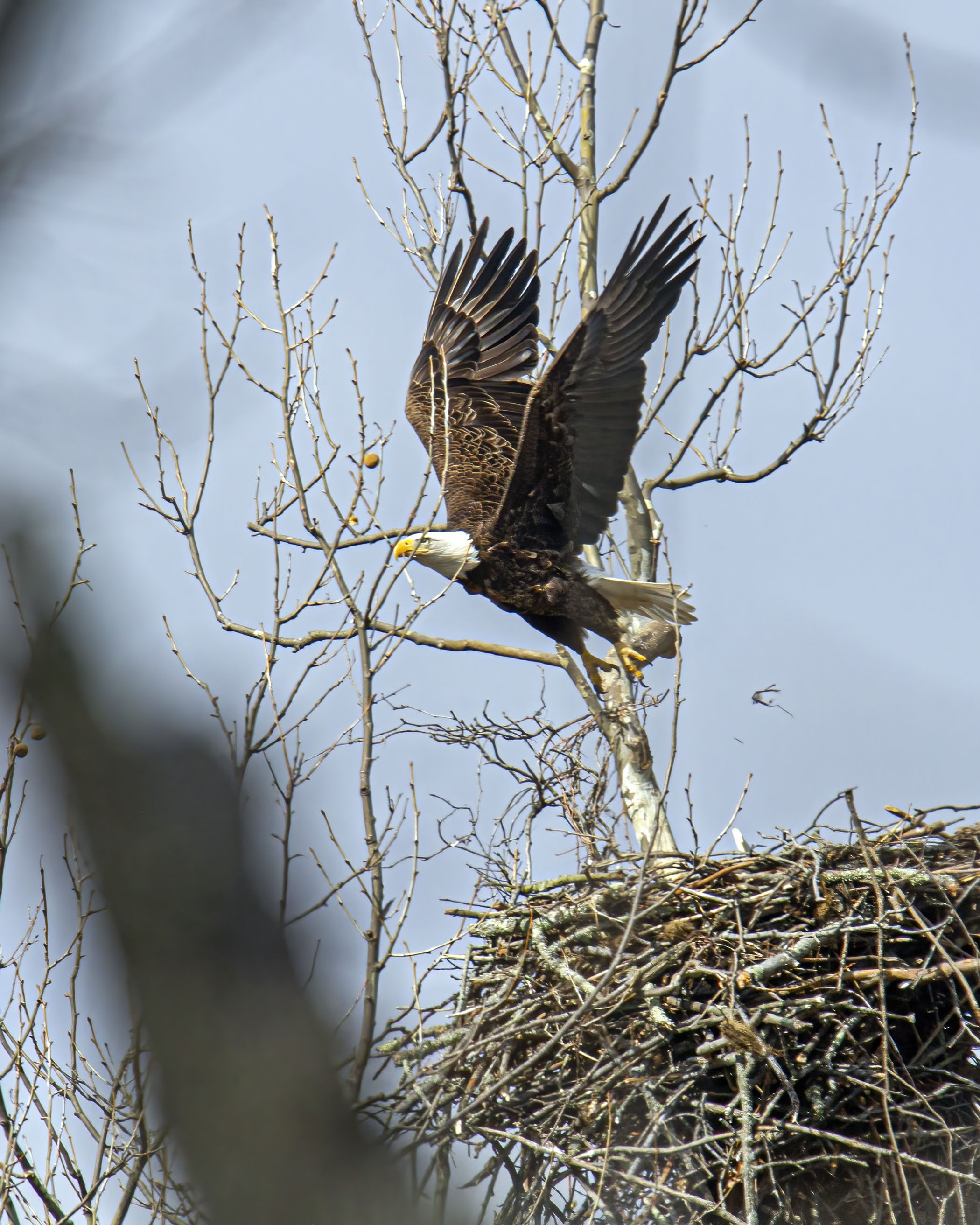
Later that same day I passed by the nest again and an eagle was sitting in the nest. I captured the second image when the eagle unexpectedly took off from the nest. I like the way that I captured the action,although I would have preferred not to have clipped the eagle’s wing as it extended it upwards to generate lift for its takeoff.

Bald Eagle

bald eagle

© Michael Q. Powell. All rights reserved.

Read Full Post »

I patiently watched the large Bald Eagle (Haliaeetus leucocephalus) nest last Thursday at Occoquan Bay National Wildlife Refuge and eventually caught a glimpse of an eaglet. As some of you may recall, I have been keeping an eye on three eagle nests at this refuge and have already seen eaglets at the other two nests. This nest is significantly larger than the other two nests, as you can see in the second photo, and it is difficult to see activity in the nest.

I was zoomed in as close as I could with my telephoto lens and still had to crop the image in the first photo quite a bit so you can see the eaglet with its open mouth—I suspect it wanted to be fed. As you can see, one of the parents was in the nest with the eaglet and the other parent was perched in a nearby tree. It is possible that there are more eaglets in the nest, but I was really happy to spot one.

In case you are curious, I did not have my longest telephoto lens with me that day. Normally I use my Tamron 150-600mm lens when I know that I will be photographing birds. I was anticipating that I would be focusing on both large and small creatures, so I was using my Tamron 18-400mm lens on this occasion.  This lens gives me a great deal of flexibility in photographing dragonflies as well as birds and in capturing landscape shots like the shot of the nest—I was standing in the same spot for both photos in this blog posting.

Bald Eagle

eagle nest

© Michael Q. Powell. All rights reserved.

Read Full Post »

As I was observing a large nest last Friday at Occoquan Bay National Wildlife Refuge, I couldn’t help but notice that the Bald Eagle (Haliaeetus leucocephalus) in the nest was keeping an eye on me. The eagle seemed to be observing me through a gap in the branches at the top of the nest, as you can see in the first two photos.

After getting a few shots, I continued walking down the trail. When I looked back towards the nest, I could see the eagle’s head poking out of the top of the nest and it still seemed to be watching me.

As you can tell from the final photo, this is a really large nest and it is hard to monitor what is going on inside of it. Are there any eaglets yet? In two other nests at the refuge, I have already seen eaglets, but those nests were much smaller, so it was not hard to spot the babies. I’ll continue to monitor this nest and with a little luck I will see an eaglet or two in this large nest.

Bald Eagle

Bald Eagle

Bald Eagle

© Michael Q. Powell. All rights reserved.

Read Full Post »

This juvenile Bald Eagle (Haliaeetus leucocephalus) may not be quite ready to fly, but it was testing out its wings by flapping them vigorously while I was observing the nest on Friday at Occoquan Bay National Wildlife Refuge. The eaglet is so large that there is no longer any room in the small nest for its parents—one of its parents was perched on a higher branch in the same sycamore tree.

A few weeks ago, I observed two eaglets in this nest and I have not had a good look at both eaglets since that time. Has something happened to the other eaglet? When I looked closely at all of my photos, I noticed that I could see the silhouettes of both eaglets sitting side by side in some of the images, as you can see in the final photo. The eagle on the left seems much smaller than the one on the right, which was the one that was flapping its wings in the first two photos.

The foliage in the tree and the barrier across the trail keep me from seeing any better what is happening in this eagle nest, but it looks like the eaglets are growing bigger and stronger, especially the one on the right. It should not be too long before it is time for the eaglet to be making its first tentative attempts at flight.

Bald Eagle

Bald Eagle

Bald Eagle

© Michael Q. Powell. All rights reserved.

Read Full Post »

This Bald Eagle (Haliaeetus leucocephalus) remained steadfastly on guard above its large nest on Wednesday at Occoquan National Wildlife Refuge as a jet flew by in the distance. As I was focusing on the eagle, I caught sight of the jet out of the corner of the eye and managed to time the shot pretty well to be able to include the jet in the frame.

Normally I do not like to include man-made objects in my wildlife photos, but in this case I really like the juxtaposition between the wildness of a bald eagle’s flight and the more “civilized” human flight.

Bald Eagle

© Michael Q. Powell. All rights reserved.


Read Full Post »

On Wednesday I visited Occoquan Bay National Wildlife Refuge to check on the eaglets in the nests there.  As the leaves continue to grow, it is becoming harder and harder to observe activity at several of the nests of the Bald Eagles (Haliaeetus leucocephalus). In one of them, though, I managed to find a small visual tunnel and was fortunate to capture the first two images that show some sweet little moments between an eaglet and one of its parents.

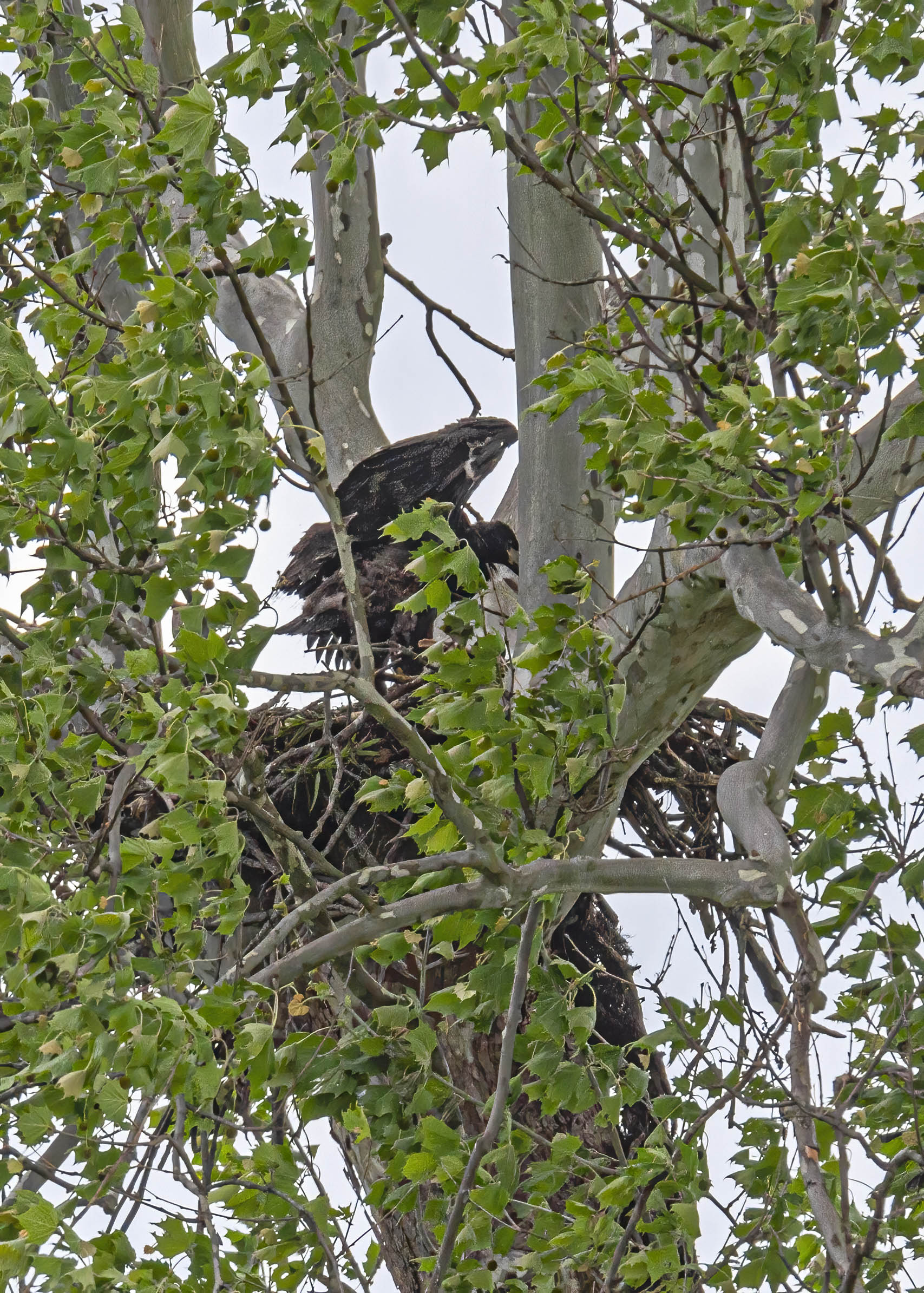
The third image shows an eaglet in a different nest. As you can see, the leaves on the sycamore tree hid most of the nest. Previously I spotted two eaglets in this nest, so there may be another hiding out of view.

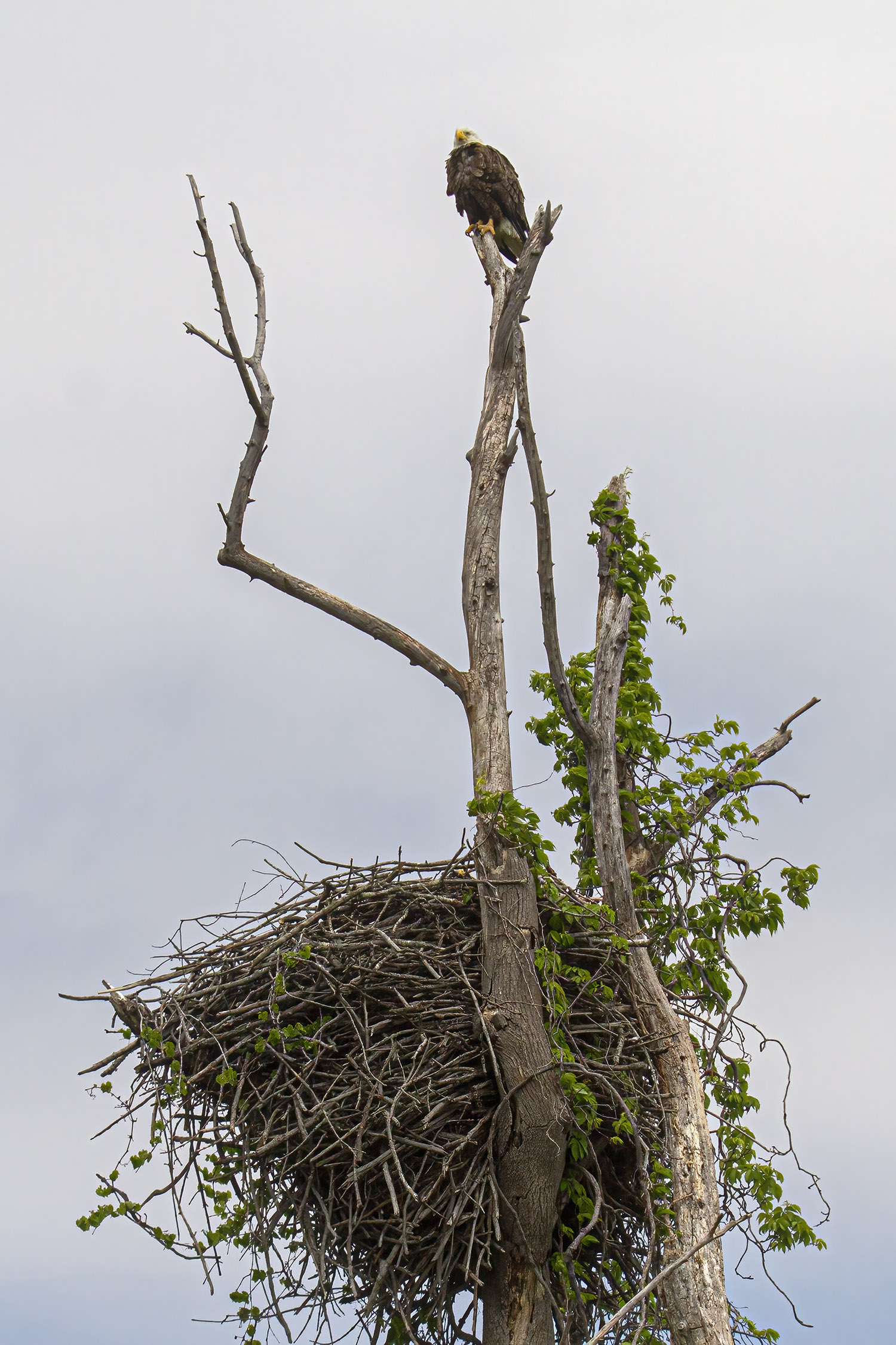
The final two shots shows the largest eagle nest at the refuge. The nest is so big and so high in the trees that it is difficult to tell what is going on inside of the nest. One eagle was keeping watch and the other adult appears to be in the nest. If you look closely at the nest right below the tree on which the eagle is perched, you can just make out the yellow beak of an adult eagle. The final image is a close-up shot of the nest that I cropped to show more clearly the eagle’s beak. The adult eagle is perched so high in the nest that it is possible that there is an eaglet or two in the nest as well—when an eagle is incubating eggs it tend to hunker down really low to keep the eggs warm.

Bald Eagle

Bald Eagle

Bald Eagle

Bald Eagle

Bald Eagle

© Michael Q. Powell. All rights reserved.


Read Full Post »

On Tuesday I hiked to the farthest Bald Eagle (Haliaeetus leucocephalus) nest at Occoquan Bay National Wildlife Refuge, hoping to determine if there were any eaglets in the nest. During most of the year you can walk past this nest as part of a big loop, but the road is now blocked to protect the eagles, so you have to double back along the trail (a distance of almost two miles (3.2 km) to return to the parking lot.

This eagle nest is in a sycamore tree. Several years ago, one of the limbs gave way and during the off-season almost half of the nest slid to the ground. The eagles have done some repairs each year, but the nest is still relatively small. At this time of the year, there is a good deal of new foliage, so it is a bit difficult to see what is going on in the nest.

When I arrived at the nest, I noticed that one of the adults was sitting completely upright, which was a good sign. When the eagles are incubating the eggs, the tend to hunker down in the nest, with only their heads visible.

As I watched and waited, the adult eagle flew to some higher branches in the tree. My flow of adrenaline and sense of anticipation increased as I waited to see if an eaglet would appear. I was double delighted when two little heads popped up. The eaglet on the left seemed to be a bit bigger than its sibling and was probably the older of the two. In the second image, the bigger eaglet is looking upwards toward the branch where the adult was perched.

I was a long way off when I took these photos with my telephoto zoom lens, so they are not super quality images, but they provide proof that there are at least two little eaglets in this nest. As I noted in an earlier post, there is one eaglet in another nest on the refuge. The third active eagle nest is so large and high up in the trees that it is not yet possible to tell if there are any eagle babies in it—any eaglets will probably have to grow stronger and larger before the climb up to the the edge of that nest.

Bald Eagle

Bald Eagle

Bald Eagle babies

© Michael Q. Powell. All rights reserved.

Read Full Post »

Most of the time I am an opportunistic photographer—I wander about and react to the the things that I see. During the nesting season of Bald Eagles (Haliaeetus leucocephalus), however, I will hangout at spots where I can observe the eagle nests.

The members of an eagle couple take turns sitting on the eggs, and I love to try to capture the changing of the guard, i.e. when one eagle switches off with the other one. Earlier this month, I observed such an exchange at one of the nests that I watch at Occoquan Bay National Wildlife Refuge.

The first photo shows the departing eagle. If you look closely behind the eagle, you will see some small twigs in the air that were dislodge during the takeoff. I had to look through a lot of vegetation to get a clear view of the nest and the dark smudges in the photo are branches that were partially blocking my vision—fortunately those branches were on the periphery of my composition.

The second photo shows the arriving eagle. The nest is so small that I don’t think it could hold both eagles at the same times, particularly when there are fragile eggs present.

Bald Eagle

Bald Eagle

© Michael Q. Powell. All rights reserved.

Read Full Post »

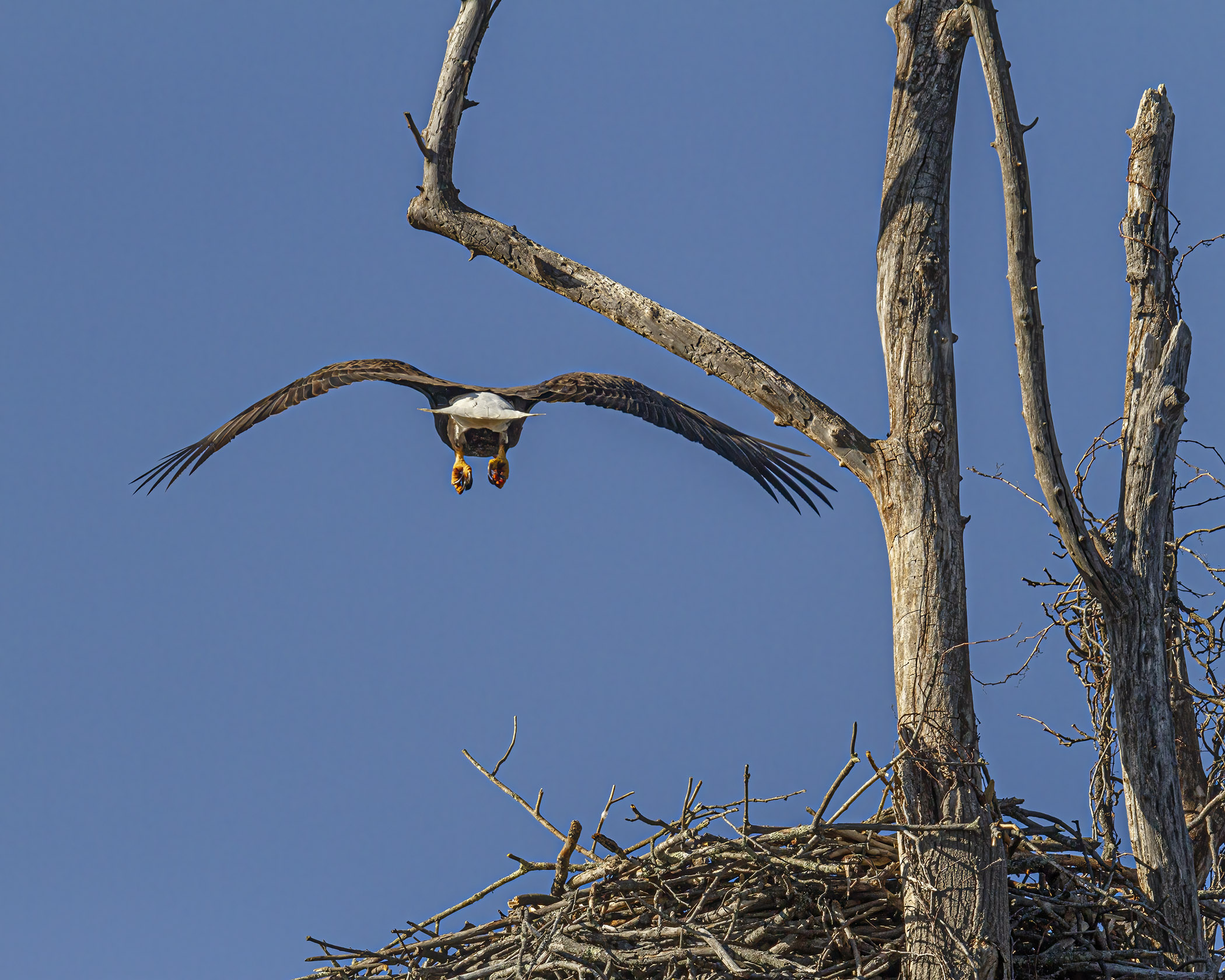
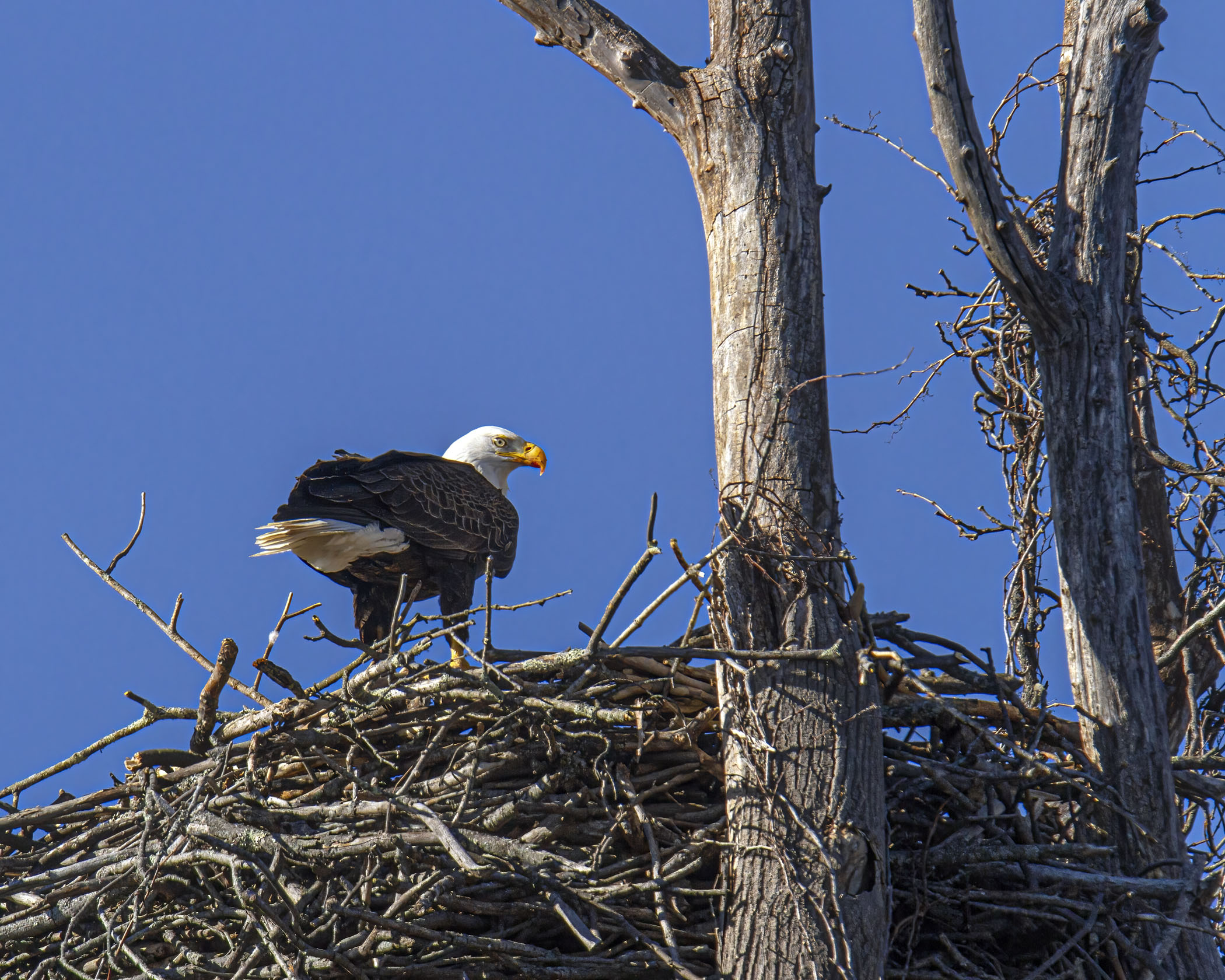
Last Wednesday I watched as this Bald Eagle (Haliaeetus leucocephalus) approached its nest to take the place of its mate, who had flown away a moment earlier. It would have been cooler if the eagle had been coming towards me when it landed, but I like the way that I was able to capture the wing, tail, and talon positions in the first two photos. In the final photo, the eagle had successfully landed at the large nest—the eagle’s head was initially in the shadows, so I was happy when it glanced over its shoulder in my direction and the sunlight hit its eye.

Bald Eagle

Bald Eagle

Bald Eagle

© Michael Q. Powell. All rights reserved.


Read Full Post »

Over the last few weeks I have been seeing a lot of activity around three Bald Eagle (Haliaeetus leucocephalus) nests at Occoquan Bay National Wildlife Refuge. This past week I finally observed eagles hunkered down in two of the nests, which suggests to me there may finally be eggs in those nests. The third nest is so large and deep that it is impossible to see if there is an eagle (or even two) inside, especially if it is sitting on eggs.

The two nests in the photos below are fairly small, so you can just see the the top of the white head of the eagles. In both cases I was quite far from the nest when I captured my shots, so I really had to look carefully to see if there were any eagles visible in the nests. With a little luck, I’ll see eaglets in those same nests in the upcoming months and maybe I will be fortunate enough to get a few shots of them.

Bald eagle nest

Bald Eagle nest

© Michael Q. Powell. All rights reserved.

Read Full Post »

It is fascinating to compare the size and construction of these three Bald Eagle (Haliaeetus leucocephalus) nests that I photographed last Thursday at Occoquan Bay National Wildlife Refuge. The first nest is by far the largest and is one that I feature quite regularly in my blog, including in yesterday’s posting. The second nest is new this year and, according to some fellow photographers, may be a converted osprey nest.

In recent months I have not seen any eagle activity at the nest in the sycamore tree in the third photo, so was not sure if it was being used this year. I was therefore delighted when I spotted a bald eagle in the nest last week and watched as its mate also flew in and they both perched on one of the branches of the tree. Although this nest was used in previous years, I believe that there were no eaglets born in it last year. It appears that one of the supporting branches for the nest broke off a year or so ago, dumping part of the nest, which was never very large, onto the ground.

Bald Eagle nest

Bald Eagle nest

Bald Eagle nest

© Michael Q. Powell. All rights reserved.

Read Full Post »

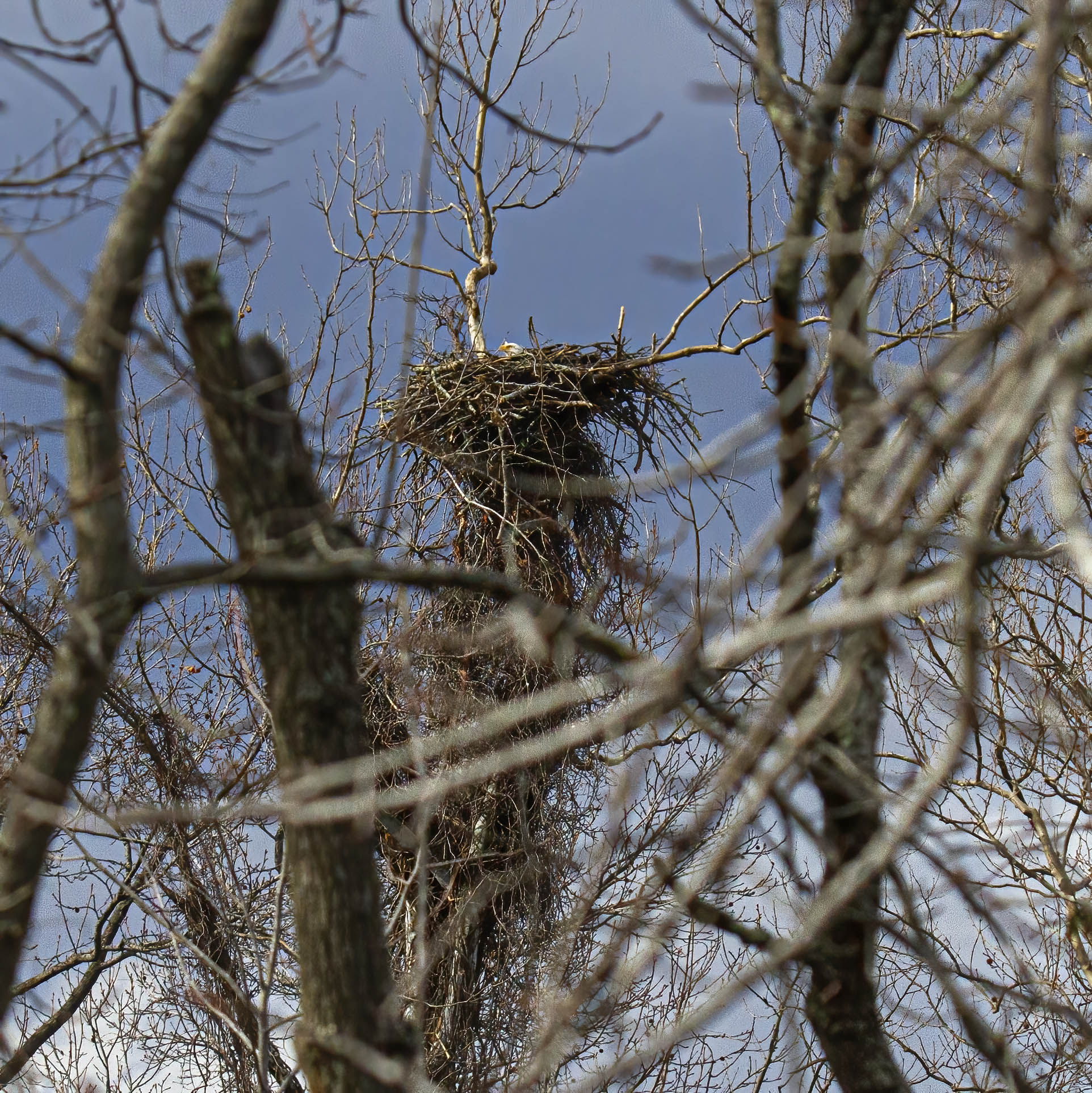
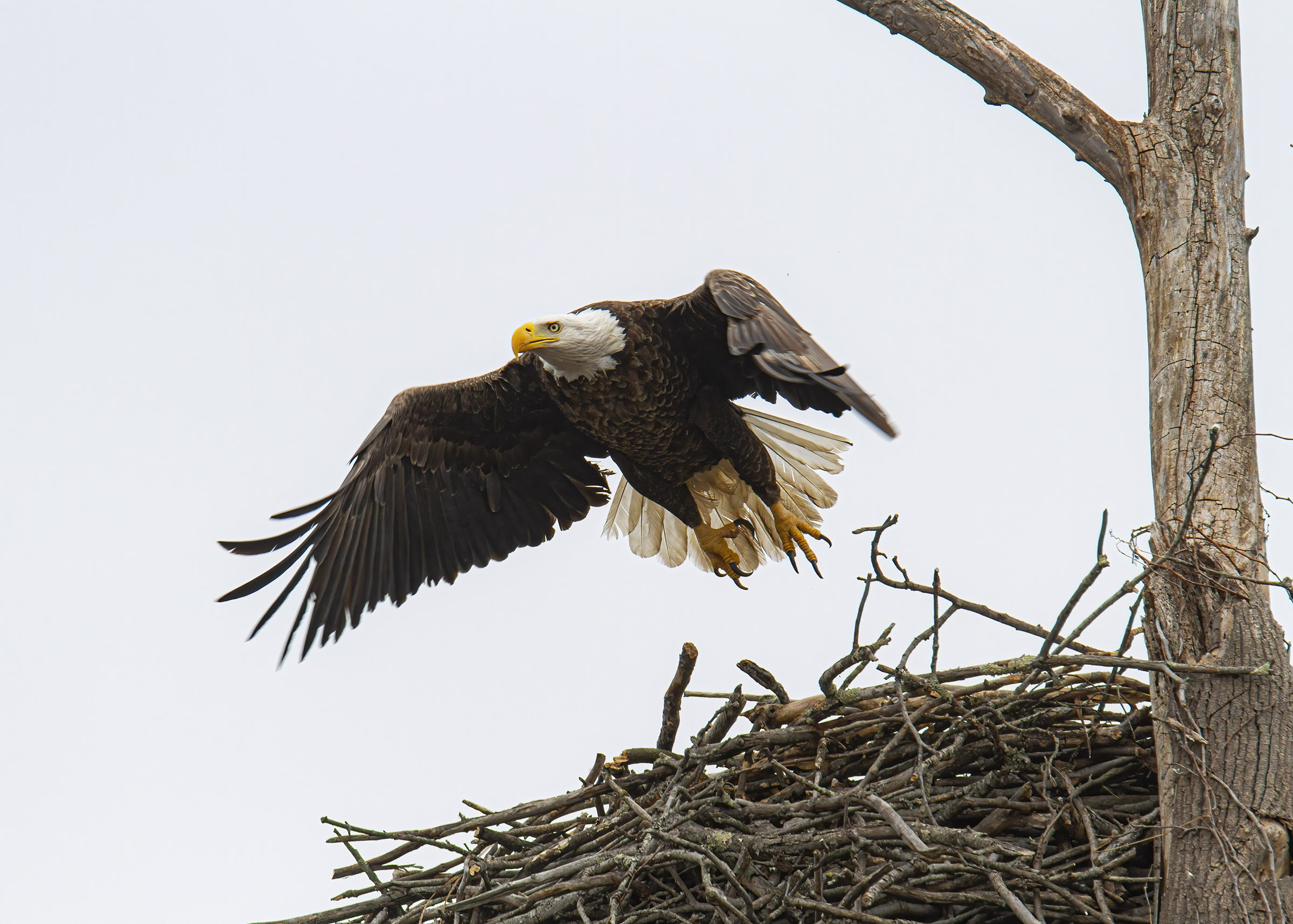
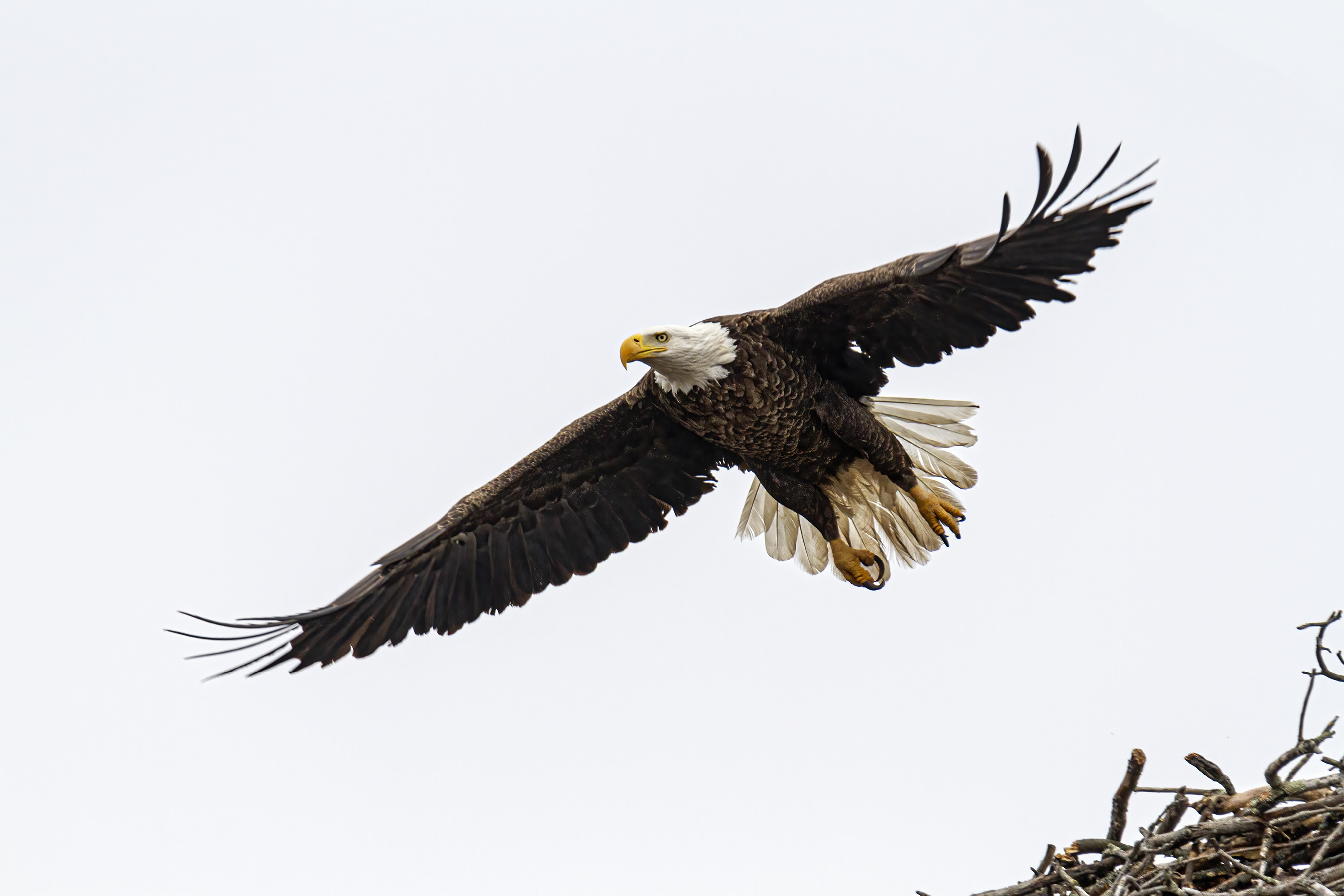
The sky was almost completely overcast last Thursday morning at Occoquan Bay National Wildlife Refuge and looked almost white in my photos, making some of my shots look like they were taken in a studio. Still, the uncluttered backdrop helps to draw the viewers attention to these cool images of a Bald Eagle (Haliaeetus leucocephalus) as it took off from the very large eagle nest at the refuge. The final photo, taken with my iPhone a few days earlier, gives you an idea of the setting in which the nest is located—the photos make it look like I was a lot closer to the nest than I actually was.

I spotted eagles perched on or in three separate nests that day, a clear sign that nesting season is almost here. The fact that the eagles did not remain continuously in the nest suggests to me that they are not yet sitting on eggs. I will continue to monitor the nests and with a little luck I may be able to see some eaglets in the upcoming months.

Bald Eagle

Bald Eagle

eagle nest

© Michael Q. Powell. All rights reserved.

Read Full Post »

Whenever I am walking on the trails at Occoquan Bay National Wildlife Refuge, I am always on the lookout for Bald Eagles (Haliaeetus leucocephalus). At this time of the year especially I keep my eyes for signs of new eagle nests. At the moment, I am aware of three nesting sites on the refuge, although I am not sure if all three are being used this year.

On Monday I spotted the bright white head of a mature Bald Eagle in a distant tree. As I trained my long telephoto lens on the eagle, I noticed that it was perched just above what looked to be a nest. I moved a bit further down the trail to get a somewhat less obstructed view of the nest and looked carefully to see if I could spot an eagle sitting in the nest.

Although I was standing quite still and was partially hidden from view by heavy vegetation, the eagle seemed to sense my presence and took off. I was happy to be able to capture a couple of shots of the eagle as it was flying away.

This may be another new nesting site or it may be a view of one of the newest nest from a different angle than I usually see it. Several roads at the refuge are not closed to protect the nesting eagles, so there is really only one nest that I can monitor closely—the very large nest that I have repeatedly featured in blog postings.

Bald Eagle

Bald Eagle

Bald Eagle

© Michael Q. Powell. All rights reserved.

Read Full Post »

For several years I have keeping an eye on two Bald Eagle (Haliaeetus leucocephalus) nests at Occoquan Bay National Wildlife Refuge. One of them is adjacent to several trails, so each year the authorities close portions of those trails to keep the nesting eagles from being disturbed. This year, an additional area was closed and a sign was posted indicating eagle nesting activity.

I knew more or less where the new nest was located, but I had trouble spotting it from the trails that are still open. On Wednesday, I was delighted to spot an eagle in the nest, as you can see in the first photo below. A second eagle was keeping watch over the nest from a nearby tree and I managed to get the second shot by zooming out with my Tamron 150-600mm telephoto lens.

There was quite a bit of vegetation between me and the tree where the new nest is located, so I had to move about a lot to get a relatively unobstructed view of the nest. I suspect that the nest will be completely hidden when leaves reappear in a few months. Until then, I will continue to observe the new nest with a hope of seeing some eaglets. The incubation period is about 36 days for bald eagle eggs, but I do not think that any eggs have yet been laid.

Bald Eagle

Bald Eagle

© Michael Q. Powell. All rights reserved.

Read Full Post »

Monday, I spotted a Bald Eagle (Haliaeetus leucocephalus) sitting in the large nest at Occoquan Bay National Wildlife Refuge and my first thought was that the eagle couple had already begun to sit on eggs in the nest. When I thought about it for a moment, though, I realized that was probably not the case—when one of the eagles is incubating an egg, it tends to sit really low in the nest and is hidden from view. This eagle seemed to be perched rather high in the nest and flew away from it a few moments after I spotted it.

I was pretty happy to be able to compose this shot so that the eagle is clearly visible and you can get a sense of the massive size of the nest. I worry sometimes that the weight of the nest will cause it to collapse during a rain or wind storm, but it has held up remarkably well during the five or so years that I have been watching it.

It shouldn’t be too long before actual incubation begins. According to the journeynorth.org website, the incubation period is 24-36 days. “Adults share incubation duties. Nest exchanges may occur after only an hour but usually take several hours between exchanges. Frequently the incoming adult brings a new branch or fresh vegetation for the nest, then the incubating adult carefully stands and takes off while the other settles over the eggs and rakes nesting material up against its body.”

Additionally the adult eagles have to also need to turn the eggs about once an hour to ensure that the eggs are evenly heated and that the embryos don’t stick to the insides of the shells. Be sure to check out the linked website for more fascinating facts about the process of bald eagle incubation.

Bald Eagle nest

© Michael Q. Powell. All rights reserved.


Read Full Post »

I was thrilled last week at Occoquan Bay National Wildlife Refuge to spot two Bald Eagles (Haliaeetus leucocephalus) in the large nest at the refuge. They have been hanging around the area for a while, appearing to be keeping an eye on the nest, but this was the first time that I have spotted them inside of it. The eagle on the left was visible for an extended period of time, while the one on the right popped up only occasionally and appeared to working on renovating the interior of the nest.

The nest is quite large and deep, so it is often hard to tell when the eagles are in it, especially when they begin to sit on their eggs. I was not able to get many clear shots, but was happy with the two images below that show slightly different poses of the eagle couple.

UPDATE: I decided to add a third photo to give you an idea of the massive size of the eagle nest. Every year it seems like they add a new layer of sticks that increases its size.

Bald Eagles

Bald Eagles

eagle nest

© Michael Q. Powell. All rights reserved.

Read Full Post »

It had been over a week since I last went out with my camera, so I was thrilled yesterday to walk the trails at Occoquan Bay National Wildlife Refuge. One of the first places where I usually look for activity is the large eagle nest shown in the second photo. It may be a little early for the eagles to begin nesting, but an eagle couple is often in the surrounding area at this time of the year.

I scanned the trees in the immediate area, but came up empty-handed. As I continued down the trail, however, I spotted the bright white head of a Bald Eagle (Haliaeetus leucocephalus). As I maneuvered about, trying to get a clear shot, I suddenly realized that there were two eagles partially hidden in the trees. I don’t know for sure if the eagles were a couple, for they seemed to be perched far apart for a couple—maybe the pandemic has caused the eagles to practice social distancing.

I was happy to be able to capture an image that shows both of the eagles pretty well. As I have said many times before, any day when I am able to photograph eagles is a good day.

Bald Eagles


eagle nest

© Michael Q. Powell. All rights reserved.

Read Full Post »

It was really cool on Monday to see a Bald Eagle (Haliaeetus leucocephalus) working on a new nest at Occoquan Bay National Wildlife Refuge while the other member of the couple kept watch from a nearby tree. I suspect that this is the same nest that another frequent visitor to the refuge recently photographed. It is not yet clear if this will be a replacement for one of the nests used in the past or will be an additional one.

In the past I have seen active eagle nests in only two locations in the past. One of them is very large, but seems to be getting a bit precarious. The other is quite small and prior to last year’s nesting season seemed to have partially collapsed. Eagles were successful in the large nest this past season with at least one eaglet, but I don’t know for sure of there was an eaglet in the smaller nest.

In case you are curious, the new nesting site is almost equidistant from the two existing sites. It is a long way from any of the trails from which I can take photos and I suspect it will be tough to monitor when the leaves return to the trees in the spring.

eagle nest

© Michael Q. Powell. All rights reserved.

Read Full Post »

I was concentrating so intently on photographing the large eagle nest at Occoquan Bay National Wildlife Refuge last Wednesday that I almost missed the Bald Eagle (Haliaeetus leucocephalus) that was sitting in the nest. This nest is really deep and during nesting season it is hard to tell if one or more of the eagles are inside of it. The nesting season ended quite some time ago, so I definitely did not expect to see the nest occupied at this time of the year.

The second shot is the one that I was intending to capture. I liked the way that the red leaves were creeping up the side of the trees holding the nest and that was what I was I was photographing. If you look really carefully, you can just see a bit of the yellow beak of the eagle stick out from behind the leftmost tree, but I did not notice it at the time I took the shot.

After I had taken a few shots, I continued on the trail a half dozen steps, seeking to photograph the nest from a different angle. It was only then that I spotted a bit of bright white that turned out to be the eagle’s head. The eagle was hidden really well, but appeared have positioned itself so as to be able to keep an eye on what was happening around it.

I captured a series of images, but the eagle’s head was blocked by the nest and/or the leaves in most of them. Fortunately, the eagle was moving its head from side to side and eventually I managed to capture a shot in which we can see the eagle’s eye pretty clearly.

Quite often in my wildlife photography, I detect the subject only because of its movement, but in this case, the subject was stationary and it was the difference in color of the eagle’s head that allowed me to spot it. As you can probably guess, my eyes are moving constantly when I am out with my camera, searching high and low, near and far, and left to right for potential subjects to photograph.

eagle nest

eagle nest

© Michael Q. Powell. All rights reserved.


Read Full Post »

Earlier this month I did a posting called  Looking out of the nest that featured a young Bald Eagle (Haliaeetus leucocephalus) sitting up in a large nest at Occoquan Bay National Wildlife Refuge and wondered when it would be able to fly. Last Friday I returned to the refuge and was delighted to see the eaglet flapping its wings and testing them out—I think it is almost ready to fly..

The eaglet repeatedly extended its wings, but seemed a bit uncoordinated, like a gawky teenager who has experienced a growth spurt. Several times it was able to rise up into the air, but looked uncertain about what to do next. The photos below show some of the action, which lasted only for a few minutes. The eaglet then disappeared into the deep nest, possibly to rest after its exertion.

I watched for a while longer and eventually the eaglet reappeared, but it simply sat up, looking out of the nest. A fellow photographer told me that he spotted the eaglet the following day perched in the tree that you can see in the right side of the image. I suspect, though, that the eaglet will need some quite a bit more practice before it will be capable of venturing out on its own and, of course, it will have to learn how to fish.

I will probably make a trip to the refuge this week to check on the eaglet. So many of the nearby trees are covered with leaves that I may have trouble spotting the eagle, particularly because its dark, and mottled plumage help it to blend in well with the foliage. Adult Bald Eagles tend to stick out a bit more because of the bright white feathers on their heads.

Bald Eagle

Bald Eagle

Bald Eagle

© Michael Q. Powell. All rights reserved.

Read Full Post »

There was a lot of activity on Tuesday at the large Bald Eagle (Haliaeetus leucocephalus) nest at Occoquan Bay National Wildlife Refuge. I still cannot determine if any eaglets have hatched, but several times I observed an eagle fly into the nest or fly out of it. The nest is so deep that an eagle is often hidden from view when sitting on an egg—the only way to know for sure that an eagle is present is when one of them arrives or departs.

The eagle in the first photo was arriving and had spread its wings to slow down its speed and forward momentum. In the second photo, an eagle that was in nest had popped its head up and was looking towards a nearby tree where its mate was perched. After the eagle had reassured itself that everything was ready, the two eagles executed a changing of the guard ceremony—the eagle in the nest flew away and the perched eagle took its place. I captured the third image just as the eagle was taking off from its perch to take its turn watching over the nest.

Bald Eagle

Bald Eagle

bald eagle


© Michael Q. Powell. All rights reserved.

Read Full Post »

I had already spotted a Bald Eagle (Haliaeetus leucocephalus) sitting on a small nest at Occoquan Bay National Wildlife Refuge (see the final photo in my recent posting Out on a limb). However, until Wednesday  I had been unable to determine if the eagles had started to sit on eggs in the much larger and prominent nesting sight. That nest is so large and deep that a nesting eagle is hidden from view most of the time.

We had unusually warm weather on Wednesday, so I felt compelled to leave my house with my camera and towards my favorite site for wildlife photography. As I walked past my normal viewing site for the nest, I wasn’t surprised that I could not see an eagle in it.  As I continued to walk down the trail, however, I continued to keep my eye on the nest as I continued to walk down the trail. My view was partially blocked by trees, but looking through the trees, I suddenly spotted a small white head sticking out of the nest.

I don’t know if the warmer weather prompted the eagle to sit up higher in the nest than during cold weather, when the eagle would tend to hunker down to keep the eggs warm. Whatever the case, I welcomed this confirmation that the eagles were in the nest. The first image shows that the eagle was quite alert and keeping and eye on things. The second image helps to give you all a sense of the massive size of this nest.

As I write this posting, my heart is breaking as I continue to watch horrific events unfolding in Ukraine. I would simply ask that you pray for the brave Ukrainian people who are fighting and, in many cases, dying to defend themselves and their country.

Bald Eagle

Bald Eagle

© Michael Q. Powell. All rights reserved.

Read Full Post »

As we near the end of the month of February, we are moving into nesting season for the Bald Eagles (Haliaeetus leucocephalus) that I regularly observe at Occoquan Bay National Wildlife Refuge. Some other wildlife photographers have photographed one of the eagle pairs mating, but when I visited the refuge last Wednesday, there was no such activity. The best images that I was able to capture were of a solitary bald eagle perched on the outermost tip of a branch overlooking the trail on which I was walking—as the first photo shows, the eagle was quite aware of my presence.

Later that same day, I spotted a bald eagle that appears to be sitting on one of the two nests that monitor. One of the nests is so large and high up in the trees that it is almost impossible to tell when an eagle is sitting on the nest. The other nest, which is the one shown in the final photo, is much smaller and a sitting eagle is quite visible. There are barriers blocking the road to keep eagles from being disturbed, because a trail runs right under the nesting tree, so I am able to capture images only from a distance.

I will be checking in on the nests as time passes and with a little luck will be able to share some images of any eaglets that I manage to spot.

Bald Eagle

Bald Eagle

Bald Eagle

© Michael Q. Powell. All rights reserved.


Read Full Post »

As many of you know, I have been keeping an eye on a pair of Bald Eagle (Haliaeetus leucocephalus) nests at Occoquan Bay National Wildlife Refuge, waiting for the eagles to begin sitting on the nests. I featured one of the nests, an enormous one high in a tree, several times during January, but have not yet posted any shots of the smaller nest this year until now.

The most direct roads leading to this smaller nest are blocked off at this time of the year, because the nesting tree is located near the intersection of several major trails, including one on which cars are normally permitted to drive. However, I am able to take a circuitous route to reach one of the barriers that provides a distant view of the nest from which I can take some photos.

Several weeks ago I was delighted to photograph both members of an eagle couple perched together on a limb of the tree with the small nest that has been used in each of the past three years (and maybe even longer than that). As you can see in the first photo, one of the eagles is quite a bit larger than the other—generally the female is the larger one.

When I first started watching the nest that day, only the smaller eagle to the left was perched on the limb. As I pulled back on my zoom lens to be able to show the nest in the lower righthand corner of the photo, the second eagle flew in to perch next to her mate, and I captured that moment in the second photo.

The two eagles stayed together for a short while side-by-side, when suddenly the larger eagle took off. The final shot shows the eagle extending her wings and taking off from the perch, leaving the smaller eagle to keep watch over the nesting site.

I have been back several times to the site since this encounter, but have not seen the eagles there again. I am optimistic that they will soon be sitting on some eggs. In this smaller nest, the eagle is partially visible when she is sitting on eggs, whereas the other nest is so big and deep that a nesting eagle is hidden from view.

Bald Eagle

Bald Eagle

Bald Eagle

© Michael Q. Powell. All rights reserved.

Read Full Post »

The Bald Eagles (Haliaeetus leucocephalus) left their big nest at Occoquan Bay National Wildlife Refuge unattended last Wednesday and several Turkey Vultures (Cathartes aura) decided to check it out. I don’t know if the eagles were eating fish in the nest in the past or if the vultures were merely curious.

Later in the day I passed the same nest and both of the eagles were perched near the nest, including the one shown in the second image below. That shot gives you a good sense of how big that nest really is. The eagles have been using it for many years and each year they seem to add on to it. It is so deep now, that it is almost impossible to tell if an eagle is sitting on eggs, but I will be checking periodically for other signs.

Turkey Vultures

eeeagle nest

© Michael Q. Powell. All rights reserved.

Read Full Post »

Older Posts »