Feeds:
Posts
Comments

Posts Tagged ‘Bald Eagle in flight’

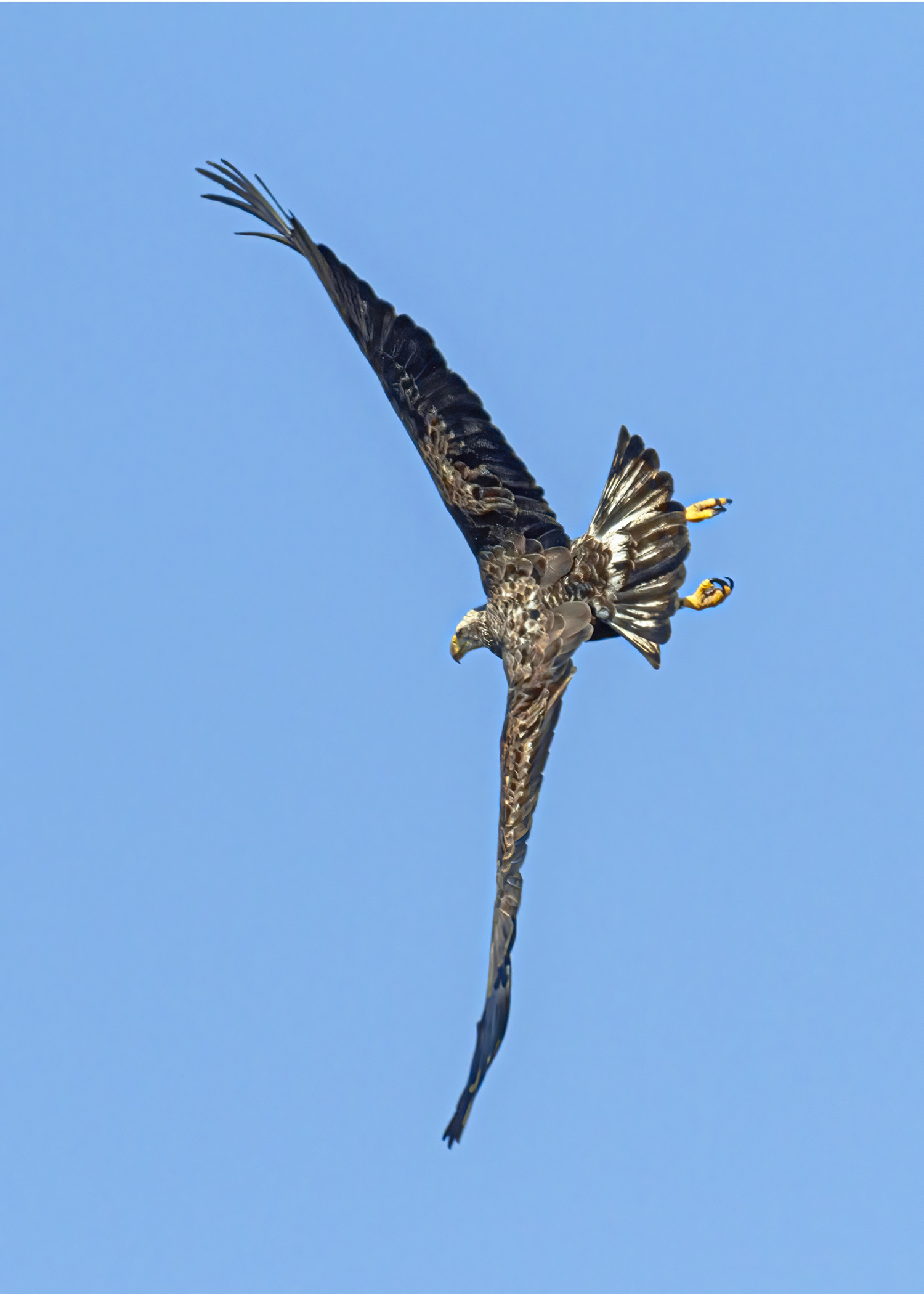
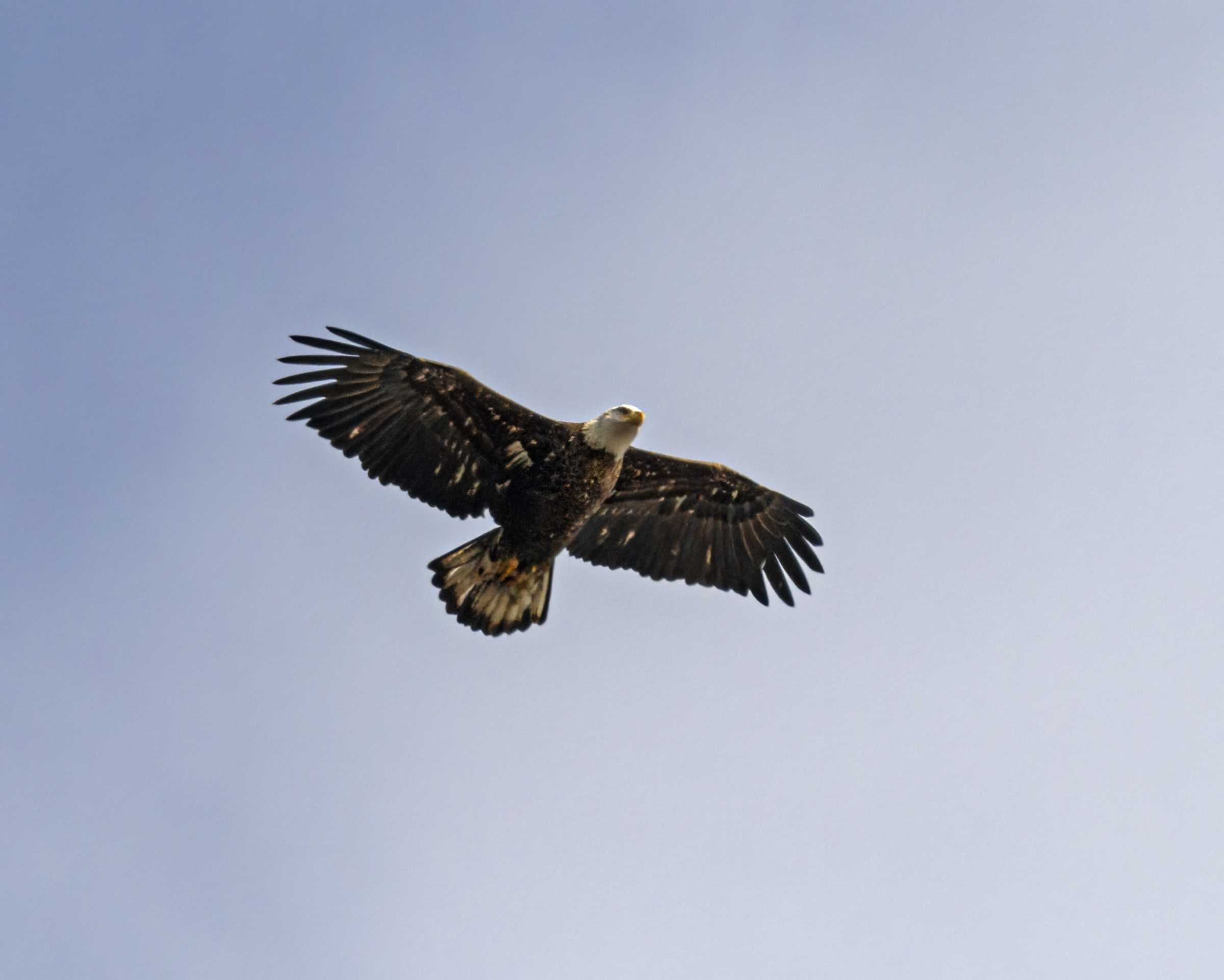
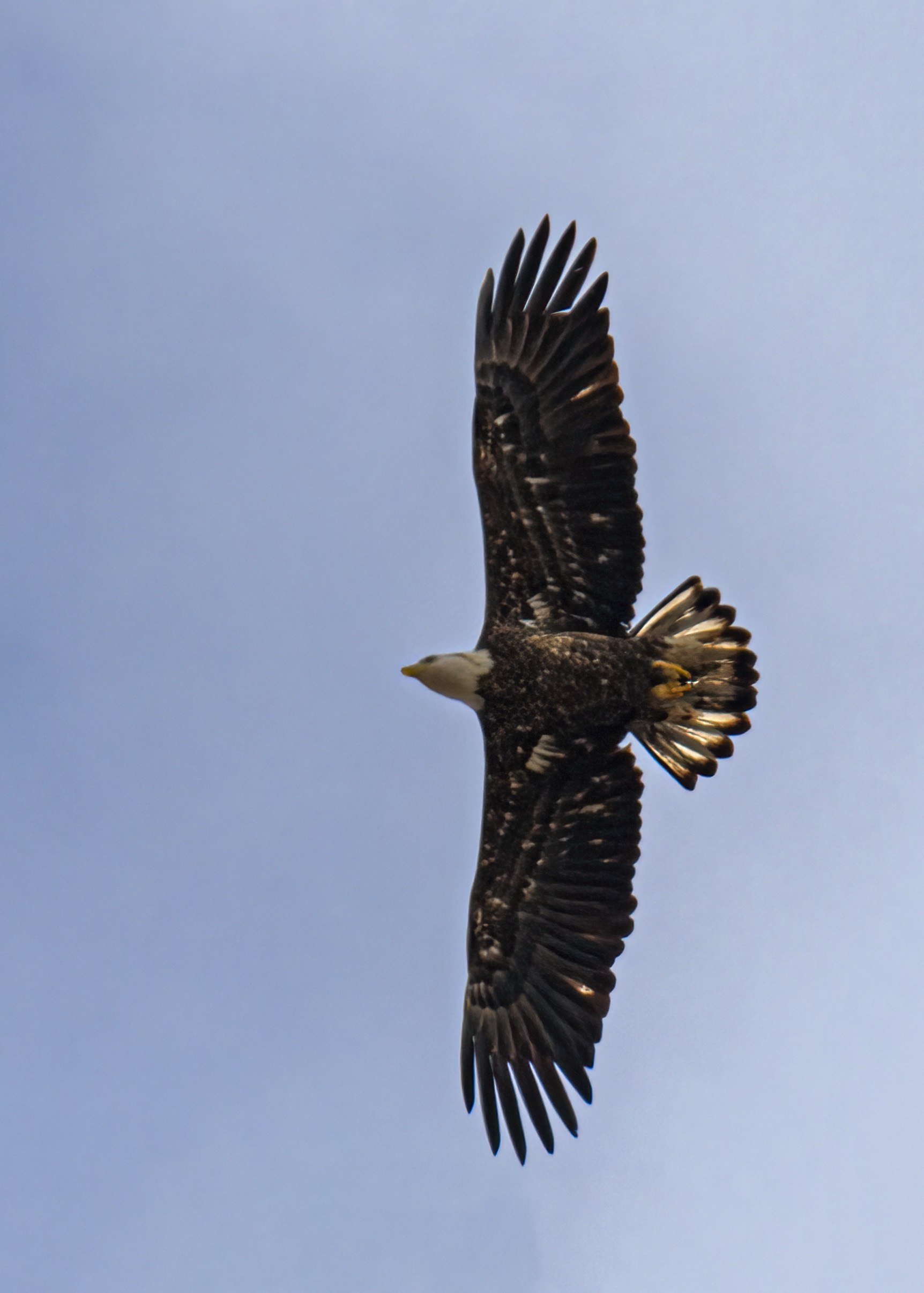
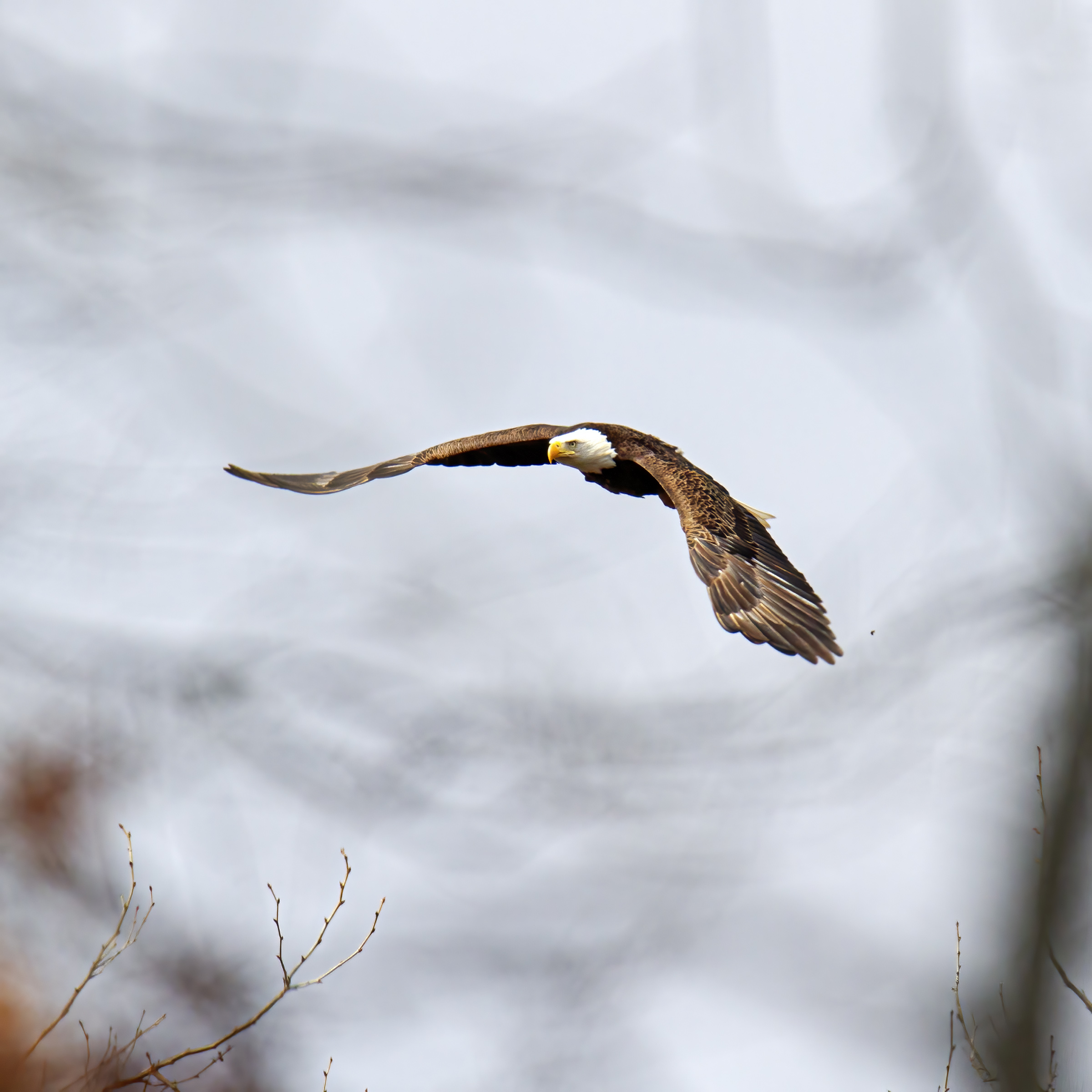
The last few days I have been really busy and have not had a chance to get out very much with my camera to capture new images. I went over the shots from my visit to Occoquan Bay National Wildlife Refuge and decided to post some more shots of the subadult Bald Eagle (Haliaeetus leucocephalus) that I photographed as it flew about, twisting and turning in the air above my head.

Previously I posted a shot of the eagle with outstretched wings (the 20 February posting was called Eagle Gyration). Today’s posting shows the same eagle in a number of other positions. I am always intrigued by the way that birds use their wings and tails in combination to move in the desired direction. Eagles make flying seem so effortless.Bald Eagle

Bald Eagle

Bald Eagle

© Michael Q. Powell. All rights reserved.

Read Full Post »

It takes about five years for a Bald Eagle (Haliaeetus leucocephalus) to develop into adulthood and acquire the bright white heads and tails that we generally associate with this species. When they are young, the eagles have dark feathers and beaks and during the intermediate years their feathers have a mottled appearance.

Yesterday I watched a subadult eagle flying about in the skies over Occoquan Bay National Wildlife Refuge. Judging from its coloration, I’d guess that it was about three to four years old.

The eagle put on quite an aerial show for me, twisting and turning in an amazing display of aerial prowess. I was particularly impressed by the way that the eagle would stretch wide its wings and flare its tail as it changed directions, as you can see in the photo below.

When an eagle or any other raptor is moving about like that, it is quite a challenge to track it and keep it within the frame. Suffice it to say, I have quite a few shots in which the eagle is partially cut off at the edge of the frame or occasionally is completely absent from the photo.

Bald Eagle

© Michael Q. Powell. All rights reserved.

Read Full Post »

I was thrilled to be able to capture a few shots of this sub-adult Bald Eagle (Haliaeetus leucocephalus) last Monday as it soared overhead at Occoquan Bay National Wildlife Refuge. Judging from the fact that there are light feathers in the wings, which are completely dark for adults, and dark feathers in the tail, which are completely white for adults, I’d guess that this eagle is about 3-4 years old. Bald Eagles take almost five years to fully develop the “look” that we normally associate with this species.

Bald Eagle

Bald Eagle

© Michael Q. Powell. All rights reserved.

Read Full Post »

I could sense that this Bald Eagle (Haliaeetus leucocephalus) was preparing to take off and captured this image last Friday at Occoquan Bay National Wildlife Refuge right after it had taken a leap from the tree. I was hoping that the eagle would fly upwards and give me a chance at getting some more in-flight shots, but the eagle flew downwards and away from me.

Bald Eagle

© Michael Q. Powell. All rights reserved.

Read Full Post »

I think this Bald Eagle (Haliaeetus leucocephalus) may have been trying to snag a duck last Friday at Occoquan Bay National Wildlife Refuge. It repeatedly would swoop down over the water without success–the approach seemed quite different from the one that I would normally see when an eagle was fishing. In the bottom right of the first image, you can see some droplets of water that may have been caused by a duck diving under the water.

In the second photo, the eagle is not is as sharp focus as in the first shot, but you have a better look at the splash of the duck (?) diving to avoid the oncoming eagle. Perhaps it was just a fish, but I just don’t know enough about eagle behavior and the behavior of their potential prey to know for sure.

As you can probably tell, the lighting was less than optimal when I was taking these photos. The limited lighting made my camera’s focusing system struggle a bit and maintaining focus on the eagle in flight was a bit of a challenge. Still, I am pretty happy that I was able to capture some of the action, even if I am not 100 percent sure what was going on.

Bald Eagle

Bald Eagle

© Michael Q. Powell. All rights reserved.


Read Full Post »

The late afternoon sun was shining low in the sky and softly illuminated the side of a Bald Eagle (Haliaeetus leucocephalus) perched in a tulip tree last Friday at Occoquan Bay National Wildlife Refuge. A short time later, I spotted a Bald Eagle in a sweetgum tree with the sun shining a bit more intensely—it kept going in and out of the clouds as it dropped lower on the horizon—which made the second image feel “warmer” than the first one.

The final image shows a Bald Eagle as it was flying over the water. The sunlight was coming from almost directly behind the eagle and provided some beautiful backlighting of the eagle’s white tail feathers as well as a bit of rim lighting around the edges of its body

Bald Eagle

Bald Eagle

Bald Eagle

© Michael Q. Powell. All rights reserved.


Read Full Post »

Yesterday I observed the “changing of the guard” at one of the Bald Eagle (Haliaeetus leucocephalus) nests at Occoquan Bay National Wildlife Refuge. I was watching the nest and could see the white head of the eagle as it sat in the nest, when suddenly the eagle stood up and took off a few moments later. A short time later, the second eagle landed at the nest to take over nesting responsibilities.

I had a tricky time trying to track the departing eagle, because it flew among the trees initially. The three photos below show different wing positions that I was able to capture during the eagle’s flight. In the final photo, the eagle seems to be glancing in my direction. I thought I was pretty well-hidden by the vegetation, but an eagle’s vision is so sharp that it is quite possible that it could see me clearly.

Bald Eagle

Bald Eagle

Bald Eagle

© Michael Q. Powell. All rights reserved.


Read Full Post »

Adult Bald Eagles (Haliaeetus leucocephalus) are easily identifiable because of their white heads, but it actually takes four years for them to grow “bald.” In earlier stages of development their beaks and eyes are dark and their feathers are mottled. Experienced birders can tell the precise age of a juvenile by bald eagle simply by its coloration.

This juvenile eagle that I was excited to photograph on Tuesday at Occoquan Bay National Wildlife Refuge appears to be about two to three years old. The beak has turned yellow excepted for the tip and its eyes, which are dark brown when they are really young, look like they are starting to get almost as light as those of an adult. If you want to learn more about the developmental stages of a bald eagle, check out this interesting article by Avian Report on Juvenile and Immature Bald Eagles.

The young eagle was flying above the water, apparently looking for fish, when I captured these images. I tracked it for quite a while, but never did see it pull a fish out of the water. Still, I was happy with my images and definitely enjoyed my time basking in the warmth of a sunny spring-like day as I watched and waited.


Bald Eagle

Bald Eagle

© Michael Q. Powell. All rights reserved.

Read Full Post »

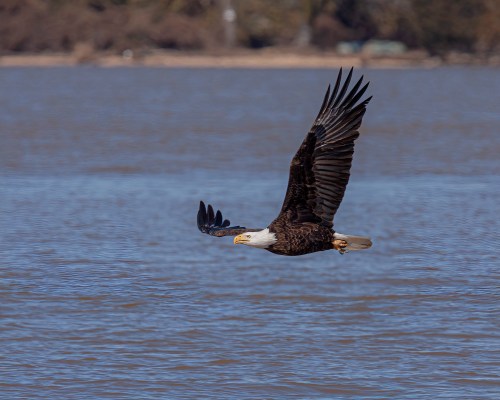
I did not have much time to react yesterday when this Bald Eagle (Haliaeetus leucocephalus) zoomed past me, flying low over the waters off of Occoquan Bay National Wildlife Refuge, so I was thrilled to capture this image. I am not really sure where the eagle was headed, but it looked like he was fiercely focused on getting there quickly.

Photographing birds in flight is rarely easy. If you spot the bird when it is far away, you might have time to check your settings, calmly track the bird as it approaches, and shoot off a burst of shots at the decisive moment. That ideal situation almost never happens in my world. More often than not, the bird seems to come out of nowhere and I frantically raise my camera to my eye and try to find the bird in my viewfinder and focus on it, never knowing for sure if the camera settings will be anywhere near appropriate.

Yesterday, I managed to snap off only three shots of the eagle and only one came out in decent focus. I decided to include the second photo to give you an idea of what I was seeing through the viewfinder—it is slightly edited, but uncropped. I end up cropping most of my images, which sometimes gives the impression that I was closer to the subject than I actually was.

As you can see the eagle was quite large in the frame in this case, which meant that my heart was really racing as I scrambled to get the shot before it was too late. For those of you who might be curious, I captured the image with my Canon 50D and Tamron 150-600mm lens at 500mm with settings of f/8, 1/1250 sec and ISO 400.

In some ways I am just using a point and shoot technique when I photograph birds in flight, but it is much more sophisticated than what most people think when they hear the words “point and shoot.” After thousands and thousands of shots, I have built up reflexes and muscle memory that help me to react quickly and instinctively in situations like this. There are no guarantees of success, of course, but I have reached a point in my development as a photographer that I feel like I have a fighting chance of getting a decent shot in some pretty challenging shooting situations.
 

Bald Eagle

Bald Eagle

© Michael Q. Powell. All rights reserved.

Read Full Post »

Timing is a critical skill in taking wildlife photographs (and in telling the lame jokes I so enjoy), and I was thrilled to capture this image last Friday as a Bald Eagle (Haliaeetus leucocephalus) was lifting off from its nest high in a tree at Occoquan Bay National Wildlife Refuge. I kept my wits about me and was able to track the eagle and get a few shots as it flew parallel to me  before turning and flying away.

If you remember yesterday’s posting with the singing eagle, you can’t help but notice the contrast in the sky colors. On Monday of last week, we had brilliant blue skies, which have been rare this winter, but when I took these photos a few days later, we had reverted to the gloomy, gray skies that are more typical.

Without the glare, I didn’t have to worry about blowing out the details of the eagle’s bright white head and tail, which was a definitely plus, but my camera and lens combination tends to work best when I have better light. Nonetheless, it is always a joy to successfully capture images of birds in flight, especially bald eagles.

I am particularly happy with the eagle’s wing positions in the final photo, though I dud have to crop it in an unusual way because it was near the bottom of the frame in the original shot—if the eagle had extended the wings, they would surely have been cut off in my shot.

Bald Eagle

Bald Eagle

Bald Eagle

© Michael Q. Powell. All rights reserved.

Read Full Post »

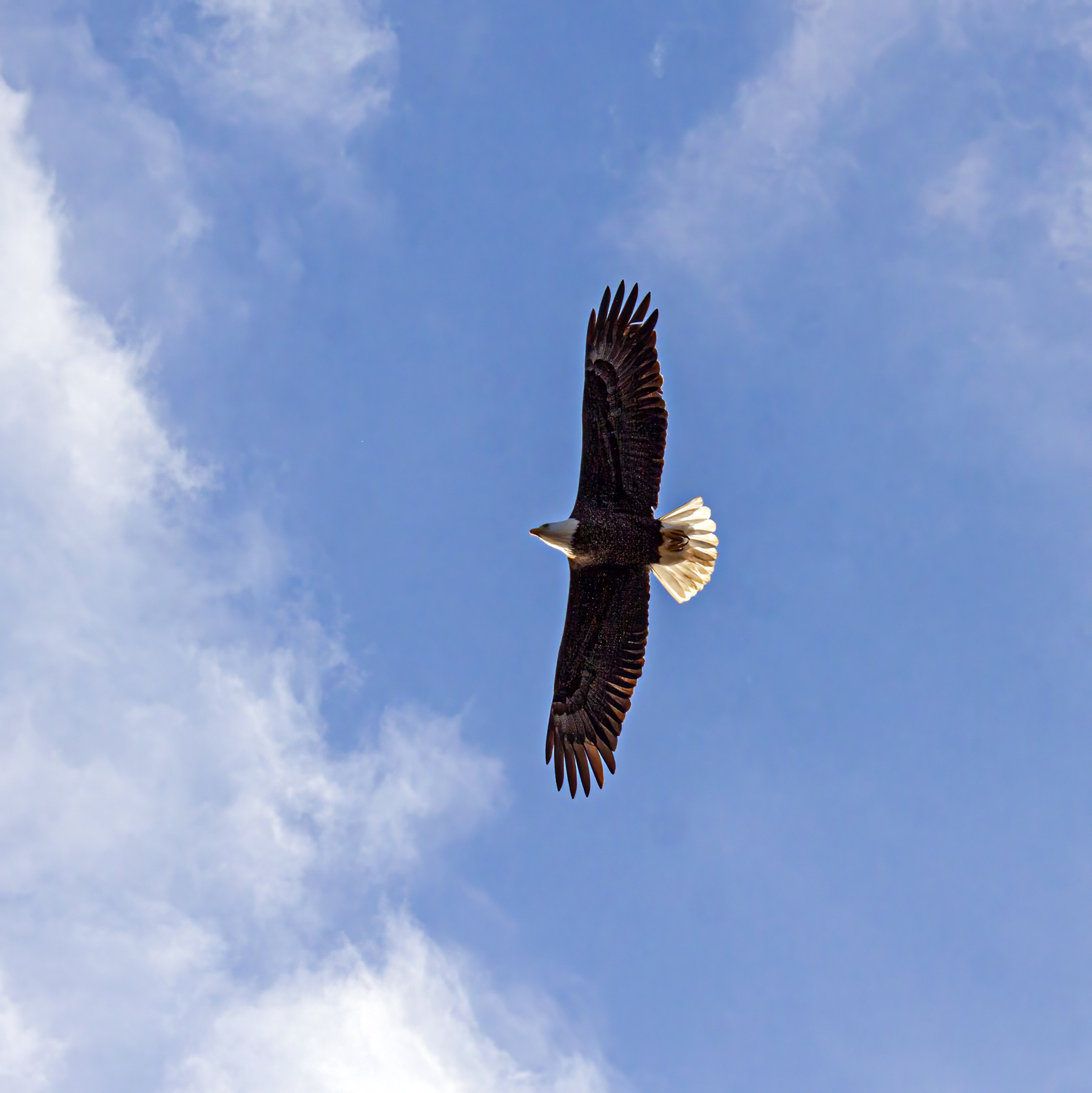
I love watching Bald Eagles (Haliaeetus leucocephalus) flying so effortlessly in the sky, propelled by their massive wings and the currents of air. Quite often they soar so high that they are beyond the range of my camera, but this week I was able to capture some images of them at a somewhat lower altitude while I was visiting Occoquan Bay National Wildlife Refuge.

I would love to be able to fly so freely above all of my earthbound cares and can’t help but think of some of the lyrics of “Fly Like an Eagle” by the Steve Miller Band.

“I want to fly like an eagle
To the sea
Fly like an eagle
Let my spirit carry me
I want to fly like an eagle
‘Til I’m free.”

The other thought that inevitably comes to mind when I see eagles in flight is a promise from Isaiah 40, one of my favorite verses in the Bible, “But they that wait upon the Lord shall renew their strength; they shall mount up with wings as eagles; they shall run, and not be weary; and they shall walk, and not faint” (Isaiah 40:31).

During this pandemic time, we all need that kind of strength and endurance and hope as we continue our daily struggles, looking forward to a time when we too will soar again.

Bald Eagle

Bald Eagle

Bald Eagle

© Michael Q. Powell. All rights reserved.

Read Full Post »