Feeds:
Posts
Comments

Posts Tagged ‘Bald Eagle’

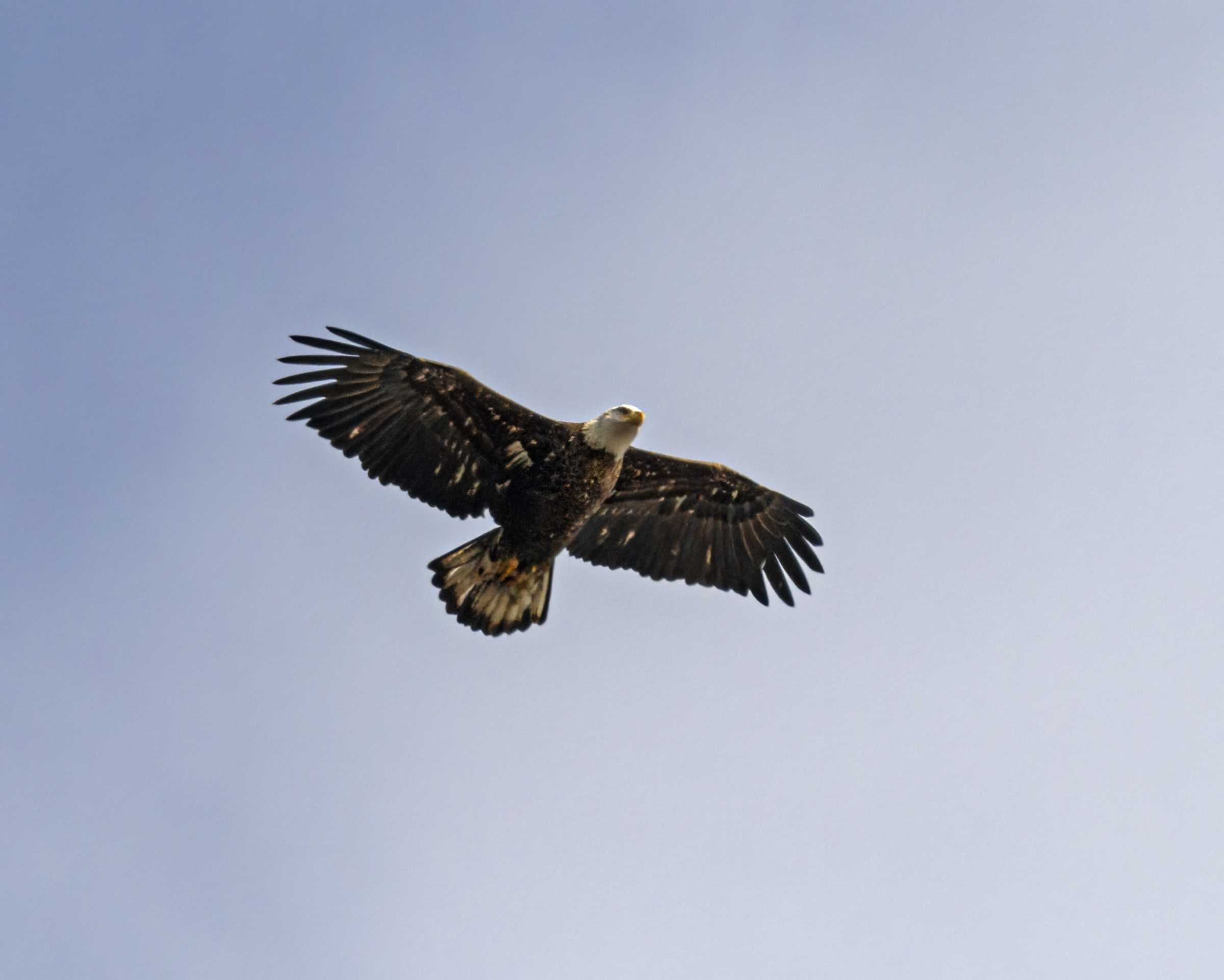
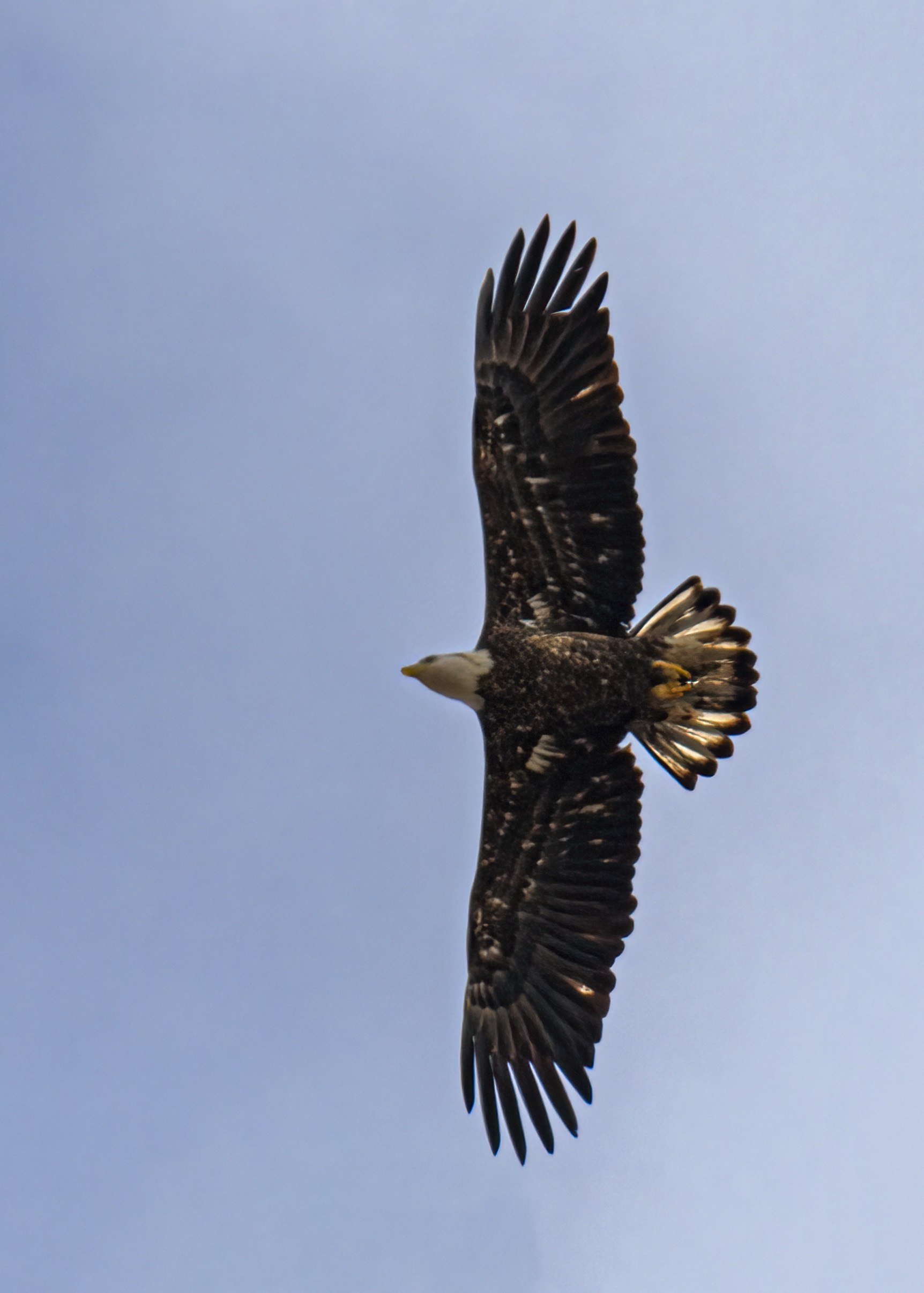
When the leaves are gone from the trees, it’s a little easier to spot perched Bald Eagles (Haliaeetus leucocephalus), like this one that I photographed last week at Occoquan Bay National Wildlife Refuge. I am blessed to live in an area where there are enough bald eagles that it is not uncommon for me to spot one. However, the eagles have much more developed senses that I do, so often my first indication of their presence is when they are flying away from me, as you can see in the first photo below.

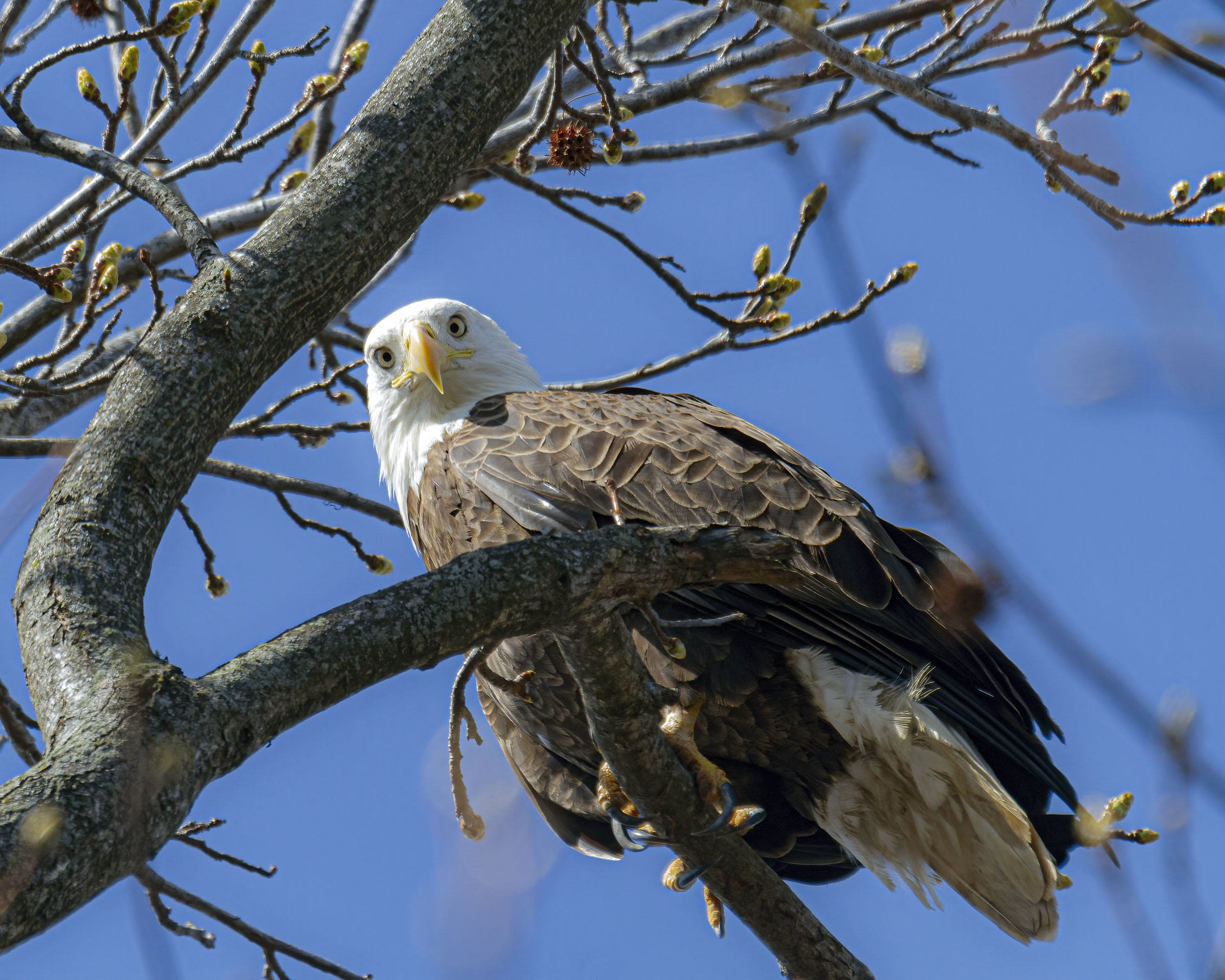
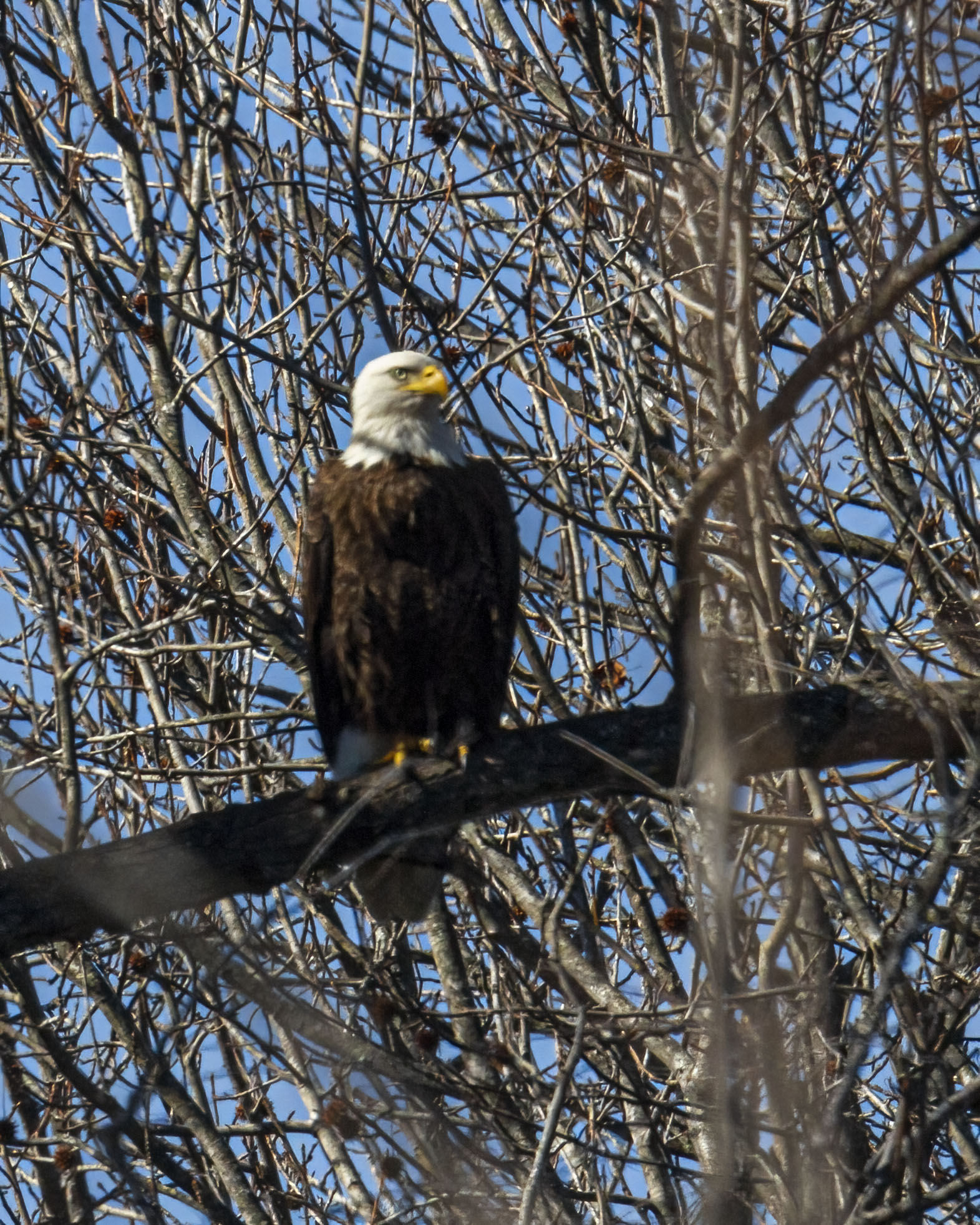
In the case of the second photo, there was a good deal of vegetation between me and the eagle that partially hid my presence. I was able to manually focus my lens on the perched eagle through the vegetation and get a relatively clear shot of the eagle, which took off almost immediately after I had snapped a couple of photos.

I am not certain if I will be able to get out with my camera during the few remaining days of 2025, so these photos may well be my last shots of the year of these majestic birds.

Bald Eagle

Bald Eagle

© Michael Q. Powell. All rights reserved.


Read Full Post »

Happy Thanksgiving to all those celebrating this American holiday. Whether we are soaring high or resting at water’s edge, like this Bald Eagle couple (Haliaeetus leucocephalus), we are all blessed.

The Scriptures tell us we should “Rejoice always, pray continually, give thanks in all circumstances.” A recent sermon reminded me that we are called to give thanks “in” all circumstances, even when it may not be possible to feel thankful “for” all of them. It’s a matter of having what some have called an “attitude of gratitude.”

© Michael Q. Powell. All rights reserved.


Read Full Post »

As I rounded a bend in a trail last Monday at Occoquan Bay National Wildlife Refuge, I spotted a Bald Eagle (Haliaeetus leucocephalus) in the foliage of a tree right in front of me. The eagle and I both reacted instantly, but its reflexes were faster than mine and the eagle took the air. I managed to capture a few shots of the departing eagle, a testament to both my luck and a quick reaction in bringing my camera up to my eye.

Bald Eagle

Bald Eagle

Bald Eagle

© Michael Q. Powell. All rights reserved.


Read Full Post »

Earlier this season, it looked like a pair of Bald Eagles had occupied a large nest at Occoquan Bay National Wildlife Refuge. Each time that I visited the refuge, I would check the nesting site to look for indications that an eagle was sitting on eggs. Unfortunately, the nest is so deep and so high up that it is almost impossible to tell if an eagle is inside of the nest.

Last week, I watched a pair of Ospreys (Pandion haliaetus) fly into the nest and seize it and captured this shot of them doing so. Generally ospreys use much smaller, thrown-together nests, but I guess that this pair decided to advantage of what I assume is a currently unoccupied eagle nest.

As I watched the two ospreys approach the nest with dangled legs, I couldn’t help but think of the scenes from the Wizard of Oz movie in which the flying monkeys seized Dorothy. The mind works in strange ways.

osprey

© Michael Q. Powell. All rights reserved.


Read Full Post »

Every year in the late winter and early spring I try to keep an eye on the nests of Bald Eagles (Haliaeetus leucocephalus) at Occoquan Bay National Wildlife Refuge. Several of the locations with nests that were used last year apparently are not being this year, but I have repeatedly observed eagle activity at one very large nest at the refuge.

On Monday, I spotted one eagle perched on the edge of that nest and another eagle in a nearby tree keeping watch over the nest. Does that mean that some eggs have hatched? Who knows? The nest is so deep that it is impossible to see what is going on inside of the nest. I watched the nest for quite a while, hoping I might see a tiny head pop up over the edge of the nest, but a baby eagle never appeared

I will continue to monitor this nest and a couple of other potential nesting sites and, with a little luck, may catch a glimpse of some eaglets in the upcoming weeks.

bald eagle

© Michael Q. Powell. All rights reserved.

Read Full Post »

I never get tired of photographing Bald Eagles (Haliaeetus leucocephalus), like this one that soared by me last week at Occoquan Bay National Wildlife Refuge. The eagle made minor adjustments to its wings and tail to maintain its speed and direction, but it mostly seemed to be enjoying itself without exerting much effort. I couldn’t help but think of the Steve Miller Band and its well-known song “Fly Like an Eagle” from the 1970’s.

“I want to fly like an eagleTo the seaFly like an eagleLet my spirit carry meI want to fly like an eagle‘Til I’m freeOh, Lord, through the revolution…”


Bald Eagle

Bald Eagle

Bald Eagle

Bald Eagle

© Michael Q. Powell. All rights reserved.

Read Full Post »

As I peered through the thick vegetation on Tuesday at Occoquan Bay National Wildlife Refuge, I spotted the bright white head of a Bald Eagle (Haliaeetus leucocephalus) perched on a distant tree above what may be a new eagle nest. Some of the nesting sites that eagles used in previous years are empty this year and none of the roads at the refuge appeared to be closed. I have been searching diligently for indications of new nests and am hopeful that this one is now being actively used.

I suspect that there is also nesting activity at the large eagle nest shown in the second photo below. The nest is so large and deep, however, that it is impossible to tell for certain if an eagle is currently sitting on eggs inside.

Spring is a time for new life and for new growth and I am hopeful that I will spot some baby eaglets in these two nests in the upcoming months as spring draws near.

Bald Eagle

eagle nest

© Michael Q. Powell. All rights reserved.

Read Full Post »

As I was exploring Occoquan Bay National Wildlife Refuge last week, I spotted a Bald Eagle (Haliaeetus leucocephalus) perched high in a sweetgum tree. The eagle seemed to be surveying the entire area, like a king keeping watch over his kingdom. I am pretty sure that he spotted me, but may have judged correctly that I was not a threat, and therefore the eagle remained in place as I passed on by.

bald eagle

© Michael Q. Powell. All rights reserved.


Read Full Post »

Last week I spotted a Bald Eagle (Haliaeetus leucocephalus) couple perched near each other in a tree at Occoquan Bay National Wildlife Refuge. Although it is not quite nesting season here in Northern Virginia, the eagles were within eye sight of the large nest that you can see in the second photo below. It is hard to get a sense of the massive size of the nest from the photo, but it is so large that the eagles disappear from sight when they are sitting on eggs in that nest.

I suspect that the eagles will soon occupy that nest and, with a little luck, I hope to see some baby eagles in the next few months.

Bald Eagle

eagle nest

© Michael Q. Powell. All rights reserved.


Read Full Post »

It is still a little early for the Bald Eagles (Haliaeetus leucocephalus) to begin nesting at Occoquan Bay National Wildlife Refuge, but both members of an eagle couple were perched in a tree near a large nest last week when I visited the reserve. One of the eagles was partially blocked from view by the tree’s branches, but I was able to capture this image of the other one as it kept watch over the nesting site.

Bald Eagle

© Michael Q. Powell. All rights reserved.

Read Full Post »

Last Thursday I captured my first shot of a Bald Eagle in a few months during a visit to Occoquan Bay National Wildlife Refuge. I have spotted Bald Eagles several times this summer, but I did not see them from a distance, because of the foliage on the trees, and my first indication of their presence was when they were flying away from me.

There are still quite a few leaves on the trees, so I was startled when I flushed an eagle last week. I was fortunate, though, the eagle flew across my field of view and I was able to snap off a couple of shots before it disappeared from sight. This is a crop of the image that came out of my camera and I am pretty happy with the results, especially considering the fact that I had no time to make any adjustments to my camera before taking the shot.

I am still trying to focus primarily on insects, but know that before long I will be switching my focus to birds. However, as this photo shows, I will rarely pass up an opportunity to get a shot of a Bald Eagle, irrespective of the season.

Bald Eagle

© Michael Q. Powell. All rights reserved.

Read Full Post »

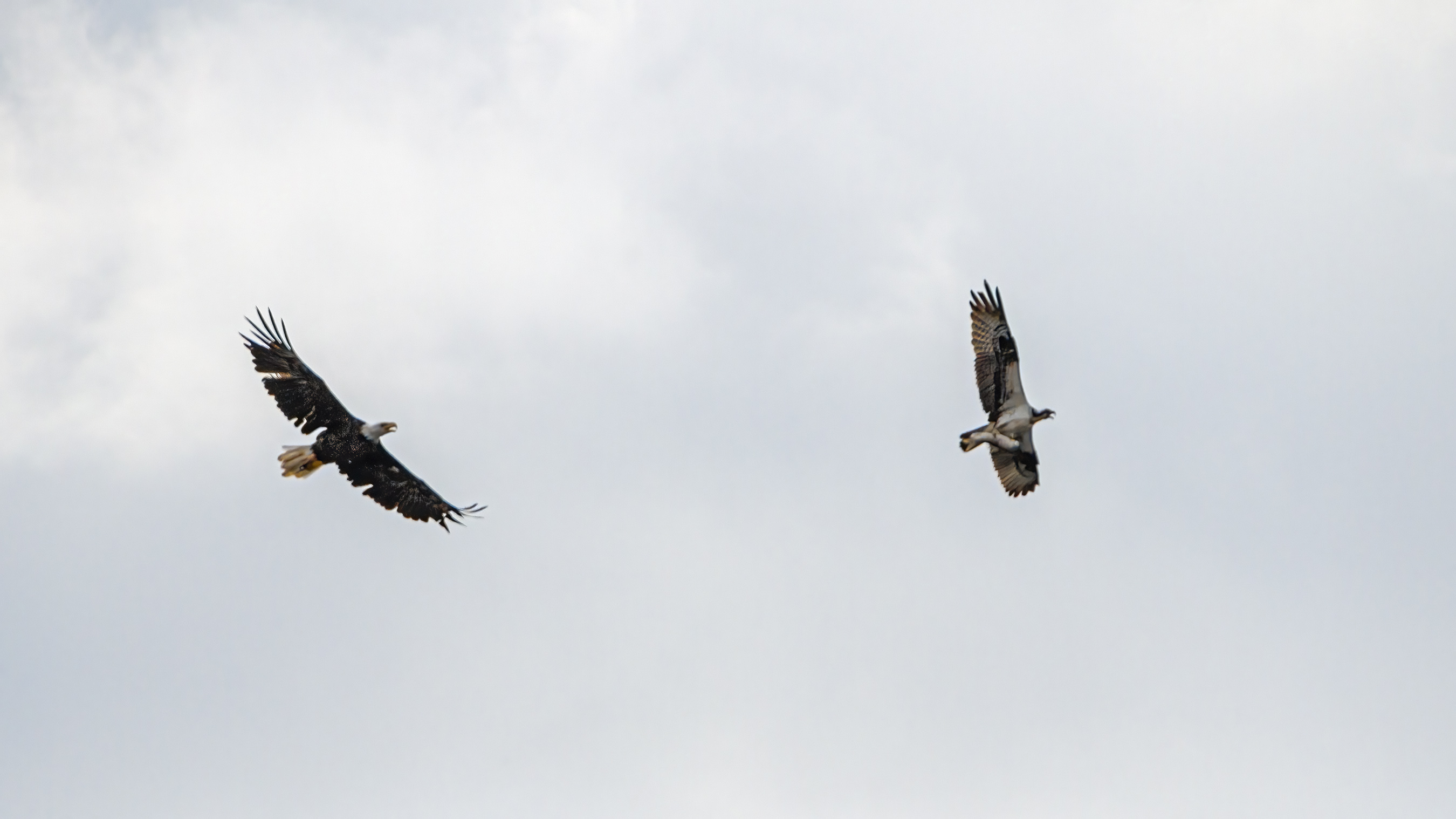
On Wednesday I watched as a Bald Eagle (Haliaeetus leucocephalus) chased an Osprey (Pandion haliaetus) high in the sky above the waters off of Occoquan Bay National Wildlife Refuge in a vain attempt to steal its freshly caught fish. I captured the second shot when the eagle flew past me after giving up on its chase.
It has been several months since I last photographed a Bald Eagle, so I was thrilled to capture these images. As most of you know, I concentrate most of my photographic attention on dragonflies and other insects during the warmer months. However, I am always alert to the possibility of photographing birds when I manage to spot them.
During the winter months I generally use a 150-600mm telephoto zoom lens that gives me a long reach, but in the summer I tend to rely on a 180mm macro lens or the 18-400mm zoom lens that I used for these shots. This lens gives me a good deal of versatility, allowing me to capture my close-in tiny subjects and some longer distance ones like these raptors in flight.
Eagle and Osprey
Bald Eagle
© Michael Q. Powell. All rights reserved.

Read Full Post »

As many of you know, I keep an eye on several eagle nests at Occoquan Bay National Wildlife Refuge at this time of the year, waiting with hopeful expectation for the birth of new eaglets. In one nest that is relatively small, the adult Bald Eagle (Haliaeetus leucocephalus) is now sitting upright, rather than hunkering down over the eggs to keep them warm. I suspect that there is at least one eagle baby, but I have not yet seen any tiny eagle heads pop up over the edge of the nest.

I am not sure what’s happening with the much larger eagle nest. I had assumed that the eagles were sitting on eggs. However, on Tuesday I watched as an osprey perched on one of the trees supporting the nest and buzzed a nearby perched eagle. Several other photographers have reported seeing osprey actually sitting in the eagle nest.

As I observed the nesting area on Tuesday afternoon, two eagles in a tree overlooking the nest briefly engaged in what looked like mating behavior. Was an earlier nesting attempt unsuccessful? Are the eagles going to make another attempt to have babies this season?

It is a bit late in the year for the eagles to begin nesting, but I think there is still time for them to do so. Normally this process begins earlier in the year before the ospreys have returned, so there is no competition for the nest. Although there appears to be competition now, I would put my money on the eagles, which I believe are larger and stronger than the osprey.

I will continue to monitor the nesting situation. There may be more drama there this spring than in previous years.

Bald Eagle

© Michael Q. Powell. All rights reserved.


Read Full Post »

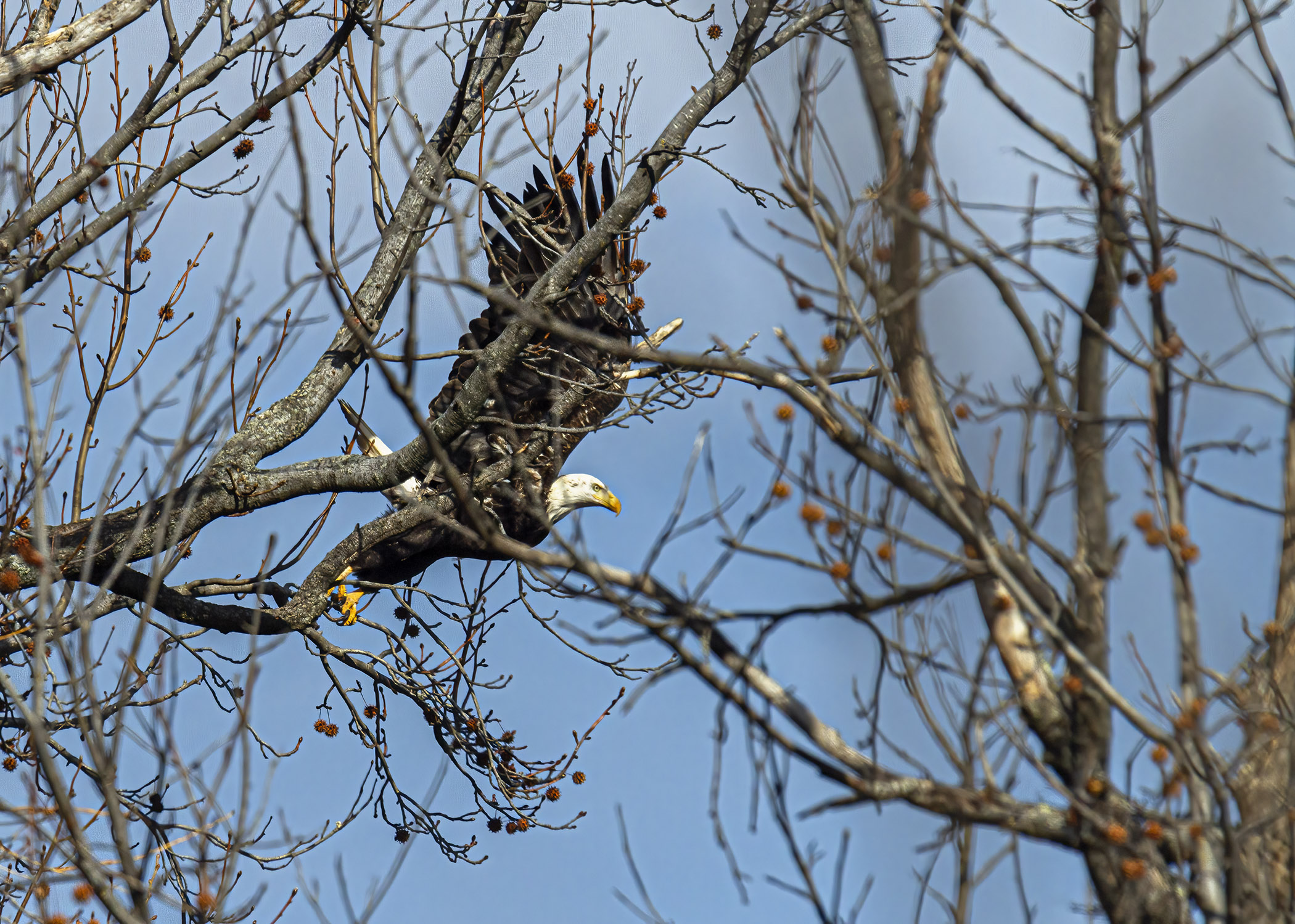
This Bald Eagle (Haliaeetus leucocephalus) was partially hidden by tree branches when I first spotted during a recent visit to Occoquan Bay National Wildlife Refuge. I tried to move as stealthily as I could to try to get a clearer view of the eagle, but the eagle detected my presence. I captured this image as the eagle was preparing to take off. The eagle flew downwards from its perch and my view was completely obstructed, so I was not able to capture any in-flight shots of the eagle.

As you can see, many of the trees in my area have buds now. I think this tree might be a Sweet Gum tree, because I can see some of its distinctive spiky seed balls still hanging from the tree.

Bald Eagle

© Michael Q. Powell. All rights reserved.

Read Full Post »

It was cool, cloudy, and windy when I visited Occoquan Bay National Wildlife Refuge last Friday. I did not see any activity at the two eagle nests that I checked, but suspect that there was an eagle in each of them, hunkered down keeping the eggs warm.

I did encounter solitary adult eagles several times as I walked along the trails. Perhaps these Bald Eagles (Haliaeetus leucocephalus) were the mates of the eagles sitting in the nests. Whatever the case, these eagles looked to be hypervigilant and serious, keeping a close watch over the entire area. This eagle kept its head moving a lot, so I was happy when I managed to capture this profile shot as it perched in what I believe is a Tulip tree.

Bald Eagle

© Michael Q. Powell. All rights reserved.


Read Full Post »

It is always cool to capture an image with multiple birds of the same species, especially when they are at different stages of development. This past Monday at Occoquan Bay National Wildlife Refuge I spotted two Bald Eagles (Haliaeetus leucocephalus) perched next to each other in some distant trees.

The larger eagle on the left was clearly an adult, with a white head and yellow beak. This eagle had its head raised and was calling out loudly. In similar circumstances in the past, it appeared to me that one member of a couple was calling out to its mate. I am not at all sure if that was the case this time.

The eagle on the right is quite a bit smaller than the adult. I cannot see all of its markings, but I would guess that it is about two to three years old—it takes almost five years for a bald eagle to mature.

Was this younger eagle related to the adult? Perhaps it was a parent-child relationship. For some reason I imagined a teenager that had left home to live on its own and then decided that it wanted or needed to move back in with its parents.


Bald Eagle

© Michael Q. Powell. All rights reserved.

Read Full Post »

Yesterday was a beautiful day, with blue skies and temperatures soaring above 60 degrees (16 degrees C). I visited Occoquan Bay National Wildlife Refuge and was thrilled to have multiple sightings of Bald Eagles (Haliaeetus leucocephalus).

One eagle seemed particularly vigilant, keeping careful watch over the entire area. Initially the eagle was mostly hidden from view by the heavy vegetation, but eventually I found a visual tunnel that gave me a mostly unobstructed view of the majestic eagle.

Photographing bald eagles can be quite challenging—the extreme contrast between the bright white heads and the dark bodies means that I have to choose the exposure for the image carefully to avoid blowing out the highlights in the head or losing the details of the body in the shadows.

Bald Eagle

© Michael Q. Powell. All rights reserved.

Read Full Post »

The last few days I have been really busy and have not had a chance to get out very much with my camera to capture new images. I went over the shots from my visit to Occoquan Bay National Wildlife Refuge and decided to post some more shots of the subadult Bald Eagle (Haliaeetus leucocephalus) that I photographed as it flew about, twisting and turning in the air above my head.

Previously I posted a shot of the eagle with outstretched wings (the 20 February posting was called Eagle Gyration). Today’s posting shows the same eagle in a number of other positions. I am always intrigued by the way that birds use their wings and tails in combination to move in the desired direction. Eagles make flying seem so effortless.Bald Eagle

Bald Eagle

Bald Eagle

© Michael Q. Powell. All rights reserved.

Read Full Post »

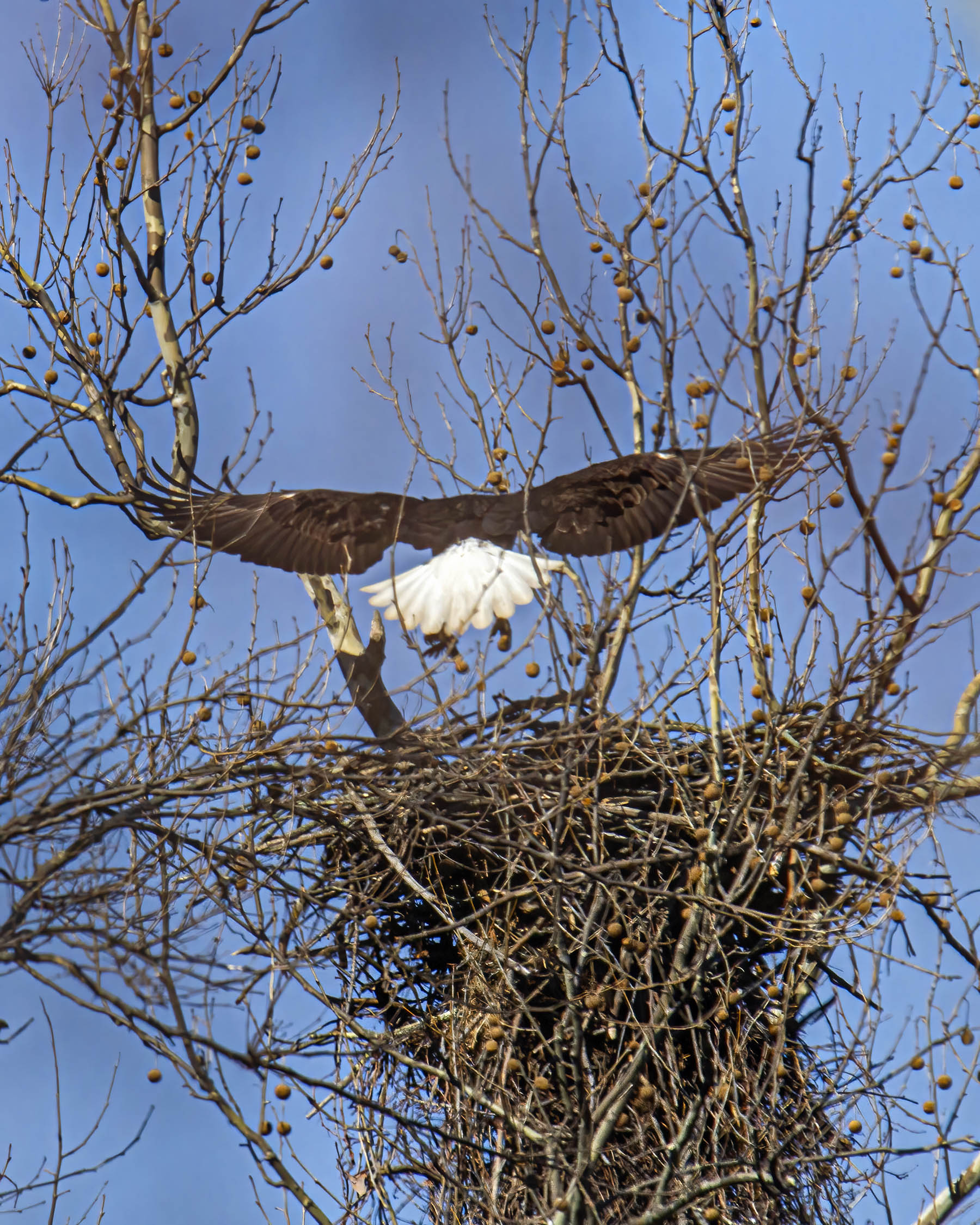
When I watched a Bald Eagle (Haliaeetus leucocephalus) fly into a nest on Monday at Occoquan Bay National Wildlife Refuge, I was not sure if it was occupied. We have reached the time of the year when the eagles at this refuge begin to sit on their eggs, but I did not know if the process had begun at this small nest that was used for the first time last year. As you can see in the first photo, the nest is only about as wide as the eagle’s outstretched wings.

After the eagle had landed and settled down, the body of a second eagle appeared from within the nest. I never did get a good look at the second eagle, because it kept its head down as it made some adjustments in the nest while the newly arrived eagle waited patiently to take over nest responsibilities.

One eagle flew away and the remaining one sank lower from view as it spread its body to cover the eggs. The nest is quite shallow, though, so I could still see the top of the eagle’s head most of the time. Occasionally the eagle would raise its head a little and I was able to capture a few shots like the final one here in which the eagle was looking up into the sky, wondering perhaps when its mate would return to the nest.

Bald Eagle

Bald Eagle

Bald Eagle

© Michael Q. Powell. All rights reserved.

Read Full Post »

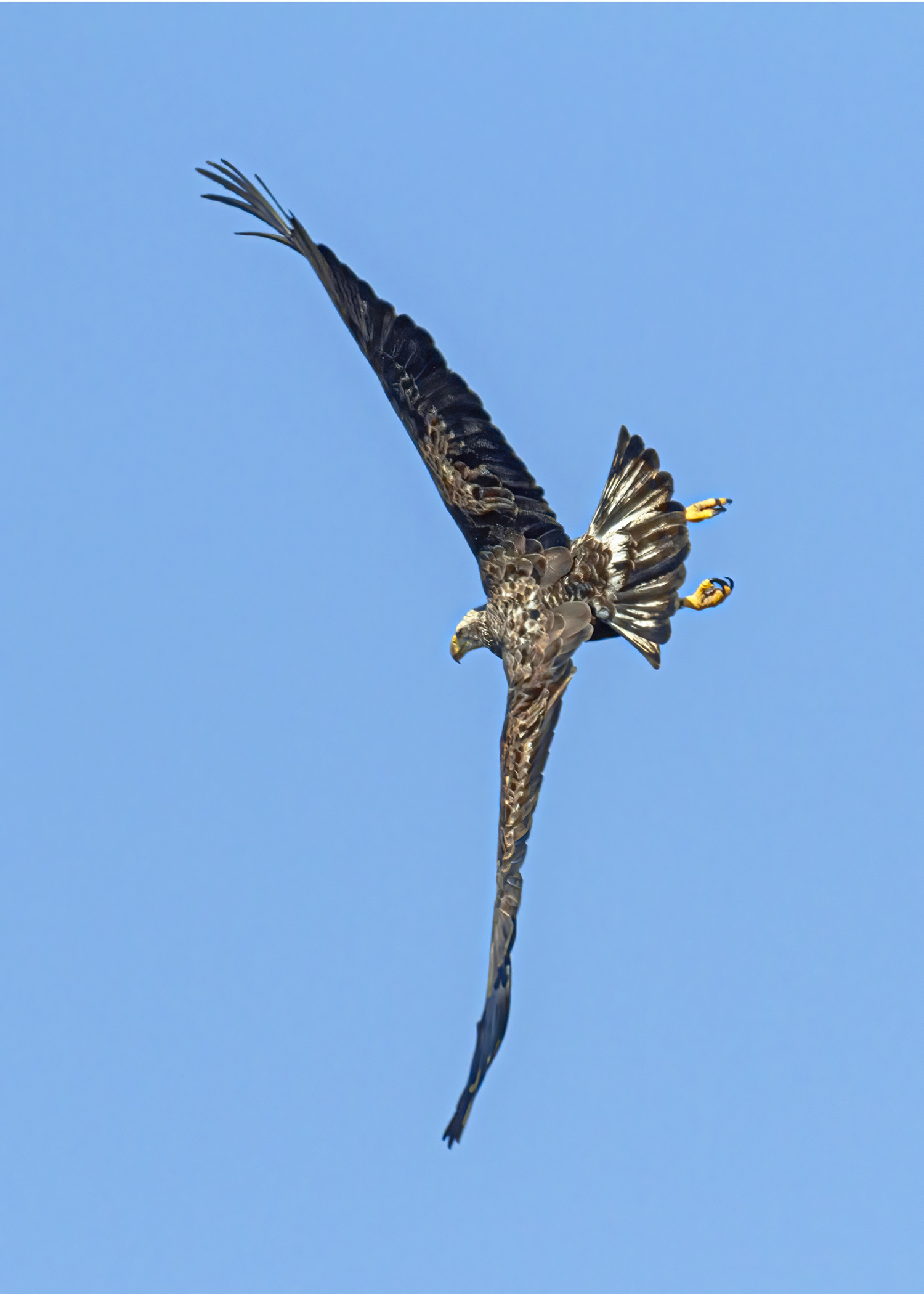
It takes about five years for a Bald Eagle (Haliaeetus leucocephalus) to develop into adulthood and acquire the bright white heads and tails that we generally associate with this species. When they are young, the eagles have dark feathers and beaks and during the intermediate years their feathers have a mottled appearance.

Yesterday I watched a subadult eagle flying about in the skies over Occoquan Bay National Wildlife Refuge. Judging from its coloration, I’d guess that it was about three to four years old.

The eagle put on quite an aerial show for me, twisting and turning in an amazing display of aerial prowess. I was particularly impressed by the way that the eagle would stretch wide its wings and flare its tail as it changed directions, as you can see in the photo below.

When an eagle or any other raptor is moving about like that, it is quite a challenge to track it and keep it within the frame. Suffice it to say, I have quite a few shots in which the eagle is partially cut off at the edge of the frame or occasionally is completely absent from the photo.

Bald Eagle

© Michael Q. Powell. All rights reserved.

Read Full Post »

Have you ever tried to sneak up on a Bald Eagle (Haliaeetus leucocephalus)? Given the eagles’ superior eyesight and quicker reactions, they almost always detects me before I can get within camera range and often my first indication of an eagle’s presence is when I see it flying away from me.

As many of you know, there are several eagle nests at Occoquan Bay National Wildlife Refuge and this is the time of the year when eagles begin nesting in them. The roads are blocked in the area surrounding one of the nests, so it is hard to get a good look at it. The largest nest, though, is set way back in the trees, but is visible from one of the main trails, which remains open.

During a visit to the refuge on Wednesday (Valentine’s Day), I noticed through the trees that both members of an eagle couple were perched atop the nest. Male eagles are often smaller than the females, so I think that the eagle to the left in the first photo is a male. I was still a long way from the nest when I captured that first photo, but experience has taught me that it is best to capture a “record” shot, before trying to get closer for a better one.

I continued down the trail in the direction of the eagle nest doing my best to walk near the high vegetation at the edge of the trail that blocked the eagle from seeing me and, alas, prevented me from seeing the eagle.

I know where the spots are where there is an open view of the nest and I prepared myself as I approached the best one. As I stepped partially into the open and raised my camera, one of the eagles took off and I captured the second shot below. As I was trying to track that eagle in the air, the second one took off too and I watched as they both flew away over the waters of the bay.

Before long, the eagles should be sitting on one or more eggs in the nest. The nest is quite deep and high up that it is almost impossible to tell if there is an eagle in the nest when they are incubating the eggs. The members of the couple rotate the responsibility for sitting on the eggs and I have been lucky on a couple of occasions to see the “changing of the guards.” Perhaps I will have that same good fortune this year.

Bald Eagle

Bald Eagle

© Michael Q. Powell. All rights reserved.

Read Full Post »
Bald Eagles (Haliaeetus leucocephalus) at Occoquan Bay National Wildlife Refuge are increasingly spending time in and around existing eagle nests. It probably won’t be long before eggs are laid and the eagles begin to sit on the eggs.

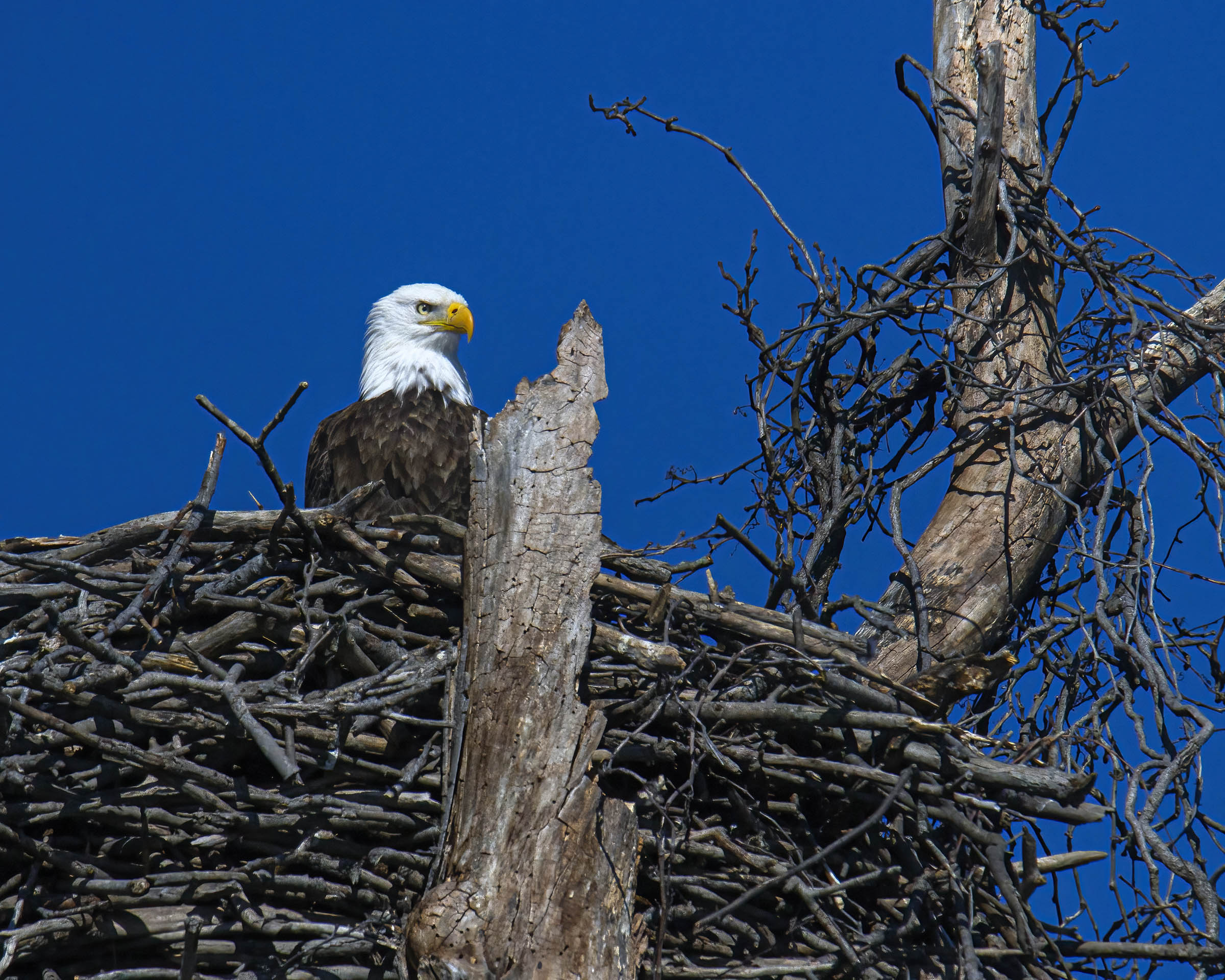
On Thursday I spotted an eagle perched high in a nest while its mate kept watch from a nearby tree, as you can see in the final photo. This eagle nest is huge and is by far the largest one at the wildlife refuge. The nest has been used for many years and each year the eagles seem to add another layer to it. It was very easy to spot this eagle, because its bright white head was sticking prominently out of the nest.

When the eagles begin incubating the eggs, however, they hunker down in the deep nest and it is usually impossible to know for certain when they are present. During that period of time I will sometimes watch and wait, hoping to be there for the “changing of the guard,” when one member of the couple takes over duties from the other, but I have been lucky enough to be there only a few times when that happened. Otherwise I have to wait for the eaglets to get big enough to poke their little heads out of the top edge of the nest.

On another part of the refuge, barriers have now gone up to protect the nesting eagles at that location. That nest is adjacent to one of the trails, whereas the large nest pictured here is far enough away from the trail that the authorities do not seem to think that the eagles require additional protection.

Bald Eagle

Bald Eagle

Bald Eagle

Bald Eagle

© Michael Q. Powell. All rights reserved.


Read Full Post »
I never get tired of photographing Bald Eagles (Haliaeetus leucocephalus)—it always feels special to catch sight of one of these majestic birds. In Northern Virginia, where I live, we are blessed to have a relative abundance of Bald Eagles and I see one or more of them quite regularly. Getting a good shot of one, though, is a bit of a challenge, because the eagles’ eyesight and reaction times are vastly superior to my own. A lot of the time my first indication of the presence of an eagle is when I see it flying away from me.

This past Tuesday I spotted a Bald Eagle perched on a broken-of branch of what appeared to be a small, dead tree at Occoquan Bay National Wildlife Refuge. There was some vegetation between the two of us that hopefully hid me from view. Initially my view of the eagle was partially blocked, but by bending and twisting myself, I managed to find a clear visual tunnel.

When I captured the first shot, the “regal” one, the eagle appeared to be surveying its surroundings from on high, like a royal sovereign. A few seconds late, the eagle seemed to have become aware of my presence and stared directly at me. It is hard to interpret the facial expressions of an eagle, but “fierce” is a descriptive word that often comes to mind.

Although it might have been a little curious about me, the eagle seemed mostly unhappy that I was there. I can imagine the regal eagle thinking, “We are not amused.”

Be sure to click on the second image to get a closer look at the eagle’s face. How do you interpret that expression?

Bald Eagle

Bald Eagle


© Michael Q. Powell. All rights reserved.

Read Full Post »
It won’t be long before the Bald Eagles (Haliaeetus leucocephalus) begin to incubate their eggs at one of several nests of which I am aware at Occoquan Bay National Wildlife Refuge. The smallest nest was used for the first time last year and I was curious to see if the eagles would return to it. I was therefore quite happy to spot an eagle on Tuesday perched in that nest in what looks to be a sycamore tree. Usually eagles sit much lower in the nest when there are eggs present, so I suspect that this eagle was checking out the nest, possible as a prelude to renovating or enlarging it.

I was a pretty good distance away from the eagle and was partially hidden by vegetation and trying to be stealthy, but the eagle detected my presence. I captured the second image right after the eagle flew out of the nest. I managed to get only a single decent shot, because the eagle descended and was immediately hidden by the abundant branches—if the eagle had flown upwards I might have had a better chance of getting several clear shots.

Last year the authorities at the refuge eventually blocked the trail on which I was traveling to keep the eagles from being disturbed during the nesting season. I would not surprised to find the trail blocked the next time I visit the refuge. During the period of time before the trees begin to leaf out, I may still be able to keep track of the nest, albeit from a slightly greater distance from it.

Bald Eagle

Bald Eagle

© Michael Q. Powell. All rights reserved.

Read Full Post »

I was thrilled to be able to capture a few shots of this sub-adult Bald Eagle (Haliaeetus leucocephalus) last Monday as it soared overhead at Occoquan Bay National Wildlife Refuge. Judging from the fact that there are light feathers in the wings, which are completely dark for adults, and dark feathers in the tail, which are completely white for adults, I’d guess that this eagle is about 3-4 years old. Bald Eagles take almost five years to fully develop the “look” that we normally associate with this species.

Bald Eagle

Bald Eagle

© Michael Q. Powell. All rights reserved.

Read Full Post »

Quite often when I review my photos a second time I find photos that I missed during my initial look, like this photo of a Bald Eagle (Haliaeetus leucocephalus) that was just starting its liftoff from a tree last Saturday morning at Occoquan Bay National Wildlife Refuge.

When I spotted this pair of eagles in a distant tree, I watched and waited, hoping that they both would turn in my direction. However, the eagle in the back kept looking in the opposite direction and branches were also blocking my view. Suddenly the eagle in the front raised its wings to take off and I was able to react quickly enough to capture the moment when it was just starting to push off from the branch.

As you can probably tell from the lighting in the photo, this was another early morning encounter with bald eagles. I was very fortunately to have multiple encounters that morning. It will soon be nesting season for the eagles and I hope to able to capture some images as the eagles work on preparing the nests for another season—there are three nesting locations at the wildlife refuge, although one of the nests looks like it may have disappeared, possibly because one of the main supporting branches collapsed.

Bald Eagle

© Michael Q. Powell. All rights reserved.

Read Full Post »

Last Saturday morning I spotted a Bald Eagle (Haliaeetus leucocephalus) perched in the middle of a tangle of small trees at Occoquan Bay National Wildlife Refuge. My view was partially obscured by a large number of branches, but I still managed to focus on the eagle.

I captured this sequence of shots when the eagle unexpectedly took off. The eagle had to maneuver its wings carefully until it was away from the branches and in the final photo the eagle was finally able to display its impressive wingspan.

Bald Eagle

Bald Eagle

Bald Eagle

© Michael Q. Powell. All rights reserved.

Read Full Post »
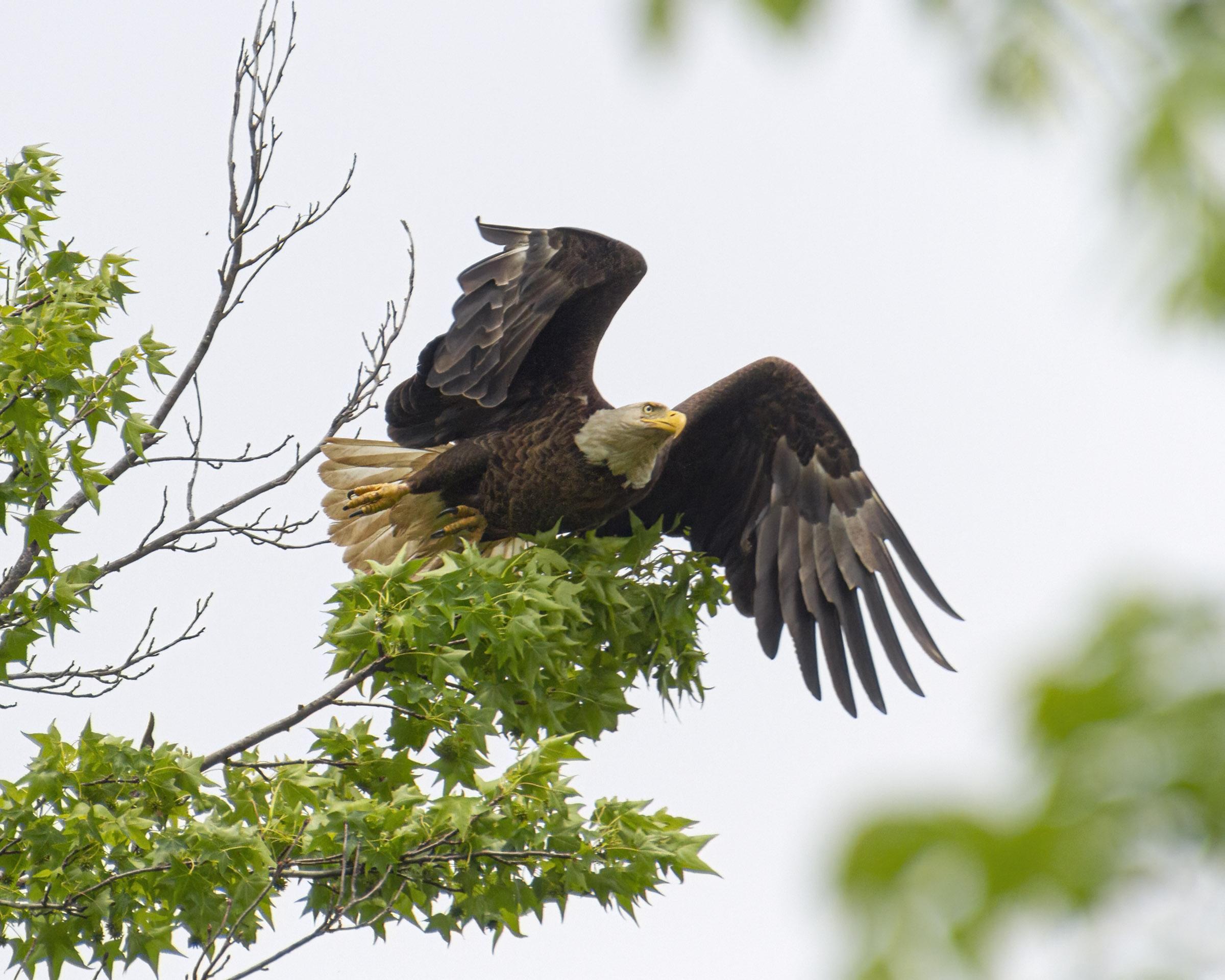
Two Bald Eagles (Haliaeetus leucocephalus) were perched together in a distant tree early in the morning last Saturday at Occoquan Bay National Wildlife Refuge. One of them suddenly decided to take off and I captured this fun shot. I encourage you to click on the image to get a closer views of the details, including the expression on the eagle that was in mid-air.

Somehow the eagle’s pose reminded me of the winged monkeys in the Wizard of Oz. I guess it has something to do with the dangling legs that look like they could easily snatch up Toto.

The early morning light gave this image a glow that I really like. Photographers sometimes refer to this time of the day as the “golden hour,” though it often lasts for a much shorter period of time.

Bald Eagle

© Michael Q. Powell. All rights reserved.

Read Full Post »

I could sense that this Bald Eagle (Haliaeetus leucocephalus) was preparing to take off and captured this image last Friday at Occoquan Bay National Wildlife Refuge right after it had taken a leap from the tree. I was hoping that the eagle would fly upwards and give me a chance at getting some more in-flight shots, but the eagle flew downwards and away from me.

Bald Eagle

© Michael Q. Powell. All rights reserved.

Read Full Post »

I think this Bald Eagle (Haliaeetus leucocephalus) may have been trying to snag a duck last Friday at Occoquan Bay National Wildlife Refuge. It repeatedly would swoop down over the water without success–the approach seemed quite different from the one that I would normally see when an eagle was fishing. In the bottom right of the first image, you can see some droplets of water that may have been caused by a duck diving under the water.

In the second photo, the eagle is not is as sharp focus as in the first shot, but you have a better look at the splash of the duck (?) diving to avoid the oncoming eagle. Perhaps it was just a fish, but I just don’t know enough about eagle behavior and the behavior of their potential prey to know for sure.

As you can probably tell, the lighting was less than optimal when I was taking these photos. The limited lighting made my camera’s focusing system struggle a bit and maintaining focus on the eagle in flight was a bit of a challenge. Still, I am pretty happy that I was able to capture some of the action, even if I am not 100 percent sure what was going on.

Bald Eagle

Bald Eagle

© Michael Q. Powell. All rights reserved.


Read Full Post »

It is almost nesting time for the Bald Eagles (Haliaeetus leucocephalus) at Occoquan Bay National Wildlife Refuge. Last Friday I spotted two eagles perched in the trees adjacent to the very large nest that has hosted numerous eagle couples over the years.

Later that same day I passed by the nest again and an eagle was sitting in the nest. I captured the second image when the eagle unexpectedly took off from the nest. I like the way that I captured the action,although I would have preferred not to have clipped the eagle’s wing as it extended it upwards to generate lift for its takeoff.

Bald Eagle

bald eagle

© Michael Q. Powell. All rights reserved.

Read Full Post »

Older Posts »