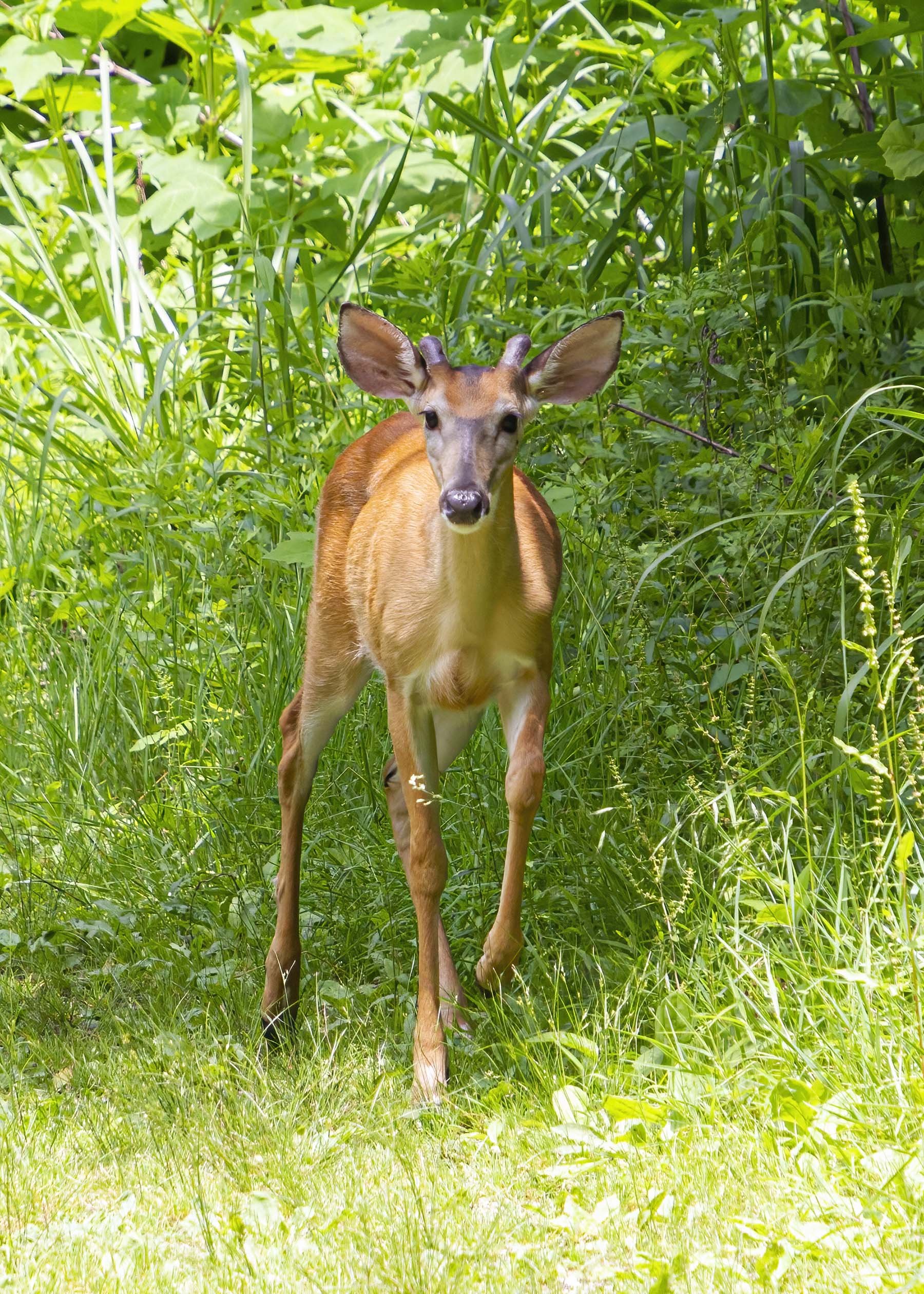
Last Friday I almost literally stumbled upon a young White-tailed Deer (Odocoileus virginianus) during a visit to Occoquan Bay National Wildlife Refuge. As I turned a corner, I suddenly spotted this little deer slowly coming towards me. I immediately stopped, but the deer initially kept on walking. I noticed that the deer had nubs on its head instead of antlers. Was this a buck who was too young to grow antlers or was this a somewhat older deer who was regrowing his antlers?
I grew up in the suburbs of Boston and confess that I know very little about deer. I do know that male deer shed their antlers during the fall and winter and then regrow them in the spring each year. According to the Fish and Wildlife Service, antlers are the fastest bone growth in the world and the antlers of an adult White-tailed Deer can grow 1/4 inch (6 mm) a day and those of an elk can grow an inch (25 mm) a day.
This deer seemed more curious about me rather than afraid of me and eventually moved only a few feet off of the trail to let me pass. I was happy to see this beautiful young animal in its natural habitat. In many parts of the suburban area surrounding Washington D.C. there is an overpopulation of deer and a variety of measures are used to try to control the population. At this wildlife refuge, for example, several deer hunts are conducted each year.
I personally am not a hunter, but I do recognize the dangers that deer overpopulation poses to the habitat, to the human population, and to the deer themselves. When I am out with my camera, though, I am not thinking about these things, but instead am focused on sharing the beauties of nature and peacefully coexisting with my fellow creatures, like this young deer.
© Michael Q. Powell. All rights reserved.

 Mike Powell