Feeds:
Posts
Comments

Archive for the ‘damselfly’ Category

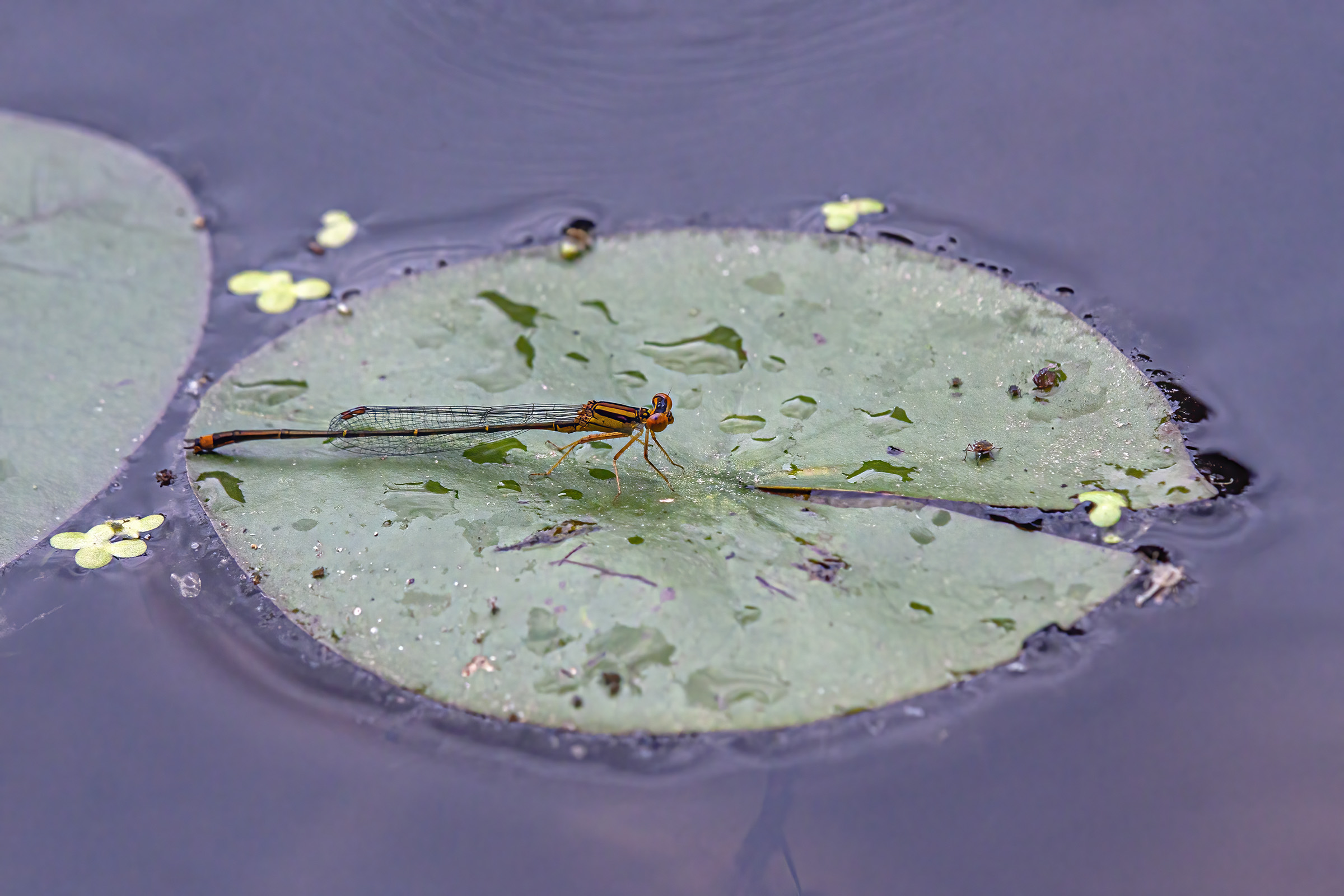
When I spotted this damselfly on 17 October at Occoquan Bay National Wildlife Refuge, I initially couldn’t figure out what species it was. I asked for help in a dragonfly/damselfly group in Facebook and was informed that it was an Orange Bluet damselfly (Enallagma signatum).

The name Orange Bluet seems to be an oxymoron. As the name “bluet” suggests, most of the 35 members of the genus American Bluet (Enallagma), the largest damselfly genus in North America, are blue. However, certain species come in other colors including red, orange, and green and the Rainbow Bluet combines red, yellow, and green.

I have actually photographed Orange Bluets before, but they have been a much brighter orange in color, as you can see in the second photo below from July 2022. The damselfly in the first photo was much duller in color, which may well be the reason for my uncertainty. However, it seems to be a perfect visual representation of the current autumn season.

Orange Bluet

orange bluet

© Michael Q. Powell. All rights reserved.


Read Full Post »

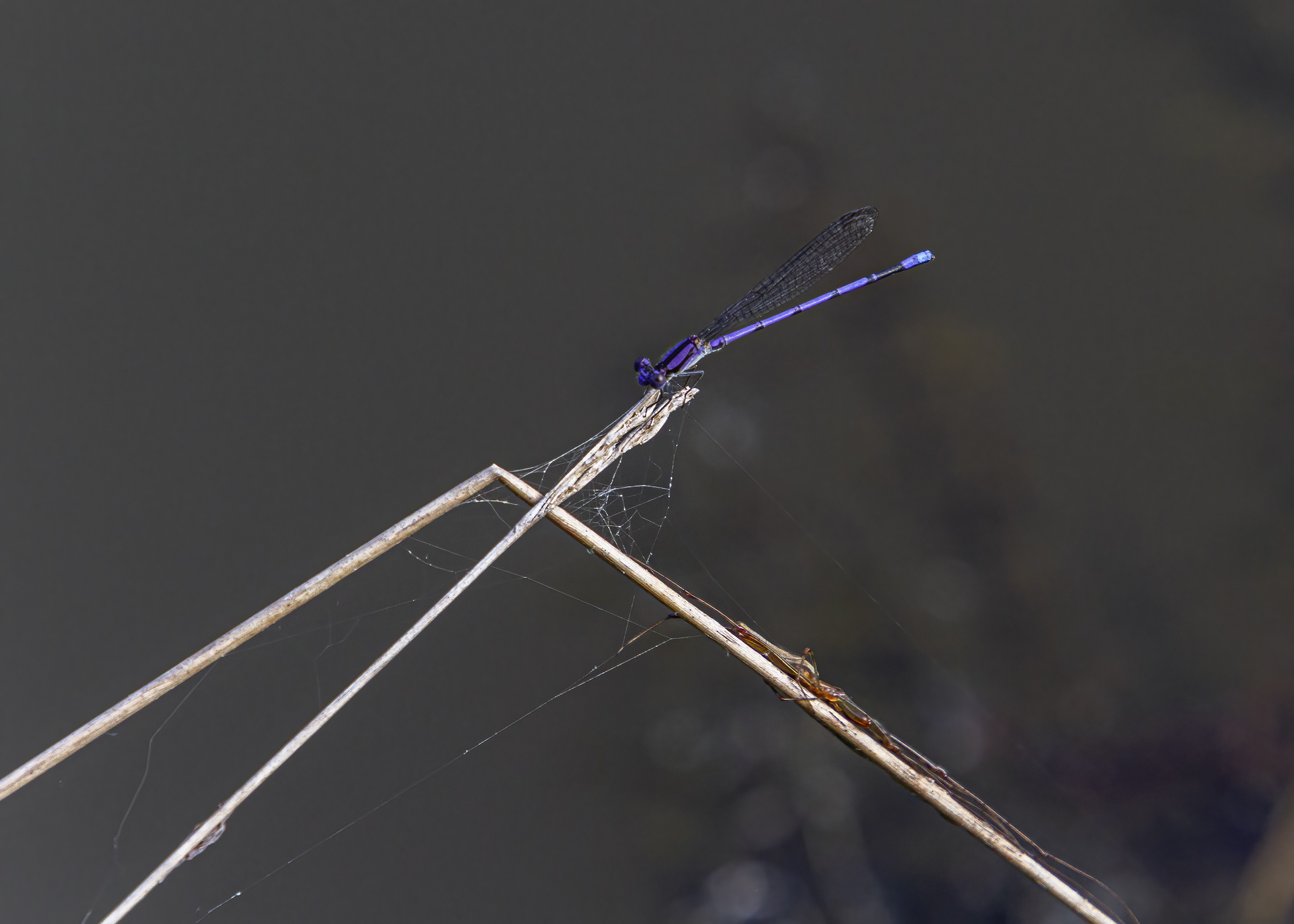
Do you have a favorite damselfly? I have had the opportunity to photograph some pretty spectacular damselflies, but I am irresistibly attracted to the unique coloration of the Violet Dancer damselfly (Argia fumipennis violacea), a subspecies of the Variable Dancer damselfly (Argia fumipennis). In fact the banner photo for my blog page includes a photo of a beautiful Violet Dancer, so my fondness for this species is not exactly a secret.

Maybe I am a little weird for having a favorite damselfly. If that is what you think, perhaps you have forgotten what it is like to view the world as a child as I try to do. Years ago I remember reading a Reader’s Digest article that included the following Tweet, “I like having conversations with kids. Grown-ups never ask me what my third favorite reptile is.” That Tweet (or whatever they are called now) captured my feelings really well

I spotted this colorful little damselfly last Friday (26 September) as I was exploring a small pond at Jackson Miles Abbott Wetland Refuge. I was a little surprised, but very much delighted to see the Violet Dancer so late in the season.

I did not dare lean over the edge of the pond for fear of falling in, but I really like the long distance shot that I was able to capture. The simple lines of the vegetation and the dark pond waters help to draw the viewer’s eyes to the Violet Dancer, even though it occupies only a small portion of the frame.

As I get older I find that I care less and less about what others think about me. Dare to be weird today!

violet dancer

© Michael Q. Powell. All rights reserved.

Read Full Post »

Many of the trails at Occoquan Bay National Wildlife Refuge are now littered with fallen leaves as we move deeper into autumn. In my area the colors are not as bright and intense as in New England, where I grew up, but the muted colors here are a sign nonetheless that the seasons are changing.

Every year I try to get shots of dragonflies and damselflies perched on the colorful foliage. It is tough, though, to get these beautiful little creatures to cooperate, even though I try to communicate my desires to them telepathically. I doubt it was because of my weak attempts at communication, but on Monday a Big Bluet damselfly (Enallagma durum) perched momentarily on one of the brown, crunchy leaves on the ground and I managed to capture this shot.

I really like the way that the bright blue of the damselfly make it really “pop” in an environment of mostly muted colors. In a simple, uncomplicated way, this modest photo is a symbol to me of the arrival of autumn. For the record, there is no damselflies species called “Autumn bluet,” but I thought the title was a little more punchy as “Autumn bluet,” rather than “Bluet in autumn.” I apologize if I caused anyone to search frantically in their identification guides for a new species.

Big Bluet

© Michael Q. Powell. All rights reserved.

Read Full Post »

During my visit to Occoquan Bay National Wildlife Refuge last week I noted that some species of damselflies were still active, notably Big Bluet damselflies (Enallagma durum). Several couples were busily engaged in activities to ensure the perpetuation of their species.

The damselflies in the photo below were in the “tandem” position in which the male continues to clasp the head of the female. Often this position is assumed after the pair has mated and the male holds on while the female deposits the fertilized eggs. I think that may be what was going on when I captured the image, although it is possible that the pair was simply resting before flying to the actual spot where the eggs will be deposited.

Big Bluet

© Michael Q. Powell. All rights reserved.

Read Full Post »

On Monday I spotted several Blue-fronted Dancer damselflies (Argia apicalis) during a visit to Jackson Miles Abbott Wetland Refuge. I don’t see this particular species of damselfly at most of my other favorite spots, so it was a nice treat to see them. According to my identification guide, Damselflies of the Northeast by Ed Lam, Blue-fronted Dancers can be found “on a wide variety of rivers and streams, occasionally lakes and ponds.”

In this case, I spotted the damselflies perched in the vegetation at the edge of a small pond (first photo) and perched on an exposed tree root a few feet from the pond (second photo). The males of this species are pretty easy to identify because their thoraxes (their “chest”) are almost completely blue, with only hairline black stripes.

Blue-fronted Dancer

Blue-fronted Dancer

© Michael Q. Powell. All rights reserved.


Read Full Post »

I’m reluctant to go out in our current extreme heat here in Northern Virginia, so here’s a shot from earlier this month (11 June) of a Blue-tipped Dancer damselfly (Argia tibialis) at Wickford Park in Alexandria. This damselfly looks a bit like several other species, but the angle of this photo shows the distinguishing features of a Blue-tipped Dancer including its mostly black abdomen, the wide deep purple stripes on its thorax, and, of course, the blue color of the final two segments of its abdomen.

Some of you may recall a recent posting that featured a Common Sanddragon dragonfly perched on a leaf at this same location. Believe it or not, this is the exact same leaf. I am not sure that there is anything special about the leaf, other than the fact that it was the only on the sandy/rocky bank of the creek, but I was more than happy to capture images of both a dragonfly and damselfly separately perched on it.

Blue-tipped Dancer

© Michael Q. Powell. All rights reserved.

Read Full Post »

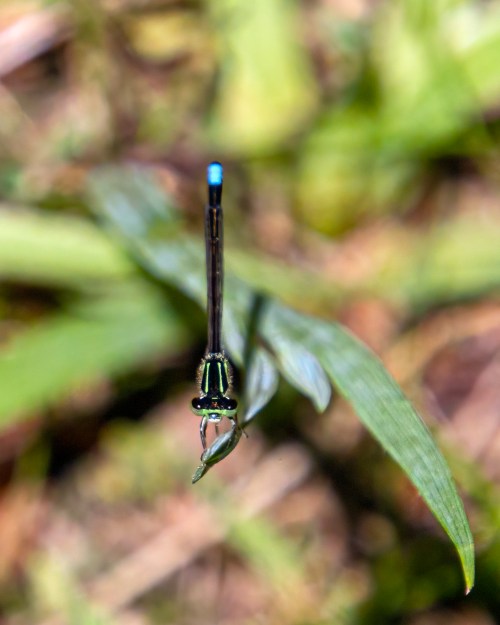
Variable Dancers (Argia fumipennis) are one of my favorite damselflies, as you may have guessed if you have seen the banner page of my blog that features a photo of a gorgeous violet-colored Variable Dancer. Technically there are three subspecies of Variable Dancers, but I think that all of the ones that I see in my area are members of the subspecies Argia fumipennis violacea, the Violet Dancer.

Last week I spotted several male Variable Dancers at Wickford Park in Alexandria, Virginia, as you can see in the second photo below, so I knew that they lived in that habitat. I was a bit confused, though, when I spotted the damselfly in the first photo and initially could not identify it. After poring over my reference guides and searching for the internet, I realized that the damselfly was probably an immature male Variable Dancer. Many immature male dragonflies and damselflies change colors as they mature, but this color change is particularly striking.

Today is the summer solstice for those of us in the Northern Hemisphere, officially marking the beginning of summer. (Technically it comes this evening at 10:42 where I live.) Happy Summer to all of you in the north and Happy Winter to those of you in the Southern Hemisphere.

Variable Dancer

Variable Dancer

© Michael Q. Powell. All rights reserved.

Read Full Post »

I spotted my first Ebony Jewelwing damselflies (Calopteryx maculata) of the year last week during a short visit to Wickford Park, a small suburban park with a creek that runs through it. Members of this species have distinctive dark wings and are generally found in shaded streams where the mixed lighting makes it challenging to photograph them.

Female Ebony Jewelwings have small white patches (known as pseudostigmas) on their wings that along with their terminal appendages make them easy to identify. The damselflies in these two photos are both female. I am not sure why the eyes of the damselfly in the first photo are so red in appearance—perhaps it is a result of the angle of the light or maybe it is related to the age of the individual. Whatever the case, the red eyes give the damselfly a devilish look.

Ebony Jewelwing

Ebony Jewelwing

© Michael Q. Powell. All rights reserved.

Read Full Post »

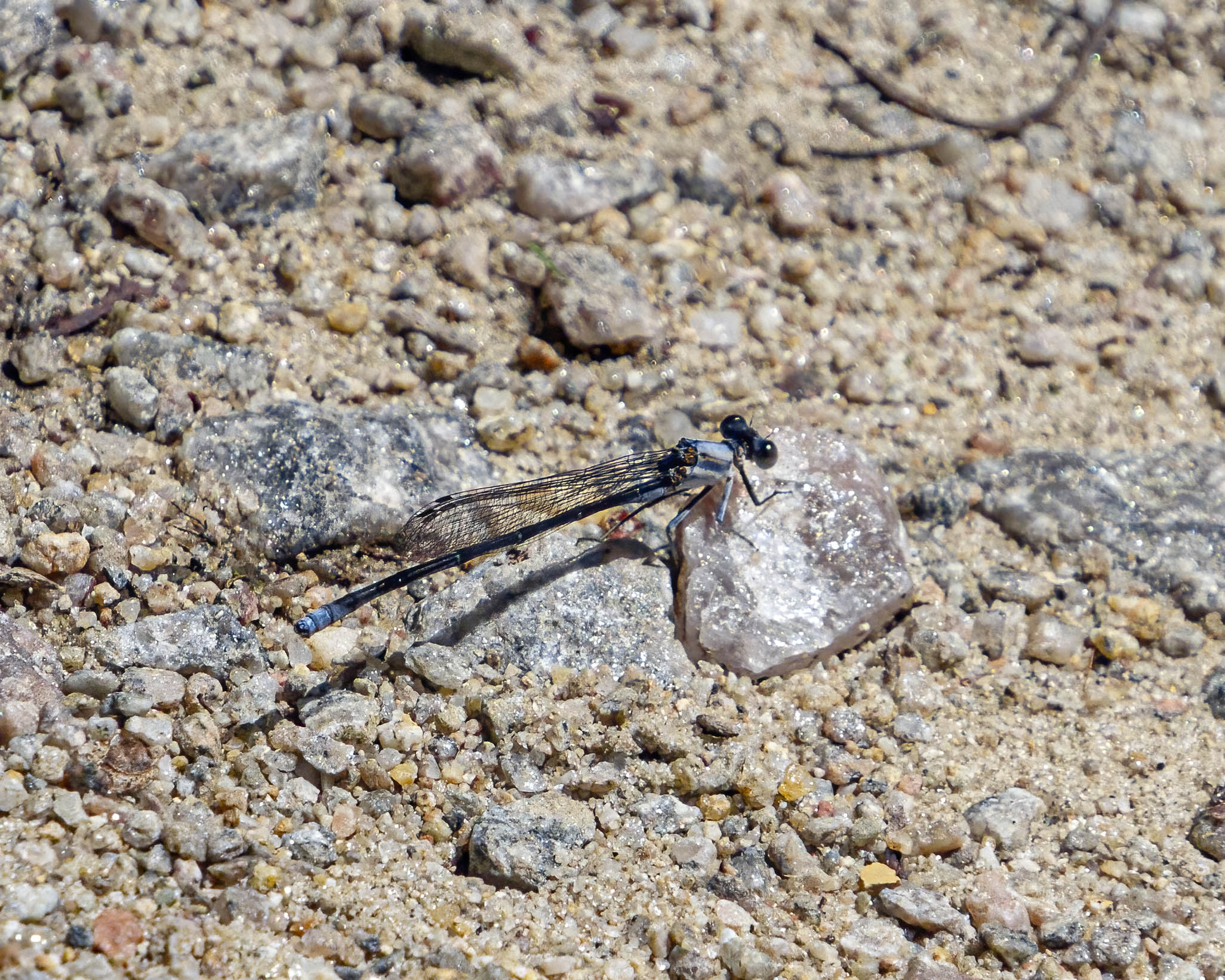
Most of the time that I see damselflies, they are perched in the vegetation. Powdered Dancer damselflies (Argia moesta), like this one that I spotted last week at Occoquan Bay National Wildlife Refuge, however, like to perch on bare ground, emergent stones, and along trails. Immature male Powdered Dancers are tan to dark brown, turn darker with age, and becoming almost completely whitish at maturity.

The “powdered” color of this damselfly helped in to blend in almost perfectly with the sand and gravel on this trail at the wildlife refuge. If I had not seen it land, I suspect that I would have had real trouble spotting this Powdered Dancer damselfly.

Powdered Dancer

© Michael Q. Powell. All rights reserved.

Read Full Post »

When I spotted these damselflies last week I was not sure what species they were. Most of the damselflies that I had seen near this location at Occoquan Bay National Wildlife Refuge in the past were Big Bluet damselflies (Enallagma durum), but the coloration of this one was different enough that I was not confident in identifying it. I posted a photo in a Facebook group that specializes in dragonflies and damselflies and one of the experts there confirmed that this is in fact a Big Bluet.

I am happy to identify this species, but I must confess that I am even more happy with the images that I was able to capture. For all three images, I believe, I had to focus manually as I tried to compose the images, which can be a real challenge with a digital camera. When I first started taking photos back in the pre-digital age, I remember that my single-lens reflex film camera had a split prism area that you had to adjust and you knew that the subject was in focus when the two halves of the image aligned.

My telephoto lens was extended fully to 400mm, so I was a pretty good distance from the damselflies when I composed these shots. I particularly like the first image, in which the branch at the top third of the shot gradually falls out of focus, allowing the viewer to focus on the damselfly clinging to the leaf.

Big Bluet

Big Bluet

Big Bluet

© Michael Q. Powell. All rights reserved.

Read Full Post »

During a visit on Monday to Occoquan Bay National Wildlife Refuge, I noted that many of the summer dragonfly and damselflies are starting to appear. I was particularly delighted to spot several Big Bluet damselflies (Enallagma durum). As their name suggests, Big Bluets are relatively large damselflies, with an overall length of about 1.7 inches (43 mm).

Big Bluets tend to active and a bit skittish, so it’s a bit tough to get a decent shot of one, especially when I am shooting with a zoom lens. The auto-focus of my Tamron 18-400mm zoom often has trouble focusing on a damselfly, because their bodies are so thin and they clasp their wings together over their bodies. Consequently, I frequently end up focusing manually and it is an advantage with this lens that the minimum focusing distance is 17.7 inches (45 cm), so I can get pretty close to my subject.

I was delighted to be able to capture this beautiful image of a female Big Bluet. My focusing was spot on and the background blurred out nicely. If you look closely, you may notice that the depth of field, i.e. what was in focus, was so shallow that much of the stalk of vegetation on which the damselfly was perched was out of focus. In case you are curious, I tried to position myself so that I was on a parallel plane with the damselfly’s body to get as much of it in sharp focus as possible.

One interesting factual tidbits about Female Big Bluets is that, like several other damselfly species, they come in two different color variants. This one is the blue form and there is also an olive form. What that means is that I cannot rely exclusively on the color of the damselfly to determine its species and must also look at other features like the shapes of the eyespots and markings on the terminal appendages.

Big Bluet

© Michael Q. Powell. All rights reserved.

Read Full Post »

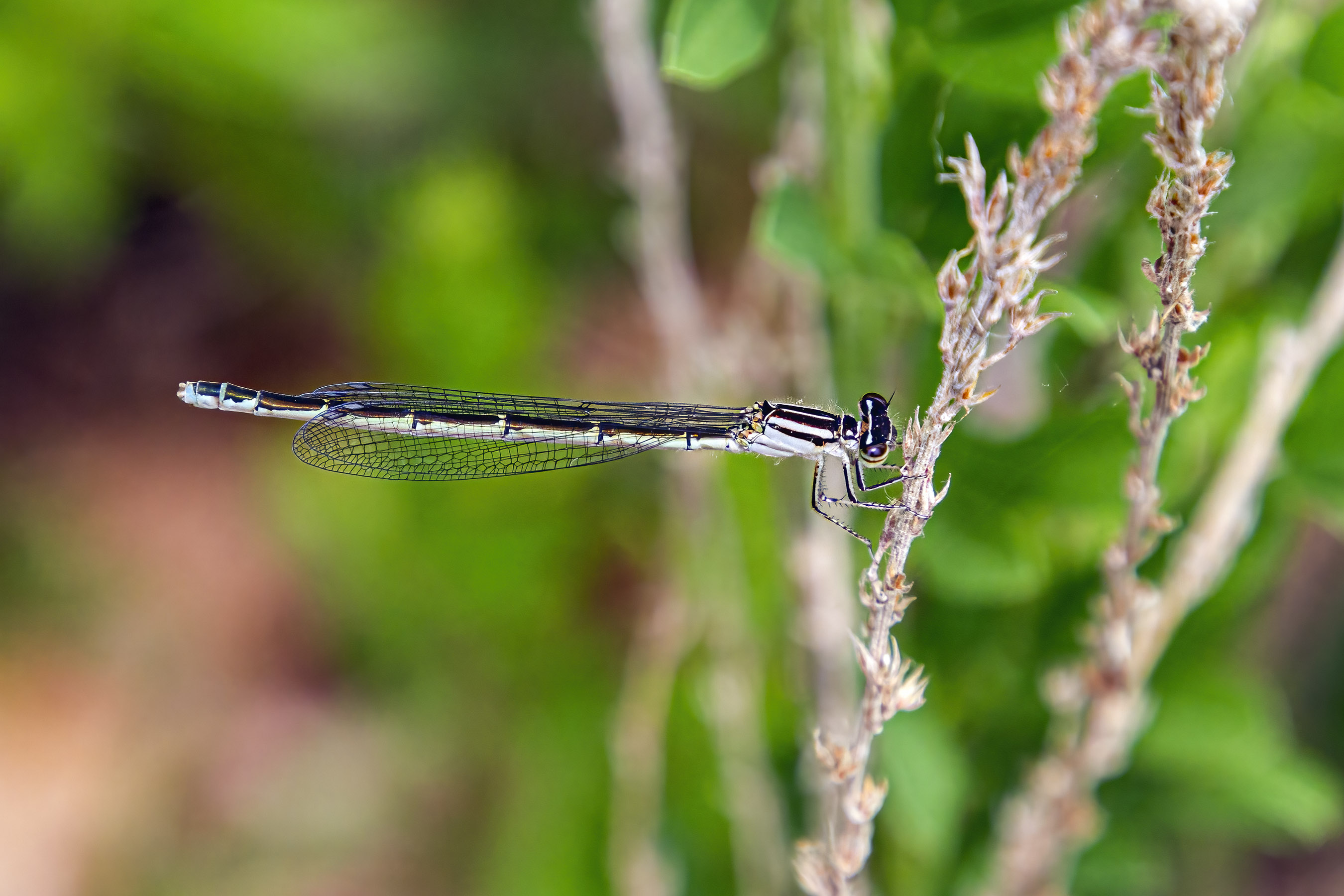
It has taken a little while, but I am starting to see damselflies during my searches for dragonflies. As many of you know, damselflies and dragonflies are “cousins” in the sense that they are both members of the order Odonata. Generally speaking, dragonflies have thicker, shorter bodies and hold their wings out to the sides when resting, while damselflies are slender with wings often folded together. The eyes of dragonflies often touch each other, while those of damselflies tend to be more widely separated.

The first photo below shows a Fragile Forktail damselfly (Ischnura posita), a very common species where I live. The interrupted shoulder stripes look like exclamation marks, which makes them pretty easy to identify.  The second photo shows what I am pretty certain is a female Eastern Forktail damselfly (Ischnura verticalis). Female damselflies of a number of species are similar in appearance, so I am a bit less confident that I have correctly identified this individual.

More damselflies will continue to appear as I shift my attention almost exclusively from birds to insects. As a result of recent rains, the trees in my area are now covered with leaves, which means that I am increasingly having trouble seeing the birds that I can hear singing.

Fragile Forktail

Eastern Forktail

© Michael Q. Powell. All rights reserved.

Read Full Post »

Last week I spotted this female Big Bluet damselfly (Enallagma durum) at Occoquan Bay National Wildlife Refuge, one of the few damselflies still around this late in the season. Big Bluets are primarily a coastal species in our area, which helped me to narrow down the possibilities when trying to identify the damselfly species. Generally female damselflies are tougher to identify than males, but I pretty confident that this one is a Big Bluet.

UPDATE: A sharp-eyed viewer pointed out to me that this is probably an immature male Big Bluet, not a female, based on a number of specific physical features. I think he’s right! It is not the first time that I have misidentified a damselfly and it almost certainly will not be the last time.

I love the way that the light green in the background matches the color of the damselfly’s body and makes for a really pleasing image.

Big Bluet

© Michael Q. Powell. All rights reserved.


Read Full Post »

During a recent visit to Jackson Miles Abbott Wetlands Refuge I spotted this Blue-tipped Dancer (Argia tibialis) damselfly. I was initially quite far from it when I first saw it and was not at all certain what it was. As I got closer to it, I could see that it was mostly black and only the very tip of its abdomen was blue in coloration. I did not immediately recognize it, but figured that I would be able to do so after the fact. In doing so, I was applying one of my primary rules of photography—shoot first and ask questions later.

When I got home and was processing the images, I decided that it was probably a Blue-tipped Dancer, a fairly common dark species that is reportedly found at a diverse number of locations. Upon discovering its name, I did a search of my past blog postings and discovered that I had seen one a few times before. I guess I would have remembered the name of the species if I saw it more often, but am happy that I was able to be able to retrieve it.

Yesterday we finally had a break from the extremely hot weather and I finally was able to get out with my camera. I am pretty sure that I captured some images that I will want to share with you all. Stay tuned for more.

Blue-tipped Dancer

© Michael Q. Powell. All rights reserved.


Read Full Post »

I was happy to spot these male Powdered Dancer damselflies (Argia moesta) on Monday at a creek in Prince William County, Virginia. Most of the damselflies that I see regularly are found at small ponds and marshy areas, but this species prefers rocky streams and rivers. Sometimes Powdered Dancers will perch in the streamside vegetation, but often they will perch flat on rocks in the water, as you can see in several of these shots.

The thoraxes of Male Powdered Dancers are mostly white due to pruinosity, i.e. they are covered by minute waxy dust particles that makes them look frosted or powdered. This phenomenon is present in some dragonflies too, most notably the male Common Whitetail dragonflies.

Powdered Dancer

Powdered Dancer

Powdered Dancer

© Michael Q. Powell. All rights reserved.


Read Full Post »

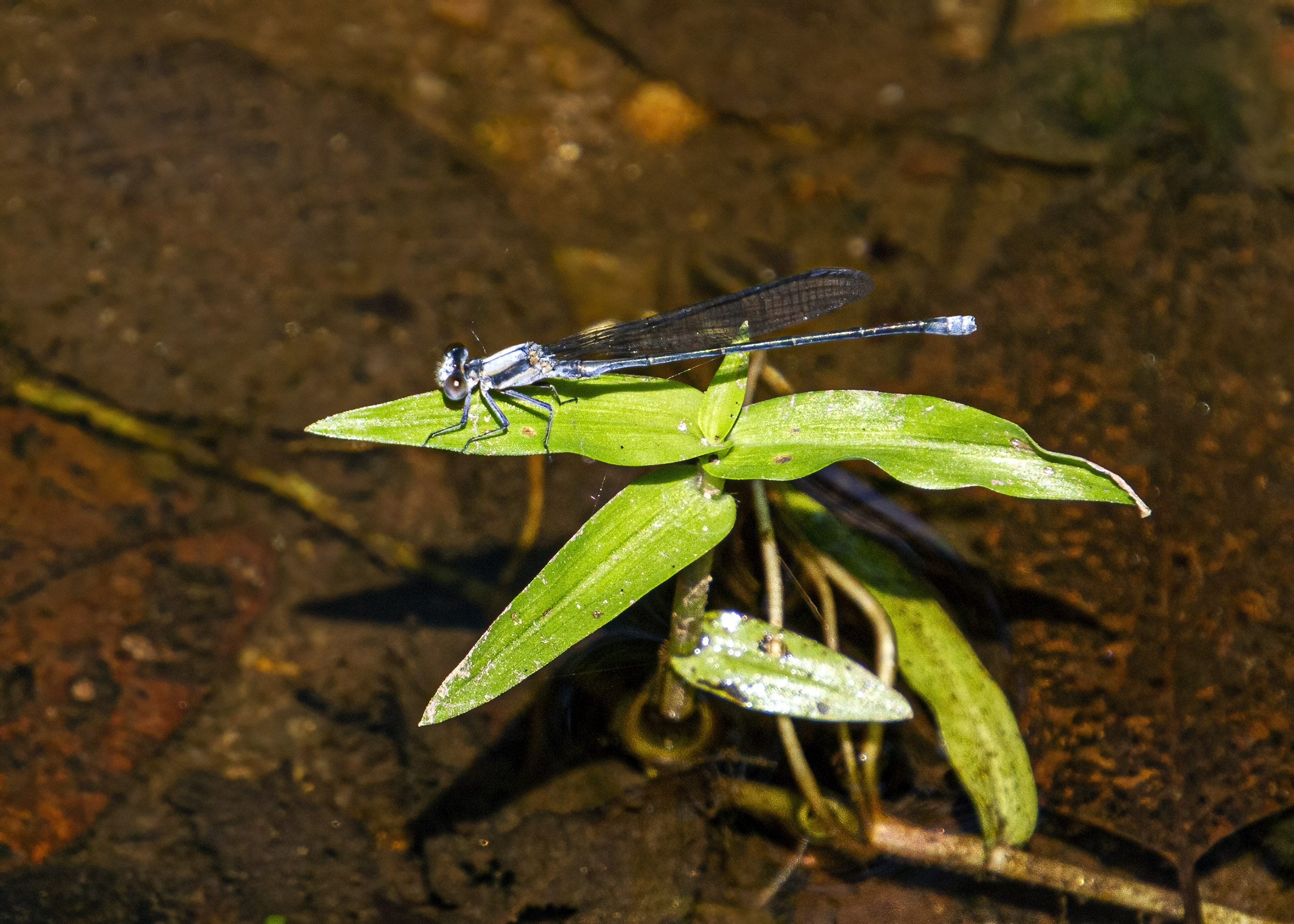
I was delighted to spot this handsome male Blue-fronted Dancer damselfly (Argia apicalis) on Thursday during a quick visit to Jackson Miles Abbott Wetland Refuge. This species is not rare, but I do not see it very often at my favorite locations for dragonflies and damselflies. It is pretty easy to identify a Blue-fronted Dancer because, as its name suggests, its thorax is almost completely blue, with only a few hairline shoulder stripes.

According to Wikipedia, the damselflies in the genus Argia, are commonly known as “dancers” because of the distinctive jerky form of flight they use, which contrasts with the straightforward direct flight of bluets, forktails, and other pond damselflies.

Blue-fronted Dancers are quite small, about 1.5 inches (38 mm) in length, so it was quite a challenge to get this one in focus as he perched on some vegetation close to the ground. I am pretty sure that I switched to manual focus for this shot, because the autofocus of my camera has trouble staying on such a narrow subject and kept trying to focus on the ground.

Blue-fronted Dancer

© Michael Q. Powell. All rights reserved.

Read Full Post »

After mating, many male damselflies hold on to the female as she deposits eggs in order to keep any rival males from interfering with the process. The male grasps the head of the female with the terminal appendages of his abdomen in the “tandem” position and the two linked damselflies move about from spot to spot as the female inserts eggs into floating vegetation.

Last Friday at Jackson Miles Abbott Wetland Refuge I managed to capture this image of a Slender Bluet (Enallagma traviatum) couple as the female arched her body, made a little slit in the vegetation and inserted eggs, a process known as “ovipositing.”

I am not absolutely certain I have correctly identified the damselfly species—there are a lot of bluet species—but I have made my call primarily on the basis of the markings on the abdomens of the male and the female. I intend to post this shot in a dragonfly/damselfly forum on Facebook and will update this posting if one of the experts in the group corrects my initial identification.

Slender Bluet

© Michael Q. Powell. All rights reserved.


Read Full Post »

I was delighted this week to spot my first Ebony Jewelwing damselflies (Calopteryx maculata) of the season while I was exploring at Occoquan Regional Park. Members of this species have distinctive dark wings and are generally found in shaded forest streams where the mixed lighting makes it challenging to photograph them.

When things work out, though, I can sometimes get a good shot of one, like this dramatic portrait of a female perched on a sunlit piece of vegetation. Only females have the little white patches (known as pseudostigmas) on their wings that along with their terminal appendages make them easy to identify.

Ebony Jewelwing

© Michael Q. Powell. All rights reserved.

Read Full Post »

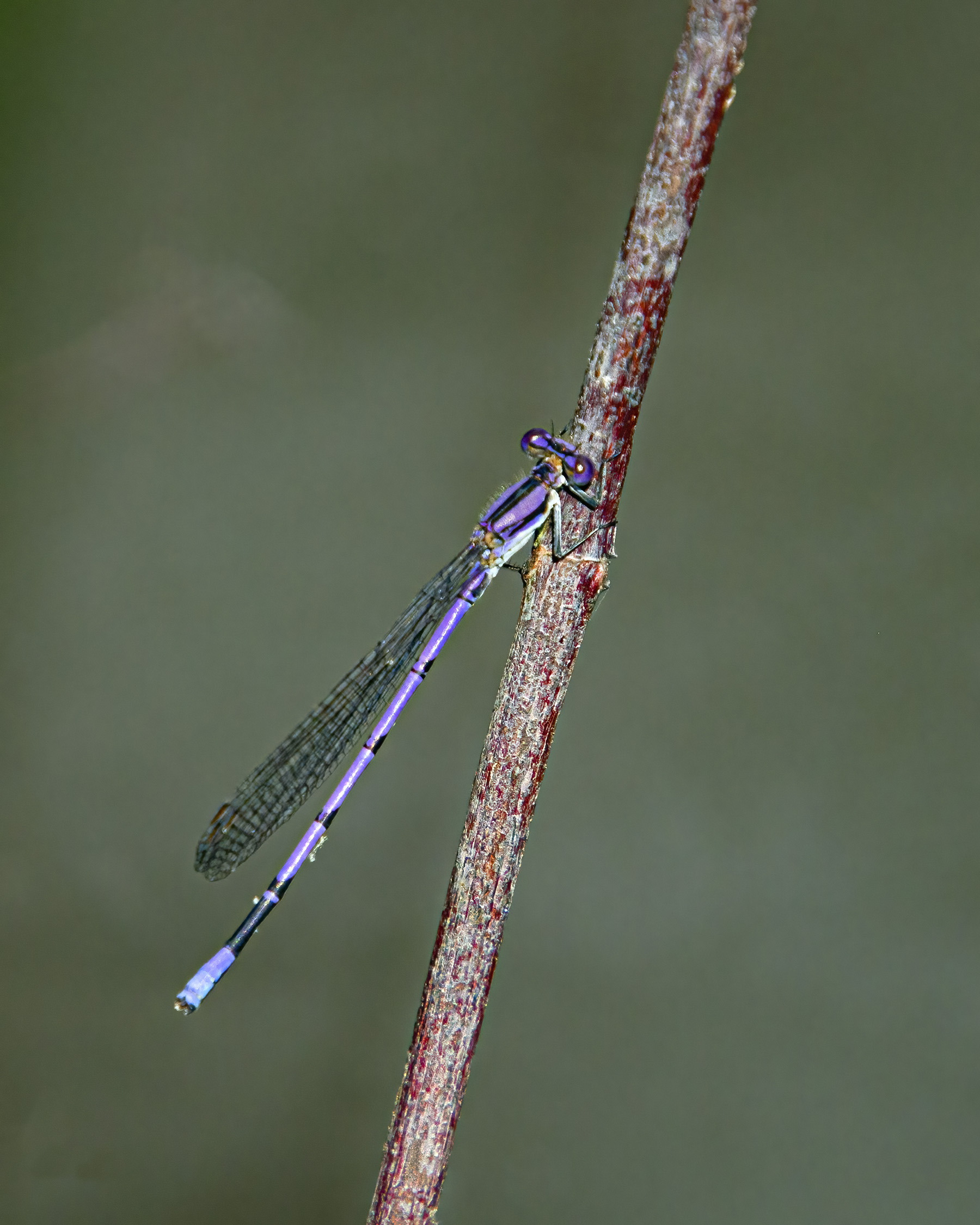
Yesterday at Jackson Miles Abbott Wetland Refuge I spotted some Variable Dancer damselflies (Argia fumipennis), one of my favorite damselfly species. I never fail to be shocked and delighted by the brilliant purple of eyes and body of the male of the subspecies known as the Violet Dancer (Argia fumipennis violacea). Some of you may have even noticed that I have used an image of a Violet Dancer as the banner image for the home page of my blog for a number of years.

Dancers are a genus of damselflies named for the distinctive jerky form of flight they use which contrasts with the straightforward direct flight of many other pond damselflies. I must confess that I don’t pay much attention to the way that particular damselflies fly, but instead rely primarily on their coloration to identify them,

Violet Dancer

© Michael Q. Powell. All rights reserved.

Read Full Post »

Identification guides for birds, dragonflies, and damselflies often use illustrations rather than photos? Why? It is almost impossible for a photo to show all of the key identification features of a species.

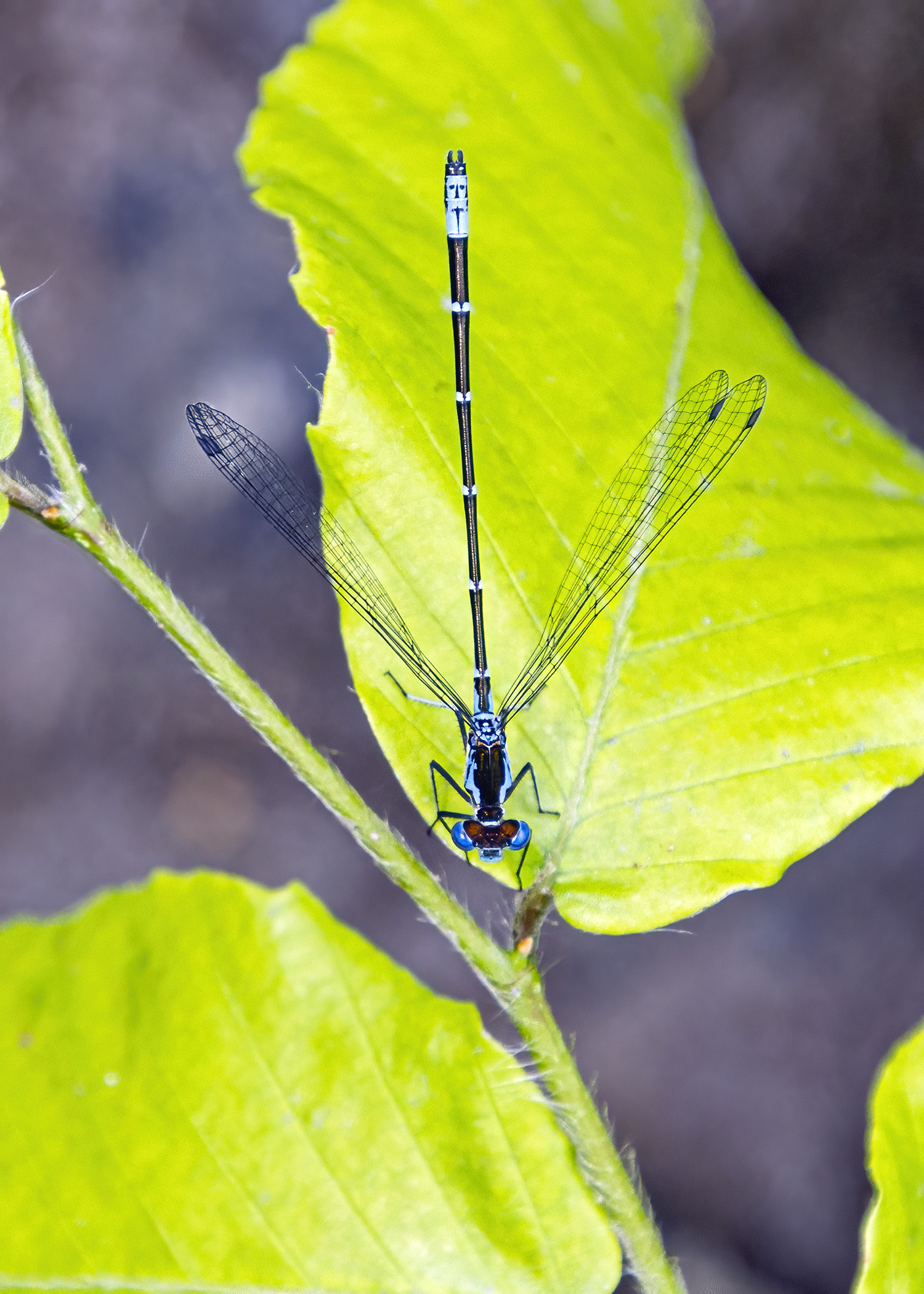
Last week, for example, I captured some wonderful photos of a male Aurora Damsel damselfly (Chromagrion conditum) at a small pond in Prince William County, Virginia. In the first photo below, I was able to capture an image from almost directly overhead that shows the markings on the tiny damselfly’s thorax and abdomen. The image also shows how this damselfly species perches with its wings partially spread, unlike most damselflies that perch with their wings closed above their bodies. The second shot shows many of the same features.

However, it is fairly uncommon to be able to capture views like those in the first two shots and they do not show what is often the key identification feature for this species. Both genders of Aurora Damsels have distinctive bright yellow patches on the sides of their thoraxes, as you can see in the third photo. You might notice that in this photo, the markings on the tip of the abdomen are much less clear than in the first two shots, but that’s not a problem, because that yellow patch immediately signals that it is an Aurora Damsel.

Whenever I can, I try to capture shots of my subjects from multiple angles. The different angles of view may help in identifying a species or may create a more aesthetically pleasing image. One of the coolest things about photography is the way in which it combines science and art—I can be as scientifically geeky or as artistically creative as I want to be.

Aurora Damsel

Chromagrion conditum

Aurora Damsel

© Michael Q. Powell. All rights reserved.


Read Full Post »

Odonata is an order of flying insects that includes dragonflies and damselflies. During the warmer months of the year I spend a lot of time hunting for dragonflies, the larger members of this group of magical creatures, but I also enjoy searching for damselflies, their smaller and more fragile “cousins.”

Damselflies, like dragonflies, come in a variety of colors and shapes. Here is a sampling of images of damselflies that I captured this past Thursday during visits to Jackson Miles Abbott Wetland Refuge and Occoquan Regional Park, both of which are located within 15 miles (24 km) of my house.

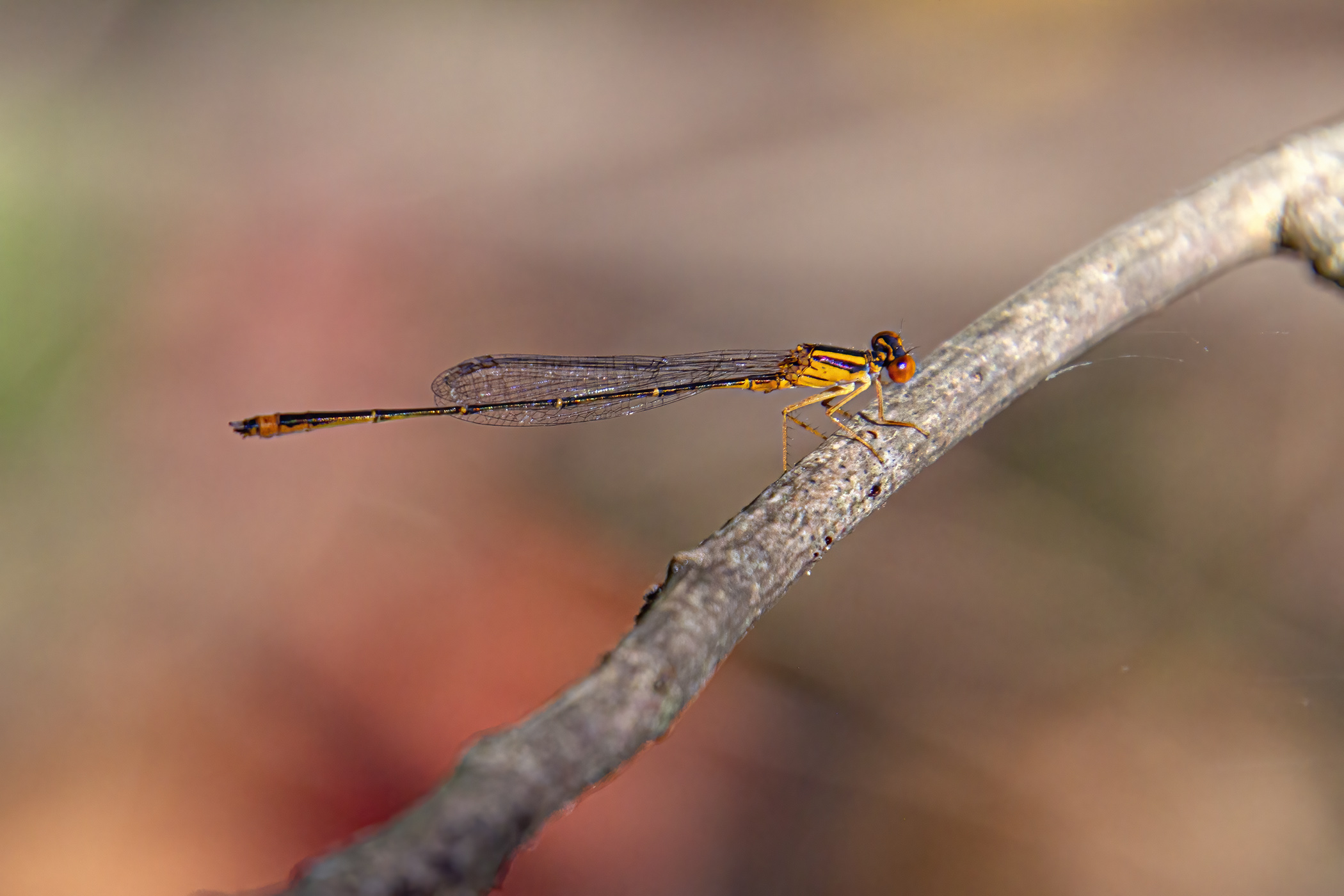
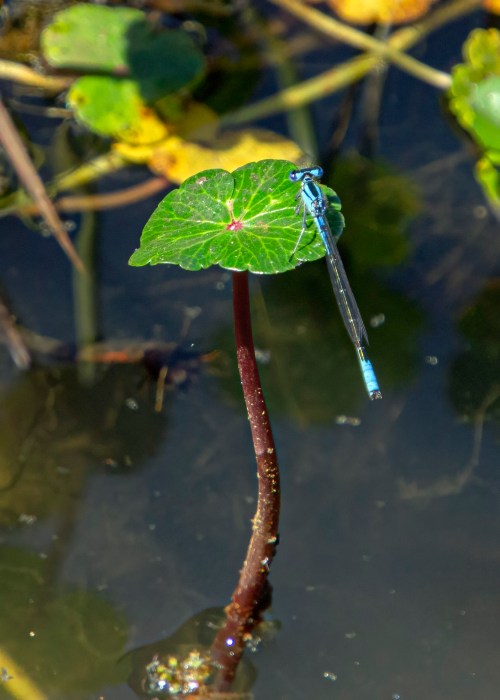
The first photo shows a Orange Bluet (Enallagma signatum). I am always amused by the name of this species, because it seems incongruous to have an orange-colored member of a genus called American Bluets. Most male bluets are, in fact, blue, but others are orange, scarlet, and burgundy and there is even a “Rainbow Bluet.”

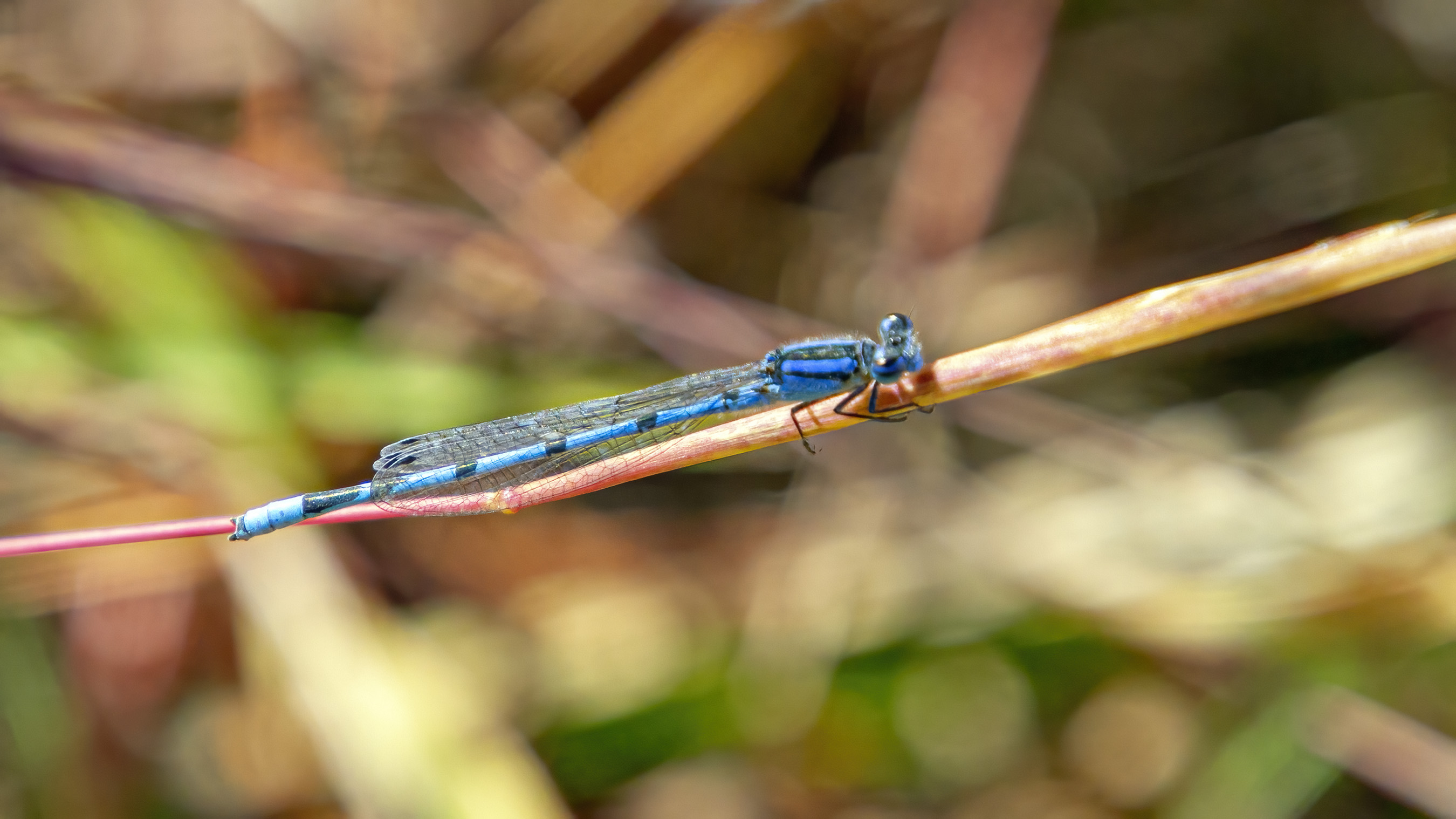
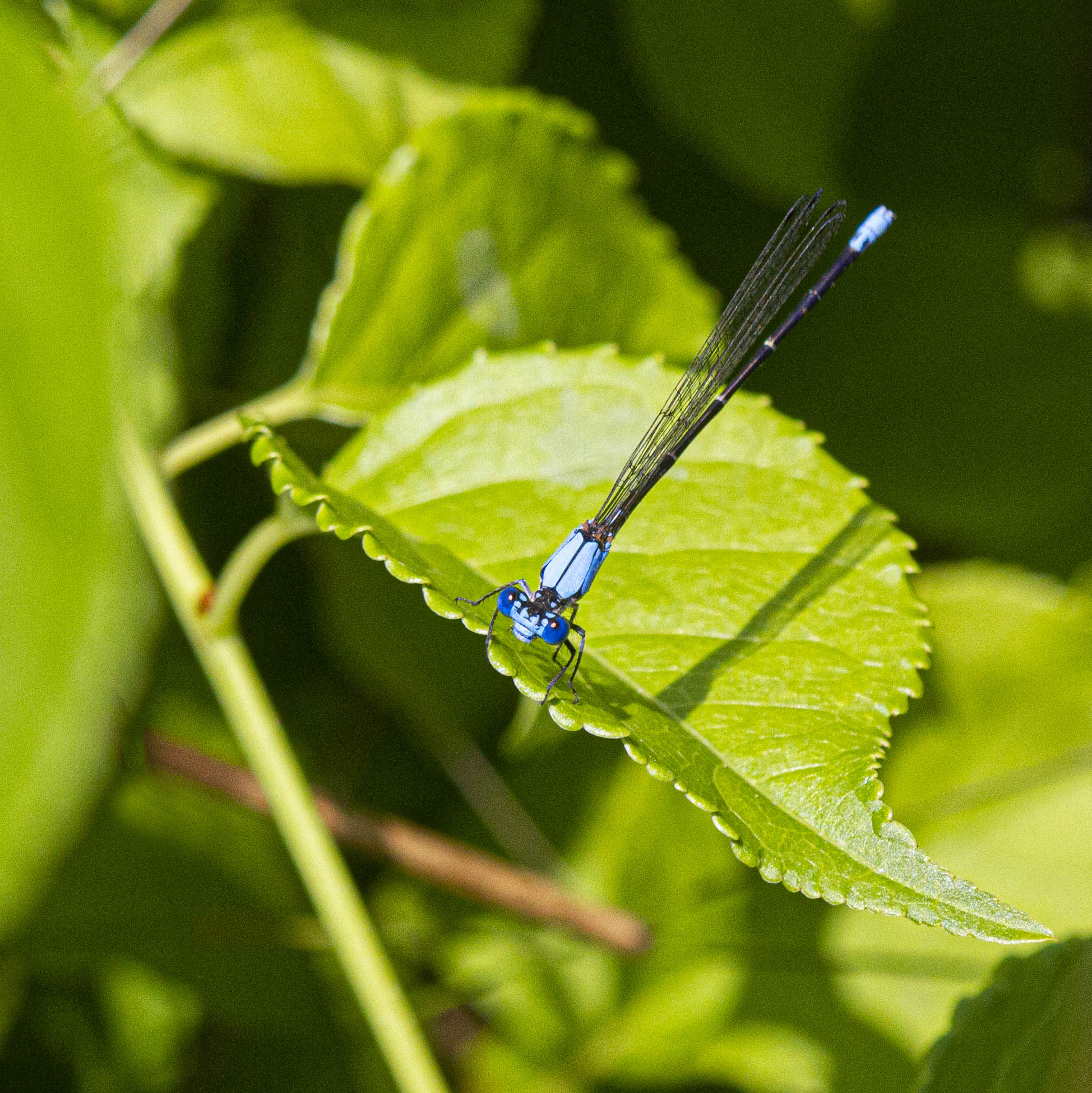
The second image shows a male Azure Bluet (Enallagma aspersum), whose colors are closer to my mental image of a bluet. Most bluets are some combination of blue and black and it can be tricky trying to determine specific species by examining the color patterns on the body and in the eyes.

The third shot is of a male Fragile Forktail (Ischnura posita), one of the first damselflies to emerge each spring. Fragile Forktails are really tiny (about an inch (25 mm) in length, but are relatively easy to identify by their broken shoulder stripe that looks like an exclamation point.

In the final photo I was eye-to-eye with the damselfly so his abdomen is almost completely out of focus. Nonetheless enough details are visible for me to say this is almost certainly a male Eastern Forktail damselfly (Ischnura verticalis).

I like to try to vary my approach to capturing images of most subjects, including damselflies, as you can see in this little collection of photos. Sometimes, as in the first shot, I will try to isolate the subject from its background in order to focus the viewer’s complete attention on the subject. Recently, though, I have developed a preference for including more of the habitat in my shots, as in the second image, in order to give the viewer a sense of the environment in which I took the shot. When possible, I like to attempt to capture some “artsy” shots, like the final image, by using selective focus and choosing carefully my angle of view.

No matter what approach I choose with damselflies, I have to be careful not to fall into the water, where most of these dragonflies were perching. I am not always successful in keeping my feet dry.

Orange Bluet

Azure Bluet

Fragile Forktail

Eastern Forktail

© Michael Q. Powell. All rights reserved.

Read Full Post »

I almost fell into the pond on Wednesday at Jackson Miles Abbott Wetland Refuge when I leaned over the edge of a steep bank after detecting some movement. Fortunately I did not lose my balance and managed to get a shot of this male Fragile Forktail (Ischnura posita), my first damselfly of this season.

Fragile Forktails are almost always the first damselflies in my area to emerge and are surprisingly easy to identify—they have broken shoulder stripes that look like exclamation points. Although they are easy to identify, you have to find them first and their diminutive size (0.83 to 1.14 inches (21 to 29mm) in length) makes them quite difficult to spot.

Damselflies and dragonflies belong to the Odonata order of flying insects. Damselflies generally are more slender, have eyes placed apart, and perch with their wings folded together along their bodies when at rest. Dragonflies tend to be bulkier, have large compound eyes that touch each other, and usually perch with their wings extended when at rest.

Fragile Forktail

© Michael Q. Powell. All rights reserved.


Read Full Post »
Like dragonflies, their larger “cousins,” damselflies have been rapidly decreasing in numbers this month. During recent visits to Occoquan Bay National Wildlife Refuge, I have seen only a few remaining damselflies. Therefore I was especially happy to spot this handsome male Familiar Bluet damselfly (Enallagma civile) last Tuesday.

The little damselfly seemed to be giving me a sideward glance as I carefully focused on him and I see a hint of what might be a smile. I really like the way that the background turned out in this image too—the colors and bokeh balls add additional visual interest without detracting from the primary subject.

Familiar Bluet

© Michael Q. Powell. All rights reserved.


Read Full Post »
Although the name of this Orange Bluet damselfly (Enallagma signatum) sounds like an oxymoron, its colors are a perfect match for this autumn season. As the name suggest, most damselflies in the bluet family are blue, but they do come in other colors.

I photographed this handsome male Orange Bluet on 10 October at Occoquan Bay National Wildlife Refuge and was thrilled to be able to capture a little autumn color in the background of the image.

Orange Bluet

© Michael Q. Powell. All rights reserved.

Read Full Post »

As we move deeper into September I have been seeing more and more Black and Yellow Garden Orbweaver spiders (Argiope aurantia). These spiders are impressively large and have prominent webs with a distinctive zigzag pattern near the center.

During recent visits to Occoquan Bay National Wildlife Refuge, I have seen multiple Big Bluet damselflies (Enallagma durum) that have gotten caught up in the webs of the Argiope spiders. In the first photo the spider is moving in on two damselflies. After immobilizing the prey, the spider will often wrap it in web material, as you can see in the second image.

The final shot shows a hapless damselfly entangled at the edge of a web. I observed the damselfly for a few moments to see if I could detect any signs of movement, with thoughts that I might be able to free it. However, I did not see any movement and suspect that I had arrived too late to rescue this damsel in distress.

Some viewers may object to these kind of graphic images, but for me it is part of the “circle of life” in nature—all creatures have to eat to survive. As I have observed numerous times, today’s predator may well become tomorrow’s prey.

damselfly

damselfly

damselfly

© Michael Q. Powell. All rights reserved.


Read Full Post »

Yesterday it was hot and humid and there was an air quality alert because of smoke from the Canadian wildfires. I was therefore not too surprised when I pulled into the parking lot at Occoquan Bay National Wildlife Refuge to see that I was the only car there. As I have mentioned previously, I prefer to enjoy nature alone whenever possible, so I was quite pleased that I had the refuge to myself.

It was about midday, so I knew that the birds would not be very active—they tend to be more active in the early morning and later afternoon—but I knew that many insects prefer the warmest periods of the day. I saw quite a few Big Bluet damselflies (Enallagma durum) in the vegetation near the water. As its name suggests, this damselfly is quite large—up to 1.7 inches (43 mm)—and is primarily a coastal species.

This was my favorite shot of the day of a Big Bluet. I like the overall cool tones of the image and the way that the vegetation fades into background, allowing the viewer to focus on the wonderful details of this beautiful Big Bluet.

Big Bluet

© Michael Q. Powell. All rights reserved.


Read Full Post »
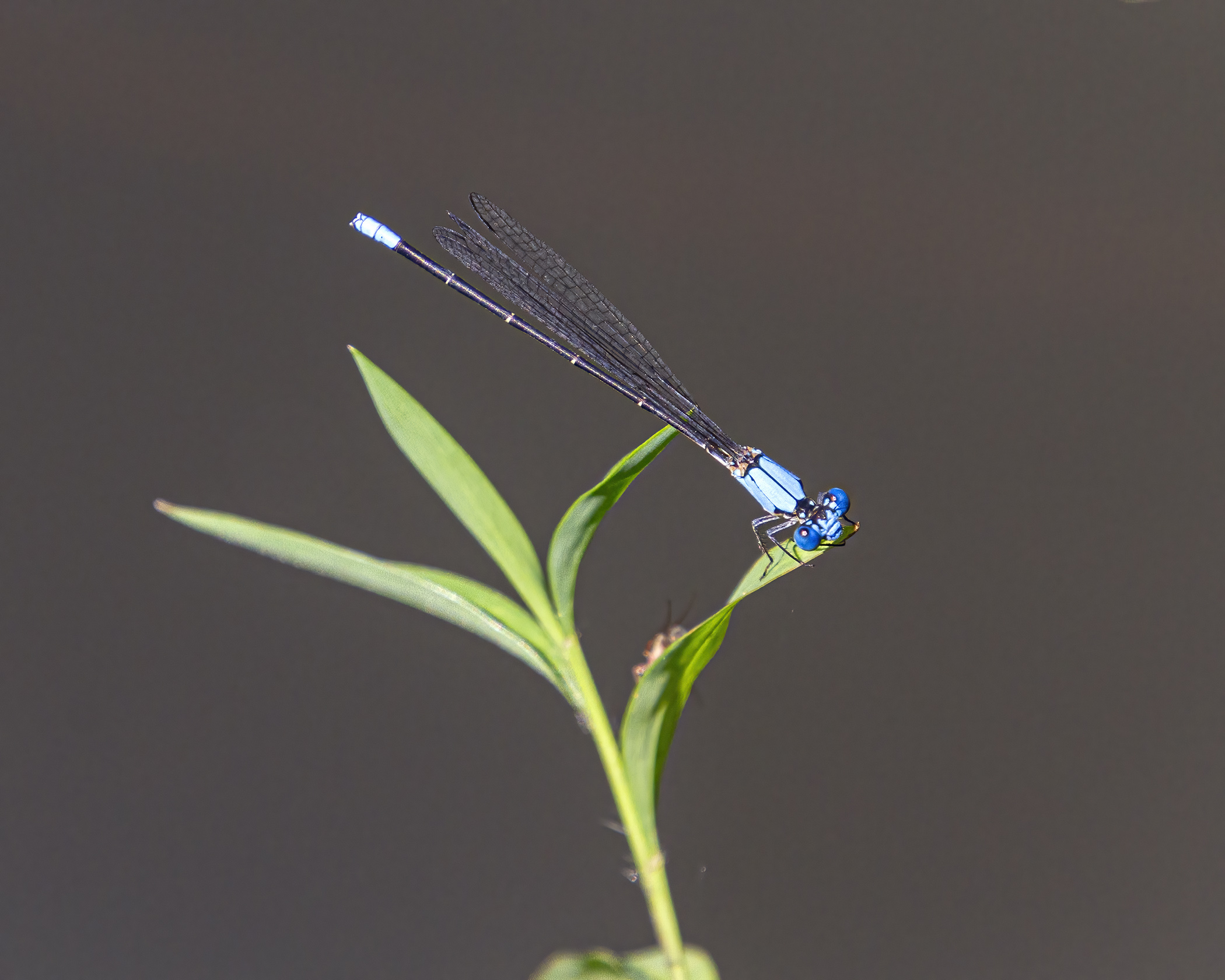
Most of the damselflies that I photograph are found at ponds. However, there are other damselflies that are found primarily at streams and creeks. I spotted two such species this past Tuesday when I was exploring a creek in Prince William County, Virginia.

The damselfly in the first photo is a Powdered Dancer (Argia moesta) that I spotted on a rocky ledge of the creek. Male Powdered Dancers are the only mostly white damselflies that I have seen and they get increasingly white as they mature. I love the way the angle of the shot makes it look like the damselfly was perched on the side of a massive mountain that it was attempting to climb.

The damselfly in the second photo is a Dusky Dancer (Argia translata). This damselfly may have the most intense blue eyes that I have ever seen on an insect. It was perched on a rocky ledge at the edge of a creek. I would have liked to get a closer shot, but the bank of the creek was high and steep and the ledge was inaccessible to me (unless I was willing to get really wet, which I did not want to do).

According to Wikipedia, the damselflies in the genus Argia, are commonly known as “dancers” because of the distinctive jerky form of flight they use which contrasts with the straightforward direct flight of bluets, forktails, and other pond damselflies.

Powdered Dancer

Dusky Dancer

© Michael Q. Powell. All rights reserved.

Read Full Post »

Dragonflies and damselflies have rather limited lifespans after they emerge from the water and are transformed from aquatic nymphs into aerial acrobats. One of their biological imperatives is to perpetuate their species, so it is not unusual to see mating activity during this time of the year that is primetime for dragonflies and damselflies.

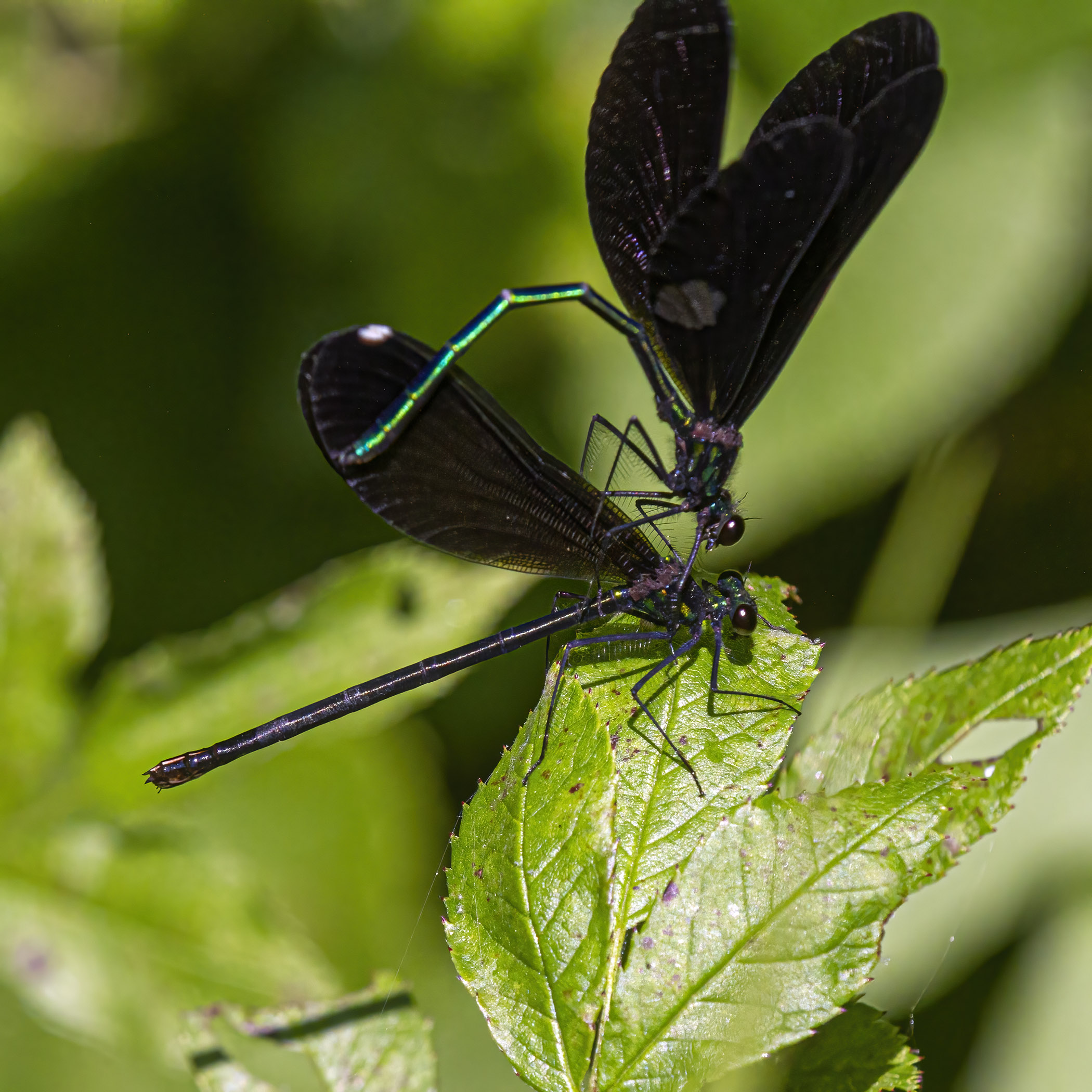
On a trip earlier this month to Occoquan Regional Park, I spotted this pair of Ebony Jewelwing damselflies (Calopteryx maculata) in their distinctive sidewards-heart mating position. I am really happy with this image because I was able to use my shooting angle and camera settings to keep the bodies of both damselflies in focus and achieve a blurry background that allows a viewer to focus on the damselflies without any visual distractions.

In case you are curious, the damselfly to the left is the female and the one with the shiny green body is the male. You can tell the genders from the mating position and from the little white patch on the wings that is present on female Ebony Jewelwings and not on the completely dark wings of the males


Ebony Jewelwing

© Michael Q. Powell. All rights reserved.

Read Full Post »

Last week I managed to capture a series of images of a hook-up between two Ebony Jewelwing damselflies (Calopteryx maculata). Initially I was focused on a female that was perched on a leaf, but then noticed a male who was circling around her. According to Wikipedia, “Calopteryx males will hover in front of a female with alternating fast and slow wingbeats; if she is receptive she will remain perched, otherwise she will fly off.” This female remained in place, so the male moved in, as you can see in the first three photos.

During mating, the male uses claspers at the tip of his abdomen to grasp the female behind her head tightly enough to resist the attempts by other males to dislodge him, a position sometimes called “tandem.” The male then flexes his abdomen to encourage the female to loop her abdomen round to interlock with him, forming the “wheel’ position,” the sidewards-heart position shown in the final photo.

I suppose that I could leave the description here, but the process that was taking place was so weird and fascinating that I thought I should explain what is going on. In order to keep from getting too graphic, I will borrow some language from Wikipedia.

“Mating in damselflies, as in dragonflies, is a complex, precisely choreographed process involving both indirect insemination and delayed fertilization….When he (the male) is ready to mate, he transfers a packet of sperm from his primary genital opening on segment 9, near the end of his abdomen, to his secondary genitalia on segments 2–3, near the base of his abdomen. The male then grasps the female by the head with the claspers at the end of his abdomen; the structure of the claspers varies between species, and may help to prevent interspecific mating… The female then curls her abdomen downwards and forwards under her body to pick up the sperm from the male’s secondary genitalia, while the male uses his “tail” claspers to grip the female behind the head: this distinctive posture is called the “heart” or “wheel.”

Wow! I think I will leave it at that. Suffice it to say that the process is complicated and the participants have to be incredibly flexible.

Ebony Jewelwing

Ebony Jewelwing

Ebony Jewelwing

Ebony Jewelwing

Ebony Jewelwing

Ebony Jewelwing

© Michael Q. Powell. All rights reserved.

Read Full Post »

Many damselflies have distinctive shoulder stripes, but the thoraxes of Blue-fronted Dancers (Argia apicalis) are almost completely blue and have only hairline black stripes. Last Saturday I was delighted to spot some Blue-fronted Dancers at the small pond at Jackson Miles Abbott Wetland Refuge, my first sighting of this species this season. Although the blue thorax made them easy to identify, what really struck me were their brilliant blue eyes, a feature that I had never noticed before. Wow!

I was able to photograph these damselflies on various locations as I repeatedly circled the pond. Periodically I would glance out at the water, where several families of Canada Geese were swimming around with their almost grown goslings. In the final photo, you can see one of the feathers from the geese, a quirky and almost whimsical addition to my photo of the Blue-fronted Dancer—I really like that image.

Blue-fronted Dancer

Blue-fronted Dancer

Blue-fronted Dancer

© Michael Q. Powell. All rights reserved

Read Full Post »

Last week I was delighted to spot several Aurora Damsel (Chromagrion conditum) damselflies as I was exploring a pond in Prince William County. I had seem some Aurora Damsels earlier in the spring, when they were newly emerged, but had not yet seen any mature adults.

According to the damselfly guide that I use for reference, Damselflies of the Northeast by Ed Lam, the genus Chromagrion “consists of a single species, the Aurora Damsel, a blue and black damselfly with bright yellow on the side of the thorax. It lacks eyespots and shoulder stripes and often perches with its wings slightly spread, unlike most members of its family” of Pond Damsels (Coenagrionidae).

As I have learned from photographing insects and birds, I rarely can capture all of the distinguishing features of a species in a single photograph. In the first photo, you can see the slightly-spread wings, the distinctive markings on the abdomen and thorax, and the lack of eye spots.  You cannot, however, see the bright yellow markings on the thorax. I like to think of these kinds of shots as “scientific,” because the entire body of the damselfly is in almost perfect focus.

I personally tend to be a little more fond of shots like the second image. The damselfly seems to be posing for me with its head slightly cocked and the background and the perch are creative parts of the image. The eyes of the damselfly are in focus, but most of the rest of its body is at least a little blurry. I like to think of this type of shots as “artistic.”

Most of my photography is a mixture of  the “scientific” and the “artistic” approaches. Sometimes the approach is dictated by the circumstance, e.g. when I have to react instantaneously, and sometimes the approach is a consequence of the creative choices that I have made in my camera settings or in composition or angle of view. The cool thing about photography is that it easily accommodates a wide range of approaches and I can be as geeky or artsy as I want to be at ay given moment.

Aurora damsel

Aurora Damsel

© Michael Q. Powell. All rights reserved.

Read Full Post »

Older Posts »