Feeds:
Posts
Comments

Archive for the ‘Birds’ Category

I thought that the Great Egrets (Ardea alba) had already left our area, so I was pleasantly surprised to see this one on Tuesday at Occoquan Bay National Wildlife Refuge. The egret was perched on the ruins of a duck blind sticking out of the water and spent most of the time that I observed it preening and simply surveying the surroundings.

As I moved about trying to compose the shot, I was fortunate to be able to get an angle in which the colors of the autumn foliage were visible in the background. The autumn colors in my area are somewhat muted, but beautiful nonetheless.

Great Egret

© Michael Q. Powell. All rights reserved.

Read Full Post »

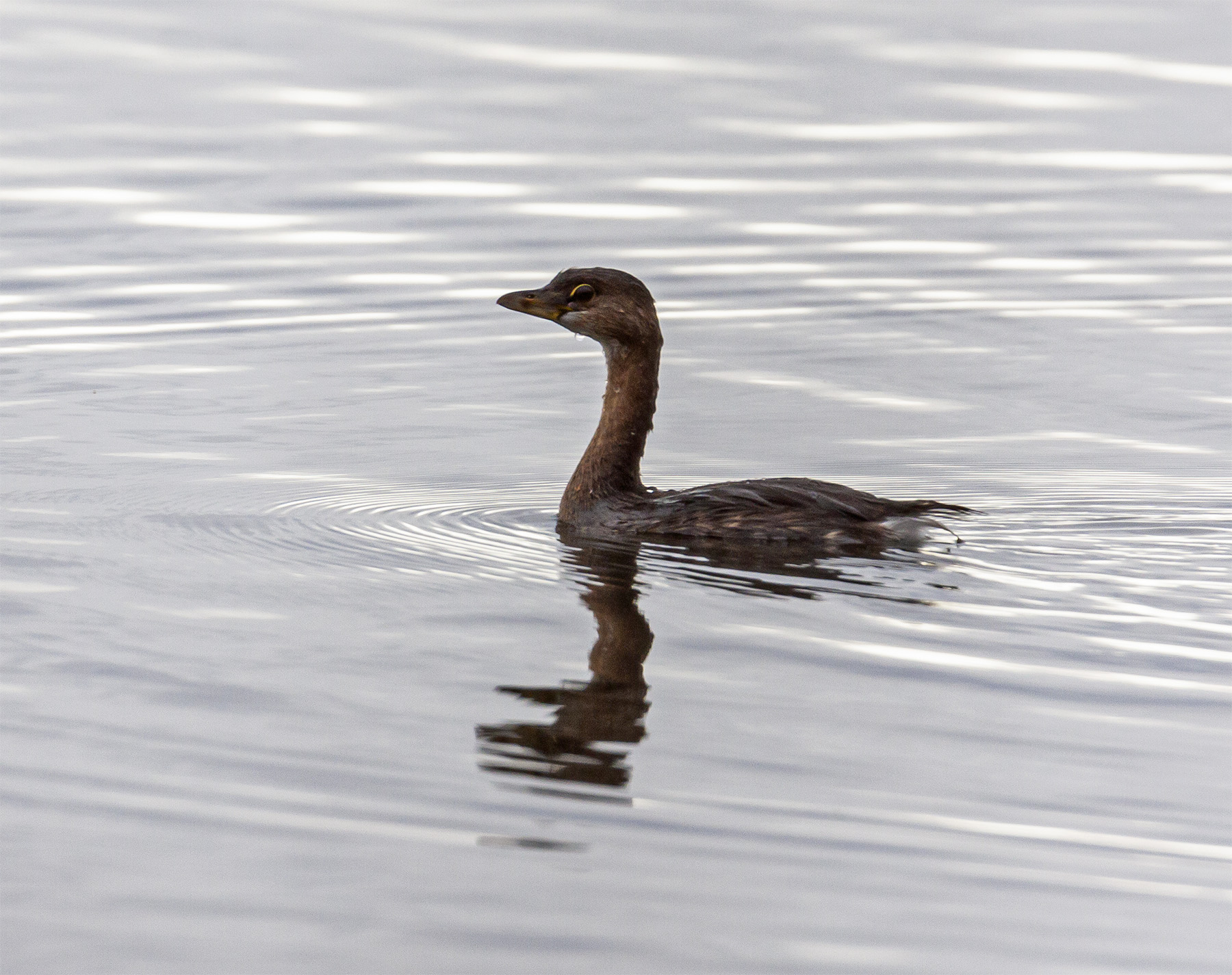
I do not know for sure if Pied-bill Grebes (Podilymbus podiceps) are migratory, but I had not seen any in a long time when I spotted a small flock of them on Tuesday in the waters off of Occoquan Bay National Wildlife Refuge. Pied-billed Grebes have a rather unusual and distinctive look—especially the bill— that makes them relatively easy to identify. Northern Virginia, where I live, is far enough south that it is a destination for some birds that will overwinter here, while many other species will pass through on their migration southward.

According to the Cornell Lab of Ornithology, “The Latin genus name for “grebe” means “feet at the buttocks”—an apt descriptor for these birds, whose feet are indeed located near their rear ends. This body plan, a common feature of many diving birds, helps grebes propel themselves through water. Lobed (not webbed) toes further assist with swimming. Pied-billed Grebes pay for their aquatic prowess on land, where they walk awkwardly.”

Pied-bill Grebe

© Michael Q. Powell. All rights reserved.


Read Full Post »

Perhaps it is because today is Halloween or because the overcast sky on Tuesday at Occoquan Bay National Wildlife Refuge caused everything to be shadowy and monochromatic. Whatever the reason, the shape of this Double-crested Cormorant (Phalacrocorax auritus) reminds me of a bat, especially in the first image.

I captured these two images as the cormorant was preparing to take off from the water. Unlike some birds that rise straight up, a cormorant has to bounce across the water to gain enough momentum for liftoff, which is why you can see the splashes of water behind the cormorant in both shots.

Double-crested Cormorant

Double-crested Cormorant

© Michael Q. Powell. All rights reserved.

Read Full Post »

When I heard the loud call of a Bald Eagle (Haliaeetus leucocephalus) yesterday I had to turn back in the direction I had come on a trail at Occoquan Bay National Wildlife Refuge. Had I walked underneath the tree in which the eagle was perched? Had it just flown in?

I did not ponder these questions for long, because it was abundantly clear that the eagle was really close and I wanted to try to get a shot. I backtracked slowly and caught sight of the eagle just after I had passed it—it was almost hidden by the foliage. I didn’t want to risk spooking the eagle, so I stayed in place and captured the first image below. Apparently I am not as stealthy as I think, for the image suggests that the eagle was monitoring my every step.

I grew a little bolder and moved to a position from which I had a clearer view of the eagle. Several times the eagle seemed to glance down at me and flex its talons a bit in a not-too-subtle reminder that it was merely tolerating my presence. After a short while, the eagle tired of our little game and took off without warning.

As you can probably tell from the images, yesterday was an overcast day. Although I really like the brilliant blue sky that served as a backdrop to some shots of a bald eagle earlier this month, I think that the clouds diffused the light and allowed me to capture more details in the white head feathers than when the sun was shining brightly.


Bald Eagle

Bald Eagle

© Michael Q. Powell. All rights reserved.

Read Full Post »

Some experienced birders can identify a bird by its call, but, except with a few common birds, I am not one of the them. I need to be able to see a bird to identify it, and that is a challenge at this time of the year, when most of the leaves are still on the trees.

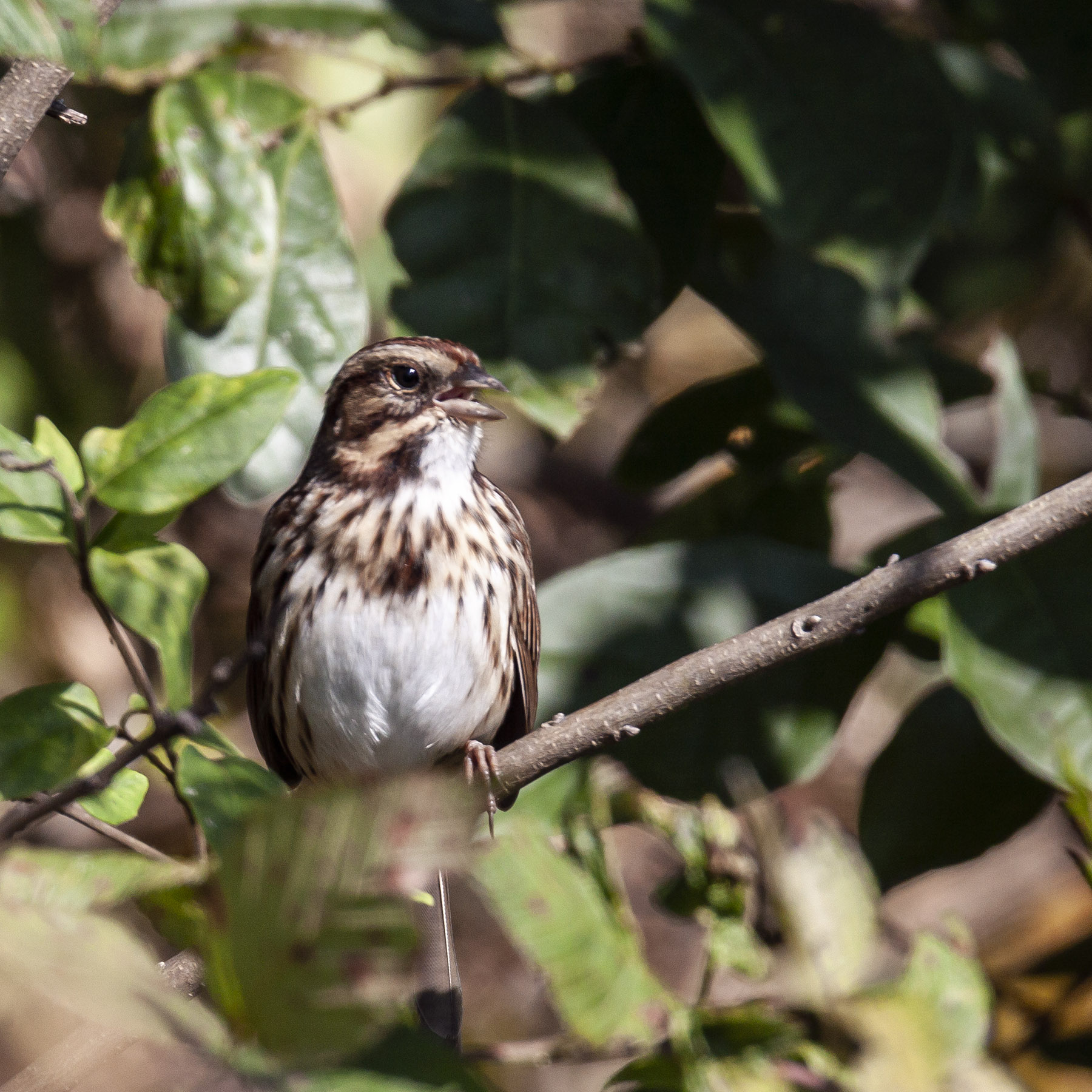
Last week as I was exploring a trail at Occoquan Bay National Wildlife Refuge, I heard a bird singing almost directly in front of me. As my eyes searched among the leaves, the bird kept on singing and eventually I located it. I could see that it was a sparrow and often that is an identification problem for me, because sparrows fall into the group of little brown birds that all basically look the same. However, in this case, I could see a dark spot on the breast of the bird, which usually means that it is a Song Sparrow (Melospiza melodia).

I was happy to be able to capture a few shots of the little Song Sparrow before it flew away. If you are curious about the sound of the Song Sparrow’s song, check out this page on the Cornell Lab of Ornithology website, where there are several audio and video clips of this birds songs and calls.


Song Sparrow

Song Sparrow

© Michael Q. Powell. All rights reserved.

Read Full Post »

Most of the time when I see or hear Carolina Wrens (Thryothorus ludovicianus), they are hidden in the undergrowth. I was thrilled therefore last Monday to be able to capture an image of this one in the open at Occoquan Bay National Wildlife Refuge.

I generally think of Carolina Wrens as cheerful, energetic little birds and I like the way that this simple shot captures a bit of that personality.


Carolina Wren

© Michael Q. Powell. All rights reserved.

Read Full Post »

I have observed woodpeckers in action numerous times, but have rarely seen one capture an insect. On Monday, however, I managed to capture this image of a Red-bellied Woodpecker (Melanerpes carolinus) at Occoquan Bay National Wildlife Refuge with a tasty morsel of some sort.

According the the welcomewildlife.com website, Red-bellied Woodpeckers are one of three woodpecker species in the United States known for storing their food and protecting their stash. I suspect that the insect in the photo was consumed on the spot, but I have often seen Red-bellied Woodpeckers with acorns in their mouths that they then jammed into a crack in a tree for future consumption. According to the aforementioned website these trees, known as granaries, may hold up to fifty thousand acorns. (In case you are curious about the other woodpeckers that exhibit similar behavior, they are the Red-headed Woodpecker, a species that is present where I live, and the Acorn Woodpecker, which I believe is found in the western part of the United States.)

Red-bellied Woodpecker

© Michael Q. Powell. All rights reserved.

Read Full Post »

I have had unusually good luck finding Bald Eagles (Haliaeetus leucocephalus) this month at Occoquan Bay National Wildlife Refuge, including this one that I spotted on Monday. Most often when I see an eagle, it flies away before I can get close, which is not really surprising given its superior eyesight and reaction time.

This time, though, I was able to approach the eagle until I was almost directly below the tree in which it was perched. In the wintertime, that might have allowed me to get some awesome close-up shots, but in this case my view of the eagle was almost completely blocked by the abundant foliage. I moved around a little until I was finally able to see the eagle’s eye and captured the first image below. The second image was my initial view of the eagle before I started to creep closer. I like that shot a lot, but it seems to me that it doesn’t quite have the same visual impact as the first shot.

Bald Eagle

Bald Eagle

© Michael Q. Powell. All rights reserved.

Read Full Post »

I love the effects of the light in this image of a Great Egret (Ardea alba) that I captured on Tuesday at Occoquan Bay National Wildlife Refuge. (For the sake of clarity, I should note that I captured the image and not the egret.) When I first spotted the egret, its wings were down and it was more or less just a silhouette. As I was focusing on it, though, the egret hopped into the air and flapped its wings and I snapped the shot. I was looking almost directly into the sun and I was fascinated by the way the light illuminated the outstretched wings and was happy that I was able to capture, at least in part, that effect.

Great Egret

© Michael Q. Powell. All rights reserved.


Read Full Post »

Two Black Vultures (Coragyps atratus) appeared to be intently staring at me as I drew closer to them on Tuesday at Occoquan Bay National Wildlife Refuge. Were they sizing me up, hoping I might drop dead on the spot? As Halloween approaches, it is easy to feel a little creeped out in situations like this. Although I believe that they were simply curious about my presence, I did make sure that I moved around enough to ensure that the vultures knew that I was still alive.

Black Vulture

Black Vulture

© Michael Q. Powell. All rights reserved.


Read Full Post »

Any day that I spot a Bald Eagle (Haliaeetus leucocephalus) is a good day. Yesterday qualified as a great day when I was able to capture an image of a Bald Eagle taking off from the slender branches of a tree at Occoquan Bay National Wildlife Refuge.

I was a bit shocked when I initially spotted the eagle perched in a cluster of leaves overhanging one of the trails at the wildlife refuge—presumably there was a branch in there somewhere, but it did not seem substantial enough to hold the weight of an eagle.

I zoomed in all the way with my 150-600mm lens and was able to get a pretty detailed shot of the eagle, as you can see in the final shot. The eagle turned its head in various directions and I knew that I did not have much time before it decided to take off. When the eagle turned its body toward the water and began to crouch, I tried to ready myself and anticipate the direction of its initial movement. In most of the shots in the burst that I took, the eagle’s wings blocked its face or extended well beyond the edges of the frame, but I was pretty happy with the one that I posted as the initial photo in this posting.

Why did the eagle choose such a precarious perch? I have no idea why, but I am happy that it gave me the chance to get these shots.

Bald Eagle

Bald Eagle

Bald Eagle

© Michael Q. Powell. All rights reserved.

Read Full Post »

I spotted a Great Blue Heron (Ardea herodias) perched in a tree last Friday at Occoquan Bay National Wildlife Refuge, calmly surveying the area, as shown in the second shot. As I drew closer, I could sense the heron beginning to gather itself.  I managed to capture the first image as the Great Blue Heron leaped into the air, preparing to take flight.

Great Blue Heron

Great Blue Heron

© Michael Q. Powell. All rights reserved.

Read Full Post »

This Bald Eagle (Haliaeetus leucocephalus) was so well hidden in a tree on Friday at Occoquan Bay National Wildlife Refuge that I almost missed it. Fortunately I caught a glimpse of the sun reflecting off of its bright white head and was able to move close enough to capture this image.

As you may have noticed in recent postings, I have marked the changing of the seasons by changing my “walk around” lens from a Tamron 180mm macro lens to a Tamron 150-600mm telephoto zoom lens. This means that it is easier for me to get photos of birds like this eagle, but tougher, though not impossible, to capture images of the remaining butterflies and dragonflies.

Bald Eagle

© Michael Q. Powell. All rights reserved.
Read Full Post »

It won’t be long until all of the Great Egrets (Ardea alba) leave my area and head for warmer locations. That makes each encounter now with a Great Egret even more special. Yesterday while I was exploring Occoquan Bay National Wildlife Refuge, I spotted this egret perched high in a tree. Initially my view was blocked by a lot of branches, but eventually I was able to maneuver into a position from which I could get an unobstructed shot.

I really like the way that the branches act as a natural frame for the egret. Additionally I like the whimsical element of the feather sticking up on the bird’s head—it reminds me of the cowlick that I had as a young boy, back when I had hair. Sometimes my Mom would lick her fingers and unsuccessfully attempt get my hair under control.

Great Egret

© Michael Q. Powell. All rights reserved.

Read Full Post »

When I spotted this raptor flying over a distant field earlier this week at Occoquan Bay Wildlife Refuge, I suspected that it was a Northern Harrier (Circus hudsonius). Although I do not see this species very often, Northern Harriers fly in a very distinctive way—they glide low over grasslands and marshlands, in part because they rely on their sense of hearing  when hunting.

I was a little disappointed that this harrier, which several folks in a Facebook birding group identified as a female, made only a single pass over the field and never flew very close. However, I am pretty happy that I was able to capture this image that gives you a good sense of the flight profile of the harrier and the environment in which she was flying.

Northern Harrier

© Michael Q. Powell. All rights reserved.

Read Full Post »

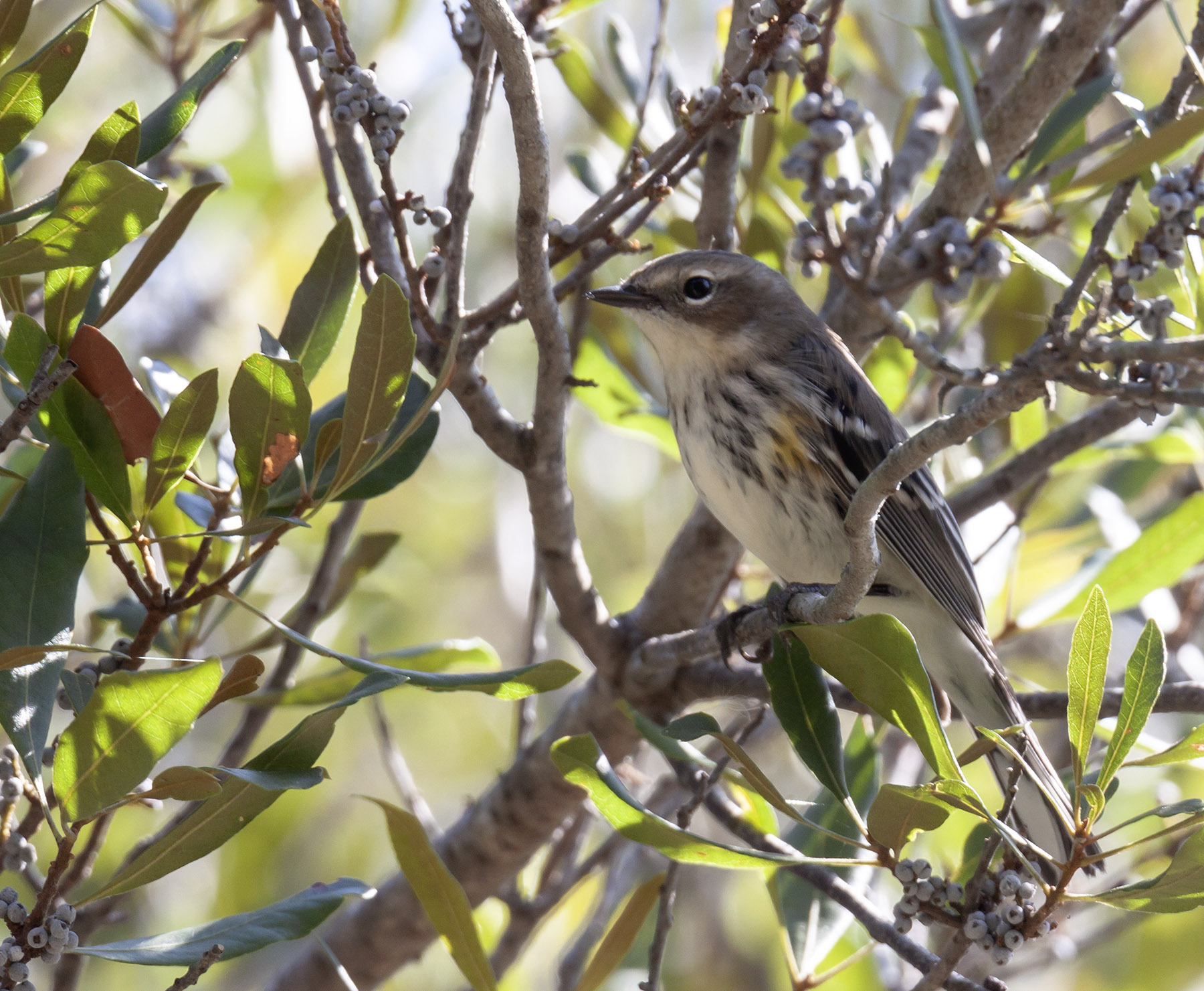
Yellow-rumped Warblers (Setophaga coronata) have returned in force to Occoquan Bay National Wildlife Refuge. There are still lots of leaves on the trees, though, so it is a real challenge to get unobstructed shots of them. I catch sight of them moving in and out of the foliage, but only rarely do they pop out into the open. So I patiently watch and wait.

Here are pretty clear views of Yellow-rumped Warblers that I eventually managed to capture on Wednesday. Most warblers are in our area only briefly as they make their way north in the spring and south in the autumn. Yellow-rumped Warblers, however, remain with us for much of the winter, so I may have more chances to see them better as the trees gradually give up their leaves.

Yellow-rumped Warbler

Yellow-rumped Warbler

Yellow-rumped Warbler

© Michael Q. Powell. All rights reserved.

Read Full Post »

What is the fastest animal on earth? My mind immediately thinks of the cheetah, which can run in short bursts at speeds up to 75 miles per hour (121 km/h). Indeed the cheetah is the fastest land animal. However, the Peregrine Falcon (Falco peregrinus), the fastest member of the animal kingdom, can reach speeds up to 242 miles per hour (389 km/h) when in a dive.

I was thrilled last week to spot this Peregrine Falcon perched at the top of a distant tree while exploring Occoquan Bay National Wildlife Refuge. The bird was hard to see on an overcast day, but the muscular way that it was perched caused me to conclude that it was a bird of prey. I took this shot with my macro lens in order to document my sighting. As I was pulling out my camera with a longer zoom lens, the falcon flew off into the air. It flew away too fast for me to get a shot

When I read about the top speed of the Peregrine Falcon, I wondered how in the world that speed was determined. I came across this fascinating National Geographic film clip that documents one effort to measure the speed of a Peregrine Falcon. It is a short video that is well worth watching and includes a trained falcon and sky-diving scientists.

I love watching birds of all shapes and sizes, but there is something really special about seeing a powerful raptor like this Peregrine Falcon.


Peregrine Falcon

© Michael Q. Powell. All rights reserved.

Read Full Post »

Most woodpeckers have simple patterns of red, black, and white feathers and it is sometimes difficult to tell them apart. The Northern Flicker (Colaptes auratus) outdoes them all with a dazzling combination of colors and patterns—they are pretty easy to identify.

The sky was overcast yesterday morning when I went exploring at Occoquan Bay National Wildlife Refuge. I had to play around with my camera exposures and as a result the background turned almost pure white when I photographed this male Northern Flicker that had light coming from behind him. I like the effect in this case because it helps viewers to focus on the details of the beautiful bird, including the wonderful yellow feathers that you can see in the final photo. In case you are curious, I can tell that the flicker is a male because of the black “mustache” that females do not have.

There are two distinct subspecies of flickers. The ones that we have in the North and East have a little red crescent on the back of its neck, yellow underwings, and, in the case of males, a black mustache. The western flickers have no red crescent, have red underwings, and, in the case of males, a red mustache.

Northern Flicker

Northern Flicker

Northern Flicker

© Michael Q. Powell. All rights reserved.
Read Full Post »

Warblers are migrating southward through my area at this time of the year. Although I can sometimes hear them, most often they stay hidden behind the foliage. I was happy therefore when I caught site of this Palm Warbler (Setophaga palmarum), one of our most common warblers, this past week at Occoquan Bay National Wildlife Refuge.

When I initially spotted this little bird, it was feeding in the grass, as shown in the second image. The warbler was part of a small group and all of them appeared to be really skittish and took to the air when I was still a long way off. Fortunately one of them flew into a tree and paused momentarily, allowing me to get a mostly unobstructed shot of it.

Most of the warblers remain in our area for a short period of time, so I am never confident when or if I will see any of them. I guess that the best way to increase my odds is to spend more time outside with my camera at the ready.

Palm Warbler

Palm Warbler

© Michael Q. Powell. All rights reserved.

Read Full Post »

I do not know where the Wild Turkeys (Meleagris gallopavo) were hiding, but I don’t think that I spotted a single one all summer. All of the sudden they seem to be back and I have seen them repeatedly during my most recent visits to Occoquan Bay National Wildlife Refuge.

During most of my encounters, I have spotted them in the distance, pecking away at the side of the trail. Before I can get within camera range, they usually sense my presence and waddle into the undergrowth. I was fortunate, however, to capture a shot of this one turkey who had lingered in the open a bit longer than his compatriots.

Wild Turkey

© Michael Q. Powell. All rights reserved.

Read Full Post »

I am blessed to live in an area in which Bald Eagles (Haliaeetus leucocephalus) are present throughout most of the year. During the summer, however, my encounters have been pretty infrequent, so I was excited to spot this one on Monday while visiting Occoquan Bay National Wildlife Refuge. I was looking for dragonflies that day and had a macro lens on my DSLR camera and I realized the eagle was too far away for me to capture a decent image.

It was precisely for situations like this that I also carry my Canon SX50 super-zoom camera. The resolution of this camera is not as good as that of my “big” camera, but it gives me a lot of reach. After I had zoomed in to take the first shot, I zoomed out and realized that there was a second bald eagle perched above the one I had just photographed. The second shot shows the relative positions of the two eagles.

I was hoping for better head positions for the two eagles, but they flew away shortly after I took the second shot. I have discovered that it is usually best to get a shot as early as possible in such encounters and then work to get a better shot. If I had waited for the “perfect” moment, I almost certainly would have come up empty-handed.

Bald Eagle

Bald Eagles

© Michael Q. Powell. All rights reserved.

Read Full Post »

A few days ago I made a trip to the National Zoo in Washington D.C. and one of my highlights was visiting the massive Amazonia exhibit. While walking through the indoor rain forest, I could hear activity high in the trees and caught sight of some brightly colored small bird. I think there are also several varieties of monkeys that I did not spot and all kinds of amphibians and fish.

I was shocked and thrilled when a Roseate Spoonbill (Platalea ajaja) flew over and perched a few feet away from me when I was observing an exotic duck. I had previously marveled at the photos of Roseate Spoonbills posted by photographers in Florida and other southern US states, but had never seen one before. The spoonbill seemed to be a bit curious about my presence and willingly posed for me.

It was nice that the Roseate Spoonbill was so cooperative, because I had only a single lens with me, a Canon 24-105mm zoom lens. Initially I was worried that most subjects would be too far away for me to capture with the modest telephoto reach of the lens, but it proved to be perfect when taking portraits of the spoonbill who was less than three feet (one meter) away from me.

My wonderful experience with this beautiful bird increases my desire to see a spoonbill in the wild. I really enjoy visiting zoos, particularly ones like the National Zoo that, I believe, make special efforts to care for the animals. The zoo gives me a chance to observe animal behavior, including animals that I am not likely to see in the wild, but it can never be a replacement for the overall experience of observing animals, birds, and other wondrous creatures in their natural environment.

Roseate Spoonbill

Roseate Spoonbill

Roseate Spoonbill

© Michael Q. Powell. All rights reserved.

Read Full Post »

When I first spotted two small dark shapes in the the waters of Occoquan Bay, I wasn’t sure what I was seeing. As I zoomed in and saw that it was two birds, I assumed that they were cormorants or some similar bird. When the birds changed position and the sun reflected off their white heads, I was shocked to realize that it was two adult Bald Eagles (Haliaeetus leucocephalus) perched on a floating log.

The photo is a little deceptive because it makes it look like the foreground is a beach. The tide was fairly low when I took this shot and the shallower water was covered with some kind of floating debris—it was definitely not solid ground.

Why were the eagles on the log? I thought that maybe they were feeding, but when I scanned the log, I could not see any evidence of a fish. It looks to me like this is a couple, with the larger female on the left, that is involved in some kind of marital dispute. She seems to be telling her mate something and he seems to be a bit cowed and defensive.

What do you the conversation is about between these two eagles?

bald eagles

© Michael Q. Powell. All rights reserved.

Read Full Post »

From  a distance I noticed a flash of yellow moving from a tree to a patch of flowers. The flight was too fast for a butterfly, and when I moved a bit closer I spotted, as I had suspected, an American Goldfinch (Spinus tristis). Judging from its coloration, I think it may be a juvenile, though I must admit that after a summer of chasing insects, my bird identification skills are a little rusty. The goldfinch was somewhat skittish and uncooperative, but I was able to capture these two images that I decided to share them with you all.

American Goldfinch

American Goldfinch

© Michael Q. Powell. All rights reserved.


Read Full Post »

I have not seen as many Green Herons (Butorides virescens) this year as in previous years, so I was happy to spot one this past Tuesday during a quick trip to Meadowlark Botanical Gardens in nearby Vienna, Virginia.

Green Herons are smaller and squatter than the more commonly seen Great Blue Herons (Ardea herodias). Normally I see Green Herons at water’s edge, because their shorter legs do not allow them to wade into deeper water, and they are often partially hidden from view by vegetation. This Green Heron, though, had placed itself at the edge of a drainage system in the middle of a small pond, which is why I was able to get an unobstructed shot of this handsome bird.

Green Heron

© Michael Q. Powell. All rights reserved.

Read Full Post »

I was excited to spot this Ruby-throated Hummingbird (Archilochus colubris) during a short visit yesterday to Meadowlark Botanical Gardens with some friends. The hummingbird was feeding on some distant orange jewelweed flowers (Impatiens capensis) and I was using a macro lens at that moment, so I was especially thrilled when I managed to capture this image.

I do not see hummingbirds very often, so it really is a treat for me to see one in action. It is absolutely mesmerizing to watch these little birds frenetically flying among the flowers, stopping from time to time to sip the nectar from one of them. Tracking the moving hummingbird was definitely a challenge with my 180mm macro lens. Strangely enough, though, I probably had an easier time in doing so with this lens than if I had been using my much longer telephoto zoom lens—it can be tough trying to track, focus, and zoom simultaneously when handholding a long lens.

This image is a significant crop of the original image, but the detail holds up fairly well, all things considered. Does equipment matter? It matters to some extent, but you can often get decent results by simply taking the shots with whatever camera and lens that you have at hand.

Ruby-throated Hummingbird

© Michael Q. Powell. All rights reserved.


Read Full Post »

As I was searching for butterflies last week at Jackson Miles Abbott Wetland Refuge, a flash of brilliant yellow suddenly crossed my field of view. It took a moment for me to figure out what it was and then I realized that several American Goldfinches (Spinus tristis) were diving into a field of Black-eyed Susan wildflowers (Rudbeckia hirta).

I waited for a long time, hoping in vain that the goldfinches would perch in the open on the flowers nearest me, but mostly they stayed buried deep in the vegetation. Here are a couple of long-distance shots that give you a sense of my experience with these colorful little birds.


American Goldfinch

American Goldfinch

© Michael Q. Powell. All rights reserved.

Read Full Post »

I inadvertently spooked a Great Egret (Ardea alba) last week while exploring a small pond at Occoquan Bay National Wildlife Refuge. I thought that it was going to fly away, but instead it opted to perch in a nearby tree. The sun was really bright as I tried to track the bird in my camera’s viewfinder, so many of my shots were overexposed. As the bird was settling in among the tree branches, I was able to capture this shot.  I really like this shot because of the egret’s wing  positions that are  so  unusual  and  graceful.

Great Egret

© Michael Q. Powell. All rights reserved.

Read Full Post »

This Osprey (Pandion haliaetus) spotted me about the same time as I spotted it and immediately took to the sky with its half-eaten fish yesterday at Occoquan Bay National Wildlife Refuge. Fortunately I had heard the osprey’s cry a few seconds earlier and was able to capture this image as it prepared for takeoff. Like another shot that I posted recently of an osprey, this image was captured using my 180mm macro lens.

This osprey was definitely not interested in sharing its freshly caught fish with me. If I want sushi, I’ll have to find it on my own.

Osprey

© Michael Q. Powell. All rights reserved.

Read Full Post »

Birds seem to spend a lot of time grooming themselves and this Great Blue Heron (Ardea herodias) was no exception. I spotted it yesterday on a small island in the Potomac River, midway between Riverbend Park and Great Falls Park. I knew that Great Blue Herons had flexible necks, but I must admit that I had never before seen one contort itself into the position shown in the first photo below.

After it had adjusted its feathers, the heron stood for a while with its wings partially opened. The position looks really strange and I have been told that it is a way for herons to dissipate heat when the weather gets hot by allowing greater air circulation. In case you are curious, I took the second and third photos from exactly the same spot—for one of them I was standing and for the other I was crouching.

Great Blue Heron

Great Blue Heron

Great Blue Heron

© Michael Q. Powell. All rights reserved.

Read Full Post »

As I was walking along a trail last Tuesday at Occoquan Bay National Wildlife Refuge I heard the cry of an Osprey (Pandion haliaetus) that sounded like it was really close. I looked up, reacted quickly, and managed to capture this sequence of shots.

In many ways I should not have been able to get these shots. I had the wrong lens on my camera. Instead of a long telephoto lens, I had my 180mm macro lens. My camera settings were more appropriate for a static portrait than for a moving subject. Fortunately I almost always have my camera set for continuous shooting, so I was able to fire off a quick burst and was pretty pleased with the results.

These images remind me of the importance of taking photos whenever and however you can. Conditions may not be optimal and your gear may not be perfectly suited to the task, but I think it is best not to worry about that when you find yourself presented with a photo opportunity—just shoot it with what you have.

Osprey

Osprey

Osprey

Osprey

© Michael Q. Powell. All rights reserved.


Read Full Post »

« Newer Posts - Older Posts »