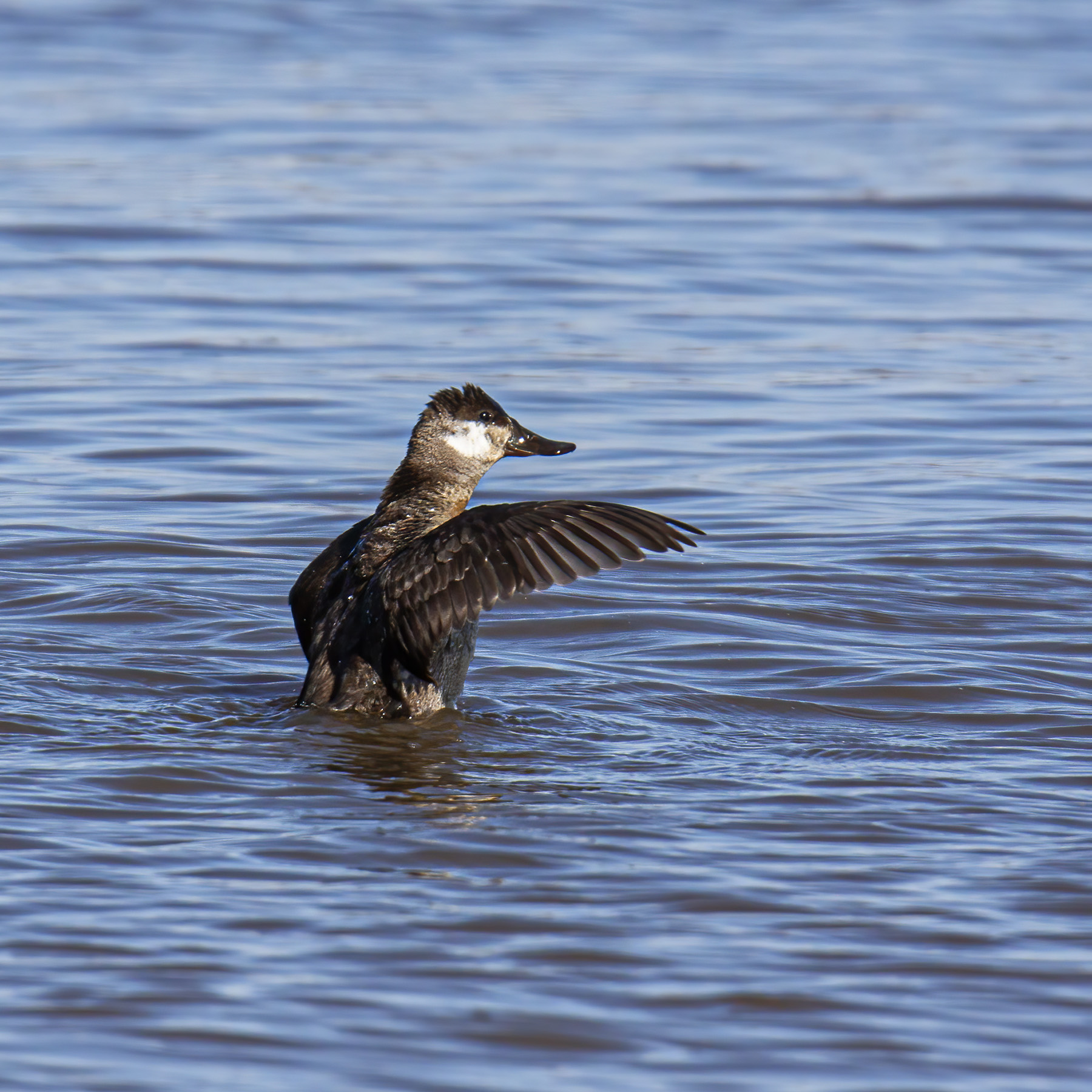
Ruddy Ducks (Oxyura jamaicensis) are one the many duck species that overwinter in the Northern Virginia area where I live. The males are pretty easy to identify, even from a distance, because of the bright white patch on the sides of their heads. I spotted this one on Tuesday as he was shaking himself dry after a plunge in the waters off of Occoquan Bay National Wildlife Refuge.
Unfortunately they do not breed in our area—I would love to see the brilliant plumage of the breeding males. The Cornell Lab of Ornithology notes that, “Breeding males are almost cartoonishly bold, with a sky-blue bill, shining white cheek patch, and gleaming chestnut body.” Wow!
It is so much fun to read the “Cool Facts” section that is part of the description of each bird on the Cornell Lab of Ornithology website. I love this description of the Ruddy Duck:
—The bright colors and odd behavior of male Ruddy Ducks drew attention from early naturalists, though they didn’t pull any punches. One 1926 account states, “Its intimate habits, its stupidity, its curious nesting customs and ludicrous courtship performance place it in a niche by itself…. Everything about this bird is interesting to the naturalist, but almost nothing about it is interesting to the sportsman.”
As you can see from the three shots below, I played around with the cropping of the images. They were all part of the same sequence, so initially the framing was similar for all three. I am not sure that any one of the three crops jumps out as “better,” but I really enjoy the process of considering options and thought that some of you would enjoy getting this little peek behind the curtains of my mental processes when working on an image.


© Michael Q. Powell. All rights reserved.
Read Full Post »






















 Mike Powell