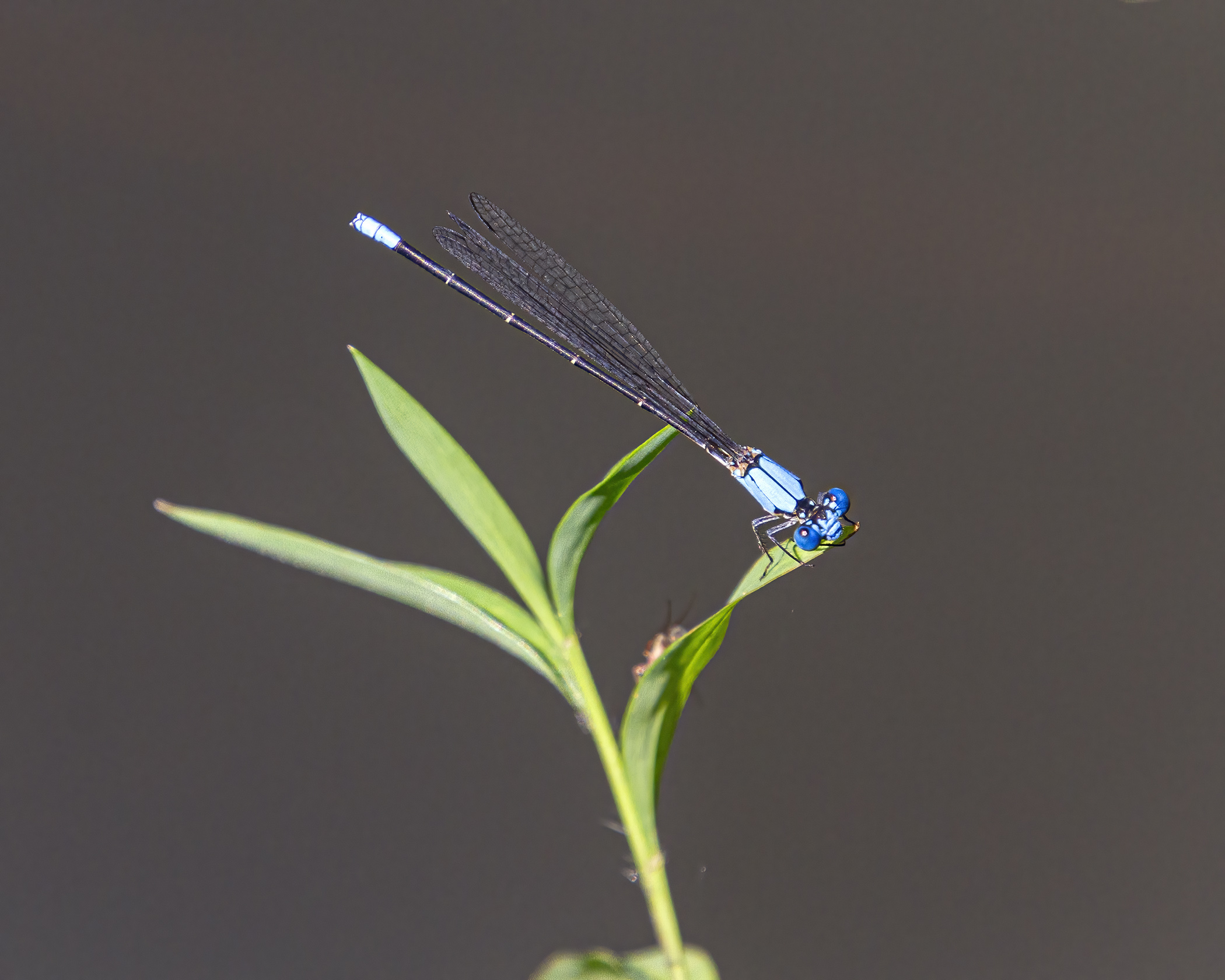
On Monday I spotted several Blue-fronted Dancer damselflies (Argia apicalis) during a visit to Jackson Miles Abbott Wetland Refuge. I don’t see this particular species of damselfly at most of my other favorite spots, so it was a nice treat to see them. According to my identification guide, Damselflies of the Northeast by Ed Lam, Blue-fronted Dancers can be found “on a wide variety of rivers and streams, occasionally lakes and ponds.”
In this case, I spotted the damselflies perched in the vegetation at the edge of a small pond (first photo) and perched on an exposed tree root a few feet from the pond (second photo). The males of this species are pretty easy to identify because their thoraxes (their “chest”) are almost completely blue, with only hairline black stripes.

© Michael Q. Powell. All rights reserved.
 Mike Powell
You really capture the delicacy of this lovely damselfly. That shade of blue is so gorgeous.
Thanks, Laura. A lot of damselflies have some blue, but mostly it’s in much smaller amounts than on the Blue-fronted Dancer. I really like the combination of the black lower body and the almost solid blue upper body and tip of the abdomen. The brilliant blue of eyes certainly grabs your attention too.
When I double-clicked on the first photo I saw a new world, Mike. What a stunning damselfly.
Thanks, Jet. Truly a macro lens (or in this case a telephoto lens zoomed in as closely as possible) opens up the world, a place full of beauty in wonderfully tiny details.
💙🌻
How beautiful, Mike!
So delicate and lovely.
Thanks. Damselflies are so small in size that I often have to rely on manual focusing to get a shot of them–the camera’s autofocus just won’t pick them up most of the time.