Feeds:
Posts
Comments

Archive for February, 2025

I was delighted on Monday to photograph this male Bufflehead (Bucephala albeola) duck in good light, which allowed me to see the beautiful purple-green iridescence on its head. Male Buffleheads have a large white patch that wraps around the back of their heads that makes them easy to identify from a distance. It is rare, though, for me to be close enough and in the right light to see the beautiful head coloration.

Buffleheads are small, large-headed ducks that migrate to my area of Northern Virginia during the winter and I often see some of them during my visits to Occoquan Bay National Wildlife Refuge. During the summer, Buffleheads breed near ponds and lakes in boreal forest and aspen parkland of Canada and Alaska, according to the Cornell Lab of Ornithology.
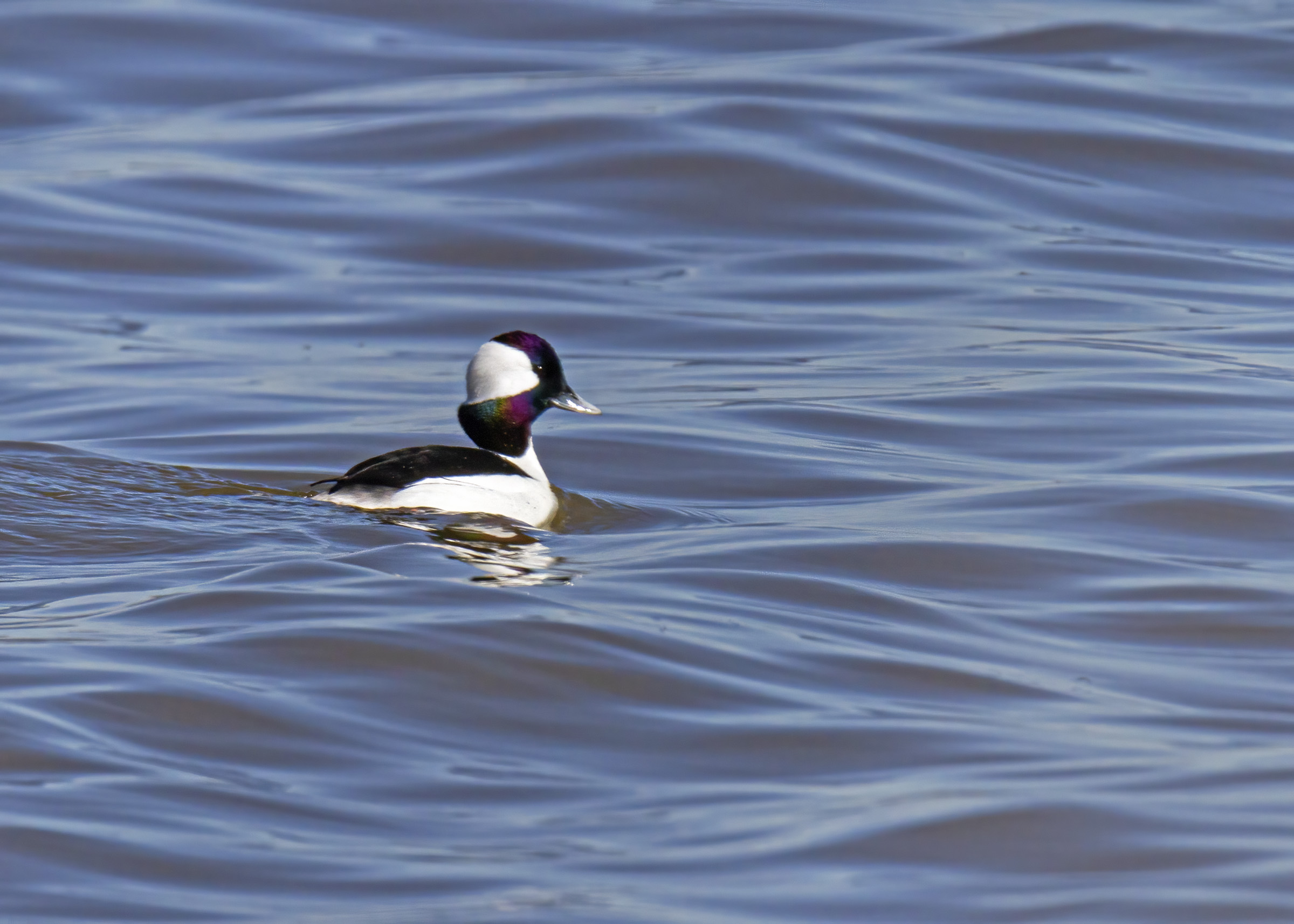
bufflehead

© Michael Q. Powell. All rights reserved.

Read Full Post »

Every year in the late winter and early spring I try to keep an eye on the nests of Bald Eagles (Haliaeetus leucocephalus) at Occoquan Bay National Wildlife Refuge. Several of the locations with nests that were used last year apparently are not being this year, but I have repeatedly observed eagle activity at one very large nest at the refuge.

On Monday, I spotted one eagle perched on the edge of that nest and another eagle in a nearby tree keeping watch over the nest. Does that mean that some eggs have hatched? Who knows? The nest is so deep that it is impossible to see what is going on inside of the nest. I watched the nest for quite a while, hoping I might see a tiny head pop up over the edge of the nest, but a baby eagle never appeared

I will continue to monitor this nest and a couple of other potential nesting sites and, with a little luck, may catch a glimpse of some eaglets in the upcoming weeks.

bald eagle

© Michael Q. Powell. All rights reserved.
Read Full Post »

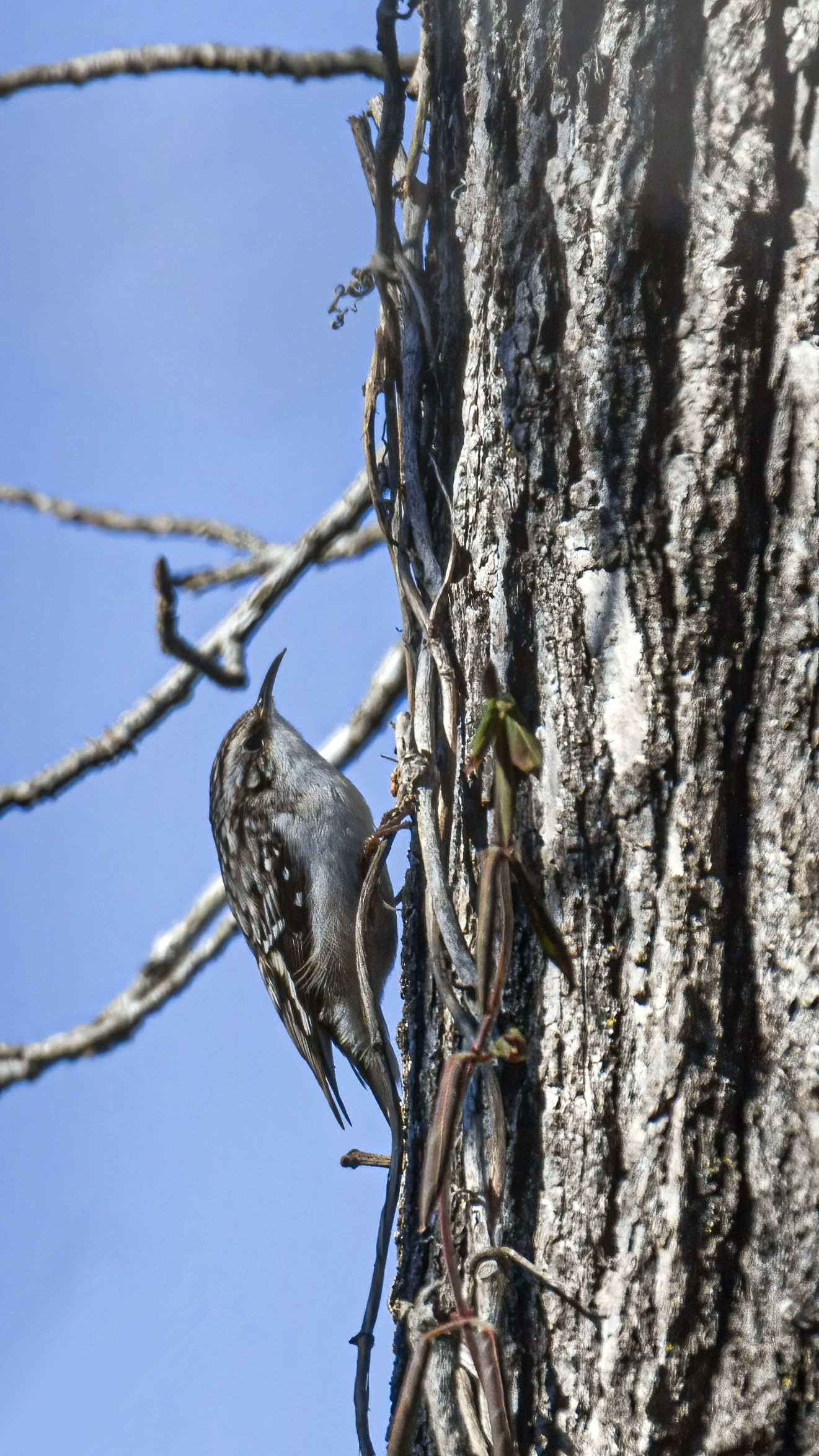
On Monday I spotted this tiny Brown Creeper (Certhia americana) as it spiraled its way up several trees alongside a trail at Occoquan Bay National Wildlife Refuge. This little bird was somewhat frenetic in its movements, often disappearing behind the trunk of the tree, but somehow I managed to track it. As you can see from the photo, the creeper blends in well with the tree bark, so movement is key to detecting the bird.

I was happy to capture an image that shows off the creeper’s distinctive bill so well. Brown Creepers use their slender, downcurved bills to probe into crevices and pick at loose bark in search of insects. From what I have observed, creepers almost always move upwards in a tree, while nuthatches seem move only downwards.

Brown Creeper

© Michael Q. Powell. All rights reserved.

Read Full Post »

The warmer weather yesterday was a welcome respite from our winter cold—temperatures rose above 50 degrees F (10 degrees C) and it is supposed to be even warmer today. During a lengthy walk at Occoquan Bay National Wildlife Refuge, I was delighted to spot this tiny Golden-crowned Kinglet (Regulus satrapa) on a tree with some visible buds.

Such signs are starting to appear—I can’t wait for spring to arrive with new growth, new colors, and new life.

Golden-crowned Kinglet

© Michael Q. Powell. All rights reserved.
Read Full Post »

The weather this past week has been cold and windy, so I have not been able to get outdoors very much this past week. According to the weather forecasts, things should warm up next week, so hopefully I will be a bit more active.

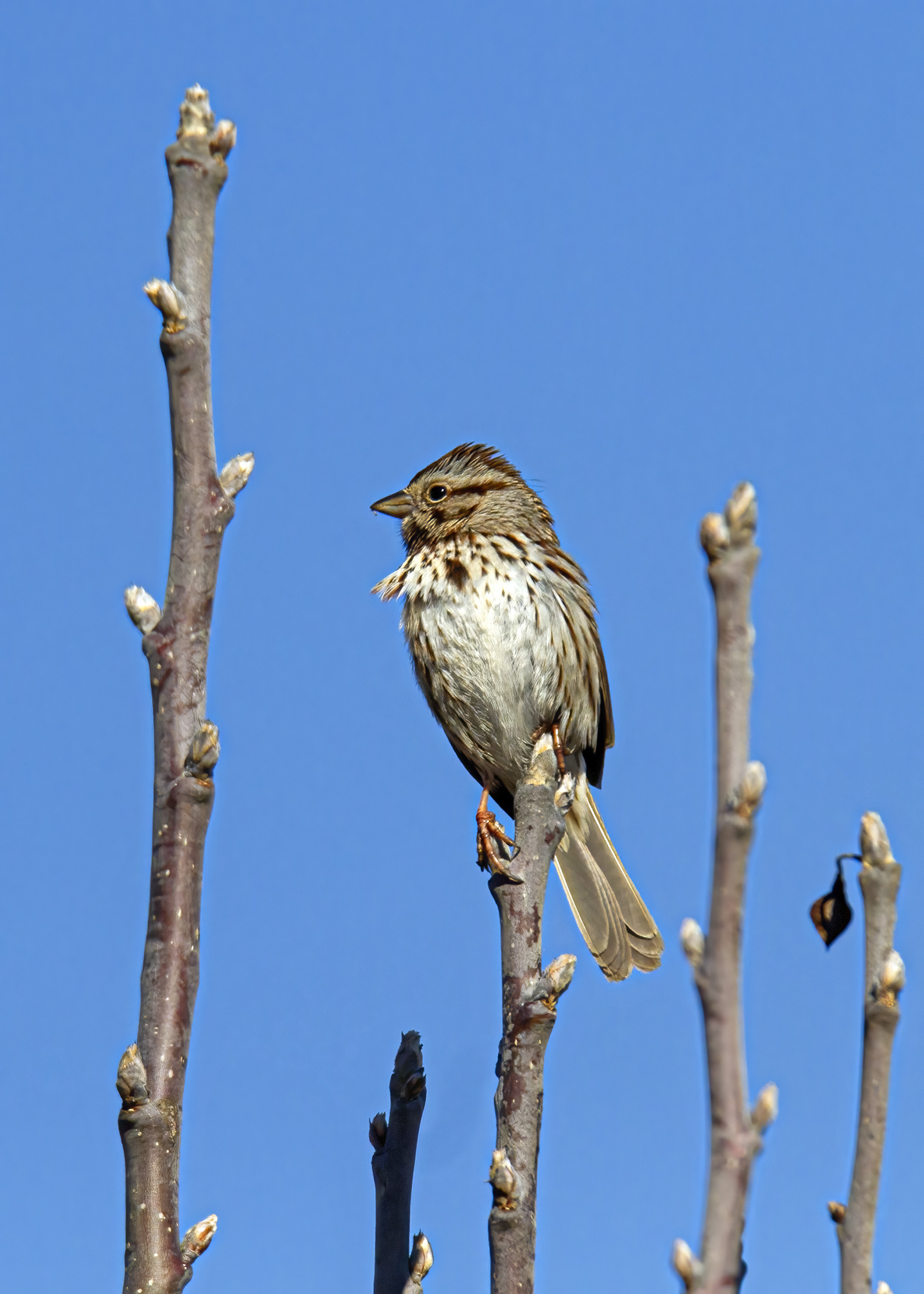
When I last visited Occoquan Bay National Wildlife Refuge a week or so ago, I captured this image of what I believe is a Song Sparrow (Melospiza melodia). The little bird was perched on the bare stalks of some unidentified vegetation, which permitted me to capture an uncluttered shot—most of the time I see sparrows foraging on in ground in the cluttered underbrush.

Song Sparrow

© Michael Q. Powell. All rights reserved.

Read Full Post »

This past Friday I photographed this Great Blue Heron (Ardea herodias) at Occoquan Bay National Wildlife Refuge in stealth mode as it attempted to sneak up on some potential prey. At other times, the heron walked through the water with its head held high. It was a fun little photo session for me, though I suspect that the heron wished it were more successful in catching some fish.

Great Blue Heron

Great Blue Heron

Great Blue Heron

© Michael Q. Powell. All rights reserved.


Read Full Post »

I never get tired of photographing Bald Eagles (Haliaeetus leucocephalus), like this one that soared by me last week at Occoquan Bay National Wildlife Refuge. The eagle made minor adjustments to its wings and tail to maintain its speed and direction, but it mostly seemed to be enjoying itself without exerting much effort. I couldn’t help but think of the Steve Miller Band and its well-known song “Fly Like an Eagle” from the 1970’s.

“I want to fly like an eagleTo the seaFly like an eagleLet my spirit carry meI want to fly like an eagle‘Til I’m freeOh, Lord, through the revolution…”


Bald Eagle

Bald Eagle

Bald Eagle

Bald Eagle

© Michael Q. Powell. All rights reserved.

Read Full Post »

Last Friday I spotted a Double-crested Cormorant (Nannopterum auritum) in the waters off of Occoquan Bay National Wildlife Refuge. As I was bringing my camera up to my eye, the cormorant suddenly took off and I captured a couple of shots of the action. I was shooting almost directly into the light, so the bird is almost a silhouette, but I was happy to capture some of the action. As you may be able to see, the cormorant initially runs across the surface of the water to generate some momentum before it takes to the air.

When I went searching for the Latin name, I was a little surprised to see that it had changed. The Double-crested Cormorant used to be considered part of the genus Phalacrocorax, but, according to Wikipedia, a 2014 study supported reclassifying it and several other American cormorant species into the genus Nannopterum. The International Ornithologists’ Union reportedly adopted this change in 2021.

Double-crested Cormorant

Double-crested Cormorant

© Michael Q. Powell. All rights reserved.

Read Full Post »

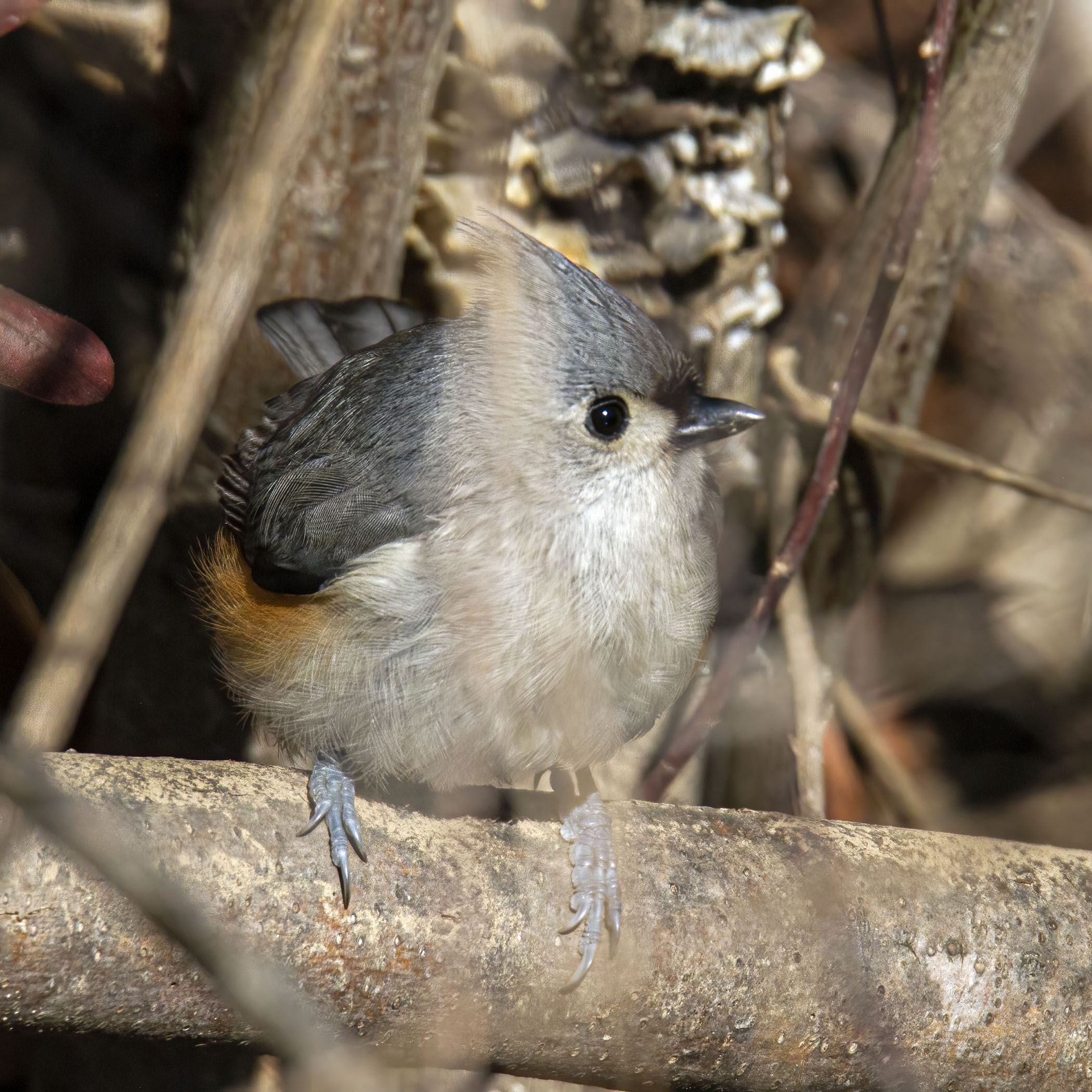
I was thrilled to capture this shot of a tiny Tufted Titmouse (Baeolophus bicolor) during a visit to Occoquan Bay National Wildlife Refuge last Friday. Normally I see Tufted Titmice flitting about high in the foliage, but this one came down closer to the ground for a moment. As you can see, I was shooting through branches, but I like the feeling that the photo somehow conveys of entering into the private world of this little bird.

Tufted Titmouse

© Michael Q. Powell. All rights reserved.

Read Full Post »

Last Friday I was walking slowly along a trail that runs parallel to the water off of Occoquan Bay National Wildlife Refuge when I noticed a Great Blue Heron (Ardea herodias) doing the same thing. Most of the time when I see a heron, it is in the water, though occasionally I have spotted one perched in a tree. It is highly unusual for me to see one on dry land, but this heron seemed to strolling down the path, taking in the sights.

I slowed down a little to maintain my distance from the heron and managed to capture this shot as heron was lifting its long toes to take another step. Eventually the heron became aware of my presence and quickened his walking pace a bit until he reached an opening to the water and flew away. What a fun little encounter with the heron!

Great Blue Heron

© Michael Q. Powell. All rights reserved.

Read Full Post »

When I first spotted this bird in the water on Tuesday at Occoquan Bay National Wildlife Refuge, I thought it might be a Northern Shoveler, because of the enlarged shape of its bill. I zoomed in with my long 150-600mm telephoto lens to try to confirm the identification and decided that it instead looked more like an immature male Lesser Scaup (Aythya affinis) with some kind of mollusk or snail in its mouth.

According to the Cornell Lab of Ornithology website, “Lesser Scaup eat primarily aquatic invertebrates such as mollusks, insects, and crustaceans, but they also eat aquatic plants and seeds.” However, I am not very good at distinguishing Greater Scaups from Lesser Scaups and immature birds make identification even harder, so I am not all that confident that I have correctly identified this bird.

As you can tell from the photo, the it was windy and the water was quite rough that day, so the birds on the bay were bobbing up and down. I decided not to crop this image any closer in order to give you a sense of the choppiness of the water.

Lesser Scaup

© Michael Q. Powell. All rights reserved.

Read Full Post »

As I peered through the thick vegetation on Tuesday at Occoquan Bay National Wildlife Refuge, I spotted the bright white head of a Bald Eagle (Haliaeetus leucocephalus) perched on a distant tree above what may be a new eagle nest. Some of the nesting sites that eagles used in previous years are empty this year and none of the roads at the refuge appeared to be closed. I have been searching diligently for indications of new nests and am hopeful that this one is now being actively used.

I suspect that there is also nesting activity at the large eagle nest shown in the second photo below. The nest is so large and deep, however, that it is impossible to tell for certain if an eagle is currently sitting on eggs inside.

Spring is a time for new life and for new growth and I am hopeful that I will spot some baby eaglets in these two nests in the upcoming months as spring draws near.

Bald Eagle

eagle nest

© Michael Q. Powell. All rights reserved.

Read Full Post »

Carolina Wrens (Thryothorus ludovicianus) are quite common in Northern Virginia, where I live. Most often, though, I get a only a glimpse of one when I hear it loudly singing. Carolina Wrens often seem to bury themselves in the low vegetation and it is hard to get an unobstructed view of one.

Last week at Occoquan Bay National Wildlife Refuge, I spotted a Carolina Wren as it was moving about and manage to track it. I attempted to take a lot of shots of the little bird, but most of them were blurry or had the head hidden by branches. There are a lot of branches (and shadows) in this photo too, but I was fortunate enough to be able to focus on the wren’s eye.

I really love the warmth of the colors on the wren’s body and how well it blended into its surrounds. The color palette is minimal, with mostly varying shade of brown, but the little green bits add some visual interest and give rises to hope that the bleak days of winter will eventually be replaced by the new growth of spring.

Carolina Wren

© Michael Q. Powell. All rights reserved.

Read Full Post »

In the midst of all of the chaotic turmoil swirling in my country, I feel a need to post an image reflective of the inner peace that I am seeking at this time, a peace that seems so elusive during this challenging time. This past Monday I encountered this Mourning Dove (Zenaida macroura) as I was walking along one of the trails at Occoquan Bay National Wildlife Refuge.

The dove was part of a small flock that I inadvertently flushed as the birds were foraging on the ground. Most of the doves flew away, but this one perched in a nearby tree and I was able to capture this peaceful portrait.

Here in the Washington D.C. area we are all in mourning for those who died when a helicopter collided with an airplane over the Potomac River. I hope and pray that we all can use this time for support and sympathy for those who lost loved ones in the accident and not for launching accusations or blame on either end of the political spectrum. “To everything there is a season…A time to weep, and a time to laugh; a time to mourn, and a time to dance.” (Ecclesiastes 3:1,4)

Best wishes to all for a blessed month of February.

Mourning Dove

© Michael Q. Powell. All rights reserved.
 

Read Full Post »