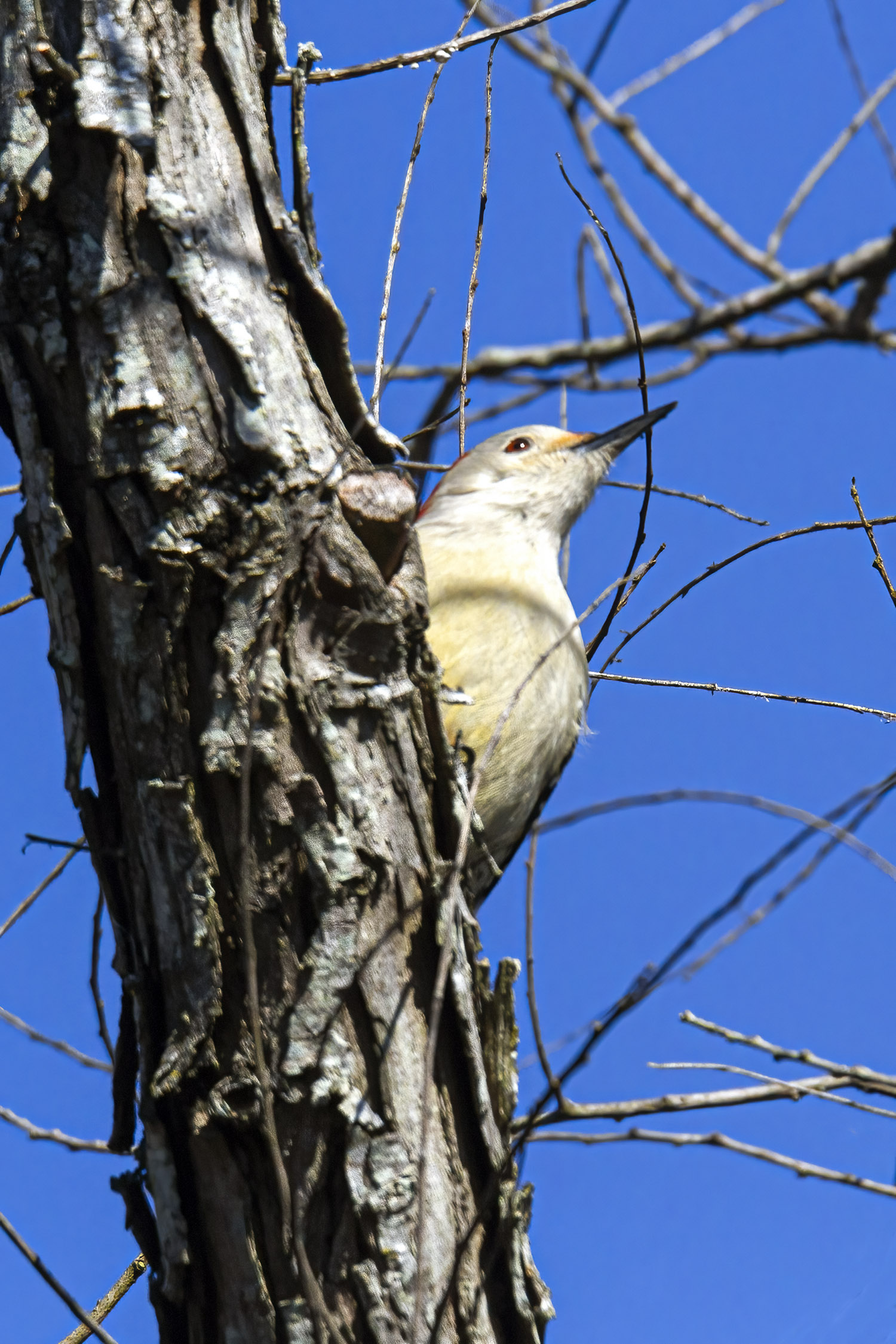
Red-bellied Woodpeckers(Melanerpes carolinus) are one of the most common woodpeckers in my area. I catch glimpses of them often as the move about in the trees, but I rarely manage to get a clean shot of one. I remember when I was first began to photograph birds and was super excited to spot the bright red heads of these woodpeckers. I mistakenly assumed that they would be called Red-headed woodpeckers, but I was wrong—Red-headed Woodpeckers are completely different species.
I was always a bit confused by the name of this species, because I never managed to see the woodpecker’s “red belly.” In the second photo below, you can see an orangish tinge in the lower abdomen area that I guess may qualify as a “red belly,” but that is a bit of a stretch.
Red-bellied Woodpeckers spend a lot of time probing beneath the bark of trees for insects. If you look closely at the first photo, you can see the woodpecker at work with its bill. According to the Cornell Lab of Ornithology, “A Red-bellied Woodpecker can stick out its tongue nearly 2 inches past the end of its beak. The tip is barbed and the bird’s spit is sticky, making it easier to snatch prey from deep crevices. Males have longer, wider-tipped tongues than females, possibly allowing a breeding pair to forage in slightly different places on their territory and maximize their use of available food.” Wow!
Things are warming up a bit and it was delightful to walk about in the sunshine at Occoquan Bay National Wildlife Refuge last Thursday. I decided to leave my heavy coat in the car and wore just a hooded sweatshirt with a long-sleeved thermal shirt underneath. Spring is coming, but I suspect that we will have a bit more winter weather before then—here in Northern Virginia February often has the most severe weather of the winter.

© Michael Q. Powell. All rights reserved.
 Mike Powell
So pretty! I heard one this morning before I saw him! 👍👏
Blue Rock HorsesFrederick County, Virginiabluerockhorses.com
<
div dir=”ltr”>
I have a red bellied woodpecker have an unusually long break like 3 inches long?
It sounds like a Hairy Woodpecker.