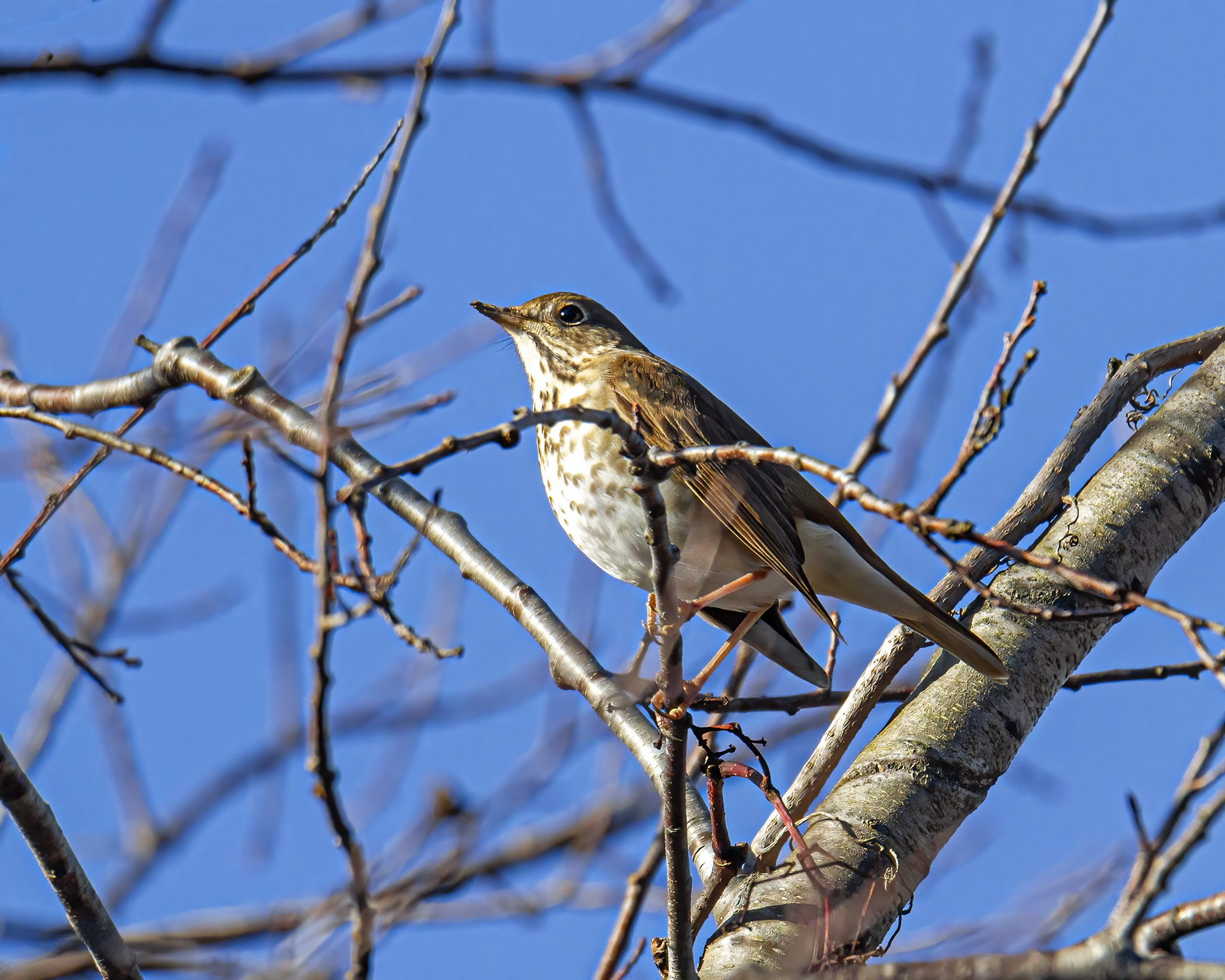
When I first spotted this little bird on Monday as it perched high in a tree at Occoquan Bay National Wildlife Refuge, its shape caused me to think that it was an American Robin. As I got a little closer, though, I could see that the bird’s breast was spotted and did not have the distinctive orange color of “our” robin.
I remembered that the American Robin is a member of the thrush family, so I assumed that this bird was another kind of thrush. (The European Robin, by contrast, belongs to the chat subfamily of the Old World Flycatcher family—check out this November 2019 blog posting to see a photo of a European Robin that I photographed in Paris.) When I returned home and checked by bird identification guide, I was able to determine that this is probably a Hermit Thrush (Catharus guttatus), a species that I have encountered only a few times.
As I was looking up information on the Hermit Thrush, I discovered that this bird played a an important role in “When Lilacs Last In The Dooryard Bloom’d,” an elegy on the death of Abraham Lincoln by noted American poet Walt Whitman. The thrush, along with lilacs and a star, is one of the recurring elements in the poem and seems to represent a kind of reconciliation with death and its song is described as “Death’s outlet song of life.” I am providing a link to the entire poem in case you are interested in reading the beautiful poem in its entirety. As a foretaste, I will leave you with one small section of the poem in which Whitman first introduced his readers to the Hermit Thrush:
“In the swamp in secluded recesses,
© Michael Q. Powell. All rights reserved.
 Mike Powell
Great photo, Mike. Thank you for poem too!
Thanks, Mitzy. I sometimes get distracted when doing a little research on a subject that I have photographed. Discovering the Walt Whitman poem was a happy find during one of my little tangents.
Tangents can be wonderful.🙂
Hermit thrush is the state bird of Vermont.
Wow!