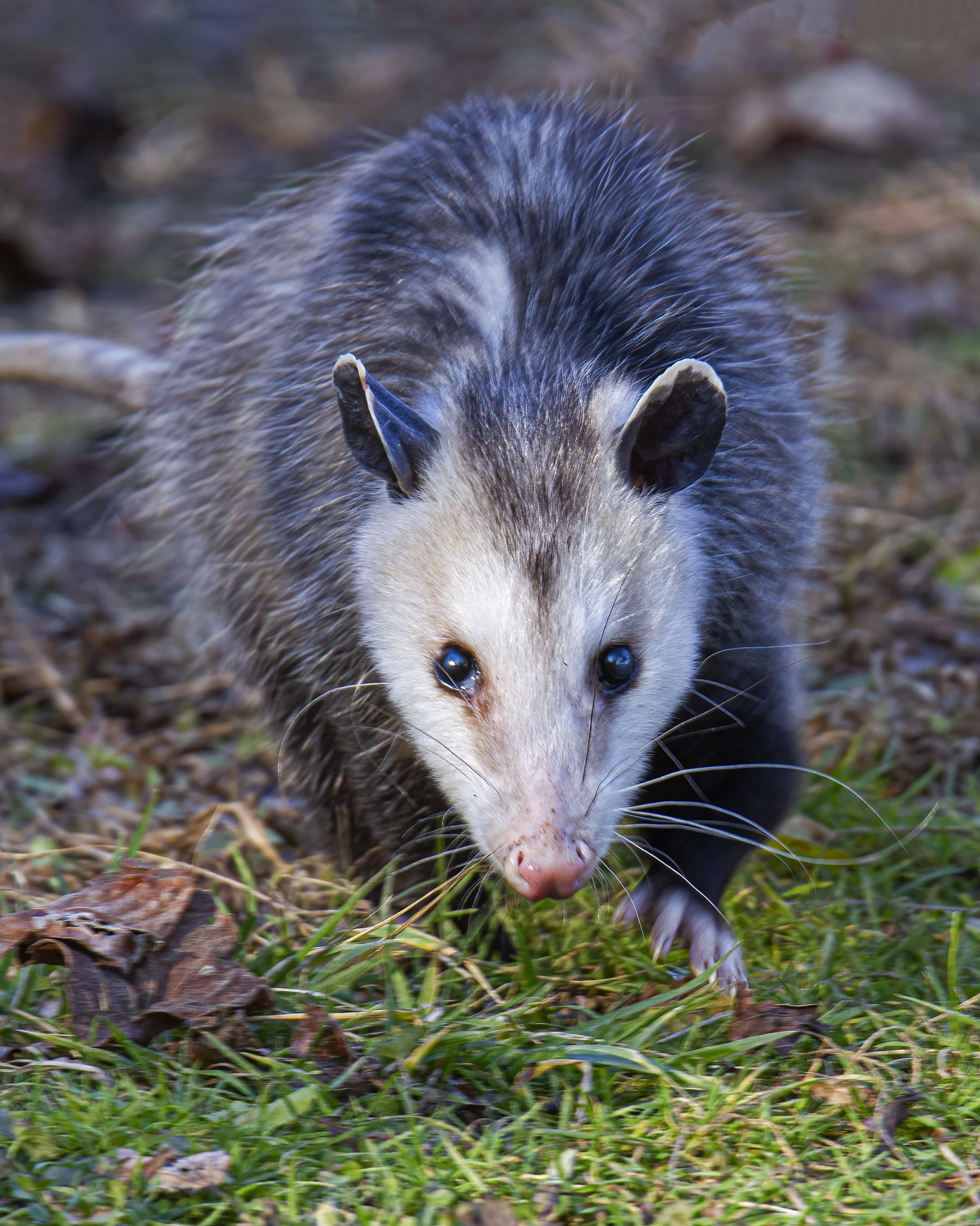
Yesterday I encountered a cool-looking Virginia Opossum (Didelphis virginiana) at Occoquan Bay National Wildlife Refuge. It was walking down the middle of a trail straight towards me and did not seem aware of my presence. Opossums are mostly nocturnal, so I do not see them very often—apparently they do not seem me very often either. An opossum’s eyesight is much better in the dark than it is in daylight, so the opossum may not have initially seen me, even though it was looking right at me in a number of these photos.
Virginia Opossums, also known as North American Opossums, are the northernmost marsupial in the world, and the only one living north of Mexico, according to Wikipedia. Like other marsupials such as a kangaroos, kolas, and wombats, opossums give birth to incompletely developed babies that develop further in a pouch—he word “marsupial” comes from the Latin word “marsupium”, which means pouch.
The gestational period lasts only 11-13 days, according to Wikipedia, and the average litter size is 8–9 infants, although over 20 infants may be born. “Newborns are the size of a honeybee. Once delivered through the central birth canal, newborn opossums climb up into the female opossum’s pouch and latch onto one of her 13 teats. The young remain latched for two months and in the pouch for 2+1⁄2 months. The young then climb onto the mother’s back, where she carries them for the remainder of their time together. It is during this time that the young learn survival skills. They leave their mother after about four or five months.”
If you want to learn more about opossums, check out an article called “50 Opossum Facts That Are Too Awesome to Miss” at the website facts.net. For example, I was shocked to learn that the word “opossum” originated in Virginia, where I live. Between 1607 and 1611, colonists John Smith and William Strachey first recorded the usage of opassom and aposoum at the early British colony in Jamestown, Virginia.
The opossum seemed curious, cute, and almost cuddly, but I kept my distance and tried not to disturb. From certain angles, such as in the second image, though, the opossum seemed focused and a little menacing.
I encourage you to click on the photos to get a closer look at some of the details of the opossum, like its prehensile tail and the little claws on its feet. You can’t see it very well, but opossums have opposable clawless thumbs on their hind feet that lets them grip onto tree branches.



© Michael Q. Powell. All rights reserved.
 Mike Powell
I’m really fond of these creatures. I have one that visits my bird feeders regularly, and last year either that one or a different one showed up with a youngster in tow. They’ll snarl if cornered, but their best defense in the wild is ‘playing possum.’ I startled one late at night next to my car, and it just flopped over and lay perfectly still. I left it alone for about ten minutes, and when I went back out, it was gone.
Nicely done 😁. Good info and images. A really misunderstood animal.
Thanks, Ted. I would love to see one carrying babies on her back, that it is one of those aspirational images that I would have to be very lucky to be able to capture. 🙂
Thanks Mike for presenting the opossum and for the nice illustrations. I loves the 50 facts – I learned a lot form it.
Thanks, Rudi. I really did not know very much about opossums, so it was a real treat for me too learning so many cool things about them.
What a delightful encounter and a lovely series of portraits. I have not yet seen a living opossum in the wild.
Thanks, Laura. This is only the third or fourth time that I have seen an opossum in the wild, so it was a real treat for me. I was actually a little shocked when I saw that my photos came out as well as they. I was fortunate that the light was coming from behind me and illuminated the opossum well and gave it nice catch lights in its eyes.
Nice captures, Mike, I especially like your second image, coming right at us, taken down at ground level.
What a cool chance encounter! And such a nice, willing subject. 💜
I am always cautious when encountering subjects like this (and have a long telephoto lens). The opossum was either unaware of my presence or simply did not care, but I made sure to give it lots of room. 🙂