Feeds:
Posts
Comments

Archive for March, 2020

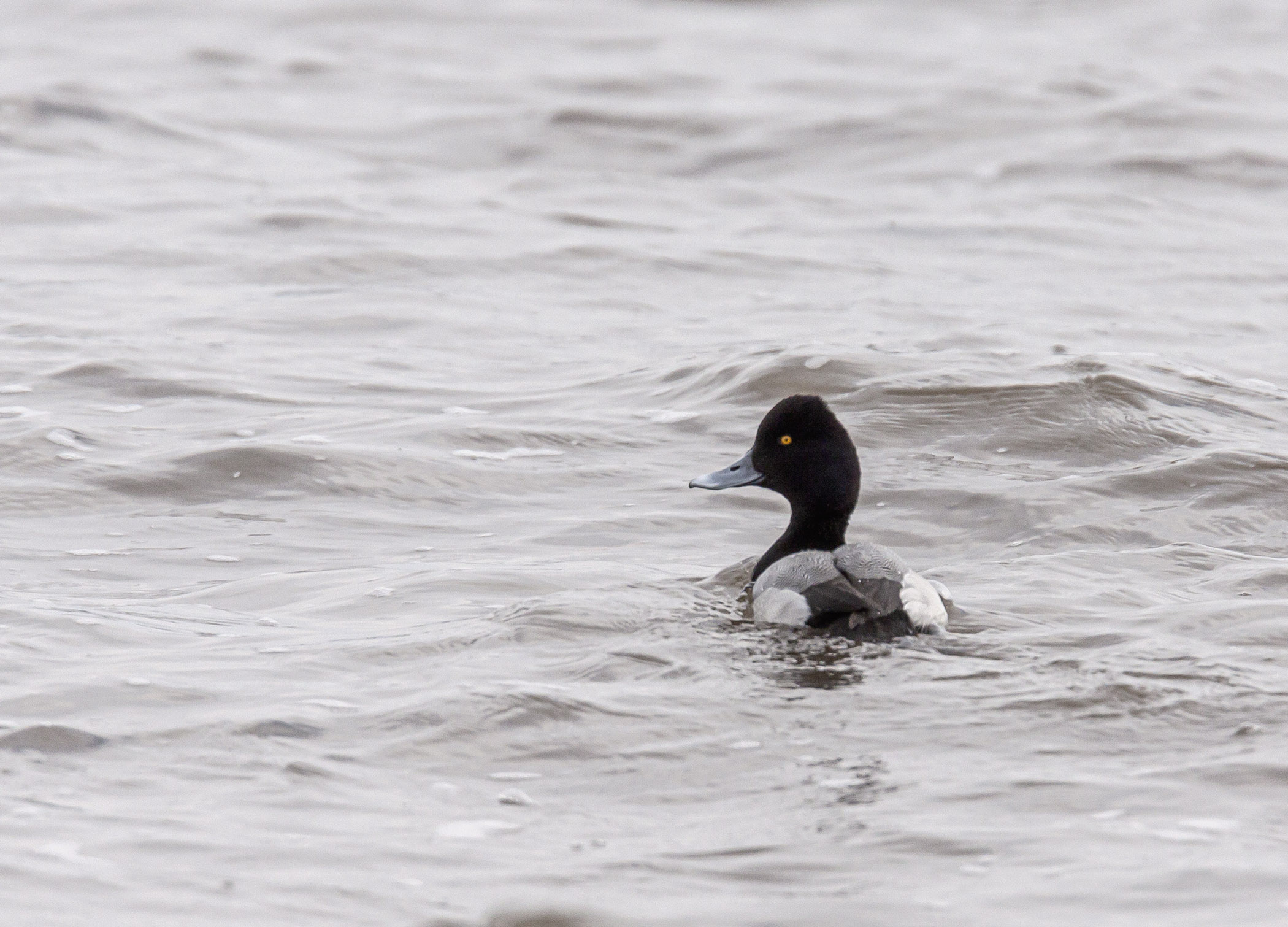
The wind was blowing strongly on Monday morning, kicking up lots of waves in the waters off of Occoquan Bay National Wildlife Refuge. In the deeper water I could see a small group of scaups bobbing up and down among the waves. Were they Greater Scaups (Aythya marila) or Lesser Scaups (Aythya affinis)?

I confess that I can’t tell the difference between the two species. I was content to get shots of both genders, especially the female with the distinctive white markings at the base of her bill.

scaup


scaup

© Michael Q. Powell. All rights reserved.


Read Full Post »

Yesterday morning I was delighted to spot this immature Bald Eagle (Haliaeetus leucocephalus) at Occoquan Bay National Wildlife Refuge. It takes approximately five years for a Bald Eagle to gets its classic white head and I estimate this one to be about three years old, judging from its coloration.

Initially I spotted the eagle when it flew into the midst of a group of trees. I moved around only a little, fearful of spooking the bird, and captured the second shot below when the eagle leaned forward a little and exposed its head. Moving as stealthily as I could, I maneuvered to a position from which I had a somewhat clearer shot and captured the third shot below. I noted that the eagle was crouching, which is often a prelude to taking off, but the eagle remained in place.

Eventually I reached a little opening and was able to capture the first image, which I think is the best of the group. The tree in which the eagle is perched is, I believe, a sycamore. Unlike the sweet gum trees with spiky seed balls that have appeared in many of my perched eagle shots, the seed balls of this tree appear to be much smoother.

If you are interested in the developmental stages of a Bald Eagle and how its appearance changes over time, I recommend that you check out a posting from onthewingphotography.com entitled “Bald Eagles – Age Progression from one to five years old” that features wonderful photographs of each stage.

Bald Eagle

Bald Eagle

Bald Eagle

© Michael Q. Powell. All rights reserved.


Read Full Post »

There are at least two Bald Eagle nests (Haliaeetus leucocephalus) at Occoquan Bay National Wildlife Refuge, the location where I take many of my wildlife photos. One of them is located adjacent to a popular trail and most years the authorities close nearby trails during eagle nesting season. There has been a lot of construction at the refuge over the past few months and, although I saw an eagle couple at that nesting site on several occasions, it looks like they may not have occupied that nest this year (and the trails have not been closed).

The second nest, pictured below, is in a more remote location—it is visible through the trees from one of the trails, but is surrounded by dense vegetation, so the eagles are more insulated from human activity. On a recent visit to the refuge, I was pleased to spot both members of an eagle couple in the nest. I am pretty sure that the eagle on the left is the male, because male eagles tend to be considerably smaller than their female counterparts.

With a bit of luck I hope to be able to spot some eaglets here in the upcoming months, although I noted last year that it is a real challenge to do so, because the wall of this large nest appear to be quite high and effectively hide the eagles from view.

Bald Eagle

© Michael Q. Powell. All rights reserved.


Read Full Post »
Although the old proverb asserts that “birds of a feather flock together,” I have learned the value of examining groups of floating birds, because they often include multiple species. I was examining one such group last week in the waters off of Occoquan Bay National Wildlife Refuge when I spotted an obvious outlier, a duck that was larger and more brightly colored than the rest. I am pretty sure that this is a male Canvasback duck (Aythya valisineria), a species that I do not see very often and still have not seen at close range.

Canvasback duck

© Michael Q. Powell. All rights reserved.

Read Full Post »

« Newer Posts