Feeds:
Posts
Comments

Archive for November, 2019

I seem to be having problems recently getting unobstructed views of small birds. Although the leaves are falling from the trees at an increasingly rapid rate, there are still plenty of them to block my view. I have to admit, however, that the colors and texture of the fall foliage can sometimes provide additional visual interest to a shot of a perched bird.

I spotted this Gray Catbird (Dumetella carolinensis) last week at Occoquan Bay National Wildlife Refuge. The catbird’s direct look suggests that he had spotted me too. Normally I do no photograph birds head-on like this, but in this case I like the way that it gives the catbird a comical, almost cartoonish look.

I like to shoot whatever captures my attention and have a hopeful expectation that the images will turn out ok. I have found that most often when I shoot what I like, I like what I shoot.

Gray Catbird

© Michael Q. Powell. All rights reserved.

Read Full Post »

It is normally hard for a male Northern Cardinal (Cardinalis cardinalis) to camouflage itself, but it seemed to blend in pretty well with the brilliant red leaves of these sumac plants last week at Occoquan Bay National Wildlife Refuge.

Northern Cardinal

© Michael Q. Powell. All rights reserved.


Read Full Post »

I thought that the Great Egrets (Ardea alba) had already left our area, so I was pleasantly surprised to see this one on Tuesday at Occoquan Bay National Wildlife Refuge. The egret was perched on the ruins of a duck blind sticking out of the water and spent most of the time that I observed it preening and simply surveying the surroundings.

As I moved about trying to compose the shot, I was fortunate to be able to get an angle in which the colors of the autumn foliage were visible in the background. The autumn colors in my area are somewhat muted, but beautiful nonetheless.

Great Egret

© Michael Q. Powell. All rights reserved.
Read Full Post »

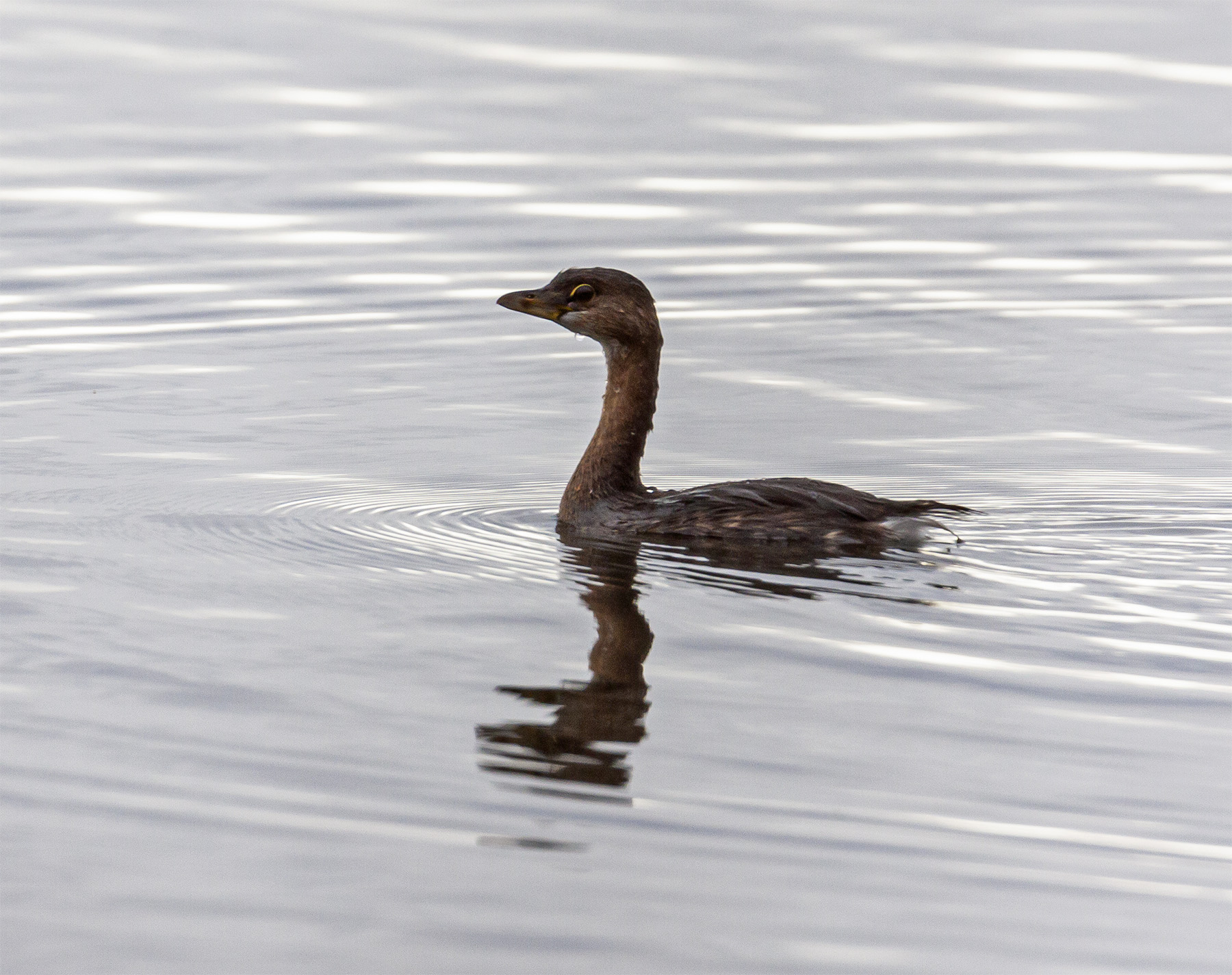
I do not know for sure if Pied-bill Grebes (Podilymbus podiceps) are migratory, but I had not seen any in a long time when I spotted a small flock of them on Tuesday in the waters off of Occoquan Bay National Wildlife Refuge. Pied-billed Grebes have a rather unusual and distinctive look—especially the bill— that makes them relatively easy to identify. Northern Virginia, where I live, is far enough south that it is a destination for some birds that will overwinter here, while many other species will pass through on their migration southward.

According to the Cornell Lab of Ornithology, “The Latin genus name for “grebe” means “feet at the buttocks”—an apt descriptor for these birds, whose feet are indeed located near their rear ends. This body plan, a common feature of many diving birds, helps grebes propel themselves through water. Lobed (not webbed) toes further assist with swimming. Pied-billed Grebes pay for their aquatic prowess on land, where they walk awkwardly.”

Pied-bill Grebe

© Michael Q. Powell. All rights reserved.


Read Full Post »

« Newer Posts