How much of the environment do you show when your primary subject is a bird? Normally I try to fill as much of the frame as possible with the bird through a combination of zooming and cropping.
Yesterday as I walking along Cameron Run, a suburban waterway that feeds into the Potomac River, I spooked a Great Blue Heron when I took a few steps in its direction. A smaller bird was also spooked and it flew to a rock in the middle of the stream. I was thrilled when I realized that it was a Black-crowned Night Heron (Nycticorax nycticorax), a bird species that I don’t see very often.
It would have been easier to get a shot if I had been carrying my long zoom lens, but instead I had my 180mm macro lens on my camera. Fearful that the bird would take flight again, I took some initial shots and then slowly moved forward. As I climbed over large rocks toward the water’s edge, I’d stop and take a few more shots. After I reached the water, I decided to change lenses and put on the 70-300mm lens that was in my camera bag and, of course, the night heron flew off as I was changing lenses.
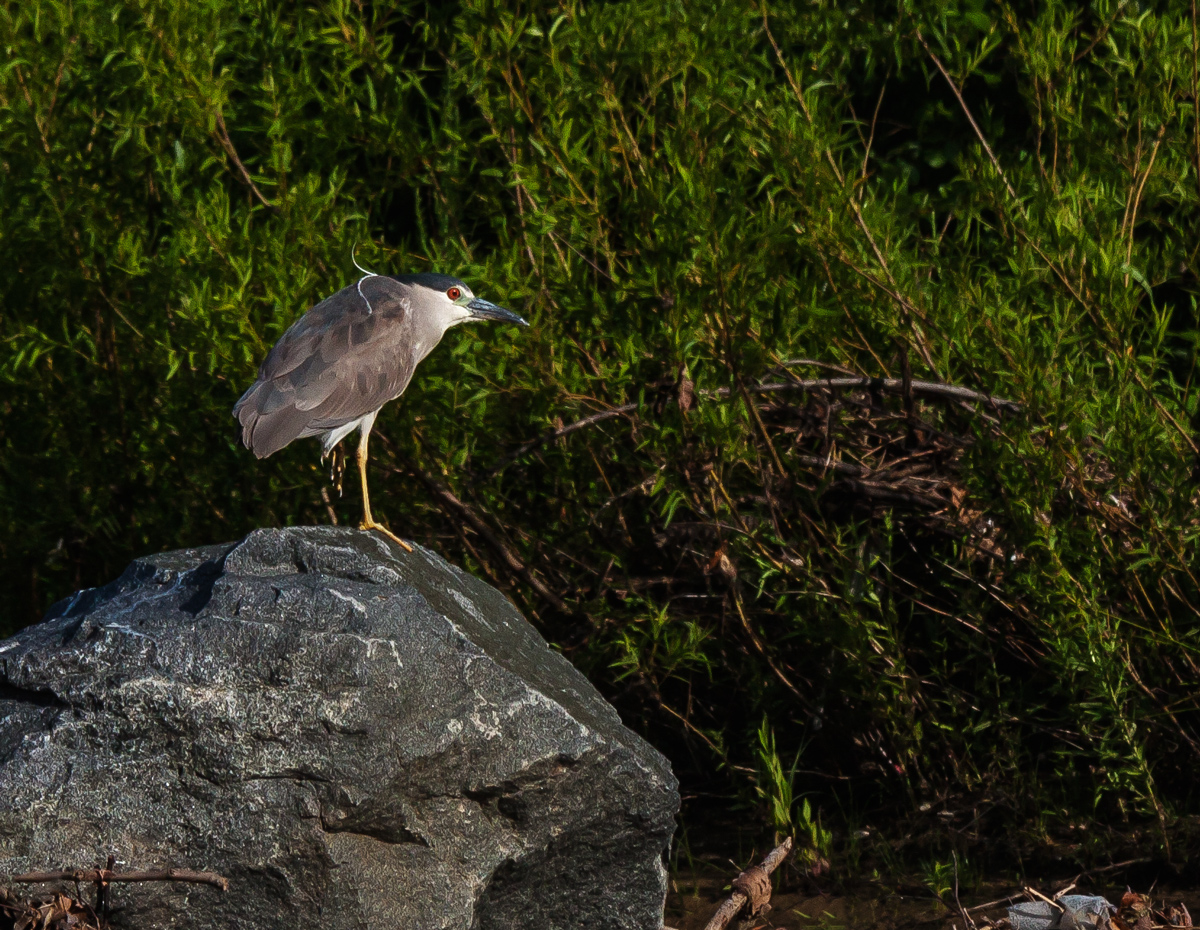
When I was at the closest point, I was able to capture an image that, with a lot of cropping, shows some of the beautiful details of the heron, including its startlingly red eyes, but as I looked over my images, that was not my favorite one. My eyes kept returning to the landscape shot. in which the heron is only one element of a beautiful composition of rocks and water.
What do you think? I’m posting three different shots of the night heron with varying amounts of background context, so you can see how the scene changed as I zoomed with my feet (and cropped in post processing).


© Michael Q. Powell. All rights reserved.
 Mike Powell
That last shot is wonderful. I like that it shows both the tucked foot and the breeding plummage. I might have cropped a bit more off the bottom, just because the rock seems to overwhelm the bird a bit. But I do like the middle photo, a lot. All of the elements seem nicely balanced, and it shows off the bird in its natural environment better, I think.
Thanks for sharing. It’s clear from your comments that you looked really closely at the images and saw the details. Normally I would have cropped more as you suggest in the close-up, but it was already cropped so much that I was concerned about losing whatever sharpness and contrast I had.
My favourite is your middle image – a good compromise that shows the heron in its environment, but not so small as to get lost in it. I think it is nice to show this.
Thanks, Chris. I guess I generally am drawn to the extremes. 🙂
The middle photo is fine by me.
Thanks, Victor. It seems like many others too were drawn to the middle image, which balanced the scope of the wide shot and the details of the close-up.
In this series, I like the first, Mike. But that doesn’t dimminish the impression of the other two. I do the same often, try for the wide shot, but love the detail of a close-up. In this case, the reflections in the water with the nicely balanaced explosure throughout, can be ignored. M 🙂
It’s hard to put into words sometimes why we like what we like. Thanks so much for sharing your views as well as the approach you take when taking photos.
Beautiful shots! Beautiful colors!
Thanks, Sally.
I agree – I love the whole scene around the bird. The water and the rocks and the background are a perfect setting to show off his unique beauty.
Thanks. I fell in love with the scene, with the water and the rocks especially. Even if the heron were not there, I think I would like the image.