I have repeatedly observed a small spider or two hanging around the periphery of the web of the large Yellow Garden Orbweaver spiders (Argiope aurantia) that I have been photographing recently. Initially I thought it might be the male of the species, which is considerably smaller than the female, but when I finally took a clear enough photo of one of these small spiders, I realized it was a different species.
My research suggests that this is a kleptoparasitic spider. Let me explain. It may sound like I’m trying to sound like a scientist, but “kleptoparasitism” is a single word that captures the idea that this spider steals or feed on the prey captured by another spider. According to Wikipedia, kleptoparasitic spiders occur in five different families and I am pretty sure the little spider below is of the genus Argyrodes, which are also called dewdrop spiders.
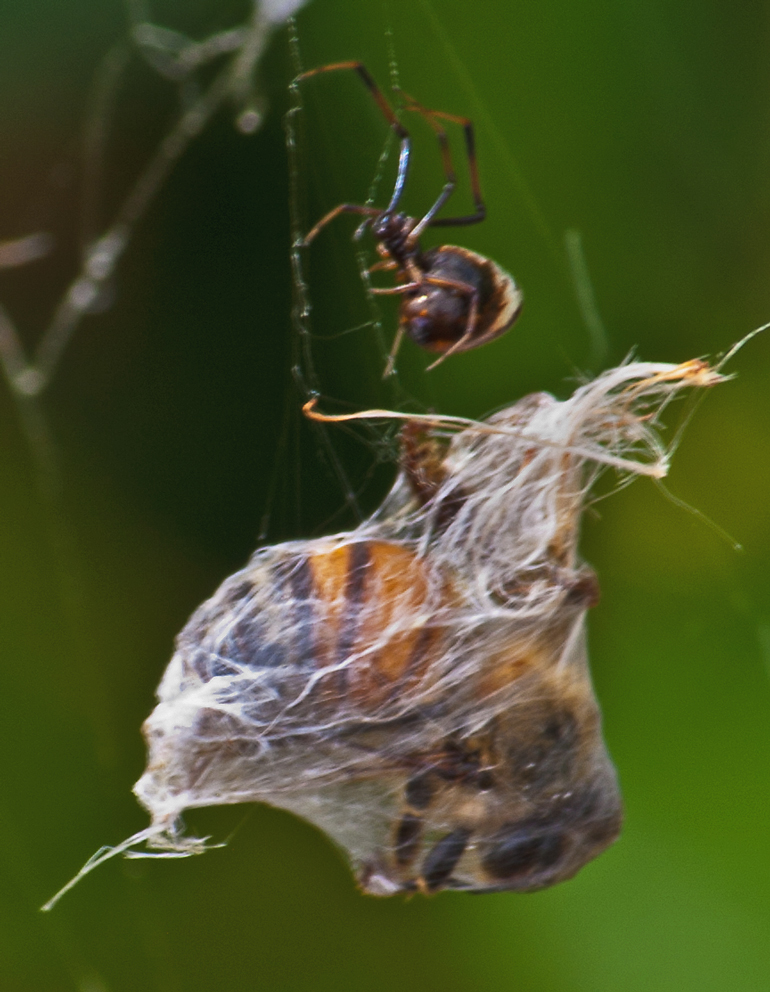
Kleptoparastic spider eyes another spider’s catch
Let me set the scene for you. The much larger Yellow Garden Orbweaver spider caught what looks like a bee and returned to the center of the web, leaving the wrapped bee on the periphery. The little spider moved in and appears to be checking out this potential new food source. Compare the relative size of the spider and the bee—the spider is tiny. That made it tougher to get a clear shot of both the spider and the captured bee. My shot is far from perfect, but it does allow you to see some of the details (and you can get a higher resolution view if you click on the image).
It seems to me that the little spider plays a risky game, living with (and maybe stealing food from) a larger, more dangerous spider. Maybe he’s a thrill-seeker, an adrenaline junkie who enjoys living in a state of constant danger.
© Michael Q. Powell. All rights reserved.
 Mike Powell
That little spider better be real quick! Good information-thanks!
You’re welcome. Your info=packed posts help inspire me to learn more and share that new knowledge with others.
Cool. Maybe the orb weaver actually sometimes has leftover food? It does sound risky!
An elderly lady at the desk of a nature center told me that the large spiders tend to be a little sloppy when sucking the juices out of their prey. As a result there may be enough left for the little spiders when the big one is finished (kind of like licking the frosting bowl after my Mom had frosted a cake).
Thanks! I just learned something I didn’t know. I’ve been watching a garden spider for a while now. It’s dark now, but first thing tomorrow I’m going to check around the web. It’s in a large sedum patch that has MANY visitors every day.
I first noticed when I was looking at my photos of garden spiders and I started seeing out of focus images of small spiders, sometimes between me and the larger spider. It took some careful manual focusing for me to get a clearer look at the little ones.
I use a Canon PowerShot, so I don’t know if I could get decent pictures … first I’ve got to find the spiders. It’s always good to have an excuse to not do housework. Thanks
I have a Canon PowerShot A620 7.1 megapixels that I shoot with some of the time. You can get pretty decent macro shots with it–you just have to be pretty close and the light has to be pretty good.
Mine is a SX130 IS 12 megs pixels. I usually use the P because of the focusing. My biggest challenge has been our wind. It’s been windy for seems like weeks. Our drought’s let up somewhat and there’s more flowers blooming and more insects.
[…] week I did a posting entitled “Kleptoparasitic Spider“ that talked of the little spiders that hang around a larger spider’s web and steal or […]